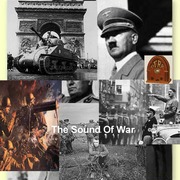
The Westinghouse Broadcasting Company brings you the sound of war. The actual sound record of World War II. 2,191 days from the time Hitler's Panzer divisions moved across the Polish borders to the ceremony of the Japanese surrender aboard the United States Battleship Missouri in Tokyo Bay. World War II, the most terrible period of death and destruction in the long history of man. World War II, a drama preserved for all time through the medium of radio. An era never to be forgotten. Tonight, the day they attacked Pearl. President Roosevelt's announcement of Japanese air attacks on United States Pacific bases staggered London according to a dispatch just received. And London now awaits Prime Minister Churchill's promise to declare war on Japan within the hour. Honolulu, a naval engagement is in progress off Honolulu with at least one black enemy aircraft carrier in action against Pearl Harbor defenses. At 2 22 p.m. Sunday, December 7th, 1941, radio stations throughout the nation were interrupted. This was the first news bulletin to tell the world that the Japanese naval and air force had attacked the United States Naval Base of Pearl Harbor. American territory had been bombed by an enemy. The United States would soon be at war. It is September 1940. German bombers are by day and night leveling London. Great Britain fights alone. Through the attacks, the Royal Air Force takes to the skies. They are the last bulwark of defense against the German invasion of the home islands. On September 16th, 1940, many in the United States feel that the United States will soon be at war. In Washington, President Franklin Delano Roosevelt picks the first draft number. Dr. Dykstra, ladies and gentlemen, members of your government are gathered here in this federal building in Washington to witness the drawing of numbers as provided for in the Selective Service Act of 1940. This is a most solemn ceremony. It is accompanied by no bonfire, no blowing of bugles, or beating of drums, and there should be none. We are mustering all our resources, manhood and industry and wealth, to make our nation strong in defense. For recent history proves all too clearly, I am sorry to say, that only the strong may continue to live in freedom and in peace. We are well aware of the circumstances, the tragic circumstances in lands across the sea, which have forced upon our nation the need to take measures of total defense. On October 16th, more than 16 million young Americans registered for service. Today begins that selection from this huge number, the selection of 800,000 who will go into training for one year. Through the year, many young men are drafted into service for the term of one year. There is much opposition to the United States participation in foreign wars. I speak tonight to those people in the United States of America who feel that the destiny of this country does not call for our involvement in European wars. We must band together to prevent the loss of more American lives in these internal struggles of Europe. We must keep foreign propaganda from pushing our country blindly into another war. American war, with all its consequences, is too tragic and too devastating to be approached from anything but a purely American standpoint. We should never enter a war unless it is absolutely essential to the future welfare of our nation. This country was colonized by men and women from Europe. They preferred the wilderness and the Indians to the problems of Europe. On August 18th, 1941, a bill goes before Congress to renew the draft extending the term of service from one year to 30 months. In one of the most dramatic sessions in United States Congressional history, the House of Representatives passes the bill by one vote, 203 to 202. The United States will be able to keep its men in the armed forces. Unbeknownst to the country, the single vote ensuring passage is the most important vote ever cast. Earl Harbor is less than four months away. The summer comes. America is still at peace. What was the United States like that summer of 1941? New Chevrolets could be bought for less than $700. Lou Gehrig retired from the New York Yankees, still claiming he'd licked the impurable illness that afflicted him. The invasion of England was no longer expected. Charlie McCarthy and Edgar Bergen were household radio names, and the first of the giveaways, the pot of gold, glued millions to their radios. Joe Lewis had defended his heavyweight crown against Arturo Godoy, and Mr. Average American was earning $2,000 a year. Richard Rogers had not yet begun his collaboration with Oscar Hammerstein. The musical comedy sensation Oklahoma was still two years away. The summer went. Now ominous reports were coming out of the Pacific. Americans who had always expected to eventually be fighting Hitler and Mussolini were now hearing rumblings in the Far East. Japan. Japan, the country with the bamboo roots. The country that could be set aflame by one small bomb. Japan. The country of little men with ancient ideas. Japan. Unable to conquer China after years of terrible warfare. Japan was making aggressive moves in the Far East. A brief recapitulation. On November 25th, elements of the Japanese Navy quietly moved from their berths in Tonkan Bay in the Kuril Islands of Japan and set sail on a voyage that in less than two weeks would climax in the greatest defeat in United States military history. Their destination, Pearl Harbor. Pearl Harbor, the United States Pacific naval bastion on Oahu Island in the Hawaiian group. The Hawaiian Islands. Twenty islands forming the Hawaiian group. Seven inhabited and known as the wonderland for vacationers throughout the world. The island of Hawaii. Lanai, Maui, Molokai, Kauai, Niihau, and the territory that houses the capital of Honolulu. The island of Oahu. Oahu. The home of Waikiki Beach. Coco Head and Diamond Head. Legendary places for romance seekers since the year 1778 when Captain James Cook happened upon them. Oahu. The home of the American naval base of Pearl Harbor since 1900 when the United States annexed the island. In the middle of Pearl Harbor, another small island. Ford Island. In Pearl Harbor, 96 ships of the United States Pacific fleet. With their berths in Ford Island and Pearl Harbor, the battleships of the American fleet. Battle wagons, traditionally named after states of the United States. Massive but silent in the dawn hours of December 7th. The names Arizona, Nevada, Tennessee, West Virginia, Maryland, Oklahoma, and California. Between 7.55 a.m. Sunday, December 7th, Hawaiian time. The bomb bay doors are open. Pearl Harbor is being attacked by planes of the Imperial Japanese Navy. Shortly after the attack, radio stations throughout the United States interrupted their programs. It's a long one down to around the three yard line. We interrupt this broadcast to bring you this important bulletin from the United Press. Flash, Washington. The White House announces Japanese attack on Pearl Harbor. And as the nation awaited the President's message of war, Prime Minister Winston Churchill spoke to the Empire. This is London. Listeners, I'm now to hear the Prime Minister. The Right Honorable Winston Churchill. Ladies and gentlemen, Mr. Churchill. You will remember that a month ago, with the full approval of the nation and of the Empire, I pledged the word of Great Britain that should the United States become involved in the war with Japan, British declarations would follow within the hour. I therefore spoke to President Roosevelt on the Atlantic telephone last night with a view to arranging the timing of our respective declarations. The President told me that he would this morning send a message to Congress, and I assured him that we would follow immediately. When we think of the insane ambition and insatiable appetite which have caused this vast melancholy extension of the war, we can only feel that Hitler's madness has infected the Japanese minds and that the root of the evil and its branch must be extirpated together. And as I told the House of Commons this afternoon, in the past we had a light which flickered. In the present we have a light which flames. And in the future there will be a light which will shine calm and resplendent over all the land and all the sea. Back in the United States there was nervousness and fear amongst the populace. The drone of the airplane engine sent eyes looking skyward, and men, women, and children remembered well the slaughter at Rotterdam, London, Coventry, and just yesterday at Pearl. New York's Mayor Fiorello H. LaGuardia, head of National Civilian Defense, spoke to the people. And now in the event of an air raid, and let me warn you all again that distance is no protection, that we who live on the Atlantic coast are just as much in danger of being bombed as our countrymen who were bombed last night in Honolulu. So here are some of the fundamental rules to remember. Don't listen to rumors. Don't follow any excited person who may be screaming. He may be trying to create a panic. Keep off the streets during a raid. If you're more than five minutes from home when an air raid comes, lie down under shelter. Otherwise go home and stay there. Get out the lights if the planes come over. The lights that are out will never guide a JAP or any other bomber. Cooperate with your air raid warden. He is your friend. He will help you. Don't be a wise guy and get hurt. We can lick the JAPs if everybody does his part, but we are not afraid and we are confident that we are going to beat the JAPs so badly that they will never attempt such a dastardly act as they committed yesterday for the next 300 years. It is Monday, December 8th, 1941, the place Washington, D.C. The situation? President Roosevelt is about to speak to a joint session of Congress. He enters the Great Hall on the arm of his son James, a captain in the Marine Corps. There is wild cheering, rebel yells, enthusiastic applause from both sides of the chamber. The President is in formal mourning attire. In the more than two decades since the speech, it has rarely been heard in its entirety. Yet it took the President less than six minutes to ask Congress to declare war against the Empire of Japan. Here then is the entire speech. Vice President, Mr. Speaker, members of the Senate, and the House of Representatives, today, December 7th, 1941, a date which will live in infamy, the United States of America was suddenly and deliberately attacked by naval and air forces of the Empire of Japan. The United States was at peace with that nation and, at the solicitation of Japan, was still in conversation with its government and its emperor, looking toward the maintenance of peace in the Pacific. Indeed, one hour after Japanese air squadrons had commenced bombing in the American island of Oahu, the Japanese ambassador to the United States and his colleagues delivered to our Secretary of State a formal reply to a recent American message. And while this reply stated that it seemed useless to continue the existing diplomatic negotiations, it contained no threat or hint of war or of armed attack. It will be recorded that the distance of Hawaii from Japan makes it obvious that the attack was deliberately planned many days or even weeks ago. During the intervening time, the Japanese government has deliberately sought to deceive the United States by false statements and expressions of hope for continued peace. The attack yesterday on the Hawaiian island has caused severe damage to American naval and military forces. I regret to tell you that very many American lives have been lost. In addition, American ships have been reported torpedoed on the high seas between San Francisco and Honolulu. Yesterday the Japanese government also launched an attack against Malaya. Last night, Japanese forces attacked Hong Kong. Last night, Japanese forces attacked Guam. Last night, Japanese forces attacked the Philippine island. Last night, the Japanese attacked Wake Island. And this morning, the Japanese attacked Midway Island. Japan has therefore undertaken a surprise offensive extending throughout the Pacific area. The facts of yesterday and today speak for themselves. The people of the United States have already formed their opinions and well understand the implications to the very life and safety of our nation. As Commander-in-Chief of the Army and Navy, I have directed that all measures be taken for our defense. And always will our whole nation remember the character of the onslaught against us. No matter how long it may take us to overcome this premeditated invasion, the American people and their righteous might will win through to absolute victory. I believe that I interpret the will of the Congress and of the people when I assert that we will not only defend ourselves to the uttermost, but will make it very certain that this form of treachery shall never again endanger us. Hostilities exist. There is no blinking at the fact that our people, our territory, and our interests are in grave danger. With confidence in our armed forces, with the unbounding determination of our people, we will gain the inevitable triumph. So help us God. I ask that the Congress declare that since the unprovoked and dastardly attack by Japan on Sunday, December 7, 1941, a state of war has existed between the United States and the Japanese Empire. Within one hour, the Senate unanimously voted war against Japan. In the House, there was one dissenting vote, Congresswoman Jeanette Rankin of Montana. She was consistent. In 1917, she voted against war with Germany. So the United States and Great Britain were now joined in the fight. Three years, eight months, and 25 days later, the war ended and another ceremony would take place. This time aboard the battleship Missouri in Tokyo Bay. It is September 2, 1945. President Roosevelt is dead. He is one of almost 300,000 American battle deaths. Aboard the Missouri, there is a dramatic remembrance of the past. From the foremask flies an American flag. It is the same flag that flew atop the Capitol in Washington on December 7, 1941. December 7, 1941, the day of the attack on Pearl. There is an epitaph. It was spoken by General George C. Marshall, Chief of Staff, United States Army. Said General Marshall, it is impossible for the nation to compensate for the services of a fighting man. There is no pay scale high enough to buy the services of a single soldier for even a few minutes of the agony of combat or the physical miseries of the campaign. To him, the nation owes eternal debt. The Westinghouse Broadcasting Company has brought you December 7, 1941, the Japanese attack on Pearl. This program was written, produced, and directed by Bud Greenspan. My name is David Perry. Thank you.