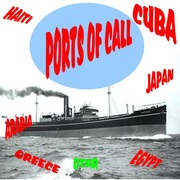
projects Those came up as or a sub 真的 god god god the Beyond blue horizons far at the world's end, strange, fascinating lands beckon us, bid us revel in their exotic splendors. Come with us as we head for ports of call. As our steamer cuts through the shark-infested waters of the Caribbean Sea, we approach an island of extraordinary beauty. Coming precipitously from palm-fringed beaches, great craggy mountains are set against the transparent tropical sky, reaching stony fingers to the hot shield of the sun overhead, and then sweeping down swiftly beyond, toward luxuriant plains, dense jungles, deep swamps. This is the land on which Columbus first set foot when he sailed into the dark mystery of the Western Sea. This is Haiti, land of Toussaint Louverture, of Christophe, the Black Emperor, Haiti, the land of Voodoo. This is the Negro Republic. This is Haiti, our port of call. Our ship docks at Cape Haitian on Haiti's northern shore. And do you think we'll really get a chance to see a voodoo ceremony like William Seabrook tells about in the Magic Island? Not much. This is the black man's country, and they don't like the white man silving around. Voodoo's against the law anyway. Yeah, so is liquor for a while in America. It was not far from the site of the bustling town of Cape Haitian that Columbus landed in 1492. And it was through this country that the ruthless Spaniards hunted and killed so many Indians that finally they were forced to import slaves from Africa to do the work of the colony. At the close of the 17th century, the western half of Columbus Island of Hispaniola was granted to the French. And under the administration of their eminently successful colonial system, Haiti, or San Domingo as the French called it, became the richest colonial possession in the world. Magnificent plantations covered the land. Cities and roads were built. Fields of sugarcane, coffee, cotton, and indigo flourished under the tropical skies. But with swollen wealth, inevitably came dissipation and bittering corruption. Unrest and dissatisfaction began to smolder among the 500,000 Negro slaves, the 50,000 mulattoes, and the 40,000 whites. In the dead of night, in reeking compounds crouched the miserable black men. Our blacks are scarred with many weapons. Our legs tremble from long hours in the fields. We are tortured. We are degraded. Our wives and daughters are taken from us. Our bodies ache for food. Our souls long for freedom. There are some among us who can remember freedom, under plagues and in the jungles of Africa freedom. Oh, be quiet. You will be heard. And among the mulattoes, that caste sprung up from the union of white aristocrats and black mistresses. There was the age-old heartbreak of the half-breed, refused acceptance by one caste or the other. Often in their homes, they met and fought. We are called free men of color, but are we free? No, no. We live at the property of the colony, compelled to serve in the banks, forced to live on the highways. We have black blood, yes, but we are also half-white. Are we not intelligent? Have not many of us been educated in France? Have we not also accumulated riches and slaves? Calm yourselves, calm yourselves. Our friends in Paris are petitioning the National Assembly for our complete freedom. Wait a little longer. And in the shops and stores of the petit blanc, the little whites, the petty tradesmen of Haiti, jealousy and hatred reigned. Not only do the big whites cheat us out of our coffees, but these mulattoes, I despise them. They make as much money as we do. I hate them worse than I hate the blacks. They want equality. The upstart. While over the mansions of the grand blanc, the big whites, the aristocrats of exorbitant wealth, the pall of satire and decay descended. I tell you, Pierre, we must watch these tradespeople. They are becoming insolent. Oh, dear, mon dieu. It is not the tradespeople we must watch. It is these insufferable mulattoes. They gain too much power. They are getting rich. We must put tighter restrictions on them. Pierre, Pierre, oh, I am so angry. It's poor, oh, it's poor. Please, please do not get so excited, Marcherie. Remember my nerves. Now, what is it? That miserable slave. The black cook. She burned the pastry for the banquet. Oh, the cushion was. Well, well, what did you do? What did I do? What was there to do? In the fire. I had to throw into the oven. Into this confusion and turmoil, into this seething colony was born in the middle of the 18th century a black slave boy destined to lead his race out of bondage. His name was Toussaint, and he was owned by Monsieur Comte-de-No, an aristocratic planter, an exceptional man who believed that slaves were at least half human. Taking a liking to the boy, Toussaint, he taught him to read and write, made him his body servant. It was when he was 18 that Toussaint married Susan, Susan Simon, wife of Gaou, a slave who had been sold away from the plantation. On their wedding night, when Susan and Toussaint have retired to their hut, the beat of the voodoo drums sounds to the jungle. I never knew you were looking at me, Toussaint. Oui, chérie. I've held you in respect for a long time. But so long as Gaou was with you, he was your man. Now that Gaou has grown away, I think you need another man, a real husband this time. I'm very grateful, Toussaint. Nowhere in all the land could I have gotten a better one than you. Why what's the matter, mon cher? Why are you so quiet? Those drums, I hate them. Moomin, moomin, forging the chains of ignorance and superstition about the souls of our people. I hate voodoo. Shh, don't say that. Voodoo listening all the leaves and the clatter of the leaves. I fear voodoo. You talk like that, I unmarry you. Susan, chérie, you must stop fearing voodoo right now. You and your son, Placide, must not listen to the voodoo drums. You frighten me more than the drums when you talk like that, Toussaint. Gaou never talked like that. Gaou was a good man, but he did not know what I know. What you mean? I'll show you. This book I brought from Master's house. I'll read something for you. It sounds different from talking, reading, dusk, but you listen good and you know what it means. Go ahead, you read it for me. Here's what it says. Nations of Europe, your slaves are not in need of your councils to break the sacrilegious yoke which oppresses them. The negroes lack only a chief. Where is that great man? He will appear. He will show himself and he will unfurl the sacred standard of liberty. He will open the door of freedom for the slaves. Madame, you heard the name I married you with. Louvature, I took that name today. You know what it means? No. Louvature, it means the opener of the door to liberty for our slaves. Then you are going to be this grand man, this big man? Yes. How do you know? I know. Then you made big mistake, Toussaint. You took the wrong woman. I'm just a plain slave woman. I can't help you when you get to be that big man. Toussaint, Toussaint. Oh, mon dieu. It's the papaloi. Rico, the voodoo papaloi heard your talk. He's a coming for you. Did you hear me, Rico? I heard you, Toussaint. You say you're going to free the slaves. I say you die in black dungeon, Toussaint. See, the voodoo listen every place. I say to them come the bala-gabamba tonight. You'll be free. You'll be free. You'll be free. You'll be free. You'll be free. You'll be free. You'll be free. You'll be free. You'll be free. You'll be free, Toussaint. You'll be free. You'll be free. You'll be free. You'll be free. You'll be free. Toussaint, the papaloi's afraid. He's afraid of you. He'll run away into the jungle. He know you're going to kill him. Why, he knows you better than voodoo. He knows that... Our father which art in heaven, hallowed be thy name. Thy kingdom come, thy will be done. On earth as it is in heaven, in heaven, in heaven. The fall of the Bastille in Paris in 1789 shook the French colonial empire to its very foundations. When the National Assembly passed its famous declaration of the freedom and equality of all men, fury seized the colonists in Haiti. The white aristocrats put the mulattos to death. When the priests attempted to intervene, the white bourgeoisie executed them. While to Malt and Gulf the towns, there was an ominous rumbling growing nightly more powerful. From the mountains came the ceaseless throbbing beat of the voodoo drums. Night after night, black men slipped furtively from their compounds to join the tense throngs around the drums. They fight more and more among themselves. They don't think of us now. We have secured many iron implements and staves. We have our knives. We must be strong. We have everything to gain and nothing but an unhappy life to lose. They're all recounting liberty and equality. Well, we too have a right to liberty, equality, fraternity. While anarchy carries its banners of flames through the streets of Haitian towns, an important visitor arrives in Port-au-Prince from Paris. One of the first men he calls upon is Monsieur de Nau, Toussaint Louverture's master. Monsieur de Nau? Oui. I am Vincent Dauge. Indeed, Monsieur, I am grateful for this audience. As you may readily see, I am a Malakka. Though I have spent most of my life in Paris, the cause of the Negro of Haiti is close to my heart. I come partly to praise your enlightened treatment of your slaves and partly... Oh, your pardon, Monsieur de Nau. Toussaint, will you come in? I presume you come in because of the Society of Friends of the Blacks. I do indeed, Monsieur. I should like my slave Toussaint to hear you. Master. This gentleman from Paris represents the cause of your people, Toussaint. I thought you would be interested. This then must be Vincent Dauge. Oui. You arrived on the boat today with General Lavaux? Oui, with a message of hope. Monsieur de la Rousse Foucault, now for yet in Robespierre, no doubt. I question their hope for our early freedom. Our time has not yet come. The streets of Port-au-Prince are bright with liberty caps, and one hears the cry of liberty and equality everywhere. But this is hysteria, Monsieur. Voodoo hysteria. It cannot last. But liberty... Who has offered us liberty? The lesser whites of the island are shouting it, yes, and regaling themselves with titles and uniforms. But the slaves... but the slaves... but the slaves... where is their liberty? It is theirs for the taking. Do you suggest leading them into violence, Monsieur? Oui, ah oui. Then I only say you know not what you do. Your pardon, Master. This man is a slave. I take considerable pride in owning the wisest slave on the island. You own a caged parish. Good day, Monsieur. Toussaint Loubeture was powerless to stop the ill-advised and hot-headed Vassadoge. He could only remain silent, sadly watching his people led toward doom. For under the leadership of the fanatical mulatto, drunk on the new freedom of revolutionary Paris, the long-threatened black uprising became a fact. Suddenly all over the colony, thousands upon thousands of slaves, insane with the memory of bloody cruelties, delirious with unnameable hopes, arose to throw from their bleeding backs the unendurable oppression of slavery. Burning, slaying, torturing, they spread like molten lava from one plantation to another. But the white men captured Vassadoge, and they put him to death on the rack. Then the leadership of the black uprising fell upon the shoulders of Rigo, the fanatical voodoo papilloi. Deep in the jungle, Rigo incites his followers to still greater fury. It's the plantation of logginers. It's the cause of the burn. Toussaint's soakin' up the boys' heads. Toussaint's soakin' up the books. Toussaint's soakin' up the books. He's eatin' the voodoo. He's gonna die in the deep, cold black. He's gonna die someday in the black. It's the cause of the burn. In the flame to burn. It's the cause of the burn. Master, master. Rigo? Oh, well, Toussaint, why are you waking me in the middle of the night? Master, Rigo is leadin' his mob again. They've ravaged Monsieur Lebrun's estate. Now come on here. I beg you, take madame and flee for your lives to the United States. When peace reigns, I will send for you, monsieur. Now, ride to the port. I will hold them. Godspeed, your master and mistress. Bless you, Toussaint. Farewell. Gone! They's gone! Yes, gone, Rigo. I warned them. Toussaint, you traitor to the black people. I'll set the zombies after you. These black men raiden with me come to you. There's graves, and they ain't men. They're zombies, and they're going to eat your flesh, Toussaint. You hear him? Now you're going to see, Toussaint. I see nothing but childless focus, focus. And a cloud of poor misguided plantation slaves makin' fools of themselves. Un suave, Rigo. Un suave, Rigo. Halt! Who's there? Toussaint Louverture. I place you under arrest. By whose order? By the order of monsieur Raymond, the deputy. For what offense? For inciting Vincent Doge, Rigo, and the Voodoo cult to violence. That is not so. I hate the Voodoo. Now I'm an enemy of Rigo. I attempted to disweigh Vincent Doge from his plan. I can't argue about that. I was told to arrest you. Come along now. I've got your family in the cart over there. My family? They too are under arrest. You cannot do this to them. Can you come along quietly? No. I regret, Miserly Capitaine, but I'm compelled to resist. Then I'd order to kill the dirty lot of you. I would not attempt it, Miser. I... Why, you black dog, pull a gun on me? I'm sorry I had to kill you, Miser. You apparently would not take me seriously. Toussaint, are you all right? Oui, chérie. I'm all right. Is the war at last for the... At last. Will we be free? At last. Toussaint fled with his family to the mountains, where he gathered about himself a Teridamalian army of slaves. Slowly he fought his way across Haiti, until he had won half the former French colony. The Spaniards of Santo Domingo on the eastern half of the island welcomed Toussaint as host as conquering heroes. But when Toussaint heard that the Spaniards had leagueed with the British, who were slave owners, he suspected a trap, ordered the Spaniards to leave the island. Then, with lightning-like maneuvers, he marched his army west of Port-au-Prince in time to repel a British landing party. Toussaint, at last, was master of the island. They offered to make him king. Wisely he refused, installing rather a benign dictatorship, under which reforms were instituted, schools built, roads repaired. Everyone, black and white, worked, and everyone was paid for his labor. Prosperity returned to Haiti, and Toussaint's palace became the center of culture. But not everyone serenely accepted the black Napoleon. The French hated him, plotted for his downfall. In the office of Monsieur Sotinax, General Edovilla and the deputy are in deep conversation. I tell you, Sotinax, there is only one way to get at him. And how is that? Rigaud, secretly I have dispatched rifles and ammunition to him and his Vodouk Karkos. Slowly we can build Rigaud into an army. What do you think of that idea? We could control Rigaud. I think you are rash, Monsieur. Then are we to watch Toussaint subtly usurp this rich colony from our possession? It is clearly in his mind. Power, boundless ambition. Not the ideal of equality and liberty for all, black and white? Oh, nonsense. I am not so sure. All this time, Toussaint had not broken from the mother country, had governed Haiti with outstanding success as a colony of France. But his very success engendered antagonism, for he had hoped it would gain him friends. Monsieur Vasson, colonial delegate to Haiti, makes his report to Napoleon in Paris. There is fear in some quarters, first consul. At this black leader is planning to seize the island promise that Martinique and Waterlupe would follow. I have talked with Toussaint. I do not believe these stories. The man is magnificent. You are there the record of his achievements. Yes. I, Napoleon, have read here in a blur of contemptuous hatred of black caricature of myself. I have read in this letter to me an audacious declaration of defiance. But, excellency, you do not understand the conditions in the colony. Monsieur Vasson, Toussaint Louverture will be destroyed. And for your presumption, you will be exiled to Elba. You may go. Yes, excellency. And the army is restless for action. They will see it. My sister's husband, Leclerc, will be in command. Toussaint will be crushed to the earth, annihilated. Thus was it done. Toussaint, preparing to greet Leclerc as an envoy from Napoleon, was faced instead by a broadside from Leclerc's armada as he sailed into Port-au-Prince. Toussaint, loyal to France, due to Molien, until Leclerc's shells burst about his head, that moment declared war on Napoleon and his friends. Fleeing to the hills once more, Toussaint assembled his scattered forces. But he was no match for the well-trained army of Leclerc. Deep in the jungle, he was defeated, submitted to arrest, was taken to France. The man whom history has called the Black Napoleon faces the emperor of the French, Napoleon I. So, this is Toussaint Louverture, the renegade black monarch. Never a renegade, your imperial highness. Never a monarch. You are insolent. I can only speak the truth. Astro for the freedom of my race. Never was I disloyal to your imperial highness. You had ambition. That is disloyalty. I had ambition only for my people. I want no more of your presumption. I want only one thing from you. Yes, sire. Tell me where you have hidden your gold. I have no gold. Where is your gold hidden? My only gold is the dream of freedom from all slavery. Bovet. Yes, sire. The dungeon of Fort de Joux should loosen this black rogue's tongue. Yes, sire. See that he's taken there and that he is treated with the least amount of consideration. So, Toussaint Louverture, black child of the tropics, was thrown into the cold, wet dungeon of Fort de Joux to dream his nostalgic dreams of deep green jungles and clear blue skies. And each day he was visited by two brutal guards. And each day the same ritual was conducted until... Toussaint. Toussaint Louverture. Yes? For the last time, where is your gold hidden? Answer. Answer all the whip. Gentlemen. Gentlemen of France. Again, I say, my only gold. Yes. We know the rest. Your only gold is the dream of freedom from all slavery. This gross tyrosum. Always the same answer. Frog him, Jean. Oh, wait. Wait. It will not be necessary. What? Look. At last. He is dead. Good. That ends a pleasure that has grown uninteresting. Come. Just leave him there. He is too foul to move. Thus perished Toussaint Louverture, the great hero of Haiti, a misunderstood, despised prisoner in a dungeon half a world away from his warm, sunny island homeland. But Toussaint had sown the seeds, and other black men followed him who reaped the harvest. Faustin I was crowned King of Haiti, and he was followed by the fabulous Christophe, Emperor Henry I, who built the famous palace of Saint-Souci at Cape Haitian, and on the towering hill behind, the formidable and utterly useless Fort of La Ferriere, the most amazing structure of the New World, the erection of which cost nearly as many lives as the great city of Paris. The erection of which cost nearly as many lives as the great pyramid of Giza. From Cape Haitian, we travel across Haiti, through sleepy Guneve and Saint-Marco, across mountains and over plains, past coffee and sugar plantations, past little huts of thatch with cattle and pigs and goats and ebony babies cluttering the doorways, past streams where groups of chattering black women are pounding their washed clothes to whiteness, past palm trees and pines growing side by side, on towards the first city of the land, Port-au-Prince. The road becomes congested with peasant women going to market, huge bundles balanced on their heads, and patient, loftier donkeys laden with produce. Soon the city appears, stretching leisurely between the mountains and the bay. All about us we see the improvements in roads and public buildings, docks and barracks which were built by the American Marines during their long occupation of Haiti, an occupation which just last year came to an end as Haiti showed its ability to govern itself wisely and well. From Port-au-Prince, we take the steamer which will carry us back. As our liner pushes out into the windward passage, and as the throngs in the crowded markets and the huge white government buildings fade from view, our gaze goes up to the towering mountains. We seem to hear the mystical, magical booming, the rhythm of Haiti, the soul of Haiti, the boom, boom, booming of the voodoo drums. We invite you to join us again next week at this time, as we journey to another of the world's fascinating ports of call. Music Music