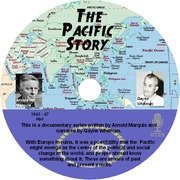
The National Broadcasting Company and its affiliated stations present The Pacific Story. The Mounting Fury of World Conflict. Events in the Pacific are taking on ever greater importance. Here is the story of the Pacific and the millions of people who live around this greatest sea. The drama of the people whose destiny is at stake in the Pacific War. Here as another public service is the tale of the war in the Pacific and its meaning to us and to the generations to come. Guam, our forsaken stepchild. December, 1941. Japanese forces struck the island of Guam from all sides before dawn on December 8th. The Americans resisted for three days. The Japanese suffered no losses in the capture of the island. Japan is now in complete possession of Guam. The Japanese today have converted the marine athletic field into a landing field. They have fortified the island. And just two and a half years before they took it, men in the American Congress were saying, Fortify Guam will offend Japan, will offend Japan, offend Japan. The cost would be prohibitive. It would cost a hundred million dollars to make Guam an effective base. Guam's position is so isolated and exposed that it cannot be defended. It will offend Japan, offend Japan, offend Japan. Early in 1939, Rear Admiral Arthur J. Hepburn and the Naval Board had looked into the proposal to fortify Guam along with many other places. And they recommended that Guam... Guam is well adapted for the maintenance of an air force equal or superior to any force that could be assembled within a 1200-mile radius. The facilities in Guam for a submarine base are excellent. So long as Guam exists as a strong air and submarine base, hostile operations against the Philippines would be a precarious undertaking. To an even greater extent, Guam would greatly impede, if not actually deny, extensive hostile naval operations to the south. No! It will offend Japan! I call your attention to what the Japanese are saying in regard to this proposal. Let the United States take warning against fortification of Guam and Wake Island if it is intended as the means toward a political foothold in China. If this is the case, the Japanese people are determined to smash the American fleet. America should understand that... We will offend Japan, offend Japan, offend Japan. Yes, the easiest solution would be to turn Guam over to the Japanese. After all, Guam is the only break in the 3000-mile barrier of islands from Parumushiro to the equator. No! I say fortify Guam! We want the world to know that we intend to defend every inch of American soil, anywhere, at any time, from anybody. Yes, Americans must take their stand for or against this country. The American frontier is where the stars and stripes fly. Congress should authorize the fortification of Guam, and then the State Department should invite the Japanese to discuss the question. No! That would offend Japan, offend Japan, offend Japan. The proposal to fortify Guam was dropped, and the bill was introduced to authorize $5 million to dredge the harbor of Apra and to make Guam usable for planes. Now they talked not of fortifications, but of improvements. It is the considered opinion of the Committee on Naval Affairs that the recommendation of the Navy Department of limited improvements at Guam should be carried out at this time. Guam is vitally important to the United States from the standpoint of naval as well as commercial aviation. The strategic position of Guam in the Western Pacific makes it of inestimable value to the United States as a possible defense base, which would act as a strong deterrent to any Asiatic power contemplating a hostile move toward the Hawaiian Islands or the American continent. No! Improvement of Guam would be tantamount to fortification of Guam. It would offend Japan. It would be a dagger at the throat of Japan. I ask for a vote. All those in favor signify by the usual... The vote was 205 to 168 against spending $5 million even to improve Guam. Two years were to pass and Pearl Harbor was only months away when at last $4,700,000 were appropriated to improve the harbor. And on Guam they waited for that dawn when the Japanese swarmed over the island from all sides. Guam came into American possession in 1898 when it was ceded to the United States by Spain. To many it was only a distant isolated infinitesimal dot in the vast Pacific. Well, what good is it? It's only about 30 miles long and four or five miles wide. It's right down there practically on the equator. There's nothing on it but coconut trees and volcanoes. And it's 5,000 miles west of San Francisco. But to thinking Americans it had another value. In 1911 the great American naval strategist Admiral Mayan saw in Guam a little Gibraltar in the Pacific. It's the biggest island in the Mariana group and it's by far the best island in all Micronesia. Admiral Mayan gathered his staff about him and pointed to Guam on a great chart of the Pacific. With the American fleet based here on Guam we could put so much pressure against Japan's communications that the Japanese would either have to yield or come out with their fleet and fight. Well, it would have the effect also of checking any Japanese movement to the east, say toward the Hawaiian islands. Wouldn't it, Admiral Mayan? Yes, Captain, it would. And likewise to the south. Guam is only 800 miles from the Japanese advance base in the Bonin Islands and only 1,400 miles from Yokohama. From Guam we could cut the Japanese communications either to the east or to the south. This was the value of Guam in 1911. Its value was increased when the Carolins, the Marianas, and the Marshalls were mandated to Japan at the close of World War I. Naval strategists then saw its new importance. You see here the islands of the Japanese mandated area surround Guam. Yes, there the Marianas to the north and the Carolins and the Marshalls to the east and south. In this position we are between Japan proper and the Japanese mandated islands. Yes, but also we are open to attack from the Japanese advance base in the Bonin Islands and from the bases in the mandated islands. That's true, but Guam is the best island in Micronesia, 225 square miles. And if it is properly fortified it should have a sobering effect on any radical moves by the Japanese in this part of the Pacific. But it looks as if the big job is to get Guam fortified. That is the big job. The Americans took over Guam in 1898. In May 1899, Captain Richard P. Leary of the United States Navy sailed from New York to become the first governor. On board the USS Yosemite as it steamed eastward to Gibraltar, Fort Side, Colombo, and Singapore, Captain Leary discussed this distant outpost in the Pacific. The remarkable thing, Doctor, is that virtually no one in the United States knows anything about Guam. It seems that even Marianas have made little note of it in their logs, Captain Leary. About all we know for sure is that the native people are Chamorros and that the Spaniards have ruled the island for several hundred years. It is my impression that the natives are something like the Solomon Islanders. Oh, no, I hardly think so, Doctor. A different race? Well, the Chamorros are something like the Polynesians as far as I've been able to learn. Of course, by this time, the native people are probably intermixed with the Spaniards. Yes, and with the Filipinos. I have a feeling, Captain Leary, we've got an enormous job ahead of us. Undoubtedly. But the only information we have about the island is bad. But that's why we're going over there, Doctor. And in all likelihood, we'll have to start from the grassroots. The USS Yosemite plowed down through the Pacific, on to Manila, and then on to Guam itself. On the seventh day of August, 1899, the Yosemite dropped anchor at Agaña. Captain Leary and his staff went ashore and met the American naval officer who was representing the United States on the island. Well, the situation, Captain Leary, is even more difficult than it appears. I'm beginning to see that, Ensign. To begin with, the people. As the people have been almost exterminated in the last several centuries. By disease? Yes, as the result of epidemics, Doctor, and by migrations to other islands. What diseases seem to be prevalent here? Well, you as a doctor will find out more than I know now. But for one thing, there are a good many natives suffering from leprosy. Leprosy? Yes. What else? Well, many are suffering from intestinal parasites. Uh-huh. What are pulmonary diseases? Pulmonary diseases seem to be common, and disease of the eyes, too, Doctor. Does it look worse than you expected, Doctor? I can't tell yet, Captain Leary, but I had an idea it would be about like this. Fortunate thing is that we brought that freshwater distilling and ice-making plant along with us out here. We'll have to get that installed and into operation at once. We'll do that immediately. We already have a site for the plant. Good. There must be good water. Yes. And we shall have to set up a system of food inspection. Much of the disease on the island is probably related to food. We'll work that out, Doctor. Yes. There are several native health officers on the island who will cooperate with us. Yes. We'll lead them. What can be done for the treatment of natives, Doctor? Well, the first thing we'll have to do is vaccinate the natives. You may have trouble doing that. Quite probably. And we'll have to give the natives free medical treatment. We've got to convince these people that we're here to help them. They have exactly the opposite feeling now. Is there any reason for that, Ensign? Well, yes. Yes, perhaps several. First, all they've known for generations is the treatment the Spaniards gave them. They don't look forward to any better treatment from us. They've seen their population almost wiped out. They tell me that before the Spaniards came here, there were between 40,000 and 50,000 natives on the island. Really? Yes. Now there can't be more than perhaps 9,000. That's serious. Serious. Well, disease probably accounted for a great many of those. Yes, and many left the island. Is it your belief, Ensign, that we can expect more than ordinary resistance? Well, sir, that problem may not be as serious as it appears. Many of the natives were led to believe by the Spaniards that all Americans are barbarians and that if we ever took over the island, they could look forward to nothing but misery. But now that we've been here these months, their attitude seems to be better. Well, that's at least promising. And we must see to it that we make the most of it. Despite its conditions of illiteracy, disease, unhygienic conditions, the Navy saw great possibilities for Guam. Before them lay an enormous task. Beyond that was the promise of a priceless outpost in the far Pacific. With courage and zeal and enterprise, the Navy set about developing Guam to its great possibilities. Hospitals and schools are being founded. The natives are being educated in sanitation and hygiene. The native population is being protected against exploitation by carpetbaggers. Abuses against them are being halted. Extensive hard roads are being built of cassaho, coral limestone. The roads are facilitating transportation throughout the island. A submarine cable has been laid between Guam and Midway and Manila, putting the island in touch with the outside world. The United States Navy has built a powerful radio station on Guam. Also commercial radio service is now available to and from Guam. From being a forlorn wilderness of pestilence and death, Guam slowly emerged, as Admiral Mayen was later to call it, the biggest island in the Marianas and the finest in all Micronesia. The people who had regarded the Americans with misgivings and antagonism now look to America with another attitude. We do not wish independence. We hope someday to be citizens of the United States. Navy officers learn to know every foot of the island, every hill and reef and lagoon. Look at that coral reef down there. It surrounds nearly the entire island. It's like an outer wall. Yes. Only an experienced steamship pilot can thread his way through it into the harbors and lagoons. Yes. And look at that harbor itself, big enough for a good many deep draft vessels right now. If some of the coral heads were removed, it would be still better. Another thing, look at those crags up above there. I've been thinking about those for a long time. Crags like that command every approach to Guam from the sea. That's probably the reason Spain fortified some of them. That's where we should develop our fortifications. Mount gun emplacements in every one of them, where we could make Guam here a stronghold. Not only that, a supply base too. Yes, and a cooling station. This would be an ideal supply base between North America and Asia, at the same time providing a safe harbor. And a communication center. Yes. From this island, the United States would be able to keep an eye on it. In the passing years, many improvements were made. The opening of the Trans-Pacific Table stimulated the plans for development. Engineers enthused over what Guam could be made into. But not many years after the United States took over the island, hard times came. Money became scarce. Especially money for the development of a faraway island outpost 5,000 miles west of San Francisco. You've read the newspapers, ain't you? You know what they say about Guam. About not needing Guam anymore. Yeah? And I think they're right. What's the sense in putting in a big colon station at a place like Guam when everybody knows that all the Navy ships and the merchant ships, they're not burning coal anymore, they're burning oil. Well, that's not the only value Guam has, a colon station. Well, what else is it good for? We can use a naval base out there in the Pacific, can't we? What for? We're developing a naval base at Pearl Harbor and a couple of more in the Philippines, at Cavite and along up all. That won't help us out where Guam is. Now look, they're putting in dry docks and, well, everything else you need to repair ships. And Hawaii, and a long way from Hawaii to Guam and a long way to get around. World War I swept up like a tidal wave in the Pacific. Germany, not Japan, then held the islands around Guam. Japan moved in and took the Marianas, except Guam, and the Carolins and the Marshalls. The crisis once more underscored the necessity to fortify Guam. Hurried military installations were put in. Come up here, you can see better. This is a strategic point. Uh-huh. Big guns you've got mounted here, Colonel. Yes. For the emplacements set on these steep mountain slopes, we have a distinct advantage over approaching ships. Excellent cover, too. Well, with our airplanes keeping constant watch, we're a great deal more secure here than we were a year ago. Well, that's something new, isn't it? An air patrol? That's a good thing. With our airplanes, we can spot an approaching enemy long before we can see them from our gun position here. I see. And by the time your naval vessels would have time to go out and meet them. Exactly. And with our expanded facilities in our Navy yard down there, we're equipped to make just about any repairs on a ship. Then after all, Washington is seeing the value of fortifying Guam. Yes. But the job is only beginning. Guam should really be fortified completely. When World War I was over, Guam again became a stepchild. The plans for making Guam a Gibranter of the Pacific were abandoned in the Washington Disarmament Conference of 1922. The plan was to make the Pacific a place of peace and a place of peace for the people of Guam. But the plan was to make the Pacific a place of peace and a place of peace for the people of Guam. This was done in the Washington Disarmament Conference of 1922. The United States and Great Britain agreed not to develop naval bases in the Far East. And Japan in turn agreed to accept the 553 naval ratio. We're not giving up fortifying Guam, are we? It's no value to us anyway. Besides, we had to make some concession to Japan if we expected her to accept that 553 naval ratio. This was the attitude of the man in the street toward Guam. The Indian naval treaty of 1922 required the maintenance of the status quo, as the defenses and military shore developments in a great area of the Pacific. This applied to Guam. The military installations put in during World War I remained as they were until 1931. Then the greatest change took place. All right, watch it over there. Easy there. Easy. Take it up. Hey, you, get away from under that derrick. I want that gun to drop on you. Up. Up. Take it up. Easy. Watch it. Watch it. Stand clear until they swing that gun over onto the transport. That's well. That's well. Now swing it over. Swing it over. I've got a strange feeling about this. Demilitarizing the island? Yes, I was here during the World War when all these guns and all this ordinance was brought in here. You saw it brought in? I helped bring it in. I helped drag it through the jungles and up onto those rugged crags in the mountains. Well, they're taking out all of it now. I don't understand it. The Washington naval treaty didn't provide for the demilitarization of Guam. That doesn't make much difference now, does it? No, I guess not. But I get a strange feeling about it. Watching ship after ship going out with howitzers and gun mounts, mobile batteries and ammunition. Everything that's needed to defend the island. Something keeps telling me we're going to need this stuff here. We're going to need it. The dismantling went on month after month. The big guns were dismantled by October 1931. Transports carried them back to the United States, 5,000 miles away. In 1932, the progress of the demilitarization of Guam was reported. Up to the date of this report, no transportation has been provided for the removal of ammunition from the magazines. When this material is finally removed, there will remain on the island only two six-pounders for saluting purposes, 12 Browning automatic rifles, four Browning machine guns, 688 Springfield rifles for use of the Guam militia, and 260 rifles for the use of the Marines. All right, all right, watch it. All right, finger out, forward away at the deck. The loading went on day by day. On April 1st, 1933, the governor of Guam reported, the demilitarization of the island of Guam is completed. The last shipment of ordinance has been sent to Gaviti. Guam had become a distant, dismantled outpost. It swelled under the tropic sun year after year. Reports filtered in that the islands surrounding Guam were being improved by the Japanese, that visitors were being discouraged from visiting the marshals, the Carolins, the Marianas. As a military stronghold, Guam was the forgotten island. It came into the headlines again in December 1935, but in a different way. There, there, there it comes. See it out there, Governor? Yes, sir. Yes, sir, that's it. The clipper. Yes, sir, all the way across the Pacific. San Francisco to Honolulu to Midway to Wake to here. Oh, pretty sight there, Captain. Coming in. Yeah, yes. But that one we've seen coming in here. According to my watch, they've flown here from Wake in, let's see, a little more than nine and a half hours. These clippers are going to make a lot of difference to what's out here in Guam, Governor. Yes, it will. Until now, it's taken us more than a month to get mail from the States. Now, Guam and San Francisco are only five or six days apart. Ah, she's coming right down to land. Watch her. Oh, look at that. Just skims down over the water. Well, let's go over and have a look at it. But while the United States and the Far East were being linked by the trans-ocean clippers, the situation in the Pacific was becoming graver. Japan had attacked China at the Marco Polo Bridge and was tightening her hold on the thousands of islands around Guam. Look, look, a letter from Sargo in Honolulu. From Sargo? How did you get it? The fishermen brought it for me. You know that it is against the law to get messages from any of the people in Guam. I know that it is against the law to get messages from any of the Japanese islands. Not even weather reports. I know, I know. But it is from my brother. He says all our people working under the Japanese are living like slaves. Put that letter away. The fishermen smuggled it by the Japanese so we would know what is happening to our people. If we could only go to them, it would do no good. We could not help them. We have been missing my people for months. We are lucky we are here. Maybe, maybe someday the Japanese will come here too. That will be the end of us. If the United States gives up the Philippines, perhaps the United States will give us up too. No, no, that must not be. If we do not have the United States, what do we have? While the matter of fortifying or improving Guam was being debated in the Congress, a final announcement was made on Guam's state of preparedness. March 26, 1939. There are no fortifications whatsoever on the island. Guam's sole garrison consists of 173 marines and 11 officers under Captain James T. Alexander, the naval governor and his administrative staff. Traffic had come to a stop between Guam and the surrounding Japanese islands. Typhoon! Typhoon! Get undercover! Get undercover! Typhoon! Right for government typhoon! A typhoon struck the island of Guam from the southeast at 4 a.m. today. The velocity of the wind is from 110 to 150 miles per hour. The typhoon has now been blowing for 10 straight hours. Every house in the village is wrecked. And all our crops. Will this typhoon never stop blowing? Get down here! Get down! Where is my family? Where is my family? The typhoon on the island of Guam has now been blowing steadily for 18 hours. The entire village of Petey, near the harbor of Apra, has been destroyed, and the wind is still howling over the island at from 110 to 150 miles per hour. Here. Here's a report on the damage, Captain. As close as we're able to get it at this time. Yeah. Thanks, Lieutenant. There's that again. Entire banana crop and 90% of the coconut crop destroyed. That's serious. Yes, sir. Considering that these are most important to the trade of the island. Entire garden crop destroyed. All utilities disrupted. The island's been devastated, Captain. Yes. We'll have to ask the American Red Cross for help. Can I come in, please? Yeah, yeah. Come on in. Big Japanese fishing boat washed up on shore. A Japanese fishing boat? Yes. Down that point. You come and see. Boat washed up on ground. All Japanese are... The Japanese fishermen had miraculously escaped death. The Americans informed the Japanese government and offered to take the Japanese fishermen aboard an American ship and land them at Saipan, 120 miles away in the Japanese Mariana Islands. Thank you for your kind offer. But the government of Japan will send their rescue ship to take the Japanese fishermen off of Guam. Lieutenant. Yes, sir. Cable them and it's all right if they want to pick up their fishermen. But that their rescue ship will have to stay offshore. We'll send their fishermen out in a tug. Unless it was sent to the Japanese. Suddenly at dawn, in a remarkably short time... Captain! Captain! Japanese warship! Japanese warship! What? Strong boat with big gun! Come on, Lieutenant. We'll go down and have a look at it. Close into shore, off April Harbor, lay the Japanese rescue ship, a sleek, powerful Japanese destroyer. And we instructed them to stay offshore. Yes, we did, Lieutenant. Yes, we did. Day by day, the tension in the Pacific grew. The value of Guam was becoming apparent. In March 1941, Congress voted $4,700,000 for harbor improvements and air facilities. Skilled workers were sent from the United States. But the hour was late. The rumblings of war were just over the horizon. November 4, 1941. American women and children on Guam, Midway and Wake Islands are being removed because of the tense international situation. November 5, 1941. American civilians and families of naval personnel in Guam have been ordered evacuated. Some 400 Marines and 155 sailors remain on the island. November 11, 1941. All forces struck Guam at dawn from all sides and made their first landing at April Harbor. 25 Japanese prisoners found interned on the island have been freed. The American governor and his staff, along with all the Americans not killed, are now our prisoners. Japan is now in complete possession of Guam. You have been listening to the Pacific Story, presented by the National Broadcasting Company and its affiliated independent stations as a public service to clarify events in the Pacific and to make understandable the cross currents of life in the Pacific Basin. For a reprint of this Pacific Story program, send ten cents in stamps or coins to University of California Press, Berkeley, California. We repeat, send ten cents in stamps or coins to University of California Press, Berkeley, California. The Pacific Story is written and directed by Arnold Marklis. The original musical score was composed and conducted by Thomas Peluso. Your narrator, Gain Whitman. This program came to you from Hollywood. This is the National Broadcasting Company.