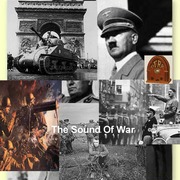
The Westinghouse Broadcasting Company brings you the sound of war, the actual sound record of World War II, 2,191 days from the time Hitler's Panzer divisions moved across the Polish borders to the ceremony of the Japanese surrender aboard the United States Battleship Missouri in Tokyo Bay. World War II, the most terrible period of death and destruction in the long history of man. World War II, a drama preserved for all time through the medium of radio, an era never to be forgotten. Tonight, VE Day, victory in Europe. It is June 6th, 1944, the time 3.32 a.m. The situation, Allied forces are moving ashore on the five invasion beaches of the Normandy coast. The first five days told the story. In those five days, the major German coastal defenses were met head on and overrun. The Allies would push through France, the gateway to Germany, the same battleground of four years before. Only this time the situation was reversed. This time Great Britain was going forward. But for the United States as an ally, the democracies were on the march. The attacking Allies were powerful, devastating, relentless. They would not be denied. This is James Cassidy with the American forces in France. Today, American forces in strength are within actual sight of Germany. Some of them in patrols have already crossed into Germany itself. I learned that the American patrols had gone over the border when I went up to the front lines of the Third Army late last night. Because of heavy enemy resistance between Metz and Marseilles, I was unable to proceed further. But early today, with advanced units of the Third Army, I was able to look across into Germany itself, a vivid demonstration of how far this tremendous army has gone and how high it has gone. And now the final issue was at hand. A common goal. The unconditional surrender of all the Axis powers. The utter defeat and surrender of Germany, Italy, and Japan. The goal of the Allies, President Roosevelt. What is now being won in battle must not be lost by lack of vision, or by lack of faith, or by division among ourselves and our allies. We must and will continue to be united with our allies in a powerful world organization which is ready and able to keep the peace by force if necessary. In the future days, if we seek to make secure, we look forward to a world founded upon four essential human freedoms. The first is freedom of speech and expression everywhere in the world. The second is freedom of every person to worship God in his own way everywhere in the world. The third is freedom from want, which translated into world terms means economic understandings which will secure to every nation a healthy, peacetime life for its inhabitants everywhere in the world. The fourth is freedom from fear, which translated into world terms means a worldwide reduction of armaments to such a point and in such a thorough fashion that no nation will be in a position to commit an act of physical aggression against any neighbor anywhere in the world. The Americans and British were now on the march from the west. From the east, the Russians were converging on German territory. The race was on. Who would get to Berlin first? Berlin, the capital of Nazi Germany. Berlin, the home of the Reichstag and the city of former Nazi greatness. Berlin, the city that would remain in turmoil long after the last shots of World War II were fired, long after Nazi Germany had crumpled. For the Americans and British, the most formidable barrier would be the Rhine River, the gateway to the heart of the German homeland. The Rhine River, treacherous and angry. No invader had ever crossed the river in war since Napoleon in 1805. The Rhine River, its east bank defended by high mountains from where the Germans could look down upon the oncoming allies. The Rhine River, its many bridges blown up by the retreating Germans. The assault must be made by water. An incredible happening. It is March 7, 1945. Between the German cities of Bonn and Koblenz lies the town of Remagen. At Remagen is the Ludendorff Bridge, connecting the west and east banks of the Rhine. At 3.30 PM, March 7, the Germans sent off a preliminary charge to destroy the bridge. The explosion was weak. The bridge remained intact. Twenty minutes later, Sergeant Alexander Drabeck and his platoon, members of the 1st American Army, reached the Ludendorff Bridge. They were amazed to see it still standing. Then they moved across. Miraculously, the explosives designed to blow up the bridge did not go off. In ten minutes, 100 troops of the 1st Army were across. At the end of 24 hours, 8,000 troops were poised for the attack on the eastern bank. Sergeant Alexander Drabeck, the first man across. They told me later that the bridge was only 250 yards across. It seemed like 250 miles. There were two other platoons ahead of us. But they'd got pinned down part of the way across the bridge, and then they sent us out. How did Sergeant Drabeck know he was the first man across? Well, that was pretty simple. There wasn't anybody in front of me. The Rhine was crossed. The 1st United States Army was again on the move. They had a rendezvous now at the Elbe River. Coming from the east was the 1st Ukrainian-Russian Army. The newspapers headlined the coming meeting. The 9th American Army from the north was hammering on a frontal plane towards Berlin. The 1st White Russian Army was moving in from the northeast. Berlin was doomed. On an hourly basis, the news bulletins told of the impending linkup between the Americans and the Russians. Nothing short of earth-shattering news could take the spotlight away from the glorious victory that would free all of Europe. We interrupt this program to bring you a special news bulletin from CBS World News. A press association has just announced that President Roosevelt is dead. The president died of a cerebral hemorrhage. All we know so far is that the president died at Warm Springs in Georgia. The news stunned the free world. In New York, the Philharmonic Orchestra canceled its concert at Carnegie Hall. The last time a cancellation took place? When Abraham Lincoln was assassinated. At Hitler's headquarters, Joseph Goebbels ran to the Führer with the news, My Führer, I congratulate you. Roosevelt is dead. It is written in the stars that the second half of April will be the turning point. So said Joseph Goebbels. The newspapers in the United States published a small obituary notice. In the casualty lists of the day under Army Navy dead, the name Roosevelt, Franklin D., Commander in Chief, wife Mrs. Anna Eleanor Roosevelt. A few days later, the free world paid its last respects to the commander in chief. Sir Godfrey was at the microphone. The drums are wrapped in black grape and are muffled as you can hear. The pace of the musicians is so slow. And behind them, these are Navy boys. And now just coming past the Treasury, I can see the horses drawing the caisson. And most generally, folks having as tough a time as I am trying to see it. And behind us, behind us is the car bearing the man on whose shoulders now, was the terrific burdens and responsibilities that were handled so well by the men to whose body we're paying our last respects now. God bless him, President Truman. We'll return you now to the studios. It is April 25, 1945. Another ironical note in the recorded history of the world. In San Francisco, the first meeting of the United Nations. In Germany, 75 miles south of Berlin, in the town of Torghau near the river Elbe, patrols of the 69th Division, United States 5th Corps, and elements of the Russian 58th Guards Division linked up. The noose had been drawn tight. After long journeys, toils and victories across the lands and oceans, across so many deadly battlefields, the armies of the great allies have traversed Germany and have joined hands together. It is April 28, 1945. Benito Mussolini is executed by Italian partisans. Two days later, Adolf Hitler and Eva Braun commit suicide. The same day the Russians reach the German capital. They raise their flag over the Reichstag. It is May 1, 1945. Berlin has fallen. The following day, German armies in Italy surrender. The world awaits the momentous news. May 3, May 4, May 5, May 6. There are rumors but no official word. It is May 7. The National Broadcasting Company delays the start of all its programs to bring you a special bulletin. It was announced in San Francisco half an hour ago by a high American official not identified as saying that Germany has surrendered unconditionally to the allies, no strings attached, and that the announcement is to be made formally by General Eisenhower. I'll repeat that the formal announcement has not yet been made, but the official says that Germany has surrendered unconditionally to America, Britain, and Russia. In London, the Supreme Allied Commander, General Dwight D. Eisenhower. In 1943, the late President Roosevelt and Premier Churchill met in Casablanca. There they pronounced the formula of unconditional surrender for the Axis powers. In Europe, that formula has now been fulfilled. The Allied force which invaded Europe on June 6, 1944, has with its great Russian allies and forces advancing to the south, already defeated the Germans by land, sea, and air. King George VI of Great Britain. Let us turn our thoughts on this day of just, of just triumph and proud sorrow, and then take up our work again resolved as a people to do nothing unworthy of those who died for us and to make the world such a world as they would have desired for their children and for ours. All that is great and traditional in the kingdom whose dominion extends beyond the seas is found in the symbol of their King, George VI. The center of a family of nations, this is in a sense a family occasion. The head of the family has just spoken, and now has always on great occasion. There's in 1918 in the Jubilee the coronation. The people of London have come together to pay their tribute to the royal family. They're waiting now eagerly, they're fighting, we want the King, we want the King. They're surging forward hoping to see him at any moment on the royal balcony over the grand entrance from the center room. We hope that the King and Queen will come out. The crowd are cheering, listen to them, and at any second now we hope to see their Majesties. And now I believe they're coming, they haven't yet appeared but the crowd in the center are cheering madly, handkerchiefs, flags, hands waving, and here they come. First Her Majesty the Queen, it comes into view, then the King in the uniform of an admiral of the fleet, the two princesses standing on the balcony listening to the crowd. The President of the United States, Harry Truman. I only wish that Franklin D. Roosevelt had lived to witness this day. The flags of freedom fly all over Europe. Now the surrender ceremony and eyewitness. And broken by the activities of the photographers. General Yodel came first, an elderly, slightly bald man of medium height with a thin red tipped nose and protruding ears, but with some dignity of bearing. He was wearing a field grey tunic with gold epaulettes, riding britches of the same colour, with a vivid red striped on the side and riding boots. Admiral Friedeburg followed in sober navy blue and then Oxenius A. DuCan brought up the rear. He advanced to the table where they were met standing by the allied delegates, whose Chief General Beatlesmith then invited them to be seated, with a gesture that showed neither warmth nor incorrection. In fact, the Americans' face remained like a mask throughout. And then came the signatures, both the two principal delegates on either side using fountain pens provided by General Eisenhower. They were streamlined gold chaperfares in the modern American style, and the German party then left the room. They were immediately taken to another room where General Eisenhower himself and his deputy Air Chief Marshal Tedder were awaiting them. The interview was brief, no salutes, only a formal bow from either side. Have you understood the terms, said Eisenhower? Yes, said Yodel. Will you carry them out? Again the answer was yes, and that was that. The Germans were in the room for exactly two minutes. So it was done. The final shot, the final act of war, the final act of war. The end of Nazi Germany. Five years, eight months, and seven days of terrible war from the time the German Panzer divisions moved into Poland to the surrender ceremony in the French city of Reims. From Times Square in New York to Piccadilly Circus in London, the Place de la Concorde in Paris, the Nevsky Prospect in Moscow, the war was over, the Allies had won, and now thoughts turn to the Far East and Japan. The Prime Minister. Yesterday morning at 2.41 a.m. at General Eisenhower's headquarters, General Yodel signed the act of unconditional surrender of all German land, sea, and air forces in Europe to the Allied Expeditionary Force and simultaneously to the Soviet High Command. The Americans were at the headquarters. The Germans were at the headquarters. The Americans were at the headquarters. The German War is therefore at an end, but let us not forget for a moment the toils and efforts that lie ahead. Japan, with all her treachery and greed, remains unsubdued. Advanced Britannia long lives the cause of freedom. God save the King. The Westinghouse Broadcasting Company has brought you V.E. Day, Victory Day, and the most dramatic and tragic period of our time. This program was written, produced, and directed by Bud Greenspan. My name is David Perrin.