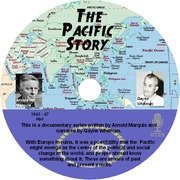
This is the story of the Pacific and its people, of the peaceful sea and the lands and lives it touches, and their meaning to us and to the generations to come. The Pacific story presented by the National Broadcasting Company as a public service and dedicated to a fuller understanding of the vast Pacific Basin. This broadcast series comes to you as another feature of the NBC Inter-American University of the Air with drama of the past and present and commentary by Owen Latimore, authority on the Pacific and director of the School of International Relations, Johns Hopkins University. World War I in the Pacific. World War I gave Japan its great opportunity. While Britain and France were engaged with Germany and Europe, Japan seized the opportunity to expand its empire. For nearly a month after the assassination at Salahabel, Tokyo and London debated the terms on which Japan should join the Allies. Then, late in August 1914, Japanese forces have landed 100 miles north of Tsingtao in Shandong province, China, in a move to occupy this German East territory. Although China has declared its neutrality, the Japanese are taking a reason far more expensive than the German East hold. Japanese troops are swinging around to the rear of Tsingtao and Japanese Admiral Keiko Tomozaburo is sweeping up mines and maintaining a tight blockade of the fortified harbor of Tsingtao. With overpowering might, the Japanese broke through the defenses of the stronghold and in November, after two months of campaigning, triumphantly paraded into the city of Tsingtao. Why, to tell you, Japanese, the making of this, Admiral Tomozaburo, it is your great victory for the Allies. I don't know about the Allies, Admiral. We have driven the Germans out of Tsingtao and saved you British from coming out here to the Far East to do it. We have to celebrate. Mm-hmm. Yeah. It is the fourth stroke for the Allies in the Pacific. For the Allies? Yes. Japan sent an ultimatum to Germany, you know, to turn over this Lee Falls and Shandong with view of its eventual restoration to China. And Germany ignored it. Does Japan plan to restore Shandong to China? We are at war now, as you Britons should know. Germany was negotiating with China to restore Shandong to China. Germany was willing to evacuate Shandong, give it back to China. When Japan attacked, Japan came into the war in compliance with our treaty with you. We have done Britain a great service. Didn't London urge Tokyo not to offer two words, General, at the hand of the Pacific? Japan acted to fulfill her obligations. So Japan came into the war on her own terms. Our Count Okuma clarified our position in his cable to the United States. You mean about Japan having no territorial ambitions and hoping to stand as protector of peace in the Orient? That is our policy. Here, you see? Look at this. This contingent of your colonials carrying the British colors marching in with our troops. That symbolizes the alliance of Japan and the Allies. Yes, Admiral Thomas de Buro. We'll probably remember this triumphal march into Qingdao for a long time. It is an important day. Yes, this day will remind us that Japan came into the war in spite of Britain rather than because of us. Based in the harbor of Qingdao was a strong German squadron under Vice Admiral von Spee. The Japanese made no effort to watch it during the tenth month of July 1914 when she, under the Anglo-Japanese treaty, was on the verge of coming into the war as an ally of Britain. Weeks before the Japanese clamped their blockade on Qingdao, the German squadron slipped out and disappeared into the broad Pacific. The Japanese had permitted Spee's squadron to slip through their fingers. The Japanese are not interested in German ships. While Spee was escaping, the Japanese were moving in on Qingdao and the Germans south the island. You realize what this means? We had been better off if Japan had not come into the war at all. It means that Spee's squadron is now free to raid our ships all over the Pacific. Vice Admiral von Spee's strong German squadron has been joined by two light cruisers and is now harassing our lines of communication. Spee's squadron has swooped down on another allied outpost in the Pacific to cut cables and smash shore installations. Spee's squadron has captured two more allied merchantmen. Spee's crack-wading squadron has destroyed the squadron of Admiral Tartika Coronel off the coast of Chile. There is only one course open to us gentlemen. We must find and destroy Spee's squadron. We can count on no help from the Japanese sir. As our allies they should help in the hunt. So far they have been indifferent to all our efforts to hunt down Spee's squadron. Japan is making little more than gestures. Japan has sent some ships. They might as well have sent windjammers. He's right sir. They've sent some old hoax and Kamamura squadron and a captured Russian battleship that was torpedoed at Port Arthur. She's keeping her fleet close to home water sir. If we must do it alone gentlemen we must still do it. Spee has detached the Emden which is now raiding alone throughout the South Atlantic and deep into the Indian Ocean. Between the Emden and the rest of Spee's squadron the Pacific stands in dread of the Germans. They will detach three battle cruisers from the European war zone and send them to run down Spee's. But sir we're in sorely need of every ton of... Spee must be destroyed. Order the following battle cruisers to proceed at once to the South Pacific. Ah they've got Spee there did. Spee's here in the paper. Caught up with him down by the Falklands eh? Yes. Down in the South Atlantic off Argentina. Was there any Japanese battle wagons in on the kill? Not within 10,000 miles there wasn't. What is it these jets are doing in this blasted war? We asked them to send the expeditionary force to France and the crisis too far. They ain't got the transportation facilities. They let Spee give them the slip and when we asked them to hunt with us... Oh I asked them what kind of a war is it these Japanese are fighting. Japan firmly entrenched herself in Tsingtao, in Shantung province around it and in the Mariana, the Carolyn and the Marshall Islands. Then she began to waver in her allegiance to the Allies. Japan seized the opportunity in 1916 to extract from Britain, France and Italy a promise to support her claims at the peace table to Shantung and the islands. Secret treaties were entered into between all. When the United States entered World War I in 1917, the United States was the only Allied nation that had not agreed to Japanese hegemony in Asia. But the Japanese were soon to create a crisis on this shore. To consult on joint efforts in the prostitution of World War I, America's allies sent missions to the United States in 1917. From Japan came by Count Ishii. All interests in Asia, Mr. Secretary, might be called a Japanese Monroe Doctrine. I see. Your worthy predecessor, William Jenning Bryan himself declared two years ago in 1915 that Japan had a special interest in China. The purpose of your visit by Count Ishii is to discuss our joint efforts in the war, is it not? By all means, Mr. Secretary, and also an understanding on problems in which we are mutually interested in the Far East. We wish only to clarify our understanding. Doubtless, Mr. Bryan, meant in speaking of your special interest in China that there were particular conditions rising from your nearness to China. Japan is sure that America sees eye to eye with us. Germany is our common enemy. Of course, of course. Then would it not be best in order to end rumors of differences between America and Japan that we show our singleness of policy and interest by exchanging notes? The United States is most eager to do that. Since Mr. Bryan declared that Japan had a special interest in China, might it not be helpful both to the United States and Japan to clarify our understanding by setting this forth in these of notes? Mr. Bryan's meaning by Count Ishii was perhaps less definite than the words imply. He meant it merely as a pleasantry. The United States is a great nation, Mr. Secretary. I have seen your battle feet in Long Island sound. I have seen your preparations to maintain an ever-increasing army in France. You are strong because you understand other nations. We have no other nations staked out for seizure by Count Ishii. You have nothing to fear, nor has Japan. Thus, you see, we have only to gain mutual confidence by clarifying the understanding between us relative to China. But there are other points on which we are in complete agreement. We have no disagreement, Mr. Secretary. Japan wishes only to state in our agreement the policy which was set forth by your William Jennings Bryan two years ago. Secretary of State Robert Lansing was unwilling or unable to repudiate the words of his predecessor, and the Lansing Ishii Agreement was signed in 1917. Before the ink was dry and prior to the date the agreement was to be announced, the Japanese informed the Chinese, the United States has admitted that Japan has special interest in China. This amount to an abandonment of the American policy of a friendship for China. China was stunned, and Japan was quick to take advantage of the situation. While the Allies sought the help of the remaining neutral nations against Germany, Japanese agents went to China, and working with Germans there sought to keep China out of the war. But China won her way into the Allied camp. At the Versailles Peace Conference at the close of the war, the Lansing Ishii Agreement clearly states that the United States recognizes that Japan has special interest in China. This does not be construed by an Monteno to mean that the United States accepts the Lansing Ishii Notes as a commitment to give Japan permanent accession to the German right in China and in the North Pacific. Japan was in possession of Shandong and the German Islands when the Lansing Ishii Agreement was signed. A clear confirmation of Japan's rights in these places. That Baron MacKinno is tying this peace conference in a knot. Yeah, for the benefit of Japan. My paper's been presently put a lead on the Shandong question. But with this guy MacKinno putting on an act that the United States is giving Japan a run around while Japan is actually giving the rest of the nations a run around. Well, there ought to be a break somewhere along here soon. They can't keep on ranting over this Shandong question forever. They can as far as China is concerned. That guy MacKinno is not going to break down. Well, I've told my paper they're giving China the works here. Well, I don't know. You watch what I tell you. Wellington Crew set the whole conference on its ear with that plea of his for Shandong as China's sacred province. But for my dough, there's going to be some horse trading here and China's coming out on the short end. Japan has got a hook on Shandong and those German islands. Japan had Shandong. Her troops were holding it. Her troops were also holding the Carolin Islands, the Marianas and the marshals. To support her claims at Versailles, she brought out the secret treaties extracted from the allies before the entrance of the United States into the war. She brought out the Lansing Ishii agreement wangled from the United States after its entrance into the war. The big four of the Versailles peace conference have surrendered Shandong to Japan. China is indignant and embittered and the Chinese delegation has been deluged with telegrams not to accept this decision. What did I tell you? They've sold China down the river. They just let that guy MacKinno make a monkey out of them on the Shandong question. Not only Shandong, the League of Nations have mandated the Carolinas, the marshals and the Marianas to Japan. I know, but they've only mandated the islands of Japan. They haven't given them to her. Japan's got them and Japan's going to keep them. And that means Japan now has strongholds south of Manila and east of Guam. And you can figure out what that means to the United States for yourself. Two days after the peace conference decided the Shandong question in favor of Japan in April 1919, China flared in protest. On May 3rd, a group of Chinese students of the National University of Peking met to protest the Versailles decision. The Shandong question is a result of corruption and injustice and we as students must fight to show the world that might should never be right. There can be only one conclusion. A greater world war is coming sooner or later and this great war will be fought here in the east. But we cannot wait for the next world war. We must drive Japan out of China now. We must drive out the Chinese traders who have sold our birthright to Japan. We students with no access to grind can carry our protest against the award of Shandong to the British and American ministers in the legation quarter. We can march in the body. We will march. All of us. Tomorrow. We must expect opposition. Some of us may die. But we can do no less than the student who bumped his head against a stone pillar at Tinsin to show how easily a student can die for his country. We can do no less than the students who have openly defied the bayonet to the Japanese or the willingness of the orphans to be imprisoned in place of students and to die for them if necessary. I pledge that I will march in protestant of death. Mr. Chairman, Mr. Chairman, look, Mr. Shia here has deliberately broken his finger and written in blood on the wall, return our sing-dow. We need your courage Shia. I shall march in the vanguard tomorrow. We shall all march in a mass parade to the British and American legations tomorrow. We will assemble in groups according to our schools and we will head for the next day. May 4th, 10,000 Chinese students marched through the streets of Peking carrying flags bearing inscription. Health determination. International justice. Down with the payers. Return our sing-dow. The students fired the imagination of the public. Marching mile after mile to delegation quarters to see the allied ministers. Hold, hold, stop where you are. We have come to see the British and American ministers. Head out there and stand back. The guards have been reinforced, yes. Only a delegation of us wish to enter. Head out there and move. If we cannot see the British and American ministers, perhaps we can see Sa Ru Lin. Sa Ru Lin the traitor. Yes, yes, Sa Ru Lin the traitor. We can go to Sa Ru Lin's house. Yes, we can go to Sa Ru Lin's house. Off to Sa Ru Lin's house. On to Chang'an street, a thousandth march to the home of Sa Ru Lin. One of the three pro-Japanese Chinese officials linked with the surrender of Shandong to Japan. We wish to see Sa Ru Lin. You cannot see Sa Ru Lin. No one is permitted to enter here. They have thrown extra guards and policemen around the soldiers, around the house. I'm asking Sa Ru Lin to come out. Stand back, stand back. Continue your march. We wish to speak with Sa Ru Lin. Stand back. Sa Ru Lin has determined not to see us. Traitor, traitor. Traitor. Traitor. One of the windows of the house is open. Shall we enter? No. Everyone throw your flags in through the window. Throw them in. Throw the flags in through the window. Let Sa Ru Lin read what is written in our flags. Throw in your flags. Look, the door is open. Somebody has forced the front door open. The door is open. The students are going in after Sa Ru Lin. Yes, let us go in and talk with Mr. Cao. Come on, in now and talk. The students are smashing the windows. They are smashing the windows. Stay close to me. Let's get in there and find Cao. I'm right with you. Let us force our way through the door. Come on, let's go. Sa Ru Lin is not here, but look who we have found. Who is it? Come on, you look up. It is Zhang Zhongzhang, our Chinese minister to Tokyo, equally guilty with Cao Ru Lin in the surrender of Jandong. He is pro-Japanese. Yes, another one of the hated pro-Japanese officials. Who is that? Zhang Zhongzhang, eh? But look at him. And I have been looking for you too, Mr. Zhang. Break up every piece of furniture of the place. Break it up. Break it up. The police. The police and the soldiers. The police. The police. The police. Reinforcements are coming. Stop it, you are under arrest. Stand back there, all of you. Back there. Do arms and arrests. Everyone of you in the company. Do fire, fire, and take it on fire. Fire, fire, fire. Who would like to escape? Fire, fire, fire, fire. Students in other schools joined the movement. Students in other cities joined. Merchants, newspapers, scholars joined. On June 6th, the guards were removed from the doors of the school. The 32 students were ordered to go home. But before they would depart, they made four demands upon the government. We demand that the three pro-Japanese traitors identified with the surrender of Jandong be dismissed. Secondly, we demand that students be allowed freedom of speech. Thirdly, that we be allowed to parade through the streets of Peking unmolested. And fourthly, that the government make a public apology to the students. We demand that these students... The students had fired the will and the imagination of China. The people of China had taken up the torch. The three traitors were dismissed. The government of its own accord sent an apology to the students. The police apologized and sent automobiles to the prison doors. And when the students marched triumphantly out... Long live the students! Long live the National University of Peking! Long live the Republican China! This last-minute bulletin has just been received from the peace conference. Quote, the removal of the three pro-Japanese officials from the Peking government has been reflected at the side. The Chinese delegation not being permitted to sign without reservation as to the Jandong question have refused to sign the peace treaty, unquote. At the close of World War I, the seeds of World War II had already been sown. Even at the start of World War I, China had foreseen the catastrophe to come. Before Japan had seized Shandong and the German islands, President Yuan Shikai said, Japan is going to take advantage of this war to get control of China. These are the facts. And here to tell the meaning behind them is Owen Latimore, authority on the Pacific and director of the School of International Relations, Johns Hopkins University. Mr. Latimore. What is the biggest difference between the World War of a quarter of a century ago and the war we are fighting now? In my opinion, the difference is in the importance of Asia. In that other war, nobody in Asia was fighting for any particular cause, good or bad. Japan just hung around the edges of the war like a jackal, hungrily snapping up any good bits that came her way. China was hardly in the war at all, though Japanese fought Germans on Chinese soil for Chinese plunder, and later a number of nations used Chinese territory as a base for intervention against Russia. It was only at the end of the war that China awoke, stung to protest by some of the more outrageous decisions of the Versailles Peace Conference. This war that we are fighting now is very different. In order to understand it properly, we Americans need to repeat to ourselves constantly a number of statistical facts and to arouse our imaginations to the vast historic sweep of the events in which we are taking a decisive part. How could anybody else's part in the war be more vivid and real than America's part? American blood paid for the beachhead at Serrano, and American courage and skill has carried the attack on inland into Italy. Americans are fighting in the most remote Pacific jungles and in the air over China and Burma. There are American prisoners behind Jap and German barbed wire. The advance on almost every fighting front is marked by its quota of American graves. Yet with all this, the war is, for us, only a recent war, and it has not cost us a kite of what it has cost many of our allies. The Dutch have lost every foot of their territory and their possessions. The British have been in the war more than twice as long as we have, and the cost to them in blood, sweat, toil, and tears has been far greater than our sacrifices. The Russians count their casualties in millions, while ours are counted only in thousands. Above all, the Chinese are the veterans of this war, and it is the reasons for which the Chinese fought and the way in which they have fought which have shaped the issues of the war as a whole. Just imagine what terrible problems we should face if this war were, in fact, on top of everything else, a racial war, a war of Asia for the Asiatics, as Japan claims. We owe it to China that the war in the Pacific is not a war of Asia for the Asiatics, but a war in which the issues are the same for the Asiatics as they are for Europeans and Americans, issues of self-defense against aggression, of freedom against subjugation. These are things that have become established clearly in men's minds, partly because the war has been going on longer in Asia than anywhere else. Yesterday, September 18, was the 12th anniversary of the stealthy and treacherous Japanese attack on Mukden. To China, the cost of that attack was the loss of three of her richest provinces, followed by steady encroachment until the whole nation was at war. But the whole world also paid a price for Japan's aggression. Failure to control the aggression undermined the League of Nations and opened the way to the rise of Hitler in Europe. What is the potential difference between the passive, lethargic China of the last war and the dynamic, history-making China of today? How sudden was the transformation? That is just the point, and it is the whole point. The awakening of China is not due to a sudden transformation, and neither is Japanese aggression the result of a sudden transformation. There is a direct line of development from the Japanese generals and admirals who were looking for loot in the war, and the Japanese generals and admirals who were looking for loot when they struck Mukden in 1931, when they struck at Marco Polo Bridge in 1937, and when they struck at Pearl Harbor in 1941. There is also a direct line of development from the passionate students of China who roused their countrymen to protest against the Versailles Treaty in 1919 to the skilled Chinese generals and tenacious Chinese guerrillas of today. In a quarter of a century, China has changed from the kind of country whose fate is settled for it in distant councils to the kind of country which determines its own fate and in so doing helps to shape the fortunes of other nations and peoples. 25 years ago, China was at the mercy not only of other countries but of its own corrupt politicians and conscienceless warlords. The protest of the Chinese students in 1919 was not only against heartless foreign statesmen but against traitorous Chinese in high places. In the quarter century since then, the Chinese have no more become a perfect people and a model nation than America has, but they have become less and less a country of civil wars and more and more a country of responsible political standards. They still have great problems to face and to solve, but it is not where they actually stand at the moment that counts. It is the direction in which they are moving. They are moving forward, and because they are moving forward, there is hope that the rest of Asia can also move forward. That in itself is enough to open out the horizons of the world and an assurance against the closed horizons of the Versailles Treaty of a quarter of a century ago. Thank you, Mr. Lattimore. Next week, at this same time, over most of these stations, we will present the Manchurian Incident and its consequences with drama of the past and present and commentary by Owen Lattimore, authority on the Pacific and director of the School of International Relations, Johns Hopkins University. You may secure an illuminating handbook of the Pacific story with background information on each program in this series with suggested further reading. This Pacific story manual will be sent to you for 25 cents in coin to cover cost of printing and mailing. Address, the University of California Press, Berkeley, California. The address again, the University of California Press, Berkeley, California. The Pacific story is written and directed by Arnold Marklis. The musical score is composed and conducted by Thomas Peluso. Your narrator, Jane Whitman. This program has been presented as a public service and another feature of the Inter-American University of the Air by the National Broadcasting Company and the independent radio stations associated with the NBC network. This is the National Broadcasting Company. .