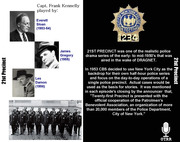
25th precinct, Sergeant Waters. All right, get on over to 2nd Avenue. The third alarm on that fire just hit. Sergeant Tenney's on the job there. He'll put you to work on traffic. Yeah, that's right. You are in the muster room at the 21st precinct, the nerve center. A call is coming through. You will follow the action taken pursuant to that call from this minute until the final call. That call from this minute until the final report is written in the 124 room at the 21st precinct. Okay, you're gone. Bring in when you get back on your post. Yeah. All right. 21st precinct. It's just lines on a map of the city of New York. Most of the 173,000 people wedged into the nine-tenths of a square mile between 5th Avenue and the East River wouldn't know if you asked them if they lived or worked in the 21st, but that they know it or not the security of their homes, their persons, and their property is the job of the men of the 21st precinct. The 21st, 160 patrolmen, 11 sergeants, and four lieutenants, of whom I'm the boss. My name is Cannelly, Frank Cannelly. I'm captain in command of the 21st. I was working my day tour, 8 a.m. to 6 p.m. It was raining hard when I came on the job, and the 63 men who had patrolled the precinct on foot and in sector cars for the next eight hours turned out wearing rubber coats, boots, and cap covers. At 10 minutes after nine, Lieutenant Gorman, the desk officer, rang into my office and informed me of a two-alarm fire in a loft building on 2nd Avenue. By the time a car came by the station house to take me to the scene of the fire, the third alarm had hit. The teeming rain added to our difficulties, and it had not stopped until about the time the fire was out at 1114. I returned to the station house to finish the paperwork and begin a required inspection of depart mental equipment. My calendar showed that I was scheduled to give a talk on safety to the student body of Julia Richmond High School at 1.30 p.m. So at noon, I changed to civilian clothes and took my rain-soaked uniformed trousers under my arm. It was my intention to leave them to be pressed while I went for my meal in a restaurant a few doors from the tailor shop on 3rd Avenue operated by Philip Parizzoni. Hello, Miss Parizzoni. How are you? I'm fine. I'm Captain Cannelli. Phil! Well, you don't have to bother him. Phil! Phil, come here! Well, Mrs. Parizzoni, I... Hello, Captain. Oh, Phil, how are you? Phil. Rose, you better get to 211 and pick up the work. Oh, all right. Yeah, the night doorman's uniform and the elevator operator's uniform from the super. 211? Yeah, 211. All right. I'll get them. Yeah, only press if they want them back by five o'clock, huh? Only press. Wives, Philip. Yeah. Sometimes they ruin more customers than they're worth. Yeah, yeah, Captain, press. I got them soaked this morning, Phil. I'm giving a talk to some high school students at 1.30 this afternoon. I wondered if I could get them pressed. Oh, sure, sure. They're not too wet, are they? No, don't worry about it. I'll take care of it. I'm going to have lunch down the block. Could I pick them up in about half an hour? Well, I'll deliver them to the station house if you want. No, no, that's all right. I'll pick them up. Yeah, okay. Thanks a lot, Phil. Oh, uh, Captain? Yeah? Could I ask you something? Oh, sure. What is it, Phil? Look, Captain. Yeah? I'm sorry, how rose-eyed you are. What happened? You two have a fight? Yeah, I guess you could call it a fight. Anyway, I'm sorry. Don't worry about it. I am worried about it. You shouldn't treat people like that. Customers, especially you. Oh, it happens in the best of families. Yeah, in the best of families. I left Phil Parasoni's tailor shop and went a few doors down the street to a restaurant where I had my meal. When I returned for the uniformed trousers a half hour later, Mrs. Parasoni was not in the shop. At 1.30 p.m., I was introduced to the student body at Julia Richmond High School, and I talked for 20 minutes on the subject of safety, especially safe driving. It was 2.10 p.m. when I returned to the station house, where in the muster room Lieutenant Gorman was desk officer and Sergeant Waters was on telephone 640. Captain. Go ahead and take the call, Sergeant. Yes, sir. I'll sign the block. 21st Precinct, Sergeant Waters. Where were you born, the borough of Manhattan? Well, you go down to the Department of Health, 125 White Street. You can get a copy of your birth certificate there. 125 White Street. Where are you, on the east side? You take the Lexington Avenue Express downtown and change it 14th Street for the local. Right, the White Street is just upstairs there. Okay, you're welcome. Yes, Sergeant, did you have something for me? Oh, yes, Captain. What? You know that Phil Parasoni from the tailor shop. Oh, what about him? Came in to see you. Yeah? He and his wife, I asked them to wait in your office. Oh, they in there now? Yes, sir. All right. 21st Precinct, Sergeant Waters. All right, where do you see? Where? Hello, Phil. Oh, Captain. Hello. You know my wife, Rose? Yes, hello, Mr. Parasoni. Hello. Well, what can I do for you, Phil? Well, he told me it wasn't the right thing to do. He told me in so many words. I wouldn't listen. Oh, Rose. That's what he told me. It wasn't the right thing to do. What wasn't the right thing to do? It was all my fault. He didn't have anything to do with it. Rose, let me talk to him. Would you wait outside? It's my fault. Would you just stand outside and I'll get it straightened out? Is that all right with you, Captain? Yeah, I guess so. Yeah, go ahead, Rose. Let me get it straightened out, huh? Yeah, all right. But it's my fault. Everything. Yeah, could I close the door, Captain? That's all right. I'll get it. Is it all right this way here? Sure, that's all right. Well, what's the trouble, Phil? Captain, when you came in the store to get your pants pressed... Yeah? Well, that's why she acted so funny, because it was you. You see, she thought you came to arrest her. That's why she acted that way. Arrest her for what? It's a long story. It's a very long story. Oh, what did she do? Look, Captain, when somebody has worked so hard for so many years, worked really struggles, can you blame them too much if they see an opportunity to make some money, just like that, a big opportunity to make it? Well, I can't blame them if it's legitimate. Well, in this case, it's legitimate and it isn't. Well, it can't be both. Well, I mean, the money don't really belong to anybody. You better start at the beginning, Phil. Yeah, well, it was yesterday morning. We were in the shop. But Rose was at the counter, like when you came in today, and I was in the back at the pressing machine. Well, the door opened and a customer came in, a woman, a very pretty young woman. Well, she came in mad as a wet hen. Well, I heard her talking to Rose and I came up to see what the matter was. But she had on a nice wool suit, see. The front of the skirt was dirty and smart, and I didn't blame her for being mad. Anyway, she said she was on the bus. She said two men got on and the man who was sitting next to her saw the two men. Well, she thinks they were detectives and they were after the man that was sitting next to her. Well, anyway, he jumped out of the seat and crawled all over her and ruined her suit with his shoe. And he went out the back door of the bus and the two men ran out after him. Well, anyway, after a minute, she looked down on her seat and there was a package, you see, a pretty big package. It must have belonged to the man that the policeman was chasing. She picked it up. And did the woman have the package when she came into the store? Oh, yeah, yeah, she had it all right. It was right down on the column there all the time. Anyway, I said I'd try to fix up a skirt as best I could and she went in the dressing room. Well, I was in the back there working on the skirt and then the lady asked Rose to bring the package into the dressing room. She'd like to take a look at it while she was waiting. So Rose brought the package in and Rose said, you know, how curiosity can get the best of ladies. Oh, sure. Well, they sat there looking at it and Rose was hoping that she would open it up and finally the lady decided to open it up. And what was in it? Well, I didn't know. I didn't find out until last night. Oh, didn't see. Well, she didn't say anything to me about it while we were in the store. I was busy back there. I didn't know what was going on in the dressing room. I see. Your wife only told you what was in it. Yeah, I never saw anything in there. Well, what was in the package? Money. Lots of money, Captain. How much? Well, I don't know exactly. Rose said at least $3,000, I think. Aren't they sure? Well, Rose told me they didn't count it. They were so scared they didn't count it. Oh, well, the money wasn't all that was in there. What else? Number slips. You know, slips from playing policy? Oh. Yeah, well, they figured out, Rose and the lady, that this fellow on the bus was a racketeer, you see, and he was being chased by the cops. Yeah. Oh, you're even asking Rose, Jim? Well, I think we ought to have this story from her, don't you? Yeah, yeah, I think we ought to. All right. Miss Parasoni? Yes? Would you come in now? All right, sure. Just have a seat. Yeah. Did you tell them, sir? Well, not everything yet. Sit down, Miss Parasoni. Thanks. I only got up to the pot after you opened the package in the dressing room. Oh. Yes, I'd rather hear the story from you, Miss Parasoni, instead of what you told your husband. Yeah, sure. Now, how much money was in there? Well, we didn't count it. We saw all that money and the policy slips, we got scared. You and the lady? Yeah. We wrapped the package back up again. What was it, a stack of money? Yeah, a stack about this thick, about two or three inches thick, lots of money. And was the pile of money tied up? Yeah, with a rubber band, a couple of rubber bands. And what was on top? A $20 bill. Do you see the bottom? Yeah, there was a 10, I think. There was a $10 bill on the bottom. You never did take the rubber bands off? I didn't even touch it. She was holding it. And you decided to wrap it up quickly? Yes, she decided it. She said the best thing to do would be to call the police. That would be the best thing. Well, why didn't you call the police? Well, I came back with the skirt. You better let her tell it, Phil. Oh, yeah, okay, all right. Well, Phil came back to the dressing room with the skirt, and she had the package all tied up again. I took her out front of where the telephone was, and she walked over toward it, and she picked up the telephone. All of a sudden, she hung up. Where was Phil? I wasn't back there. I was working on some work at the press room. I don't know. I didn't see any of it. No, that's right. You didn't see any of it. Did she tell you her name? Not then. Well, did you ever find it out? Well, later she said it would be best if I didn't know her full name. She said her first name was Marion. Ah, huh. Did she tell you why she didn't call the police? Yeah, she told me that she was afraid to call the police. She said that she was afraid that they'd find out that she had 22 parking tickets on her car. Never went to court about any of them. She was afraid to be arrested and find a lot of money and things like that. She said maybe it would be better if she left the package in the store and if I'd call the police. Did you agree to that? Well, I didn't care, but then she said there wasn't any reason why we couldn't keep the money to ourselves. Better that we should have it from the criminal. Oh, I see. The only thing was she was afraid that the man from the bus might have gotten away from the cops and might have remembered him. So what did you do? Well, it was decided that we could leave it in one of those lockers in Grand Central Station. You know, one of the lockers right in the waiting room there, you see a little locker with a key that you take out and put in a dime? Yeah, I know. Well, because she was scared, I took the package, went out of the store and she followed me. I went over and took the subway and rode down to Grand Central. I put the package in the locker and she said I could keep the key because I didn't know her full name or where to get in touch with her, but she sure knew me and she was sure I was honest. Is the package still in the locker? Yes, still in the locker. And you've got the key? Yeah, I got the key. I got it right here. See? How much cash did she ask you to put up? So did you tell them she asked me to put up cash? No, no, I didn't tell them. How did you know she asked me to put up cash? I knew. How much was it? $750. Have you given it to her yet? No, I'm supposed to meet her this afternoon. You're lucky, Mr. Parazoni. What do you mean lucky? I'm worried the best, scared the best. You're lucky. You not only didn't find $3,000 of someone else's money, you didn't lose $750 of your own. You are listening to 21st Precinct, a factual account of the way police work in the world's largest city. Now back to 21st Precinct and Captain Cannelli. I took Mr. and Mrs. Parazoni upstairs to the 21st Detective Squad and into the office of Lieutenant Matt King, Squad Commander. Shinshamming, bunko, and pigeon-dropping, as the small con games are called, are old stories and easily recognizable to police officers. But to the victim, they're most convincing. This is especially true because in many there is a blinding streak of larceny exceeded only by that in the con artist. These confidence rackets are invariably based upon the victim's desire to get something for nothing, that belongs to somebody else. To the police officer, the gullibility of people is amazing. It's incredible how many in the city of New York fall victim to these same old small con games year in and year out. In this case, Lieutenant King and Detective Louis DeLuca questioned the intended victim very closely as I listened. Why should she give you the key? If she were on the level, why wouldn't she suspect you'd go to the locker and get the package for yourself? Well, she told me that she trusted me because she knew where to get in touch with me. We were in business. She walked in off the street with a smudge on her suit, and that's sufficient reason for her to trust you with $3,000? Well, she told my wife she had to trust somebody. Yeah, that's right. She couldn't go to the police and had kind of a 22 parking ticket. You've known these people a long time, haven't you, Captain? Yes, ever since I've been in the precinct. Many years. As far as I know, they're good, honest, hardworking people. It was all my fault. After I told Phil, he said, why didn't I go to the police? I should have gone to the police. That's what he said. Gross, please, huh? If I meant for you to go to the police, I would have insisted. Now, let's pick this up for a minute while we left off. Yeah, all right. Yesterday, you and this Marion took the package down to Grand Central, and you got one of those dime lockers. Yes, that's right. Then what did you do? We went to a, I don't know, a coffee bar, I guess you'd call it, in Grand Central. We stood there and we had a cup of coffee, and she said, well, I guess nobody followed us. I guess the detectives arrested the man. I said, yes, I guess they did. So she thanked me a lot for helping her, and she started to say how much I should get for helping her. She mentioned something like 25 percent of what was in the package. Well, I would have been satisfied with 25 percent, but anyway, we settled on the fact that I should get a third. We were supposed to meet at Grand Central right at this coffee bar exactly at noon today. We'd take the package someplace and open up and split the money. How did she happen to give you the keys? Well, it was her own idea. It was very nice of her, wasn't it? I thought it was. Then you parted company? Yes. What time did you get back to the store? It was about an hour after I left. Did your husband ask you where you'd been? Well, yeah, yeah, I asked. He told me she had to go out with the lady to help her out. I asked her why she had to help out a stranger like that. She said she just did. She had to, that's all. You accepted that answer? Well, I couldn't do nothing except accept it. What else could I do? When did you tell him about the money? Last night after dinner. I just couldn't keep it in me anymore. I told him about the package and about everything that was in it and how we went to Grand Central, how we put it in the locker, and how she was going to meet me there tomorrow and I was going to get one third. Your husband told you to go to the police, didn't he? Yes, he told me. Yeah, I told her, but with no enthusiasm. With no enthusiasm whatsoever. But at least he told me. And you were intending to meet her at Grand Central Station at noon today and open up the package? Yes, that's right. Well, it was about noon that I came to your store. You were still there. Yes, I know I was there. I got a call from her on the telephone at 9.30 this morning. That's Marion? Yes, Marion. She said she was in awful trouble. She said she got home the night before, went to bed, and when she woke up in the morning there was a policeman there. A policeman? Phone almost fell out of my hand. She said the policeman came to her restaurant on account of the 22 traffic tickets that she didn't show up in court for. She said the policeman took her down to the magistrate's court and she was sitting there just waiting for her trial. So she said she couldn't meet me this noon but that I ought to go down and put another dime in the locker at Grand Central Station. I told her I'd do that. She made me promise to be sure not to open the package because we would have to count the money together. And I told her I wouldn't, but I just put the dime in. Did you go down to Grand Central? Yeah, yeah, I went down there. I went out of the store when the captain was in there. You remember that captain that I left? Yes, I remember. I'm so nervous I didn't know what to do. I thought you came to get me, that's what I thought, but when I found out you didn't, I went over and got to Subway and went down to Grand Central and put another dime in the locker. You looked inside to see if the package was still there? Yeah, yeah, I opened up the locker, I looked inside to see if it was still in there, the package. Then you went back to the store? Yes. What time was that? It must have been about a quarter to one that I got back. What time did you hear from Marion again? About one o'clock she called. What did she say this time? Well, she told me she'd been up before the judge. She said the judge was very mad at her for ignoring the 22 traffic tickets and he fined her $750. $750! She had to have the money right away if she'd go to jail. She had to pay the fine by four o'clock that afternoon. She said she didn't know what she was going to do. The judge wouldn't let her leave the building, but he let her go out in the hall and use the pay telephone so she could call some friends. If she didn't have it before four o'clock that afternoon, she'd go to jail. What did you say to her? Well, I told her she had all that money in Grand Central station and I said she ought to be able to use that. She said no, she didn't want to do that. She didn't want to take the chance on opening up the package, not down there because there were all kinds of cops around and everything. There's always all kinds of cops in the courthouse. Did you have any suggestions over? Yeah, I told her I could open it up and throw the policy slips away. I could go to the ladies room in Grand Central station and throw them in the wastebasket or something like that and just bring the money down. She said no, that wouldn't be any good because we'd have to count the money together and each take our shares so there wouldn't be any suspicion on either side. That seems fair, doesn't it? Yeah, but I knew she was in such trouble when she had to pay the $750 fine. Did she have any suggestions? Yes, she had a suggestion. She wanted to know if I had $750, if I could get it. And I said yes, I could go to the savings account. And she said please, please, wouldn't I do her a favor and draw out the money so she could pay the fine and after she paid the fine we'd go up to Grand Central and get the package and we'd split it right away and I'd get my $750 back. And she'd give me half of the rest instead of only a third. Did you agree to do that? Finally, I told her all right, I would. And I told her that I'd meet her with the $750. Where was that? In the courthouse, down on Center Street. Where in the courthouse? On the second floor right by the paytelephone there. She said that the judge had given her permission to go out and stand by the telephones to wait for calls and to make calls, but she had to be back inside the court and pay off the fine before 4 o'clock. What time were you going to meet her? At a quarter before. Well, you ought to be thankful that you decided to bring the whole thing to me. You'd have given her the $750 and never seen her again. Yeah, but the package, I'd have needed a lot of packages in there. Yes, you'd have gotten back 30 of your $750, 20 on top and a 10 on the bottom. But it looked like money to me. It always does. What made you decide to come and see me? Oh, that was Phil's idea. No, no, Rose, you decided it yourself. It's not true it was his idea. He keeps the bank book in the drawer of the cellar. He was putting a new lining in a coat and he wouldn't get away from it. Finally he stood up to get something. I got the bank book. He saw me. So he asked me what happened and I told him. He says, no, I can't go to the bank and get the money. But I told him I promised. He said, I don't care what your promise. But she decided to come here herself. She decided. He told me. So I decided. What do you think, Lieutenant? Take out a gun out of Grand Central and pick up that package? What time is it now? Quarter to three. I think you ought to leave it there, at least until we're sure that there's Marion down at the courthouse. Just as I'd be standing in Grand Central watching that locker. She sees the police all through, or Rose go get the package. She's not going to show up at the courthouse. If it stays there in the locker, then she's sure the deal is on. Is it on? What did I do? You don't have to worry about that, Mrs. Parizzoni. You just do what we tell you. It was decided that Mrs. Parizzoni would go ahead and complete the transaction with the con artist she knew only as Marion. A dummy package of money prepared in exactly the same manner as the package left in the locker in Grand Central was gotten ready. There was a twenty dollar bill on top and a ten on the bottom. In between was plain paper cut to size. The serial numbers of the two real bills were recorded for evidence. Detective DeLuca was instructed to see that Mrs. Parizzoni waited until the exact time of the appointment, entered the building, and took the elevator to the second floor. Lieutenant King and I went into the lobby of the building and met two detectives of the fifth squad. The four of us took the elevator to the second floor. It was hardly necessary to make ourselves inconspicuous in the corridor. The place, as always on court days, was jammed with police officers, defendants, witnesses, complainants, bail bondsmen, and attorneys waiting for their cases to be called in the various courts. The two detectives from the fifth squad were planted near the elevator. Lieutenant King and I walked to a place in the corridor close to the telephone booth, and there we waited. Captain, it's the first time I've heard of the criminal court building being part of a con game. It's impressive, man. You ain't got to give her credit for that. It's impressive, all right. There's a woman waiting. Think that's her? Hmm? She's pretty close to the description. Wait a minute. There's another one down there. Where? At the drinking fountain. Oh, yeah. Lots of them, Captain. Yeah, I guess we'll just have to wait and see. Get some. How's the time? She's through up here now. How about moving across there where we can see the elevator? Yes, Sergeant. There's a Dave there, in the blue dress. Yeah? That could be her, too. Yeah, we'll see. Look, we better not both watch the elevator, man. No. I'll look this way. You just let me know what's going on, okay? Okay. There's another one that could be the gal. That description fits half the women in New York. Yep. There's Miss Parizzoni coming off the elevator. She's starting to look around. Does she see her? Not yet. Which way is she looking? This way. Here she comes. She stopped. You think Marion showed? Yes, sir, she showed. Miss Parizzoni is walking over to her, the one in the blue dress. I'd better keep looking this way. Yes, sir. She's greeted her. They're making the change. Miss Parizzoni is giving her the package. She's got it. All right, let's go. Good looking, all right. You think that'll help her? So far. I don't know how much it'll do from now on. Now where will I wait for you? All right, we're police officers. I'll take that package. What's that? When you've got there, I'll have it, please. Did you bring them? Why'd you bring them? Because you were cheating me. Give me the package. You want to take your eyes out right out of your head. You're looking so wild. I'll kill him. I'll kill him. You stand over there, Miss Parizzoni. I'll kill him. I'll kill him. I don't think so. No, I don't think so either, but let her believe it. What did you do, open up the package in Grand Central? No, it's still there. What made her ring in the lock? You picked the wrong mark. He was a thief. Yeah, but you didn't count on one thing. She's got a streak of honesty. Twenty-first precinct, Targon Wardage. Yeah, that's right. Those are policemen working over there. What do you want to know for? Well, how does what they're doing concern you? Yeah. Yeah. Well, you'll just have to bear with it for a while, mister. Getting her out is more important than your losing a little sleep. All right. Yeah, we'll be through there right away. As soon as possible. Yes, sir. Yes, sir. You are welcome. And so it goes, around the clock, through the week, every day, every year. A police precinct in the city of New York is a flesh-and-blood merry-go-round. Anyone can catch the brass ring, or the brass ring can catch anyone. Twenty-first precinct, a factual account of the way the police work in the world's largest city is presented with the official cooperation of the Patrolmen's Benevolent Association, an organization of more than 20,000 members of the police department's city of New York. Everett Sloan in the role of Captain Cannelly, Ken Lynch as Lieutenant King, Harold Stone as Sergeant Waters. Featured in tonight's cast were Brina Rayburn, Joan Allison, Larry Haynes, and Bill Quinn, written and directed by Stanley Niss, produced for CBS Radio by John Ives. Art Hannah speaking. Music