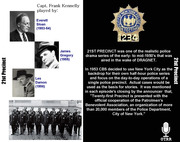
21st Precinct Sergeant Waters. Yeah, where is this? What was he shot? Yeah. Yeah. He's dead, huh? Well, I gotta send the ambulance anyway to prevent him from being away. You are in the muscle room at the 21st Precinct, the Nerve Center. A call is coming through. You will follow the action taken pursuant to that call from this minute until the final report is written in the 124 room at the 21st Precinct. Yeah, all right. I'll make a notification. You just sit tight until the detectives get there. Okay. Yeah. 21st Precinct. Just lines on a map of the city of New York. Most of the 173,000 people are wedged into the nine-tenths of a square mile between Fifth Avenue and the East River. Wouldn't know if you asked them if they lived or worked in the 21st. Whether they know it or not, the security of their homes, their persons, and their property is the job of the men of the 21st Precinct. The 21st, 160 patrolmen, 11 sergeants, and four lieutenants, of whom I'm the boss. My name is Kennelly, Frank Kennelly. I'm captain in command of the 21st. I have been off duty since completing my night tour, and I was not due back on the job until eight the following morning. At midnight, the 12 to 8 platoon was turned out by Lieutenant Gorman, the desk officer. After the 55 men who had patrolled the streets of the Precinct during the night marched out the front door of the station house, a quiet settled over the muster room. For the next 15 or 20 minutes, the quiet was broken occasionally by the men of the 4 to 12 tour coming into the station house singly and in pairs to go off duty. The men of the 21st saluted the desk as he passed through and rode to the locker room to change to civilian clothes. Then as the men reached their boats and began to ring in on the 22 police call boxes scattered throughout the Precinct, the telephone switchboard manned by Sergeant Waters started to hum at intervals. 21st Precinct, Sergeant Waters. Patrolman Farrow, box 11. Okay, Farrow. There's a body of a man on the floating platform with the laundry over here. Yes, sir. It looks like he was shot, Sergeant, once right between the eyes and again on the chest. Where is that? Well, it's the Sunningdale Laundry, 672 East 80th Street. Under the loading platform? That's right, sir. It's open to the street. I went in there to try the frank door. I saw the feet sticking out from under the platform. At first I thought it was a drunk, then I put my light on his feet. Is the weapon there? No, sir. I couldn't find any weapons. What, is he a bum? No, he looks pretty well dressed to me, Sergeant. He's a man of about 65, 70. All right. Get back on the job. I'll send someone right over there. Yes, sir. We've got it. Yes. That was Farrow ringing in. He's found the body of a man under the loading dock of a laundry at 7th Street. He thought it was a drunkard first. Yeah? He said the man was apparently shot twice, once between the eyes and again in the chest. No sign of a weapon. All right. Do you have any communications we're on here? You notified the inspector. Yes, sir. Okay, Lieutenant. Hello, C.B. Lieutenant Gormans at 21st. The guy that looks like a holocaust is 672 East 80th Street. I'm going to get him. I'm going to get him. I'm going to get him. I'm going to get him. I'm going to get him. I'm going to get him. I'm going to get him. I'm going to get him. I'm going to get him. I'm going to get him. I'm going to get him. I'm going to get him. I'm going to get him. I'm going to get him. I'm going to get him. Let's move to East 80th Street. No gunshot, apparently. 21st squad, Detective Vitale. Okay. This is Sgt. Waters on PS, Vitale. Yes, Sergeant. The Petrominoff Post reports a homicide at 672 East 80th Street. Check that out and load him back at Auloni there. Did you say 672 or 622? Six seventy-two. Okay, Sergeant, thank you. Yeah. There's a report of homicide at 672 East H.A. The loading dock at Ohlone there. Did you say 672 or 622? 672. Okay, Sergeant, thank you. Yeah. Who's cutting upstairs, Sergeant? It's my patty, Lieutenant. Give me a light on here. I want to notify the skipper. Yes. Big as a tenet. Been too quiet around here. Yeah. Captain must be sleeping. Yeah. Hello. Captain Cannelly? Yes. Captain Gorman, Captain. Oh, what have you got? A ranch out in Kale, Captain. Yeah, where? 672 East Addiot Street. The loading dock of the laundry there. The cop on the post saw the patty. He thought it was a drunk. The man was dead. Well dressed. Well, looked like a bullet hole through his head and another one through the chest. Any identification? No, sir. Not yet. All right. Send a car for me. Yes, sir. Right away, Captain. Send a car over for the Captain. While the car was en route to pick me up at my home, detectives of the 21st Squad and the Manhattan East Homicide Squad were beginning to arrive at the scene of the homicide. In addition to Patrolman Farrell, who discovered the body, six more patrolmen and a sergeant were also on the job. An ambulance surgeon from Roosevelt Hospital pronounced the victim dead. Pending arrival of a deputy medical examiner, Lieutenant Matt King, commander of the 21st Squad and the ranking officer of the detective division on the scene, dictated to a stenographer a detailed description of the body, its position, and surrounding conditions. A police photographer took pictures from every possible angle. The deputy medical examiner on arrival made a preliminary examination of the body. Then, following fingerprinting by a homicide detective and a search by Patrolman Farrell, the body was removed to the Bellevue morgue. In the meantime, detectives were sent to question neighbors who may have witnessed either the shooting or, as appeared more likely, the dumping of the body where it was found. By the time I arrived on the scene from my home, the body had already been removed to the morgue, and Lieutenant King had returned to the station house. I talked to Sergeant Collins, who was still on the job with three patrolmen, while the detectives completed their search of the loading dock and the nearby area for physical evidence. I then instructed the operator of my car to take me to the station house, where I signed the blotter and immediately went upstairs to the 21st Detectives Squad on the second floor. 21st Squad, Detective Rattelli. Where's Lieutenant King, Novec? Oh, he's in his office, Captain. Okay, thanks. We've got the Jersey State Police trying. All right, I see what we can do. Captain Cannelli. Come in, Captain. Okay, thanks. Hello, Matt. I hear you've got a heavy one, Matt. That's what it looks like, Captain. Any identification on it? Yes, sir, we think his name is Edward L. Burgess. B-U-R-G-E-S, 71 years old. He had an auto registration showing his address of 316 New Era Drive, Marble Hill, New Jersey. Rattelli? Yes, sir? Any luck on that Jersey number? No, sir, not good. We're trying. We've got a postcard addressed to him on 23rd Street, two addresses and an automobile, and we're standing still. Well, at least at 4.30 in the morning, Matt, the press and the brass aren't breathing down your neck wanting the answers to a lot of questions. Yes, sir, because I don't have the answers to. Any money in his pocket? 83 cents and change. How does it look for robbery? I don't know how it looks for anything, Captain. There's a telephone listed in the name of Edward L. Burgess at that New Jersey address. I rang it for three-quarters of an hour, there's no answer. We asked the New Jersey State Police to go around there and have a look. You heard back from them yet? No, sir, not yet. Well, this is Marble Hill, down close to Trenton. Oh, no. Yes? No back, Lieutenant. Yes, no back. Lieutenant King, this is Mrs. Oddly. Mr. Burgess has been rooming her house down on 23rd Street. How do you do, Mrs. Oddly? Frankly, not so good. Why don't you come in? I've been waiting to get this all and be giving such horrible news, rest your soul. Not so good. This is Captain Kennelly. Mrs. Oddly? Hello. Shut the door and go back. Stick around. Yes, sir. Care to have a seat, Mrs. Oddly? Not so good at all. I'm sorry to get you up here, Mrs. Oddly, but I'm sure you understand. Oh, yes, I understand. I'm sure you want to help us get to the bottom of this thing. Excuse me. Oh, yes, sure. 21st Squad, Lieutenant King. By telly, Lieutenant. Yes. That party from Jersey is ringing in on the straight line. All right, hold on to him. I'll be out there and take the call. Yes, sir. Captain, you want to come outside with me a second? Yes, sure, man. I'll be right back, Mrs. Oddly. I have a very important telephone call. Oh, that's all right. Detective Novak will stay in here with you. He doesn't have to. The telephone answer that the New Jersey address kept. Oh, I'm this one, Lieutenant. Who is it on the phone? The victim's son. He knows his father's dead. New Jersey State Super Bowl was waiting for him when he came home. He gave him this number to call. All right, I'll take it. Hello, Aaron. This is Lieutenant King, commanding the 21st Detective Squad in New York. Yes, I understand. There was this street policeman waiting here when I came home. He told me my father died. Yes, that's right. We've been trying to reach you for some time. Well, there wasn't anybody here. My wife's visiting him in Philly, and I worked the night shift at the assembly plant here. Are you sure it's my father? Is your father about 70 years old, 5'5 or 6', wishy-gray hair? Yeah, that's him all right. We'd like to have you come to New York, Mr. Burgess. We'd like to have you identify him. You want me to come there to the 21st precinct? Do you know where it is? Yes, the State Trooper gave me the address. Oh, good. We should get here as soon as possible. We're conducting an investigation. What kind of investigation? The man we're talking about was murdered. Oh, was he? Yes. So get here as fast as you can, Mr. Burgess. Yes, as fast as I can. Yes, goodbye. Goodbye. What a job. Well, somebody's got to do it, man. Yes, I guess they do. I'll be in my office for a while. Okay, Lieutenant. Why do you only do it on the alarm on the cars? All right, Captain. Thank you. Sorry to have kept you waiting, Mrs. Audley. Well, that's all right. I was talking to this nice detective here. Mrs. Audley, I understand Mr. Burgess has been roaming at your house for the last three weeks. More or less, yes. And all these years, I've never met a nicer gentleman. He was the last man in the world you'd think tragedy would fall to. The only tragedy we've had around there since my husband, the late Mr. Audley, died. Well, Mrs. Audley... I had a near tragedy once, a Carapati student. He hung himself with a neck in his room one night, but we cut him down in time. Well, I want to make sure we're talking about the same man, Mrs. Audley. The last I heard of him, the Carapati student, that is, he was back home delivering on a milk route and raising a big blue to kids. It shows you how good can come out of bad. Do you know why Mr. Burgess had come to New York? Oh, yes, to take treatment from a doctor. He was suffering from sciatica. Poor man. Did he have any particular friends that you know of? Well, not in the house, but he liked his noggin of beer. If he wasn't in the house or to the doctor, you could find him down at the bar and grill on the corner. When was the last time you saw him? Oh, about 8.30 tonight. Last night, that is. Is that when he left the house? Oh, no. He left the house sometime previously to go to the bar and grill. Hope you don't mind my mention of the fact that he liked his nip. Oh, so I... The reason I mention it is because of my late husband. Poor man. He liked to drink, too, a pint of whiskey every day of his life, except the last, that is. He got hit by the streetcar too early in the morning to finish it. Well, if he had already left the house, Mrs. Utley, when was it that you saw him last? Well, as I said, about 8.30. I happened to be looking out the window, and there came poor Mr. Burgess on his way home from the bar and grill, just struggling along, on account of his ailment, not the beer. He didn't return to the house? Oh, no. He got into the car. Whose car? His car, Mr. Burgess's. He generally kept it parked at the curb there. And drove away? Oh, no. He didn't drive. The other one did the driving. What other one? The one that was waiting at the car. A man? His son. Mr. Burgess's son? So that's what it looked like to me. His son Carl. Let me get this straight. Mr. Burgess walked down the sidewalk toward the house, and when he got to his car, his son was waiting there? Well, it certainly looked like his son. Have you seen Mr. Burgess's son previous times? Oh, yes, on two or three occasions. He brought Mr. Burgess to move in, and once more, at least once more. You're positive it was Mr. Burgess's son? Absolutely positive? Well, I couldn't swear to it, but I'm absolutely positive. Absolutely positive. You are listening to 21st Precinct, the factual account of the way police work in the world's largest city. On September 24th, 1951, newspapers carried a minor headline that read, Three UN men capture Heartbreak Ridge, and the item, quote, After four unsuccessful assaults earlier in the day, a battalion that has suffered two-thirds casualties sent a platoon with only 13 men left against enemy positions on the peak. Three men finally reached the objective, and they were quickly reinforced, unquote. What connection does that news item have with you? Just this. Those men who reached the ridge and those men who fell trying were helping to write a code of conduct for all future United States fighting men, specifically Article 1 of that code. I am an American fighting man. I serve in the forces which guard my country and our way of life. I am prepared to give my life in their defense. Now back to 21st Precinct and Captain Pennelly. The first 24 hours of the homicide investigation are priceless to detectives. The memory of witnesses is short, and as each hour passes, the trail grows colder. Consequently, all off-duty detectives of both the Manhattan East Homicide Squad and Lieutenant Matt King's 21st Detective Squad were summoned from their homes. Paired off into teams of two, they sought out and spoke to every person known to have had contact with the homicide victim, Edward L. Burgess. By 7.30 in the morning, a good picture had been drawn of the last several days' life of Mr. Burgess, his background, his financial condition, his family, and his social life. I had gone downstairs to my office to change to my uniform, preparatory to turning out the platoon. Lieutenant King sat behind his desk, drinking a cup of coffee, waiting for his detectives to show up with still another witness in the case. Come in. They got the car, Lieutenant, Burgess's car. And where? In the 15th precinct. It was parked in the garage on 1st Avenue about midnight last night. An attendant was moving it to another floor this morning and noticed what he thought were blood stains on the front seat. He called the cop on the post. The cop remembered seeing the car and the alarms. Where have they got the garage, Lieutenant? At the 15th squad, Lieutenant. All right. Get that attendant in here. Send Whitey. Well, he's going to pick up that waitress from the barn grill. Why, all right. Send Fitz. Yes, sir, Lieutenant? I'm supposed to see Lieutenant King. Well, uh, I'm Lieutenant King. Oh, my name's Carl Burgess. We were wondering what happened to you, Mr. Burgess. Come into my office? Yeah, thanks. Sally. Right with you, Lieutenant. Go ahead, Mr. Burgess. Thank you. Have a chair. I didn't think it would take you this long. Well, I told you, my wife's in Philly. I had to get in touch with her and tell her the news. Also, I didn't trust my car to come up here. I had to wait for a train. Oh. This is Detective Vitale. Sorry about your father, Mr. Burgess. Yeah, so am I. You know who did it, Lieutenant? No, not yet. You know why it was done? Why would anyone want to kill my father? Well, he was in the habit of carrying quite a sum of money, wasn't he? Not too much. He always had a couple hundred dollars in cash on him. Someone do it to rob him. Well, his wallet was on his purse, Mr. Burgess, but there wasn't any money in it. All he had in his pocket was 83 cents and change, maybe. Do you have any idea? You know, we're working out a few angles. Oh, good. I'm glad to hear that. Where is he? At Bellevue Morgue. We have to get down there to make our identification. Aren't you sure it's him? Yes, but it's a formality we have to go through. I'm sorry. Oh. Are you the closest living relative? Yeah, my mother died in 1939. No brothers or sisters. My father had been living with me since. Except recently. Well, he came up to New York for treatment. Hey, that's good. I suppose you want to claim his property, what was in his room, at Mrs. Audley's? Yeah, I was just talking about that, isn't it? Oh, sure. It's all been taken into the station house here in inventory. Did you know there were two $10,000 insurance policies naming you as beneficiary? Yeah, I knew it. Who recommended this New York doctor to your father, Mr. Bridges? They're a friend of his that lives in New York. Man friend or woman? As a matter of fact, a woman. Did your father ever say anything to you about planning to remarry? No. Of course he. That's what I'm trying to find out. You're positive now? Of course I'm positive. You just want the truth? Who, I've been telling you the truth. Have you? What do you mean? Bridges, when I finally reached you on the telephone, you told me you weren't home at that hour in the morning because you were working the night shift. Yeah, that's what I told you. I just wanted to make sure about that, so I had a detective call the personnel office to the plant. They said you didn't work at all last night, you rang in sick. Was that so? No, I didn't work. Why did you tell me you didn't? Well, you gotta be a good fellow. My wife was in Philly. I was out having a good time. A man's wife doesn't get away often. He doesn't have much chance, you know that? I know a man's wife doesn't get away often, neither does a man's father get murdered often. You didn't come to New York to have your good time by any chance? No. Where were you? From Trenton. By yourself? Yeah. Did you see anyone you knew? No. No one, Mr. Bridges? No one. No one. Where'd you go? Maybe someone would remember you. I was by myself. I just went from one bar to another, into a movie. Until three o'clock in the morning? I'm not in the movie until that time. I went to a few bars afterwards and I drove home. That took some time. I see. You're positive you weren't in New York. I swear, I swear I wasn't in New York. Now back. It's not possible, is it, Mr. Bridges, that you got a little mixed up, that you were in Trenton the night before, and last night you were in New York? I told you I wasn't in New York last night. Yes, Lieutenant. Now back. I want you and Goldman to take Mr. Bridges down to Bellevue. Yes, sir. Mr. Bridges? Yeah. Detective Novak, are you going to say that you get down to Bellevue where you'll see if that's your father? All right. You coming to tell me? No, I want to talk to the lieutenant. All right. All right, start waiting. Okay. Well, he's hooked. We'll see after that garage attendant gets a look at him. That Trenton story sure wasn't very convincing. No. He didn't have much faith in it himself, did he? The manual of procedure specifically states that commanding officers must keep in constant touch with developments in all homicide cases. Consequently, after I had turned out the platoon at 8 a.m. and discussed a few matters concerning patrol of the precinct with the oncoming desk officer, Lieutenant Snyder, I went upstairs once more to the 21st Detective Squad where Lieutenant King filled me in on the latest developments. As I left the squad room and started back down to my office, Detective Novak was headed up the stairs with an attractive but slightly overdressed girl in her middle 20s. Well, that's what I'm doing here. I really don't. Just hold it here, Kitty. Hello, Captain. Novak? You know the best people, don't you, Cap? Yeah. All right, go on. I really haven't any idea. Nobody's going to bite you. The lieutenant just wants to ask you a few questions. Waking me up in the middle of the night like this. Say 30 in the morning. Go ahead. I mean, it's the middle of the night. Turn over here. First squad, Detective Vitale. 60. Sit right down here, Kitty. Right here? That's right. Well, I won't be able to make it today. I'll go get the lieutenant. I'll be here last night. There's nothing I can do about that. Yes, Novak, Lieutenant. I'll call you tomorrow. Yes, Novak. I've got the girl, Lieutenant, the waitress in the barn room. Oh, yeah. That's her. You want me to bring her in? No, I'll talk to her out here. Yes. What's her name, Kitty? What? Kitty Crows. Oh, Miss Crows? I'm Lieutenant King. How do you do? You were working last night? Yes. Did you see Mr. Edward Burgess in there during the evening? Yes. What time was that? Oh, he came in early. About 730, quarter to eight. Did you serve him? Yes. If I remember correctly, he brought two bottles of beer. Was he alone or with someone? Oh, usually on our own. Do you know Mr. Burgess very well? What do you mean? I mean, did you have a frequent occasion to see him and talk to him? No. I mean, did you have a frequent occasion to see him and talk to him? No. I mean, did you have a frequent occasion to see him and talk to him? No. I mean, did you have a frequent occasion to see him and talk to him? Oh, yeah. He's been coming into the place every night all night. Yeah. As far as you know, he spoke to no one in the place last night. Not me, I served him. He said, hello, how are you so far? You were very busy when he was in there? No, we weren't busy at all. Tell you early. Who else was in the place? Well, there was a boss behind the bar. It was a strong man. He was a good man. He was a good man. He was a good man. He was a good man. He was a good man. He was a good man. He was a good man. He was a good man. He was a good man. He was a good man. He was a good man. And he was a strong couple at the bar you may have heard of before. And who else? Mr. Burgess in his booth. And that's all. But there were more people in the work, didn't they, Kitty? Think about it. I'm thinking. There weren't. All right, bring him in here. Lieutenant, this is Mr. Frank McPhease. How'd it go? The attendant at the garage where the car was parked. Oh, yes. Selvac, you stay here with Kitty. Yes, Lieutenant. Come into my office. Yes, Lieutenant. Here is the room number. I'm sorry. It's the room number. How'd it do? The attendant at the garage where the car was parked. Oh, yes. Selvack, you stay here with Kitty. Yes, Lieutenant. Come into my office, Mr. McLeese. Sure, sure. Anything you want. Uh, listen, those really turn out to be blood stains in the, you know, in the car. The car's being examined now. Go on in, Mr. McLeese. Oh, thank you. I've some deal I've got myself an hour. McLeese. Yeah. Do you think you could recognize the man who parked that car in your garage last night? Well, it's hard to say. I remember him and I don't. I couldn't draw you a picture of him, but if I saw him again, I think I could identify him. You know what I mean? What time was it he parked the car? 11.55 p.m. We've got a machine with a time stamp we put on the ticket so we know exactly what time they come in and what time they go out. Maybe you'll see that man before the morning is over. Oh, wait a minute. Just a second. I wouldn't identify anybody without making a positive first. You know what I mean? This could be serious. I know it could be, Mr. McLeese. What would you say he looked like? Would you give us a description? Well, he wasn't too tall a fella and not too short a fella either. Would you say about as tall as me? Or shorter? Taller. A little bit taller. About how old? Oh, 35, if you know what I mean. What color hair do you have? Dark. Kind of darker. You said before it might have been brown. Well, dark brown. Just a second. I haven't got a horse down in a while. What do you say squad, we're turning king? Just know that. They brought that young Burgess back. He identified the body and told me. Okay, I'll be right out. Stay in here with him, Battelle? Yes, sir. Sure is a busy place around here, isn't it? It sure is. Well, tell me, Kitty, why did you say he was when he wasn't? Well, he's been there all the time. I didn't remember that at all. Well, Mr. Burgess, Battelle, I understand you identified your father. That's him, all right. You mind coming into my office? I don't mind anything anymore. I just didn't remember. That's all you can tell me if you're not remembering. All right, Mr. Burgess. There was no way to put me to look at his eyes. Eyes and girls are pretty cozy, you know what I mean. McLeese, I have someone I'd like you to meet. Oh, yeah? Yes, thank you, McLeese. How do you do? Carl Burgess. How are you? You're the son of the man I got killed. Yeah, that's right. I'm sorry to hear the bad news. You never saw Mr. Burgess before? Where would I have seen him? Are you from the garage? That's right, yeah. They think I killed my father and drove his car to your garage. They're out of their minds. This is not the man, believe me, the tenor. I'd swear it on a bag of Bibles. They thought I was going to identify you, the crazy. Yeah, I know that. I see you out here. Yeah, all right. That's what they thought. Oh, there. There you go. That blue sky high enough, I can see. Did it? What have you got? All right, Kitty, tell the lieutenant. I don't know who's going to do anything like that. He just wanted to hit the old man up for a little money. That's all I have no idea to be anything like that. Anything like what? She forgot to mention that her boyfriend was in the bar when Burgess was last night. But her boss didn't forget it. He told Whitey Howard. I had no idea, honest. I mean, I wouldn't stand for anything like that. You saw him after you killed the old man. Well, he came back to the bar and grew it later, after midnight. It was right after midnight, and he was drunk. He said he was in the jam world. I mean, I had no idea what it was until I heard about that old man. When I put two and two together, and he told me not to tell anyone he was in the place, so I didn't. He just wanted to make a little money. That's what he said. Where can we find this spill? In his place, I guess. Where is that? 342 Charles Street. He's got an apartment there. You think he's there? Well, he must be. He was very drunk when I saw him. Very drunk. Where else could he go? All right, Novak, get the 6 Squad on the phone. I want to tell them we're coming down. Take a look for this boy. Yes, sir. You won't hurt him. We'll try not to. All right, Mr. McLeese, you get back to the garage. We'll call you when we need you. When will that... Maybe in a little while. We might have someone else for you to look at. Say, could I use the phone? I've got to call my boy. Ask one of the detectives out there. He'll show you which one. Oh, sure. Thanks a lot. This other person you have for him to look at, Lieutenant, you think he's the right one? I don't know. I thought you were the right one. Were you really in Trenton last night? Yep. What were you so vague about? How was that with a woman? I'd better take my advice. It'd be better for your wife to find out that than for you to sit in the electric chair. Yeah, maybe. Maybe it would be. 21st precinct, Sergeant Waters. How many whole of men were there? Where? No, that's not in this precinct. You give me the information. I'll see that the officers get there. Did they have guns? Yeah. Yeah. What'd they get? Yeah. Yeah. And so it goes, around the clock, through the week, every day, every year. A police precinct in the city of New York is a flesh and blood merry-go-round. Anyone can catch the brass ring, or the brass ring can catch anyone. 21st precinct, a factual account of the way the police work in the world's largest city is presented with the official cooperation of the Patrolmen's Benevolent Association, an organization of more than 20,000 members of the police department, city of New York. Ever slow on the role of Captain Kennelly, Ken Lynch as Lieutenant King, featured in tonight's cast were Joan Lohan, Abby Lewis, Harold Stone, Santa Sartega, Bill Smith, John Larkin, and Phil Sterling. Written and directed by Stanley Miss, our panel speaking.