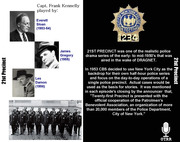
21st precinct, Sergeant Waters. Stole your what? Yeah. Oh. Where was it? 647? Where was it? Uh-huh. You are in the muster room at the 21st precinct, the nerve center. A call is coming through. You will follow the action taken pursuant to that call from this minute until the final report is written in the 124 room at the 21st precinct. All right, I'll tell you what you'd better do. You'd better come into the station house and give a report to the detectives. Yeah, that's right. Between Lexington and 3rd. Okay, you're welcome. 21st precinct. It's just lines on a map of the city of New York. Most of the 173,000 people wedged into the nine-tenths of a square mile between 5th Avenue and the East River wouldn't know if you asked them that they lived or worked in the 21st. Whether they know it or not, the security of their homes, their persons, and their property is the job of the men of the 21st precinct. The 21st, 160 patrolmen, 11 sergeants, and four lieutenants of whom I'm the boss. My name is Kennelly, Frank Kennelly. I'm captain in command of the 21st. I was working my night tour, 4 p.m. to 8 a.m. During the early part of the tour, I had been called in from patrol to investigate the attempted suicide of a prisoner confined in the cells in the rear of the station house. The prisoner, a young man of 23, had been arrested by detectives during the afternoon on a charge of grand larceny. After questioning, he had been booked by the desk officer and placed in a cell to await the opening of court. At the time of his booking, his necktie, belt, and shoelaces had been taken from him, but he attempted to hang himself using his shirt sleeve as a noose. Patrolman Bailey, the station house attendant who was in charge of the cells and the prisoners, prevented the suicide with the assistance of the 124 man, Patrolman Fallon. When I returned to the station house, I talked to the prisoner who appeared to be demented. I instructed the desk officer, Lieutenant Gorman, to notify the communications bureau of the occurrence and to send for an ambulance. A UF-49 addressed to the New York State Commissioner of Correction covering the details of the incident was prepared by Patrolman Fallon and was on my desk for my signature when I returned from my meal at 10 minutes after 8. I signed the communications along with other reports and walked out into the muster room where Lieutenant Gorman was desk officer and Sergeant Waters was on telephone switchboard duty. 21st Precinct, Sergeant Waters. Captain. Hello, Sergeant. What kind of prisoner? What's doing, Red? Pretty quiet talk, Captain. Good. Oh, how's the boy that tried to string himself up back there? Did you hear? Yes, sir. Bellevue notified me he's ready for court. But they think he's a definite psycho. Well, there's not much doubt about that. Lieutenant. Yes, Sergeant. Oh, he's got a boy over there who's standing near a firebox and about to pull a hook. Yeah? He thinks it might be the kid who's been turning in e-sports alarms. I'm going to send a car around for them. Okay, send number five. And I want to go out on patrol then. Yes, sir. Sergeant. Yes, sir. And have number two come by the house and take the captain on patrol. Yes, sir. Excuse me. Is this where we report something stolen? Yes, ma'am. Right here. What is it that was stolen? A violin cello. Your what? His cello, a musical instrument. Oh. It's my Joseph. Darling, please. Where would I get another Joseph? Where? Let me tell them, darling. I'm sure they can find it. Never. Where would they find it? Where? Well, maybe we can if you just tell us what it's all about. Where was it stolen from? From under my eyes. From under my very eyes. Please, Igor. Where can I get another Joseph? Igor. All right, all right. We were going to our place in the country, in Rockland County. Nyack. You know where is Nyack? Yes. Well, we had the car parked in front of our apartment house. In front. Right in front. Where is your apartment house? 647 Park Avenue. Under my very eyes. My Joseph. Igor. My life! Please, darling. They'll try to get it back, won't you? We'll try, sure. Captain, number two is on the way for you. Okay. You had the car parked in front of your apartment? Yes, that's right. We were going to the country for the weekend. My husband had just gone upstairs with the doorman to get a suitcase. I was down at the car. To leave the car with my Joseph inside. All right, darling. I'm sorry. Sorry? What could be sorry? Well, you see, I remembered something else I wanted my husband to bring down. So I just stepped inside the foyer for a minute to use the house phone. I was only inside a minute. Ten seconds was too much. One second! The cello was already in the car. I brought it downstairs myself when the garage came with the machine. Myself. Nobody is allowed to even lift up my Joseph except me. Now where is it? Some thief, some bum. That's where it is. Did you see the thief? No. No, I didn't see him. I couldn't from where I was phoning. Did you notice it was missing right away? I noticed it was missing when I came downstairs. Well, I had no reason to look in the car. You had no reason to look someplace else with my Joseph in there. I never dreamed it could happen in one minute. It takes less time than that to happen. What is your name, please? We are Mr. and Mrs. Rudkvig. Rudkvig. Your first name? Igor, I am. She is Irene. 647 Park Avenue. Yes, yes. Aren't you the virtuoso who will be soloist with the Philharmonic next Monday night at Carnegie Hall? In the main auditorium. Not without my Joseph. Darling, you can use the amati. My Joseph or nothing? Or nothing? What is Joseph? A nickname for the cello or something? A nickname? It's a Joseph. Joseph is an instrument made by Giuseppe Guarneri. Oh, oh. I thought that was just what he called it. Giuseppe Joseph Guarneri. It was made in Cremona in 1759. Like Estrada Varius, you mean? What, like Estrada Varius? There is no comparison, none. Estrada Varius is a tone sweet, sugary. A Joseph is robust, full. No comparison. A cello isn't that great big one, is it? That's a double bass. A double bass is not prevertuoso. A double bass plays the boom, boom, boom in the full orchestra. Oh. A cello is this high, 48 inches. You can identify the instrument if it's recovered, can't you? Of course. How many Josephs are there? And how many in this country? But your particular... I can identify it. Was it in a case? Naturally. I don't take it in a machine naked. It's in a case, a Doc Brown case. His initials are on it. I.R. How valuable is this instrument? Very valuable. How much is it worth? Priceless, extremely priceless. How much did you pay for it? Pre-voting for it. He inherited it from his father. His father was a virtuoso before him. All over Europe. Well, how much would it be worth in today's market? It is impossible to say. There is no today's market because there has been no Josephs sold for years. For many years they are unique. Do you have it insured? Is it insured? Yes, it's insured. For how much? Twenty thousand dollars. For one cello? Oh, the money is nothing. I don't want the money. I can get money. But where can I get another Joseph? I want my Joseph. Do you think you can find it? Never, never. It's gone. Well, we'll try. You better send them up to the detectives, Lieutenant. The detectives? Yes, they'll make an investigation and try to locate it. Captain, the car's here. Okay. Thank you, thank you so much. That's all right. We'll see what we can do. Captain, what, what is he? Cannelli. Cannelli. Yes. The lieutenant will send you upstairs and the detectives will handle the case. I'm going to roll, Ren. Yes, sir. You go through that door and up the stairs. I'll see you, Sergeant. Yes, sir. Go through that door here. That's right. Hello, Captain. Hello, Colonel. There's a political rally at 80th Street, New York Avenue. Let's take a look over there. Yes, sir. Well, who do you think it's going to be this year, Captain? In what? Republicans or Democrats? Oh. Now, who do you think? I wouldn't know. The press keeps harping on the fact that registration is way down from the last half-year election. It's supposed to be some sort of indication. Which way? Well, it's something the experts couldn't make up their minds about. Some say one way, some say the other. Well, I guess it's a good thing. I'm sure they'll be able to find out. What about some say one way, some say the other? Well, I guess it depends which side the expert is pulling for. Yes, sir. I guess it does. But it's a hard one to figure, though. You take things like what happened in Maine and the president with his personal appeal and scandal here and there and kennel dogs. You roll them up and what do you got? What? Beats me. Well, I wouldn't worry about it, Vaccaro. It'll all be solved for you the morning after election. Yes, sir. I guess it will. You want to go up first or yaw, Captain? Either way. Yes, sir. Pull in, Vaccaro. Yes, sir. What's the matter? I want to take a look at that man sleeping on the steps back there. He looks like a bum, Captain. A rummy. Yes, sir. He is a bum. Boy, these guys will crawl in any place. What's that he's got with him there? Come on. This guy isn't any working musician. No, I don't think so. All right. Come on, mister. I'll have to do your sleeping at home. Come on. Oh, would you? Boy, this guy is blotto, Captain. All right. Come on, dad. Let's put the show on the road. Watch out for that thing, Vaccaro. Yes, sir. What's in there? A cello or something? Yeah, a cello. All right. Listen, pops, you'll have to go some place with room service now. Come on, huh? A little action here. Let's go. Yeah, yeah, yeah. We'll go. Look, pop, you'll have to do better than that. What's he done with the cello, Captain? Where did he get it? I've got a good idea with those initials. All right. Come on, dad. Hey, come around the corner, huh? You're on a house, there. I'd better get a ride out of him. What's the matter? All right. You'd better move on, folks. It's just a man drunk. What do you like, sir? Come on, dad. Sit up. All right. Sit up. Come on. He's going to need more convincing than that, Captain. Let's get that cello out of the way. I don't want to damage it. No, yes, sir. Watch it. Be careful. Yes, sir. Now, look, dad, fun's fun. Let's sit up, huh? Yeah, sir. I'm fine. Hold him up there. I've got this side. All right. Come on, dad. Party's over. This bum has really polluted. Where'd you get it, dad? Where'd I get what? All right. All right. Sit up there now. The cello. Where'd you get the cello? What cello? That cello right there. In Milano. In Milano a long, long time ago. Oh, dad, come off it, will you? You've never been to Milano. Oh, I've been. I've been. I've been again. You've been a lot of places, huh, pup? Most any place you could name. Rikers Island included? Rikers Island included. And old you. You lifted that cello out of a car on Park Avenue, didn't you? No. Hold him up. Come on, dad. Sit up. Hold him. All right. Come on, dad. This old bird sure knows when to lose consciousness, don't he? Come on, dad. On your feet. All right. Come on. On the feet. Hold him. Watch it now, please. Watch it. All right. Where are we going? Would you mind telling me where we're going? To the station house, dad. Oh. Well, don't forget the cello. We won't. You are listening to 21st Precinct, a factual account of the way police work in the world's largest city. If you were to sit down and list some of the rights and freedoms that you have, you would probably list the big things like, oh, freedom of speech, freedom of the press, freedom of religion, and others. Well, those are mighty important. But what about the little things, things you don't think about much because you pretty well accept them as a matter of course, like choosing the business or profession you want to go into? You know, in some countries, you work at the job assigned to you with no free choice at all. Or like getting as much education as you can in schools that are open to all. In some countries, education is only for the privileged few. Or take a little thing like buying a house or renting an apartment for your family. There are places in this world where you live right where you're told. Have you ever thought about why you're allowed these free choices, why you accept it as your right? It's because such free choices are guaranteed to you and your children and to generations in the future. To be exact, it's in Article 9 of our Bill of Rights. The men who wrote our Constitution and our Bill of Rights put this in just in case they forgot to mention something important in the others. It says, The enumeration in the Constitution of certain rights shall not be construed to deny or disparage others retained by the people. You get that? It's not left to Congress or the President or any special group. These rights belong to all of us, to the people. It's one of our freedoms. Now back to 21st Precinct and Captain Cannelli. After considerable trouble, Vaccaro and I got both the cello and the drunken suspect into the car and drove to the station house. As soon as we arrived, the suspect passed out cold and was stretched out on a bench in the detective squad office. Lieutenant Matt King, the commander of the 21st squad, told me that Mr. and Mrs. Rudkovic had left a few minutes earlier after giving their report of the theft to Detective Goldman. They said they were going to a restaurant to have dinner and they had promised Lieutenant King they would check by telephone before driving to the country. We took the instrument out of the case and carefully examined it. There was no visible damage. I returned to the muster room and instructed the desk officer to send for another car to take me on patrol. I visited the political rally I had started for earlier. The crowd was small and there appeared to be no police problem. I made two or three other stops on precinct business before I returned to the station house at 10.35 p.m. 21st precinct, Sergeant Waters. All right. Hello, Ren. Captain? Oh, did that Mr. Rudkovic come by the house? No, sir, not yet. Sergeant, get me Lieutenant King on here, will you? Yes, sir. 21st squad, Lieutenant King. This is Captain Cannelly, Matt. Did you hear from Mr. Rudkovic? No, sir, not yet. But that stew bomb has come around. I'm just beginning to talk to him. All right, I'll be right upstairs. Yes, sir. I'm going upstairs to the detectives. Yes, sir. Did you get a look at that cello, Captain? I did, yeah. Does it look like $20,000? Not to me. Me either. I'd rather have the cash. I'll be upstairs. I'm sorry, I'm in precinct, Sergeant Waters. Now, wait a minute, wait a minute. Not so fast. Where is this you're talking about? Hello, Meister. Farrell. Hello, Skipper. Farrell. Yes, sir. What tour are you working? 12th day, Captain. We came in early to talk to some of the fellows on PVA business. Okay. 21st squad, Detective Goldman. Hello, Captain. Goldman. How long has he been following you, ladies? Yes. Captain Cannelli. Come in, Captain. Hello, Matt. Captain, this is Jason Newfield, noted for drinking port wine and stealing cello. I didn't realize what I was doing. I just walked by there. I didn't even know I was taking it from the car. If you stole a cello every time you killed a bottle of wine, we'd really be up to our ears in cellos, wouldn't we? I never stole anything before. Never. You told me you've been out to Rikers Island four or five times, didn't you? Yes, but never for stealing. I don't steal. What for, then? For being drunk. And for mooching. Mooching, huh? And being drunk. Where'd you get that fancy handle, Jason Newfield? It's my name. Well, I guess it's got to be. Couldn't think that up. Where do you live, Jason? Home, here and there. Around. Where? I flopped down on the barry. What were you doing uptown on Park Avenue? I was just walking. I got a right to walk on Park Avenue. What were you doing uptown? I went to work over on Lexus this afternoon. Work? What kind of work? I wanted to make a couple of bucks. I got on setting up pins in an alley over there. Wasn't any good. The other boss said I was too slow on the uptake. He gave me my money and told me to get out. What time was that? I don't know. It was just about getting dark. Just about then. What'd you do? I put the money in my pocket and I went downstairs. And into the first package store you saw. Well, as a matter of fact, you know, well, as a matter of fact, yes, I got a bottle of wine. There wasn't anything wrong in that, was there? I earned it, didn't I? I was entitled to buy a bottle of wine. What was it? A pint? A quart. You went over to Park Avenue. Well, I went walking. You know, I swigged a little bit and I walked some. That's the way I like to drink. Swig and walk a little bit. And you walked right up to this car and stole a $20,000 cello. $20,000? Is it worth it? That's what the man said. $20,000? I didn't know that. I didn't mean to steal it. I never stole anything before. Never. Well, you started big. I had no intention of taking anything like that. I didn't. Maybe you weren't looking for a cello. You had your eye on something, Jay. No, I was leaning against the building there. I was taking the last swig out of the bottle and saw this lady and this man come out of the house. He was carrying this cello and they walked to the car and he put it in. Then he went back into the house with the doorman and she waited there. I just stood there and watched her for a minute. Jay, now you can be interested in either wine or the ladies. That boat. I was interested in the cello. I thought you had no intention of stealing it. I didn't. I was just interested in it. You weren't interested in the cello. Just how much you could get in there. I was just looking for a cello. I was interested in the cello. Just how much you could get for it and hock. The cello is my instrument. Oh, is it? What didn't I tell you? No, must have forgotten to mention it. Oh, yes, I was with the Hamburg Symphony. Yeah? I was the only American ever to study under the... The great who? Pentech. Pentech in Budapest? The only American student he ever took. I was a young man. I was in Hamburg with the symphony. I was just a nobody in the cello section. Nobody. He came to be the soloist for a concert. The great Pentech. Oh, yes, Pentech. We rehearsed that day and we rehearsed. I remember and suddenly he told the conductor to stop the whole orchestra. He wanted to hear me play alone. The conductor and the whole orchestra looked at me and I played it alone. When I finished he said, you were very good. He said, Pentech, meaning himself, was getting old and would I come to Budapest and study with him. So you went to Budapest. Naturally. It was a great honor. I went and I worked and I studied with Pentech. And finally he said, you're ready. So then there were concerts arranged and recitals. You became the toast of Europe. Well, not quite, but I played in Rome and Munich and Paris, London, Copenhagen, Oslo and Warsaw. All over I... Did you ever play in New York? Well, no, never. Why not? It was her, Manya. Oh, Manya. She was a dancer. No, she was a singer. I met her in Prague and I fell deeply in love, deeply in love. But she didn't return my love and I started to drink more and more and more. In Prague? Yes, in Prague. And finally I was no good at all. And I haven't been any good for 20 years. Would you believe me to look at me? I'm only 51 years old, that's all. I know I must look 70. Tell me something. How did you get back to this country if you were in such bad shape in Prague? Well, some very kind friends took pity on me and bought my passage home to New York. They put me on the boat. The boat from Prague to New York? No, first the train to Hamburg. Then the boat. You never saw Marnier again? Never and I never will. Jason, I've been in this job 14 years. I've seen a lot of everything, especially thieves and liars. You're the lousiest thief and the best liar I've seen to date. No, no, that's the truth. The only boat trip you ever took was to Rikers Island. 21st squad, Lieutenant King. Oh, yeah? All right, Goldman. Tell them I'll be right out. Mr. Rudgavick is outside, Captain. You want to come? Yeah. Oh, uh, just a second, Matt. Jason, did you ever hear of Mr. Igor Rudgavick? Who? Igor Rudgavick. No. A great virtuoso. You stole his channel. Oh, him? Yeah, I've heard of him, but well, I haven't been keeping track of things lately. I guess you haven't. I've been kind of out of touch with the musical world. You sure have. They have told me you have my jersey. Igor. Yes, we do. Where is it? Is it all right? We think so, Mr. Rudgavick. Oh, I'm so grateful. I don't know what to say. I couldn't put it in words. You're sure it wasn't heart? Not that we can tell. You see, I told you, Igor. Where is it? In my office in there. Good. Uh, Mr. Rudgavick, the thief is in there too. Oh. Oh, he is? Igor, please, please don't get upset. You have a concert Monday, remember? I don't care for the thief. My Joseph! Is he dangerous, Captain? No, I don't think so. Oh. There he is, Mr. Rudgavick. Yes, yes, my case. We looked at it. We didn't see any damage. Listen, I want to tell you, I'm sorry. Sorry. Irene, don't speak to him. I won't bite anybody. Yes, yes, he looks all right. He looks fine. Just fine. I wouldn't hurt it. That's the last thing I'd do. Mr. Rudgavick, this is Jason Newfield. He says he was once a cello virtuoso. That's why he was so attracted to the instrument. Oh. A virtuoso too? Well, as one virtuoso to another, you stink. I didn't mean any harm. Okay, now look. The virtuoso. All right, Mr. Virtuoso. Play. Well, I haven't practiced it. A virtuoso is a virtuoso. Practice or no practice. Play. I've caused you enough trouble. Play. Maybe I could learn some technique, Mr. Virtuoso. Here, take it. Play. Igor, you shouldn't. I insist. He didn't steal it to sell, he stole it to play. So play. Sit down. Take the fiddle, take the bow. Here, here, here. So play. Play. Make beautiful music. No, please. Oh, you are shy, huh? Play. Well, if you want. So, that is it. The bow in the right hand. The fiddle between the legs. Now, play. What should I play? Anything. Igor. All right. Heh. Some virtuoso, huh? Igor. I'm sorry. I didn't remember all the notes. It's been a very long time. That was very good, Jason. Yes. Excellent. Very excellent. Thank you. Thank you very much. You stole my Joseph just to have it. It's a Joseph? Of course. A Joseph. I have never played on a Joseph. Come. We'll go home to my place. We'll forget this nonsense. You can play some more on the Joseph. Now, wait a minute. Just a second. We have a little unfinished business here. What unfinished business? Come. Igor, please, look at him. Irene, an artist is not to be judged by his clothes. Wouldn't you like to come to my home to play my Joseph? Also, I have an amati. You can shave and eat. I have some clothes for you. This man is under arrest for grand larceny. What grand larceny? Forget it. Forget the past. Come to my home. Would you like that? You know what I'd like? I'd like a drink. The alarm goes off. The alarm goes off. Twenty-first precinct, Sergeant Waters. Twenty-first precinct, Sergeant Waters. All right, get on over to Second Avenue. The third alarm on that fire just hit. Sergeant Tierney is on a job there. He'll put you to work on traffic. Yeah, that's right. We're rerouting everything off of Second Avenue. We're rerouting everything off of Second Avenue. Okay? Well, get going. And so it goes. Around the clock, through the week, every day, every year. A police precinct in the city of New York is a flesh-and-blood miracle round. Anyone can catch the brass ring. Anyone can catch the brass ring. Or... Or... The brass ring can catch anyone. Twenty-first precinct, a factual account of the way the police work in the world's largest city, is presented with the official cooperation of the Patrolman's Benevolent Association, an organization of more than 20,000 members of the police department, city of New York. Everett Sloan in the role of Captain Cannelli, Ken Lynch as Lieutenant King, Harold Stone as Sergeant Waters. Featured in tonight's cast were Ethel Everett, Santos Ortega, George Petrie, Frank Marth, and Bill Smith. Written and directed by Stanley Nis, produced for CBS Radio by John Ives. Art Hanna speaking. This is the United States Armed Forces Radio and Television Service. Music .