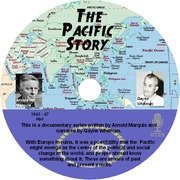
The National Broadcasting Company and its affiliated stations present... The Pacific Story. This is the story of the Pacific. The drama of the millions of people who live around this great sea, where the United States is now committed to a long-term policy of keeping the peace. This is a documentary account of the situation in the Pacific, of the men and events which are today influencing world affairs for generations to come. Storm clouds over the Philippines. Today there are familiar sounds in Manila and in many other parts of the Philippines. Working men cleaning up debris, hauling away the shattered substance of which buildings are made. Repairing the wharves on the waterfront. Putting up new structures where the old ones were the most. And in council chambers and barrios, in workshops and on plantations, in the shade of the noonday sun, in the glow of guttering lights in Mipahat, and under glistening chandeliers in the cities, there are words grown familiar with repetition. What can the government do with no money? The United States has authorized $620 million for reconstruction, but so far only a few million dollars have actually been appropriated. If we are to earn a living, we must have work, but with so many of our factories ruined and with the crops our planet... Production is now only a small part of what it was before the war. Our very existence depends upon production, and when production is down, then we can do nothing but... We are the ones who are suffering from inflation. We who resisted the Japanese the most. Provisions are made for many who did not resist, and we are without food and clothing and shelter. We must export to live, and what do we have to export? If we are to revive our national income, we must increase our exports to the $155 million which it was before the war. Right now it is no more than it was before the war. In addition to these problems, the Philippines face bitter and complex political problems. There is a sharp cleavage between the administration and those who fought the election of the present administration. Those who fought the election of Manuel Rojas as the first president of the Philippine nation are now fighting his program. Manila and the many other places ravaged by the war testify to the extent of the need of reconstruction. It's going to take a long time and a lot of money. This is an American expert. Take Manila here. The war hardly touched that section of the city over there, but it almost wiped out this part of it. Uh-huh. What is the actual extent of the damage here? Oh, I'd say 90% of the port area will have to be rebuilt. Yes, the port area was hit hard. And 70 to 90% of this area, the factories, the utilities, and the important buildings will have to be rebuilt. Manila, of course, was hard hit. But what about the war damage to other places, places like ports? Some of them were hit hard as Manila. Some of them suffered 90% damage. And that means money. How much? Well, the last president of the Commonwealth, Terrio Osmania, estimated the war damage in the Philippines at a billion dollars. Some Filipinos have estimated at a billion and a half. The United States has estimated the damage at 800 million. But it's not only money that's needed. To rebuild the Philippines also requires materials, equipment, and trained people, and peace and order within the Philippines. To aid in the reconstruction of the Philippines, the U.S. Congress passed the Philippine Rehabilitation Act, which was acceptable to some Filipinos, but which displeased others. It authorizes only $620 million, and our damage runs to almost a billion. Besides, President Roosevelt promised that the United States would compensate us for all our war damage. Still others object to the Rehabilitation Act on other grounds. What does it do for us? It benefits the ones who did little against the Japanese, the Spanish, and American compradores. But what does it do for us who suffered the most? But the strongest opposition to the Rehabilitation Act is based on Section 601 of the Act, which provides that no payment more than $500 would be paid on any damage claim until the Filipinos ratified the Trade Act. What it really means is that we cannot receive the benefits of the Rehabilitation Act unless we accept the Trade Act. The Philippine Trade Act is a mighty bone of contention. This act, called the Bell Bill before its passage, became law on April 30, 1946. The Trade Act provides that the Philippines shall continue to enjoy free trade with the United States for the next eight years, until 1954. For the following 20 years, until 1974, duties are to increase yearly until the full duty is paid. The Act divides the quotas for export among virtually the same ones who dominated exports before the war. This section evoked reaction from Assistant Secretary of State Clayton while the bill was in the American Congress. Not only does this deprive the Philippine government of a sovereign prerogative, but it has the effect of giving pre-war producers a virtual monopoly. It would enable them to prevent the investment of capital by new American enterprises, and new Philippine producers would not be able to compete freely in their own country. Section 341 of the Trade Act touched another sensitive spot. This was the section that gives Americans equal rights with Filipinos in the development of natural resources until the 28th year period is over in 1974. It is an outrage. The Americans are entitled to this for what they have done for us in the past 50 years. It is counter to the Philippine Constitution. We must amend the Constitution. Do you as a Filipino mean that we as a sovereign nation must amend our Constitution so that we can accept the Trade Act in order to get the benefits of the Rehabilitation Act? This means that our reconstruction is dependent upon whether or not we permit the Americans to share equally with us in the development of our own natural resources. You forget that American money has made the Philippines what it is. Let me remind you that only 1% of the American money invested outside the United States is invested here in the Philippines. That is half of all the money invested here. Yes. It amounts to $200 million. Let me ask you, in return for giving the Americans the same rights in developing our resources as we have, are they willing to give us similar rights in the United States? Assistant Secretary of State Clayton also took exception to Section 341. He said that the Trade Act would oblige the Filipinos to give American citizens special rights, which we cannot give to Philippine citizens. Other world capitals watched the Trade Act shaping up, and from their press came expression of their views. When America, on the one hand, grants preference to a people who are being under her tutelage, and on the other hand demands that the benefits of preference should be eliminated among the British peoples, the negotiations become farcical. This was the London Daily Express. In the Philippines, the first president of the New Republic stood staunchly for the Trade Act. The Philippine Constitution would have to be amended so that the Filipinos could accept the Trade Act. The Constitution specifies that 60% of any enterprise must be owned by Filipinos. In order to accept the Trade Act, it would have to permit Americans to own equal rights until 1974. It is the most constructive measure that could be taken in consideration of our present situation. It is American imperialism. That is what it is. Trade is our very life. Last year, we exported 400,000 tons of copra. Only 50% of what we exported before the war. Last year, we exported to the United States 130 million pounds of hemp. Only a third of what we exported before the war. And as for sugar, with all the damage done by the war, we do not even have enough for our own purposes here in the Philippines. If we are to avoid chaos, we must have a working partnership with the Americans. The Trade Act and the amending of the Philippine Constitution have been an issue in the Philippines for many months. Those opposed have charged that Manuel Rojas discreetly said nothing about the Trade Act before the election, fearing popular opposition to it, and that immediately after his election, became its champion. The entire issue was brought more sharply into focus after the inauguration last July 4th. With the meeting of the Philippine Congress, the administration majority refused to seat seven legislators from the Central Luzon provinces. Why are these seven refused seats in the legislature? You know what the Electoral Commission reported? That there was fraud in the election? Yes. The Hukbala Haps used intimidation and coercion. If this was the report, why was not an investigation made? And also, the rule is that the oath of office may be denied by no less than a two-thirds majority, and these seven were denied their seats in the House by a simple majority. These seven were elected in the provinces where there still are thousands of rebels under arms against the government. Is it possible that they were denied seats in the legislature because of their opposition to the Trade Act and the amendment of the Constitution? While the fireworks were going on in the Philippine House, a significant event was taking place in the Senate. The senators who had supported Serialist mania in the presidential election against Rojas rose from their seats and walked out, a protest against the failure of the administration majority to abide by the rules of the Philippine Congress. In the Senate, the administration had a 13 to 10 majority. Under the old rule, 16 constitute a quorum. Without a quorum, the majority voted to refuse seats to the opposition candidates from the Central Luzon provinces. A pure-all resulted. The third further to widen the gulf between the political groups of Filipinos. With the refusal to seat the legislators in question, the people of the Central Luzon provinces were left without representation. The Trade Act was then adopted by the Philippine Congress. But opposition to the Act and to the amendment of the Constitution, which is to be voted on in March, has not disappeared. In the four rice bowl provinces, the hooks are continuing to oppose. What we are fighting for is not the return of pre-war conditions, but they basically form in land tenure. 98% of the land is owned by 2% of the population. Most of the peasants in these provinces raise rice. Rice is their chief crop. Years ago, each peasant used to till about 30 acres or more. Now most of them till about 10. So from this point of view, it is largely a matter of there simply being too many peasants in these provinces. There are perhaps a million and a half in this part of the island of Luzon. Steps have been taken to move some of them to other islands where there is more available land, but these efforts have not been successful. Yes, and we have been kept poor by having to give too great a share of our crops to the landlords. We demand 70% of the crops we raise. The hook balahops, known as the People's Anti-Japanese Army during the war, number perhaps from 80,000 to 100,000 in the four rice bowl provinces. The hooks say that their military organization is disbanded and that they only have a veterans' association today. But those who support the administration declare that this is not so. They are still resisting the government with force. They are resisting the landlords who continue to try to collect 50% of their crops. While some claims have been made that most of the hook balahops are equipped for warfare, the administration has taken another view. Actually, no more than 10 or 12,000 hook balahops are armed. They captured a good deal of arms from the Japanese during the war. But even with this, it is doubtful if they could put more than 10 or 12,000 men into the field. The leaders of the hooks, on the other hand, declare that they have a well-equipped armed force of 12,000 and have nearly 100,000 peasants reserved, and they refuse to lay down their arms. In consequence of this, the situation on the plantations of these four provinces became worse. With insufficient crops because of the war, the recovery was delayed because of this continued strike. Less planting was done, less care taken of the crops. Many paddy fields grew up in undergrowth. The humid swamps teemed with unrest and resentment. With the hope of defeating Manuel Rojas in the election in the spring of 1946, the hooks joined forces with several other factions of peasants. But Rojas rode into the presidency with a majority of 200,000 out of the nearly two and a half million vote cast. With overwhelming control of Congress, Rojas moved to bring unity to the Philippines. The hooks and the other factions associated with them refused to yield. Aggravating the situation, the new president appointed governors to the various provinces to serve until the elections next year. This is against everything that is fair. The presence of the four provinces railed against the appointment. They are forcing upon us a foreign governor, a governor not of our choosing, but of the choosing of the administration to do the administration's bidding. The administration should have no right to do this, for the administration did not carry these provinces of ours in the election. Aggravating the situation still more, the foreign governors appointed mayors and peace officers to the towns of the four provinces. They are running and trying to run every part of our lives for Manila. You overlook something. Have they not sent strangers to rule us? You forget that during the war you hooks had your own government in many of your barrios. That was because the Japanese were here. Yes, the Japanese were here. But now the Japanese are gone, and the government at Manila is doing only what it has the right to do. Bring all parts of the islands under the national government. That is right. But just the same, the national government is imposing governors and mayors and police chiefs on us who are not sympathetic with us, but instead are sympathetic with those, all of those who all these years have taken advantage of us. Soon after the new president took the oath of office, he issued a warning to the hooks and the factions supporting them that they must surrender by September 1st or he would use strong measures against them. They continue to resist. How many of them do you figure are in those trunks, Captain? We have intelligence that there are perhaps 2,000 hooks in there. Are all of those in their hooks? That we do not know. I see. But we do know that many of the people in this section are sympathetic with their hooks and have even been harbored. I see. They were warned they had plenty of time to surrender. It's likely to be pretty tough on those that are not guilty in there, isn't it? We warned them that if they did not come out, we would blast them off with artillery. And that is what we are doing. More than being something that has developed recently, the fighting between the peasants and the landlords is actually an extension of the riots and disorders that have been going on in the rural areas of the Philippines for many years. There were a number of outbreaks during American occupation of the islands. Now, however, the political situation has increased the bitterness. The problem is basic. And no matter what is done in terms of disarming the hooks, the conflict will go on until there is some adequate reform in the land tenure. It started in the days of Spanish rule and has come down just as it was with some slight variations to this day. So the peasants who have faced hardships for a long time are additionally dissatisfied today. We thought that things would be better for us when we got all independence. The war and the Japanese occupation took a heavy toll of what the peasants have. Where can I get another carabao? I cannot farm without a carabao, and my animal was killed during the war. Forty percent of the work animals of the peasants were killed during the war. So the operations of many peasants willing to make the best of what they have are crippled. And all my livestock were taken during the war. Two-thirds of the livestock of the islands were taken. This brought the operations of many peasants to a complete standstill, robbed them of any participation in the economy of the island, and in effect left them empty-handed. What can I do? What can I do? Other Filipinos engaged in the production of such things as tobacco and fiber are somewhat in the same situation. Before the war, the Philippines had an agreement with the U.S. to sell all of its manila hemp to the United States. At that time, sixty percent of the fiber called abaca was raised in the Philippines by Japanese. During the war, this production of course fell off. War damage was responsible for a large part of it. At the war's end, the production of fiber was only a fraction of what it was before the war. Then, to get higher prices, the Philippines terminated its agreement to sell all its manila hemp to the United States. Prices for abaca doubled, tripled, quadrupled, increased sixfold and more. The result was, in the long-range view, harmful. They reckon the plantation. They are butchering the plants to get every possible thread in order to get the high prices. This is ruinous. For next season, they will get less. And the year after that, still less. In the fiber industry at least, it was a case of killing the goose to get the golden egg. The prospect in the fiber industry is not right, even though this ostensibly is the first Philippine industry back on its feet. Thus, in terms of economic recovery, grave problems confront the new nation. Graver, because 80% of the people of the Philippines are peasants. And it is among the peasants where there is the greatest unrest. Let me warn you who are today in power in the Philippines. Some of those who are on our side may have the power tomorrow. There are enough of us peasants to elect our own people to the highest offices in our land. In addition to its internal problems, the new nation faces problems in its relations with the world. As an independent nation, it must take its place alongside other sovereign nations. And these responsibilities are heavy. It must undertake measures for its own defense. And these must either be as part of a mutual defense system, or the Philippines must stand alone. In effect, the Filipinas are faced with a dilemma. Many of them wish to assert the fullest measure of their independence. They want to think for themselves as a free sovereign nation. At liberty to make their own decisions with no strings on them from any other nation. On the other hand, there is their great and undeniable need of help. Stirred up with internal problems, with a gigantic task of reconstruction and rehabilitation, there is a great question whether the Philippines are capable of their own defense. For a year or so after the close of the war in the Pacific, the U.S. talked of a comprehensive mutual assistance arrangement with the Philippines. The U.S. Navy should have two large fleet bases, two secondary bases, a submarine base, and a minor air service base. This was the considered opinion of some American admirals. The Army should have several military bases, and bases for long-range bombers in the Philippines. This was the plan of some American generals. They talked of bases in the vicinity of Manila, where the U.S. Army wanted port facilities and storage facilities. But valuable objections came from some Filipinos. Why should we set up our islands to be a battleground for the United States? Look at what happened to us in this war. Should some power wish to move into the Philippines for reasons of its own, we must be prepared to defend ourselves. How could we defend ourselves without the help of the United States? What we are doing by permitting the Americans to establish bases here is asking for trouble. You are taking the position that it is only the Americans who want American bases here in the Philippines. That is not true. Many Philippines want bases here, and as a matter of fact, there was some talk among the Americans about not putting bases here at all. Above the ringing voices in this dispute came the voice of President Rojas. It is not easy to reach an accord in the current discussions of military bases. Some critics are trying to gain political advantage by inflammatory denunciation of the proposal to turn land over to the United States for military installations. But let it be said, to all may know that most nations are spending from one-third to two-thirds of their national budgets for defense. We support an army of 12,000 men, or mostly in training, at a cost of less than one-tenth of our budget. We are fortunate that we can devote the greater part of our subsistence to the pursuits of peace. The opposition to tying up the United States in a mutual defense system continued in some quarters in the Philippines. Some saw American forces in the Philippines as watchdogs of American imperialism. Most saw it for what it was, a move of profound value to both the Philippines and the U.S. The Americans will have a strong Far Eastern outpost, and we will have all the benefit of the presence of the American forces. Americans in high places said that an agreement was imminent, and President Rojas announced it as the year wanes. We have an agreement with the United States permitting her to establish bases in the Philippines for mutual defense. The reorganized Philippine scouts will be used cheaply to man them. But final agreement was still to be achieved, and certain Filipinos were still in opposition. However, later developments had a sobering effect upon this opposition. It's possible that the United States may not be as much in need of bases in the Philippines as originally thought, or at least may think in terms which reduce the importance of Philippine bases in their broad strategy. There seems to be a growing inclination to shift the strategy to the north. This would mean that the U.S. would lean heavily on bases at such places as the Marianas, the Okinawans, and even the Aleutians. The Philippines would then be relatively unimportant as far as strategy is concerned. While the talk about mutual defense goes on in the Philippines, the actual negotiations have come to a standstill. Those who oppose the mutual defense arrangement are vehement not only about this, but also about U.S. aid for reconstruction and rehabilitation. In a practical sense, many Filipinos see less eye-to-eye with Americans than they have for many years. Their relations are less cordial. Those who speak loudest for Philippine autonomy and recognition of the fact that the Filipinos are now a sovereign nation speak out loudest against the U.S. What has the United States done for us for reconstruction? Almost nothing. And for the reason for this, you have only to look to the War Damages Act. What is the delay in activating the Act? Yes. And what is being done for the widows and orphans and survivors of the 60,000 Filipinos who served under the U.S. during the Batan Campaign? Last year, a bill to help was killed in the United States Congress. When are these people to receive benefits from the United States? Americans returning from the Philippines have underscored the need of aid to the Filipinos. It is not only a matter of helping the Filipinos. To some extent, they are being helped. In addition to the $75 million advance to help the new Philippine government through an emergency, about $3 million were allocated by UNRWA for relief purposes. Some Filipinos point out, however, that this $3 million is considerably less than was allocated for Yugoslavia. But what is important is that the eyes of hundreds of millions of the people of the Pacific and Asia are on American-Filipino relations. And the Filipinos know this. What we do now will either cement friendship with the Filipinos for many years to come or nullify the work we have done there for so many years past. Reconstruction and rehabilitation are first, of course. As these are achieved, there must be more industrialization. The war hit the Philippine industry hard. The Philippines have a long way to go to retrieve their pre-war status in industry, to say nothing of increasing it, which is so badly needed. Added to this, the Philippines need a more balanced agriculture. President Rojas sees this clearly. For the time being, our exports will be confined to plantation crops, which were not completely destroyed or stolen by the Japanese. But in the near future, we expect to offer to the markets of the world a larger variety and steadily increasing quantity of such products as sugar, tobacco, oprah, coconut oil, hemp, chrome, manganese, and rubber. Someday, in the not-too-distant future, we hope to offer for world consumption and especially for consumption in this part of the world, industrial goods of lighter variety. That is our goal. The Philippines are a powerful country. The Philippines are a powerful country. The Philippines are a powerful country. As the new republic looks ahead to its many and complex problems, the question is posed to what extent can the Philippines in these coming crucial years get along on its own? To its advantage are its rich resources, and more important, its surging will to be free and to assert itself as a sovereign nation. There are storm clouds gathering over the Philippines. How severe the storm will be and how well the new republic will ride out the storm is in the hands of the doughty Filipinos themselves. The Philippines are a powerful country. The Philippines are a powerful country. You have been listening to the Pacific Story, presented by the National Broadcasting Company and its affiliated independent stations, to clarify events in the Pacific and to make understandable the cross currents of light in the Pacific Basin. The Pacific Story is written and produced by Arnold Markowitz. The music was scored and conducted by Henry Russell. Your narrator was Larry Keating. Programs in this series of particular interest to service men and women are broadcast overseas through the worldwide facilities of the Armed Forces Radio Service. This program came to you from Hollywood and is heard in Canada through the facilities of the Canadian Broadcasting Corporation. This is NBC, the National Broadcasting Company.