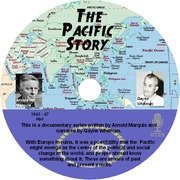
Lasting peace built on justice and understanding among nations. This is the objective of the United Nations. in background.] This is another program in the United Nations series of the Pacific Story, one of the five special series presented by the National Broadcasting Company and its affiliated stations to further world unity and world peace through understanding. [♪triumphant music playing on radio and radio in background.] For hundreds of years the Pacific and the lands it touches have been the scene of struggle, conflict for gain and power, people against people, western nations seeking to dominate and exploit the people, and the millions caught in the political and economic crosscurrent. Today with most of the world's population concentrated around and in the Pacific, the events of the Pacific are a vital world concern. The Pacific Story dedicates this series to the objective of the United Nations, lasting peace built on justice and understanding among nations. [♪triumphant music playing on radio and radio in background.] The Philippines, the birth of a nation. [♪triumphant music playing on radio and radio in background.] They were getting ready for their Independence Day down here in the Philippines. It was a good thing the paper sent me out a few days early because independence isn't something you can cover by the fire. In the streets of Manila, they were nailing streamers, putting up bells and popping a few preliminary firecrackers, the way kids do back home when they just can't wait for the fourth. I stood and listened to a couple of young fellows on a painter's scaffold. They hardly knew I was there. Enough testing of the firecrackers, Ernesto. I have no fear, Ricardo. There will be enough for the big celebration. We heard the Fourth of July is but a few days away. Everything must be in readiness. Independence finally, Ernesto. Is it not wonderful? Yes, wonderful. I will go and see if they have more bonting. The bell. Remember, we must put up the bell. It must ring out the good news on the Fourth. It must tell the world the Philippines are free. I will be back in plenty of time. Juan, come here. Lend us a hand with the bell. All right. Oh, pardon me, senor. That's all right. Sidewalk superintendents usually get stepped on. Say, isn't this the bell from that broken church? Yes, the bell tree was shut away by cannon. So we will hang it here. From the rafters of a gambling house, eh? That's funny, Ricardo. The course is good. What does it matter? All Manila and the islands and the world must hear it ring. Should be an exciting day for you. Oh, yes, senor. Our independence day, Juan. Is it not wonderful? For a nationalist like you, perhaps. What if you are of the Democratic Alliance? We can compose our differences on the eve of independence, Juan. Perhaps we can. Yes, we are getting independence of a sort. I see you are a man of the shadows also. What are you doing here in Manila? I have work here, old one. My name is Price. I am a salesman. I too. What is your line? I sell labels. Labels? What kind of labels? Various kinds. Fascist, communist, collaborationist, radical, reactionary. And do these labels you sell fit? What does that matter? Here in the Philippines, business is good. Very good. I do not like your business, Strife. Well, you old one, what is your line? I am known by many names and in many lands. In France, they call me liberty or egalité or fraternité. In Russia, it is swadota. In the United States, I am known as liberty or democracy. So, one of ideals, what do you do? I am present wherever men yearn for independence. And you think you can sell humans your line while I am peddling mine? You are the visionary. You cannot compete with me. We shall see. Juan and Ricardo forgot I was still standing around, which was just as well because I didn't want any of that polite reticence reserved for foreigners. I stuck around. The bell is heavier than I thought one, but it is worth it for the birth of a nation. It takes an ordinary baby nine months to be born. It has taken this one more than 300 years. Oh, this is no ordinary baby. We will be a free and sovereign state one with our own flag, political independence. It extends, unfortunately, to too many who trafficked with the enemy, to collaborators and fascists with power and money. That is always the cry of those without power and money. You are one of the landlords. My father owns large estates, yes. Would you have us give them away? I ask you only this. How much real independence, how much of a voice can the majority of the Filipinos, the tenant farmers, the towers have, slaving for 30 centavos a day, while men like your father get millions of pesos a year? In the greatest lands of democracy, Juan, there are economic inequalities. Such things cannot be adjusted overnight. Come, my friend, let us not quarrel. If we have differences, we must work them out together. You and I and 17 million of us. Only by working together can we build a great nation. Whoa, stop, you sawed-off little horse. Whoa! Oh, Senor Cata. Jose. You travel by pony caromato this year. Yes, if you can call that little snail a pony. Glad to see you, Jose. Thank you, Senor. Thank you. Welcome back. Your paper has sent you to Manila again? Yes, but it looks so different now. I expected some changes from the war, but this. You are shocked. So were we. And shelled and tortured and robbed of everything by the devils from Japan. How's your wife, Jose? They killed her. Target practice. I'm sorry, Jose. I had to buy the body back from them. They demanded a bribe before I was permitted to give her a proper burial. But I have shed all my tears. I must keep working to provide for the little ones. It's hard to concentrate on the coming celebration when I see the destruction here. The beast did not leave without destroying what he could on mad rage. Did you see the port area? Yes, shambles. 70% of Manila has been destroyed or badly damaged. Half of the machine industry of the islands also. Well, it will all be rebuilt, Jose. Better and finer than before. It will take time and money. They spared very little. Where are you living now, Jose? My castle is behind me. No. You don't mean... It is a roof or part of one. That is all that is left of my house. Oh, do not look so pale, my friend. I am one of the fortunate ones. What about your business? They dynamited the store. I have a small open-air market now where I can get things to sell. Here it is difficult to get things. Transportation was wiped out, you know. Army equipment helped a little. Mostly produce was moved by pony caramatos and buffalo back. Besides this, the prices. Inflation here, too, huh? Oh, very great inflation. And black markets. If I had much money and no conscience, I could buy merchandise. United States Army surpluses and imports and charge for the goods. Some do this. But I have few pesos. You see, I did not buy and sell for the Japanese. Some had no such scruples. Surely every merchant was not a collaborationist. No. Some had greater reserves or greater luck than I. They tell me the island industries are in bad shape, Jose. They speak truth. Our first export, sugar, poof. The enemy put cotton and vegetables in the fields of the mountains. They put cotton and vegetables in the fields instead. Much land they permitted to turn sour. Sugar refining centers were burned. Well, how long before sugar is back to normal again? Who knows? With money and machinery, maybe a year or two or three. Hmm. How about the copra industry? Oh, no more. Coconut groves have gone unattended too long. Crops rotted. Meals were blown up, machinery destroyed. It will be years before these can be... ...destored. How about the hemp industry? This was in Japanese hands, you know, in Mindanao. Gone now. Not a bright outlook, is it? Oh, no, Senor Carta. But we are counting on this freedom to give us the will and the strength... ...to become a nation among nations. ["The Star-Spangled Banner"] You're an aristocrat, Ricardo. How do you feel about independence for the Philippines? Oh, it is a marvelous thing, Senor Carta. Only... Only you will not quote me on this. I am a little disturbed that it should come at this time. Why? Your exports to the United States will still be tax-free for 28 years. Yes, and for this I am glad. It would mean a loss to us of 150 million dollars annually... ...if we had to pay the tax on our exports. That would have meant lowering wages and living standards... ...while we are trying to emerge from the ruins of war. But that isn't happening. Why are you disturbed? Well, these are days of social unrest. There are forces who are not satisfied with things as they are. Oh, I know we do not have perfection. But these radical forces would seek to change everything. Our agriculture, industry, economy, and one revolutionary sweep. When most of the American forces leave the islands... ...we may have trouble with these radicals. You mean the Democratic Alliance? Yes, and with all of its left-wingers, peasant unionists, socialists, and communists. Consider those terrorists the Hukbalahaps. That means people's anti-Japanese army, doesn't it? Yes. Well, weren't they the fiercest of the guerrilla fighters against the enemy? Yes, they fought well, though others fought too in various ways. But they have decided to become politicians as well as soldiers. How many do they have? Perhaps 150,000 followers. But there are some 60,000 Hukbalahaps soldiers in Lausanne. More than 12,000 are armed. They refuse to give up their guns. Have they committed much violence? Not yet. But they are disgruntled by the return to power of our conservative nationalist party. They have been marching in parades of protest, carrying red banners. Or the banners we can dismiss. But what if they decide to march with guns? That, Senor Carter, is why I do not like the return of your military to the States. We're retaining military installations here. We aren't leaving the Philippines absolutely unprotected. Yes, I know. I hope the garrison remains strong for the protection of your interests and our own. Let me go, Senor. I beg you. You have caught him, Senor. My thanks to you. As for you, T, you will be lodged in prison where you belong. Give back the bread. No, I need it for my family. I said I would repay you when I have the money. You have the money. You can't buy the bread when you have the money. Give it here, I say. No, no. Is that all that's bothering you, this loaf of bread? It's stolen from my shop. I cannot stay in business if thieves don't offer my goods. I am not thieves. How much is the bread? Your money, one dollar fifty. For a loaf of bread? Isn't that a little steep? It is the price here today. Pretty steep price. Here's your money. Thank you, Senor. Now I return to my business. Oh, be many thanks, Senor. Bless you for your goodness. I would not have taken the bread if we did not need it. Haven't you had rationing and price ceilings here? Yes. Also black markets. And when you have no money... How much did you make before the war? Thirty centavos, fifteen cents a day. But living was cheaper then. I'll see. Tell me, how do you feel about your coming independence? Independence is fine for a nation, Senor. But a nation is made of many people, is it not? The rich fascists. They are independent, yes. But people like me, how much independence do I have today? How much more will I have next year? You see, shadow of ideals and liberty? They buy the merchandise as strife. Only where there is insecurity can you fend off your label, Strife. What I offer is a fire that burns in the heart, a flame that is never put out. Very lofty words. But mortals need more. I have a good idea. I'll tell you what I'll do. Very lofty words. But mortals need more. You will see. Hi there. How about a lift with me? Mike Robbins. Imagine seeing you again. Well, how's the old reporter, Carter? Fine, Senor. Still beating out your brain so the folks at home can read the headline and then turn to the funny? Sometimes I'm inclined to agree with you. Say, you're a captain now. I should treat you with more respect. Sure? Last time we met you were shaved, Dale. A guy has to get up in the world sometime. Hop in if you're not doing anything special. I'll buy you a drink somewhere. Well, that's the best offer I've had today. I guess you're covering the Independence Day celebration. Yeah, imagine being quite a shindig. Yeah, they've been stashing away all kinds of fireworks. We'll have plenty of big guns and ships and planes and brass bands to help the Filipinos celebrate. Mike, how does this Independence strike you? They've waited long enough and been promised it often enough. The Philippines will still rely on Uncle Sam for military defense, won't they? Oh, not exactly. You see, for a long time the U.S. and other United Nations have to maintain strong land, air, and sea bases throughout the Pacific. Some of these bases will be in the Philippines. But it's supposed to be a kind of co-op deal. In case of any new enemy bobbing up, the Filipinos put up as big an army as they can and we fight side by side. Oh, in other words, you feel that while we help the Philippines in case there should be another regressive like Japan, the army of this new republic will also help us in keeping the enemy from American shores. That's about it. From where I sit, we aren't doing all the giving or all the getting. I see. What about the business set up here, Robin? Well, that's a little out of my bailiwick, but I do know Uncle Sam's coming through with a dough to help rebuild all this. Yeah. Don't worry about the Philippines, chum. They're smart, industrious. And they take to politics like a duck takes to water. If they think they need any reforms, whatever the majority wants, they'll get it. Come on, I'll buy you that drink now. What you overlook, Stry, fears that freedom is never purchased all at once. It grows with the wisdom and strength of its people. Thanks to me, old one. I do a thriving trade in labels with every new nation. I remember when I sold wig and Tory labels to a young nation called the United States. It grew stronger and wiser, thanks to its faith in liberty. Not so wise that it didn't buy labels of states' rights and federal rights, of freedom and slavery almost a century later. Not so strong that my wares didn't split it in a civil war. And not so far afield that out of this troubled cauldron didn't grow a new unified nation. I say we hook balahops who were never defeated by the Japanese are now being strangled by politics and diplomacy. You are a hard-headed one. Do not also be hasty and unwise. Work of lasting value takes time. We have wasted enough time. All of us, 150,000 strong, resisted the Japanese throughout the war. Now they would like us to give up our guns and our military organization. But who asks us to do this? I'll tell you, men high in the Nationalist Party, men who collaborated with the Japanese. There is still argument as to whether they collaborated against or for the Philippines. What about Andres Soriano, a Spaniard, leader of the phalangist movement in the Philippines before the war, honorary consul of the Franco government? Yet, he is one of the richest men in the islands, a power in politics. What about that? True, but his later record was different. Quezon made him secretary of finance in the refugee government, you know. He was also commissioned a colonel in the United States Army. And he was on MacArthur's staff after MacArthur returned to Leyte. Does that change anything? In the eyes of many Filipinos and much of the world, it does. And what of the new president? It is a fact that Manuel Rojas was attorney for the Soriano interests before the war, is it not? Yes, that is a fact, one. He dealt with the Japanese, didn't he not? He and his many followers claim it was under duress that he was really laboring to weaken the dictatorial power of the Japanese. And to serve Filipino interests. After the Americans landed, he did escape from Japanese custody and came over to the American side. Strange how he's always on the opportune side at the opportune moment. Whether we are right or wrong about him is not the question one. He was elected president. I believe in action. Everyone must have a fair chance, even President Rojas. You know what he told U.S. newspaper reporters after his election? He said, despite charges that I have fascist tendencies, I am going to be the greatest champion of democracy in politics as well as economics that this country has. That is what President Rojas said, one. Two months is too short a time to judge our new president. Now, enough of politics. When is your wife expecting the baby? In one week now. Ah, what a long week this will be for you. But at least you have the knowledge that your baby will be born into an independent Philippine republic. Yes. But what I keep asking myself is how much independence this baby will have in his lifetime. What do you say now, one of ideals? Who is supreme here now? Not you, seller of labels. Ah, but there is so little time and so little wisdom in the world. I work fast these days. And I work slowly, but surely and inevitably. The eyes of other people are upon the Philippines. Others in Asia want to watch and see what happens here. Come in. Mr. Wong? Yes. We were expecting you, Mr. Carter. This is Mr. Kim of Korea. Mr. Kim. And Mr. Ritam of Java. Mr. Ritam. Gentlemen, Mr. Carter. I wanted especially to see you three visitors attending the celebration here, Mr. Wong. As members of other Asiatic groups, you must have certain views on what this means to you. Yes. Now, you, Mr. Wong, as a Chinese, what is your impression of what's happening here? The granting of economic rehabilitation to these people is a deed that will contribute to peace and progress in the Pacific. I'm glad to hear such expression from you, Mr. Wong. However, my opinion is not without reservation. I note that the same economic interests still rule in the Philippines. Doesn't that make for stability? That is the question. I also note that Philippine trade is still to be almost entirely with the United States. Yes, for 28 years. The preferential tariff makes that to the best interests of the Philippines. It gives your country a favored position. Well, is that unrealistic after investing half a century of effort and expense in developing and building the industry of the islands? No, it is a realistic policy. Aren't the continued trade relations of the United States and the Philippines to the mutual advantage of both nations? Well, that may be, but while encouraging the American interests, what have the Filipinos been doing with my people? There are about 125 Chinese in the islands, in addition to Indonesians, Spanish, Negritos, and the various groups that have intermixed. The Chinese invested more than $100 million in the Philippines, controlled much business here before the war. Yet, the Philippine government has encouraged Filipinos to oust the Chinese here. Yes, I recall there was friction here. It still exists. Also, legislation against Chinese residents of the islands. Remember, we paid more than three quarters of the internal taxes here, supported our own schools, hospitals, social clubs. Yet, in 1941, they excluded all but citizens of the United States and the Philippines from engaging in any form of business in the public markets of Manila. We Indonesians are also watching the Philippines with interest, Mr. Carter. We wish to learn whether the Atlantic Charter and the United Nations Charter are to be promises or fulfillment for the benefit of the large nations only or the small also. Well, a new world isn't built overnight, Mr. Ritam. Many days and many nights have passed already. We who are still struggling against our Dutch masters are glad to see that United States policy is more liberal in the Philippines. We would welcome a repetition of such a pattern in Indonesia. In Korea too, so many years under Japanese domination, we seek our long-awaited independence. Independence for the Philippines is encouraging to me. Perhaps Korea will not have to wait too long for her freedom. You may tell your paper, Mr. Carter, that Asiatics watch closely every action undertaken by the great powers in their relations with weaker nations. The days, months, and years ahead will determine whether there is to be peace or unrest in the Pacific. You sold no labels to such mortal strife. In their hearts burns the fire of independence. But still lacking is the african prospects for me. Not if wisdom prevails among men, not if there is patience on one side and forbearance on the other in the movement toward self-determination. My words destroy patience and forbearance. Mine restore them. As a government official here in the Philippines, you'll get a glimpse of this picture from an angle that I may overlook. That's why I ask you, just what does this independence mean? The United States is making good her promise. What does our reconstruction aid do for the Philippines? Appropriation of $625 million permits both our government and individuals here to make a substantial start in rebuilding. As you know, materials and technical services are to come largely from the United States. All of this should speed our recovery, and we are highly gratified by it. What about the Bell Bill, the Philippine Trade Act of 1946? What does that mean to you? Our exports to the U.S. will be duty free, as they are now until 1954. During the 20 years following, our exports will be subject to a progressively increasing tariff. Yes, by 1974, United States trade with the Philippines will be on the same basis as trade between the U.S. and other independent nations. That is right. We need this extension to gain our economic feet. What about the other provisions? We must amend our Constitution to permit American businessmen and American capital to enter the islands on the same terms and with the same rights as our businessmen and capital. That, on the surface, is a distinct advantage for you. But it may prove to our advantage, too, ushering new capital and more rapid prosperity to our nation. We have worked together in the past. We will work in harmony in the future, as close friends among sovereign nations. The U.S. Department of State The U.S. Department of State The U.S. Department of State You feel that independence is in the heart? I say it is a state of mind, old one of ideals. I can put other things in their minds. There are great problems here, and mixed men and motives. The problems will be solved, the men unified. Do you have strange confidence in Marcos? I have faith, yes. A nation, like other beings, is not born without pain. This republic will grow older and stronger. You may find it troubled, as other nations have been troubled in the growing years. But you cannot trample a spirit by which men live, a spirit of freedom. We shall both work, wait, and see. Time is on my side. The U.S. Department of State The U.S. Department of State The U.S. Department of State The U.S. Department of State Manila, Philippine Islands, July 7. Three days ago, the population of the 7,000 islands of this commonwealth celebrated a great day in its history, Independence Day. Now the citizens of the new republic have returned to the grim task of reconstruction. While many problems face them, some pre-war, many war-inspired, there is a surge of enthusiasm that the United States has made good the promise of independence. Our record in the Philippines is not entirely without blemishes, but it should stand as a bright beacon to the people of the Pacific and all Asia. Music You have been listening to the Pacific Story, presented by the National Broadcasting Company and its affiliated independent stations, to clarify events in the Pacific and to make understandable the cross-currents of life in the Pacific Basin. For a reprint of this Pacific Story program, send ten cents in stamps or coin to University of California Press, Berkeley, California. Music The Pacific Story is produced and directed by Arnold Marquis. The original musical score was composed and conducted by Thomas Paluso. The principal voice was that of William Johnstone. Programs in this series of particular interest to servicemen and women are broadcast overseas to the worldwide facilities of the Armed Forces Radio Service. This program came to you from Hollywood. This is NBC, the National Broadcasting Company. Music