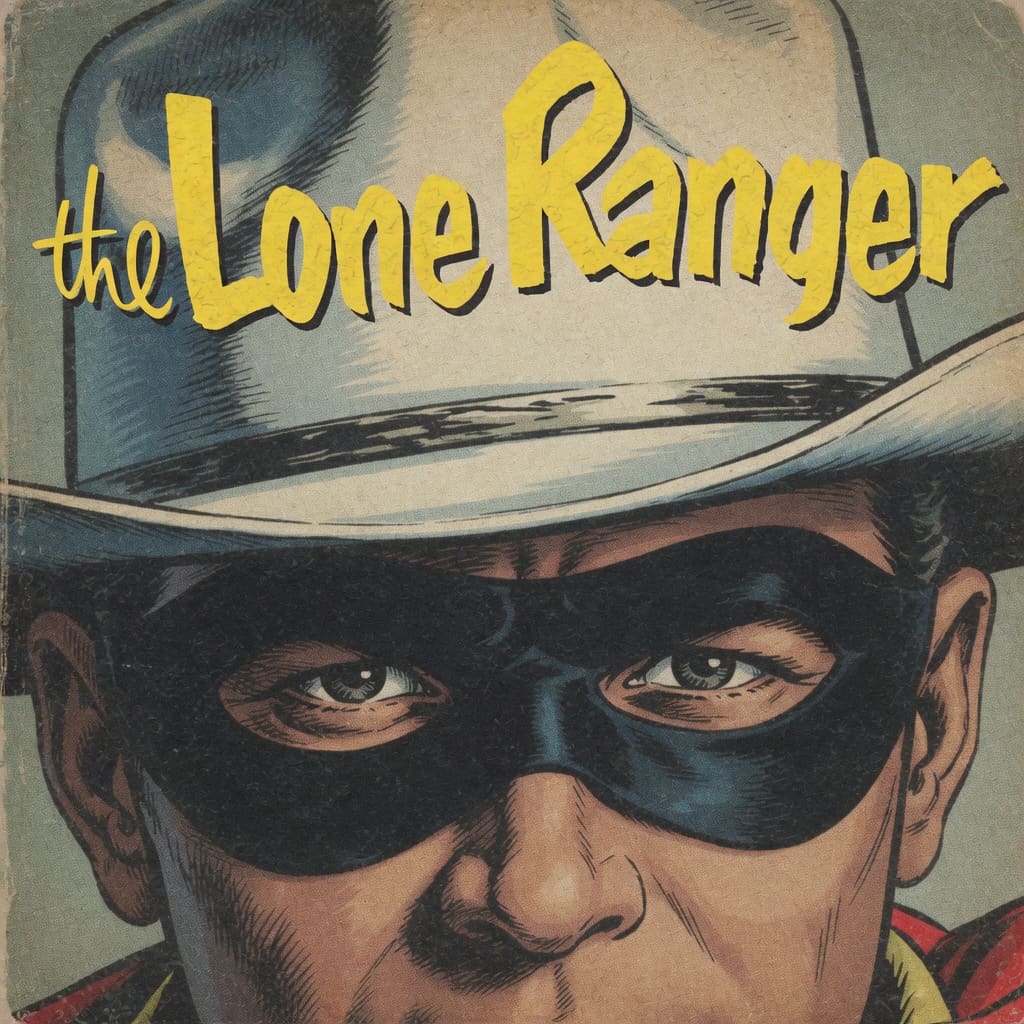
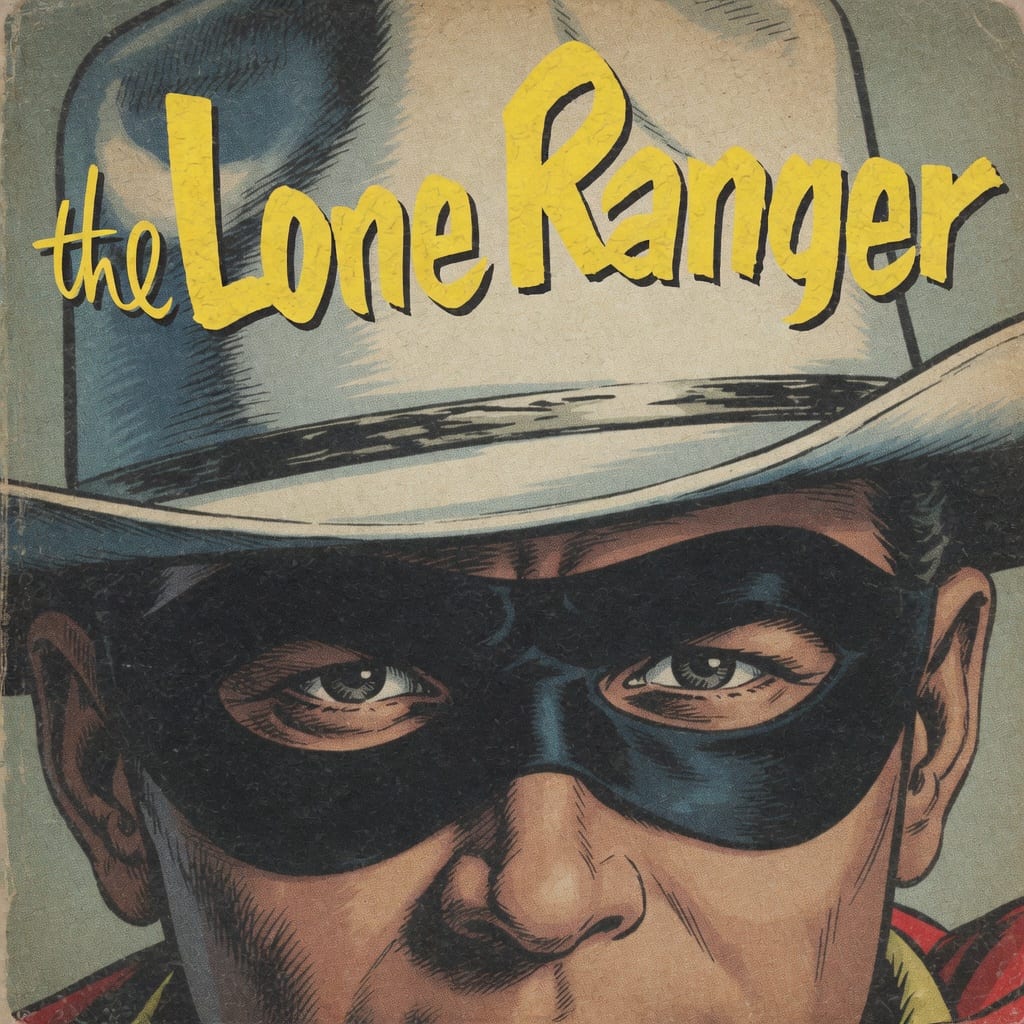
fiery horse with a speed of light, a cloud of dust, and a hearty hi-yo silver, the Lone Ranger. With his faithful Indian companion Toto, the daring and resourceful mask rider of the plains led the fight for law and order in the early western United States. Nowhere in the pages of history can one find a greater champion of justice. Return with us now to those thrilling days of yesteryear. From out of the past come the thundering hoofbeats of the great horse Silver. The Lone Ranger rides again. The stage had made poor time after leaving San Felipe, and as dust deepened into night, the town of Dorado was still ten miles ahead. Stephen Fairchild and his daughter Mary were the only passengers. They were returning to the west after ten years in Washington, where Mary had completed her education. Even in the east, Fairchild was considered a brilliant journalist, but he had made his reputation as a fighting editor in Abilene, and the problems of the frontier were still his chief concern. That was why he had bought the Mountain Times in Dorado, and now he was looking forward to assuming his old role in a new territory. He was roused from his thoughts by his daughter. Father, I don't understand why we turned off the main road. Have we? Of course, about two miles back. What's the matter, driver? Why are we stopping? Men on the trail ahead. They signal for us to stop. Why? Well, they got guns and they were wearing masks. Road agents. Look that way. Here they come. I'd advise you to take it easy, Mr. Fairchild. I have no gun. I'll have to. Now, there's no need to be alarmed, Mary. Oh, hold up. Yeah, not get much from me, eh? Do exactly as they say. All right, Mary, I know exactly what to do. All right, get out, both of you. Come on, Mary. Now, walk ahead of me along that path to the right. Fairchild and his daughter were marched along a footpath into the forest. A hundred yards from the trail, they reached an outlaw's camp in a small clearing, and the leader said... Sit down. Right there beside the fire. Even covered, men? All right. Then he disappeared into the forest on the far side of the clearing. A moment later... Good evening, Mr. Fairchild. What? Fairchild and Mary looked up at the sound of a new voice. It came from the shadow of the trees. They were able to make out the dim figure of a man. Good evening. Who are you, and why have you brought us here? If it's money you want... I'm more interested in your politics than your money, Fairchild. Politics? To be more specific, what will be your editorial attitude toward the Navajos and their new chief, Redham? It will be the same as it's always been. They must be treated fairly. If they stay in the mountains, they'll be a continual threat to the peace of this whole district. That's absurd. You'll find the people of Dorado don't think so. Then I'll do my best to change their minds. I was afraid that would be your attitude. That's why you've been brought here. It's you who must change your point of view. No one has ever dictated my point of view, and no one ever will. You're mistaken, Mr. Fairchild. Right now, the people think as I want them to think. From the distinguished Major Stafford down to the lowest pay-on. I'll not let you interfere with my plans at this late date. Do you... do you intend to kill me? Of course not. I intend to buy your name and your influence. In other words, my honor, it isn't for sale. I'm not offering you any money. Rosa, Ben, introduce yourselves. A tall, sharp-featured man and a girl with dark red hair only slightly older than Mary stepped into the circle of light cast by the campfire. I'm Ben Burnett, Mr. Fairchild. Time to be your assistant on the paper. My what? As a matter of fact, Ben will write all the editorials that carry your name. And I am your daughter, Mr. Fairchild. My daughter? Yes. I'm going to Dorado with you and Ben, and you'll introduce me as your daughter. Of all the crazy... There's nothing crazy about the arrangement. It's necessary. Your daughter is expected in Dorado, and since she'll not be able to accompany you, Rosa will take her place. What do you mean she'll not be able to accompany me? Just that. If you intend to harm her in any way, I'll... I'll... Do words failure for once? Don't worry, Fairchild. No harm will come to her, as long as you're reasonable. And being reasonable means turning my paper over to this man to edit as he sees fit, does it? As I see fit. It will be only for a few weeks, a month, at the outside. By that time, the battle will be fought and won. Red Hand's tribe will be destroyed or driven out of the mountains. Then the reservation will be open to settlers. Rosa and Ben will disappear. Your paper and your daughter will be returned to you, and you'll be free to write anything you please. You're sure no one in town knows the girl? I don't look anything like her. No one in town has ever seen her, Rosa. What are you going to do with her? She'll be our guest. You mean to hold my daughter here, prisoner until... No, not here, no. Let's say somewhere in the mountains. She'll be perfectly safe, as long as you give us no trouble. I don't want you to go through with this horrible masquerade for my sake, Father. My dear, I... I have no choice. He's so right, Mary. He has absolutely no choice. No father could be expected to condemn his daughter to death. The Radio welcomed Stephen Fairchild and had no reason for not accepting Rosa and Ben Burnett as his daughter and his assistant. But in reality, those two were the editor's jailers, and it was Burnett who ran the Mountain Times. From the beginning, his editorials warned against the menace of the Navajos and called for action against them. Fairchild found it difficult to assume responsibility for his words when Major John Stafford walked into his office toward the end of the week and offered his congratulations. Mr. Fairchild, I should like to shake your hand. That editorial in today's paper was a masterpiece. I'd hardly call it that. You're much too modest, sir. In line with your suggestion, I'm calling a meeting of all the able-bodied men in town, and I mean to propose the organization of our own militia. You have no authority to do anything like that, Major. Authority, sir? Is there anything wrong with men uniting to protect their homes? Not if that's as far as it goes. Well, I have no intention of raising an army. Under my leadership, I'm sure that a hundred well-armed men can handle the situation. I'm sure they can, too. Considering the Navajos have very few rifles, considering the fact there aren't more than two hundred people in Red Hand's tribe, counting the women and children... It's a shame, isn't it, that a handful of savages should stay in the way of progress. I don't quite follow you. You mean to say you don't know, Mr. Fairchild? Know what? There's silver on the reservation. Sure, that's it. Exactly, sir. Good day, Mr. Fairchild. Keep up the good work. That laugh. I've heard it before. The night in the forest. The accent is a fake. Major Stafford is the man who's holding Mary a prisoner. If only I dared go to the sheriff. No, I can't take the chance. The Major stopped at Burnett's desk in the outer office. He seems to be behaving very well. So far. I tried to force him into speaking his mind. He didn't. Didn't recognize her, did he? There's no sign of it. Good. You'll put the notice of my meeting on the front page. Of course. Some of the nearby ranches will be raided during the next few days. Our men will be dressed as Navajos. You'll have plenty of fuel to keep the pot boiling. That's fine. I'll be at the mansion house if you need me for anything. Right. It was the rumor of Indian trouble which brought the Lone Ranger and Toto to the Dorado District. They made their camp in a mountain canyon, and Toto went to town. When he returned with supplies, he also brought a copy of the Mountain Times. There's much talk in town about what papers say. Here, you read it. Thanks, Kimisabi. What's this? Stephen Fairchild, editor. Isn't that right? It's been ten years since we've seen him. And him changed plenty. Why do you say that? Did you see him today? Ah, me see him. Him looks same, but him not right same. People say him want war with Indian. You read. Yes, Toto. It seems that he does want war. I can't understand Fairchild writing this way. But if it's true Red Hand's tribe has been attacking the ranches, perhaps he's justified. Not true. It's hard to believe, but it may be. Kimisabi, there's something wrong. Wrong? Ah. You remember little girl with yellow hair and Abilene? Mary Fairchild? Ah. Why, of course. Is she here with her father? Their girl walked down the street with them, and people say that Mary. It's not true. It's been ten years. This girl have red hair. Come from Cafe in El Paso. Me know. Her name, Rosa. And the people in the radio think she's Mary Fairchild? That's right. Now, this girl and feller call Burnett. Them stay with Fairchild in house next to newspaper. Who's Burnett? Him work on paper. Did you ever see him before? Me not sure. Me think maybe me see him in El Paso. Strange company Fairchild's keeping these days. Ah. I think I'd better have a talk with him. Not good idea. And it had better be tonight. A lamp burned low in Stephen Fairchild's bedroom. And the editor, unable to sleep, paced the floor, considering his problem. How to act without endangering his daughter's life. He turned toward the open window and stopped short. A man was standing just outside. A masked man. Don't you remember me, Fairchild? Hello, Ranger. May I come in? Yes, yes. I'll bolt the door. If they should hear me talking to you. If they should find you with me. Burnett and the girl they call Rosa? Yes. Their rooms are just down the hall. But it doesn't matter as long as they don't hear it. Listen. Mary, my daughter, is being held prisoner by a band of outlaws somewhere in the mountains. I've had to turn over my paper to Rosa and Burnett to run as they see fit. Otherwise, Mary will be killed. Now I'm beginning to understand your editorials. They're not mine. Burnett writes them. Why does he want to provoke an Indian war? It's all part of a conspiracy to drive the Indians off their reservation. Now I have no proof of this, but I'm almost certain the ringleader is a man who's known as Major Stafford. I'd denounce him in a minute if it weren't for Mary. Can you find her? Can you rescue her? We'll do our best. But I'd like to know how far this conspiracy has gone. Is there any danger of an immediate attack on the Indians? It may happen any day now. Well, Stafford's called for a meeting in the town square tomorrow. Ben, there's someone in there with him. And the door's locked up right. Open this door, Fairchild. Quick, out the window. Who is in here, Fairchild? The window, Ben. There he is, the corner of the stables. Wearing a mask. Use your gun. The curtain falls on the first act of our Lone Ranger adventure. Before the next exciting scenes, please permit us to pause for just a few moments. Now, to continue. Burnett held his fire as the Lone Ranger disappeared around the corner of the stables. And a moment later, Rosa and Burnett caught another glimpse of the masked man as he rode away on his white stallion. Come, Silver! Silver! Who was that man, Fairchild? Well, I don't know. What were you saying to him? He must be a friend of the Indians. He wanted to know why you were trying to start a war. Did he threaten you? He was armed. He may have meant to kill me. I doubt that. What did you tell him, Fairchild? Well, I had no chance to tell him anything. He heard you and went out the window. Who could it have been? I have a good idea. I'm going to see the boss at once. Why? You saw the white horse the masked man was riding? A beauty. And he called him Silver. And from what Fairchild has told us, the masked man is a friend of the Indians. That ties in, too. They say he has an Indian companion called Tonto. You're talking about the Lone Ranger. You're right, and I'm almost positive that was the Lone Ranger who just rode away. The boss must be told he's been here. After the Lone Ranger left Fairchild's home, he and Tonto rode into the mountains to Redhand's village. There, the chief welcomed them. And when the masked man suggested that a council be held, all the braves gathered in front of the chief's lodge. The Lone Ranger rose to address them. I come to you with a warning. It is said in Dorado that Redhand's braves have been attacking the ranches of the settlers. That's not true. I believe you, chief. But there are evil men in Dorado who wish to drive the Indians from their reservation. Why, them want to do that. This land not good for ranches, farms. I agree. Still, these men want your land for some reason. And they're ready to go to war to get it. Maybe them learn secret of Black Canyon. What's that? They're much silver there. Indians try to keep secrets so white men not want hunting ground. Silver. Yes, that would explain everything. If secret lost, then it better Navajo leave Mountain. That isn't true. The government's given you this land. And if there's silver on it, the silver belongs to you. You say men of Dorado want war. My tribe not strong enough to fight them. I said there are some men who want war. But you have a friend in Dorado who may be able to help you. He's Stephen Fairchild, the editor of the newspaper. When he speaks, people will listen to him. Why him not speak? Because he can't. The same evil men I've been talking about are holding his daughter prisoner somewhere in the mountains. If we can find her and take her home to her father, he'll be able to help you. Great, chief. What you say, little elk? Me know a bad man camp. Me see girl with him. Girl with yellow hair. That's Mary Fairchild. Where is this camp? In Valley. That way. To the east. How many men are in the camp? Maybe 20. Red Hand. This is your chance to prove you're a friend of the settlers. We fine girl. Take her home to father. Maricta! Maricta! As it grew dark the following evening, Ben Burnett left for the meeting. After gagging, then tying Stephen Fairchild hand and foot. The sound of many voices reached Fairchild from the town square. And he rolled across the floor to the window of his bedroom. He struggled to his feet. He could see nothing but a glare in the sky that came from the many pine torches that lit the square. But then he turned at the sound of hoofbeats. The Lone Ranger was drawing rain in the shadow of the stables. Fairchild turned his back to the window and with his bound hands beat on the glass. A moment later, the window was opened and the Lone Ranger climbed into the room. In a matter of seconds, the editor's ropes were cut and the gag taken from his mouth. It started. A meeting in the square, you mean? Yes. And I've heard them talking, Stafford and Burnett. They have some plan that will arouse the people to a fighting pitch. They mean to attack the Indians tonight and by tomorrow morning, Stafford will have staked a claim in Black Canyon. So he knows exactly where the silver is. What about Mary? Were you able to find her? Yes. Where is she? We rescued her from the outlaw camp last night. Wonderful. You have nothing to worry about as far as Mary is concerned. She's alive and well. Right now, Red Hand and his braves are guarding her. Why didn't you bring her home to me? Because it isn't safe to bring her into town until we've dealt with Stafford. Then take me to her. No. You must make the town safe for her and for Red Hand. You have work to do here, Fairchild, and you must work fast. Major Stafford mounted the steps of the courthouse and looked at the sea of faces in the square. Burnett took his place beside him as he raised his hand in a signal for silence. Men, there's only one reason we're gathered here tonight, and that's to consider ways and means of protecting our homes. They stand in great danger. The Indians in the mountains are a sword of Damocles hanging above our heads. But we all have rifles, and we all know how to use them. And a rifle is more than a match for any sword. Many of your homes have been attacked, your barns burned, your cattle driven off. Now you've read the stirring words of that fearless editor, that great pioneer, Stephen Fairchild. He's told you that we can expect no help from the territorial militia, and that the time for action is now. All eyes were turned in the direction Stafford pointed. Rosa, her clothes torn, her hair streaming down her back, rolled into the square. Whoa, whoa there, whoa! Miss Fairchild! Please, please, let me by! Miss Fairchild, you must tell us what's happened. It was too terrible. You must tell us. I rode out to the ridge to see the sunset. I started back here as it grew dark, and then suddenly a band of Navajos swept down on me. They tried to drag me from the saddle. I fought them off. Somehow I escaped them. Please, please, let me pass! Men! Men, now the savages are attacking defenseless women! What are we going to do about it? If you're men, you'll follow me tonight! We'll drive the redskins from the mountain! Let's go! Let's go, I say! Listen to me! The men in the square raised their eyes. Stephen Fairchild and the sheriff were framed in one of the upper windows of the courthouse. The sheriff raised his hand. Before you commit murder, men, listen to Stephen Fairchild! Yes! Listen to the truth! Let me tell you what happened on the night I arrived in Teredo. My daughter and I were taken prisoners by a band of outlaws on our way here. I was told that my daughter would be killed. Killed! Killed! Killed! As Stephen Fairchild revealed the details of the outlaw plot to start a war with the Navajos and how he had been forced to serve their purposes, an angry murmur swept through the crowd. Lie upon lie has been forced down your throats. But now I have proof that Red Hand is not our enemy, but our friend. Here he comes carrying a flag of truth. The chief and Mary Fairchild rode into the square at the head of the band of Navajos. And between the warriors' lines were twenty outlaws, their horses led by the Indians, their hands tied to their saddle horns. The crowd parted to make way for the cavalcade, and the chief and Mary rode straight on to the courthouse. Mary! Oh, thank heavens you see. The editor descended to the street and took his daughter into his arms. Mimi, this is my daughter. Fairchild, the other girl is gone, and so have Stafford and Burnett. I must stop them before they get out of town. They'll not get far. Mary, tell everyone what happened last night. All right, father. Listen to me. I was being held prisoner in the mountains by these men the Indians have captured. It was Red Hand and his braves who rescued me. Afterwards, these renegades were taken to the Indian village. They thought Red Hand meant to kill them. Well, I'm pretty afraid. Yes. So afraid they were glad to tell the truth about everything. These are the men who have been dressing as Navajos and raiding the ranchers around Dorado. And they've confessed who their leader is as well. They took their orders from Major John Stafford. And you should know that Ben Burnett and the girl they call Rosa, the girl who's been taking my place here, are also members of the gang. Stafford's gone. Show them the girl and Burnett. Don't worry. The sheriff's going after them. They'll be brought back, and they'll go to jail with these other crooks. Have you had enough? Have we proved to you that Red Hand is our friend? There's your answer, chief. There'll be no more talk of war between us. That's bloody good. And this I pledge to all of you. Never again shall the mountain times become an instrument of injustice. The crowd clustered around Fairchild, his daughter, and Red Hand as rancher after rancher shook hands with the chief. Then a shout went up as the sheriff marched Stafford, Burnett, and Rosa into the square. Good work, sheriff. Did they give you much trouble? None at all. It was a mighty peculiar thing. How's that? Well, we knew they needed horses for a getaway, so we went directly to the stables behind your house, Fairchild. And there they were. Did they put up any fights? Well, they couldn't. They were hogtied. I think I understand. Well, I don't. What's more, I'm afraid a couple of the members of the gang got away. Why do you say that? Well, just as we came out of the stables, we saw a couple of men up on the hill to the south of town. The moon was shining full in their faces, and I could have sworn that one of them wore a mask. The other one looked like an Indian. Sheriff, I have an idea. It was those two men who prevented your prisoners from escaping. Yeah, they got the drop on us. I was told they'd be watching every move you made after I started to speak to the crowd. What? Sheriff, I explained that I managed to contact a friend of mine last night, that it was he who went to Red Hand. I know, but... I didn't have time to explain that my friend wears a mask, that he rides with an Indian called Tonto, that he's been fighting for truth and justice all through the West, and that every honest man of every race and creed can always depend on his help. Sheriff, my friend... You don't have to go any further. There's only one man who fills that bill of goods. So that's who he is. So that's The Lone Ranger. This is a feature of The Lone Ranger, Incorporated, created by George W. Trendle, produced by Trendle Campbell Muir, Incorporated, directed by Charles D. Livingston, and edited by Fran Stryker. The part of The Lone Ranger is played by Brace Beamer. The Lone Ranger is played by Brace Beamer. The Lone Ranger is played by Brace Beamer. The Lone Ranger is played by Brace Beamer. The Lone Ranger is played by Brace Beamer. The Lone Ranger is played by Brace Beamer. The Lone Ranger is played by Brace Beamer. The Lone Ranger is played by Brace Beamer. The Lone Ranger is played by Brace Beamer. The Lone Ranger is played by Brace Beamer. The Lone Ranger is played by Brace Beamer. The Lone Ranger is played by Brace Beamer. The Lone Ranger is played by Brace Beamer.