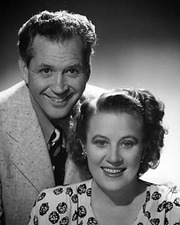
The DuPont Company of Wilmington, Delaware, makers of Better Things for Better Living through Chemistry, presents the Cavalcade of America. Tonight's stars, Douglas Fairbanks and Walter Hamdon. Tonight, during Thanksgiving week, DuPont Cavalcade presents a Thanksgiving play called The Stepping Stone. Just 330 years ago today, on November 21st in 1620, a band of cold, thick, hungry, and desperate men gathered on the deck of a ship riding at anchor off Cape Cod. There, on that day, they signed the first American Charter of Civil Liberties and Civil Responsibility, the document now known as the Mace Mower Compact. Tonight, the DuPont Cavalcade brings you their story. Walter Hamdon will play the part of William Brewster, and Douglas Fairbanks will be John Alden. I am John Alden, that same John Alden who followed the gleam in the eyes of a handsome girl westward across the ocean sea, to find joy for my heart, work for my hands, and peace for my soul. But this is not my story, nor the story of Priscilla, my good wife. It is the tale of that one amongst all the Mace Mower Company who best deserved the name they chose for themselves, the name of Saint. He was Master William Brewster, elder of the Exiles, wise leader and a second father for such poor lost sheepers, John Alden. His story begins in the council chamber of an English king, James I, newly come from Scotland on the death of Elizabeth, and still a Scot. Sometime in the year 1608, when I myself was but a child, I had thought, my lord, that we had suffered a sufficient disturbance. And now you report further and it seems obscure, you say? Yes, these are little men, your majesty, lacking in numbers, quite efficient in wealth, position, or power. Yet they are heretic. Indeed. It is their whim to suppose that religion should be free of royal power, and that each man should be permitted to worship God after his own manner. What? Monsters, monsters! Yet you say they are not important. Such is my belief. They are most of them poor men, tinkers, tailors, storekeepers, and such. Your council then? Moderation, majesty. A few clipped ears in each congregation as we find them out. A forehead branded here and there. No drastic steps. Inauspicious. I will make them conform themselves, and I will harry them out to the land. Ard you worse, children? Among the little people was Master William Brewster, postmaster and innkeeper at Scooby, in the far corner of Nottinghamshire. With Richard Clifton and John Robinson, this Brewster had formed a secret congregation of free worshippers. When word of the king's purpose reached the elders, they said, I bow, we must never submit to this lordly and carenous power. So what say you, Master Brewster, that we are like to have small choice in the matter, Richard? The power is too great. Oh, why should God have given England to the devil's very nephew? Perhaps to test the strength of our own convictions, Master Robinson. This great gilly on the throne suffers in his mind from the canker of kings. A belief in force. We must summon up unanswerable courage. But what shall we do, brother? Go on as the four. Worship God and trust in him. Meet in secret as the four. Love each one the other as the four. But must we not prepare? For exile? Yes, yes, I fear we must. When the blow falls, we must be ready. There's been talk of Holland. It is said a man may call his soul his own in the lowland city. That is true, true enough, as our world goes. I've made inquiries in Amsterdam. My friend's there. Shh. The king's men? Maybe so. So I think not. I heard no horses. Open the door. Master, Master, young Will Bradford. Master Brewster, good master, I have news of great evil. Here, lad, sit down. I'll be right back. I have ridden and walked and run from Lincoln town this night, Master, to warn you. In the market I heard it. How quietly, Will. Now what is this word that you have for us? We are betrayed. What? The names of all our congregation are in the hands of the king's bailiff. Oh, he rides to Scroobie on the morrow. They will take us up every one. Instead we shall be put to torture. It is come sooner than I thought. Brothers, it is God's will that we leave England. And so the Lord's three people fled into Holland. In Amsterdam and Leiden, grinding poverty was their lot, with hard labor and unfamiliar tasks, the burden of all, even the smallest children. Over the last of necessity their thoughts turned, little by little over the years, towards a new world. And it was William Brewster who pressed them forward in this new adventure. As Bradford was to write one day, a great hope and inward zeal they had of laying some foundation in those remote parts of the world. Yea, though they should be but stepping stones unto others for the performing of so great a work. In Leiden the elder had turned printer for his daily bread. Certain tracks published by him offended the authorities, both Dutch and English. And so he alone of all the company was still a fugitive in the year 1620. In time with the help of secret sympathizers Brewster returned to England and there he lay hidden until the little pilgrim congregation reached Southampton. There arrangements were made to smuggle Brewster aboard the Mayflower under cover of night. One day in that summer as I was at work in the dockside sack I used for my Cooper's trade. Young man, young man. Just love the Lord thy God. What say you? Heart saved, young sir. Why old man, is it a strange question to pop out so bare among my barrels? I've never given the matter great thought. So, so you're not one of us. I had hoped, but no matter. Do you love justice, young Cooper? Aye, though I've seen little of such like commodity hereabouts. If you seek justice, master, I know not where to send you for it, not in all England. I seek refuge from the injustice of the King, from the King's bailiff, hard on my heels but a moment ago. Hide me, lad, hide me quickly and turn them away. And lose my ears, perchance lose this hand that serves to grasp a mallet and earn my bread shall I lose my life? Hardly, master. What have you done? I printed the truth. Look at me, lad. Do you see evil? You see villainy? Look into my eyes. I saw gentleness and light, such goodness as in all my young life I had never known. Even now I could not tell the why of it, but I knew I must do this man's bidding despite the King's cruel law. Again I heard him implore. Frighten me, lad, frighten me, a refugio I should be taken. My life will be forfeit. For that I care nothing. But many look to me for hope. Hide me in God's name. In your own name, old man. God's a stranger to me. I must be dashed. But come back here, quickly, into this great hog's head. What? Oh, it is empty enough. A hand up and... All right. Be still now. And I'll lie my ears off if they come. In thy name or the devil's. All? Yes, they're coming. They're on us now. Who are you? John Alden, Cooper by trade. Speak truth, Cooper, in the King's name. Have you seen a small hunched-over man with a brown waistcoat and a look of hypocritical holiness on his face? That I have, save I saw not his face. He passed here not three minutes since and in great haste. Which way? Up from the docks, up into the town. He was quenching at his breast as if in great pain from running. If you lie, you shall pay up on the rack. Come along, we'll take him yet. There, old man, I've earned me a fool's reward. Let me help you out. I've been in tighter places. Thank you, thank you. Hey, I take it my first words did mystify your ears. Ah, it was a strange encounter. Just love the Lord thy God. Who can answer to that? Some of us can. We have many secret Protestants on this coast. For the man whose password, a counter sign. Oh, bad? I'm William Booster, lately a printer by trade. I'm John Alden, the trooper. Surely we are well met, though we must pass right soon. Elder Brayster. Priscilla. Oh, master, I saw the soldiers. Where's your father? Where's master Mullins? He waits upon your coming at the place we had agreed. He dared not to leave, so he sent me in search of you. I saw the soldiers enter here, I was afraid for you. Oh dear now, girl, I'm quite safe by the art of this young man. Priscilla Mullins, this is John Alden, who has done me a great kindness without asking why. My service. Yes, sir. Why do you stare, sir? Your eyes, miss. They're like the eyes of the elder here. Are you kin? Only in the spirit, John. We are both of the company who sail for the new world, to worship as we will. Would you have need of a well-skilled carpenter and cooper, master? What, you'd venture with us? Well, that I would. Ah, but your parents live. I have none. I have these two hands and tools to fit them. I can read and write, for my uncle taught me, and I have a mind to see this new land. What say you, Priscilla? If we are to go out in the great dark this night to the ship, we'll need strong arms to row. This did fret my father, for he's not young or well. Let the cooper come, if he will. From the log of the ship Mayflower, Captain Christopher Jones commanding. A 6th of September, 1620. Wade anchor, wind fair, course west to west. So we take our departure from England. You are listening to the DuPont's Cavalcade of America, starring Douglas Fairbanks as John Alden and Walter Hamden as William Brewster, sponsored by the DuPont Company, makers of better things for better living through chemistry. Out play, the stepping stones, continues. The same being the tale of the Mayflower and the Mayflower Compact, signed 330 years ago today off the Massachusetts shore, in a time when the ideas of religious freedom and equality were new in the world. John Alden tells the story of Elder Brewster. It was a curious mixed company that failed for, they thought, Virginia. Brewster's congregation numbered but 41. 63 others, the outsiders or strangers, had been lured into the adventure by the promises of the London investors who had furnished the ship for the voyage. Most of these outsiders were respectable folks, though less than churchly. A few were a little better than vagabonds, the scourings of London gutters. The churchmen insisted on ruling the whole company, but they did allow one spokesman for the unredeemed. Soon there was trouble brewing. I recall one night, midway in the passage, Priscilla Mullins came on deck to escape the cold black stench of that dreadful hold. I followed her to the rail. John, you know you mustn't talk with me. So says your father, but why? Why does Master Mullins look down his nose at me? Why? Because you are not one of us. Must I say it again? Because I won't listen to long-winded sermons and young fowls smothering holes, because I can't sing tuneless hymns when I don't know what they mean? Because you blast the inn against God and make sport of our ways, and because you are profane, John Alden. But I put speak my mind. I like to laugh a bit. I mean no harm to your people. Well, hear me out, Priscilla. There are those among this ship's company who do wish to harm the saint. What do you mean? The ship is brewing with those you call outsiders. Mutinous. They will not long book your elder's authority once land's in view. You see, they like not being forever outside. The ship is our ship by charter. Those wretched people from London have their spokesman in Master Christopher Martin. Master Christopher speaks for the soft ones, the tame cats, those with servants under bonds and guineas jingling in their purges. There are others, a different, desperate sort. Vile wretched. Wretched they are and rough, and some of them are ready for evil deeds. But do this. If you know where Master Brewster lies hidden, go to him. Tell him the Cooper says it is time for him to come forth. The winds blew and cracked their seat, and we buried young Billy Button a seed that was to die. A child, Oceanus Hopkins, was born. John Howland was swept overboard and pulled himself back by a failing halion. A miracle, declared the saint. But there were more sinners than saints aboard that storm-wracked ship. After many a weary and watery mile, land was sighted at Cape Cobb, far to the north of our proposed destination, and then another storm. It's a swindle. I tell you, mate, it's a bloody swindle. Virginia. We're yon chilly sense bit Virginia. It might be for all the means. Ah, daft. We're far to the north. And do you know for why? You tell us for why. There's too much for my wit. Because in Virginia, those psalms singing only pulpit pounders would come once more under the hand of the king. They could lord it over us no longer. It's a swindle, I say. Can we swim to Virginia? No. But we can take the ship and sail there. We used to stop it. There's no law here. There's Captain Jones' law. And he's a hard man. Captain Shrimp, all bluster and blow. I could break him in two like this wooden peg. I'll tip this business to a round dozen of the bolder lads. We'll meet here tonight to plan it out. While them canting hypocrites are at their frayers. And around the one open fire in the passenger hold, another council was in progress. Fuddled there against the November cold were Elder Brewster and John Carver of the Holland congregation, with Miles Standish, the little redheaded soldier, and Christopher Martin representing the outsiders, the unsanctified. Said Elder Brewster, Captain Jones has told us that he can proceed no further to the south, lest his supplies for the turned voyage give out. Give out, Elder? But then he speaks truth on that I cannot say. But I, for one, am content to cast our lot here upon this coast. And you, John Carver? It is agreed. We'll be further removed from the long arm of King James and his pretty boy, Stables. Captain Standish? Will you tell one to me if a harbor can be found in the hill to fetch a thought for pawn? You, Master Martin, will you speak for the outsiders? Why should I speak? My words carry no weight in this council. Christopher, this grumbling hill becomes your workman's substance. There are others who may do more than grumble. And who are the troublemakers? I know not, but there's a great whispering about, a gavel of mutiny. Mutiny? Aye, mutiny. Most of the outsiders trust me to uphold their rights in council. A few scorn my officers and plot behind my back. I've heard this talk of mutiny. Name me the traitors. I'll show them the color of action. I'll string them up on the out-arm. No, no, Captain Standish. We'll not use force. Force is the name of all we strive and suffer to conquer. Force breeds force, as maggots breed corruption. And the end of that road is ever death. No, we must try the way of reason and loving kindness. We're all Englishmen here on this far edge of earth, and we're all children of God. We must act as brother, or surely we shall perish ere the spring moves north again. What would you have us do then? I put that question most urgently in prayer, Master Carver, and my prayer has been answered. Let us draw up a compact for our governance, and in this treaty amongst ourselves, let it be written that all in the community are equal before the law. Equal? Equal before the law? Equal. Why, it is a thing unheard of. Some must rule and some be ruled. It's ever been so. Some must lead. It is true. And others follow. But by consent, not by force. Let us try this new thing here on these new shores. Let us remove all cause of strife and civil disorder among all our elements. Let us have the courage to act with reason and human-heartedness each toward the other. Let us join together the sundered members of this small and much-periled body. So we shall set forth a shining example to those who will follow after us to the shores of this new world. We have need of the law in this compact. Let the law be made equally for all. Is it agreed then? Well, Master Martin? I let it be agreed. You may stand. Aye, so be it. My thanks, good Master. This gray and fleety hour is the 11th of November, old time, in a 1620. November 21st in your new calendar, 330 years ago today. To all the assembled Mayflower Company on deck, William Brewster offers his compact. In the name of God, amen. Amen. We, whose names are underwritten, the subject of our dread sovereign law, James I, of Great Britain, France, and Ireland, brothers, brothers, I beg of you, keep it a form of word. We are in this still, this compact will be heard at home. Let us not have the Stuart Prinslings send a ship of war against us. Aye, we do. We do by these presents, solemnly and mutually, in the presence of God and of one another, covenant and combine ourselves together into a civil body, politic, for our better ordering and preservation. And by virtue hereof, to enact, constitute, and frame such just and equal laws, ordinances, acts, constitutions, and offices from time to time, I shall be thought most neat and convenient for the general good of the colony, onto which we all promise new submission and obedience. In witness whereof, we have here under, subscribed by name, at Cape Cod, the 11th of November in the year of our Lord 1620. Who will sign this compact? I, John Carver. I, William Bramford. I, Edward Winslow. I, Isaac Allerton. I, Miles Candace. Though it is a great foolishness. Who among the artisans will come forward now? This is for all of us, not just the Holland men, not just the Gentry born, this for all of us, masters and yeoman alike. Who will come forward and sign? John Alden? Yes, I'll sign with all my heart, as I do love justice. Elder Brewster. Yes, John? There'll be no mutiny now. Now the violent tongues are silent. We've removed their cause for complaint, and you've won a great victory. You've made a great light in the world. The victory belongs to the Lord, John. All light is his light, time without end. I thought you'd say that. Elder. Yes, lad. Could you teach me what you mean when you say such things? Could you show me this way you have chosen, this way of truth and light? I would share the peace I've seen in your eyes. Elder, you'll be one of us, John. If you'll teach me, master, I'll try to learn to walk your path. Though mind you, it will not be easy work. It's not an easy road, John, but I'll do my best. Wait, where are you going? Tell Priscilla Mullins and her father. A harbor was found, a settlement made, a winter came. Half of our company met death in that first winter in the New World. What shall I say for them? Those who set forth from Southampton and from Plymouth, most were brave. Many were loving. A few were wise. Out of the sum of their wisdom, their human heartedness, and their fortitude came a part of your own great American heritage. Knowingly or not, they were as stepping stones unto others for the performing of a great work, a work that's still unfinished. If the wisest of them could speak, the most gentle, the strongest of all, I think we might say, protect what you've been given, lose if not. Push forward still in the way of the Lord's three people, so the night be dark and the road a stony one. Follow ever the path of reason and courage and love in God's name. A big thanks to Walter Hamden, Douglas Fairbanks, and the Cavalcade Players for tonight's story, The Stepping Stones. And now Bill Hamilton speaking for the DuPont Company. This will be the 50th Thanksgiving Day of the 20th century, and America has come halfway through a hectic hundred years. Yet here we are, and we've taken all that fate has hurled at us, and have grown stronger every day. This is reason enough for thanksgiving. We should, as a nation, lift our voices in a great hymn of thanks to our Maker for the wisdom, the courage, the adaptability, the good fortune, the plain doggedness that have brought us through safely. One secret of this strength beyond question is the indomitable urge that God has given us to create, to build, to improve. Even a century and a half of experience has shown the secret of America's strength in war and in peace, a way of living and working we know as the American way of life. May we continue in it and prosper. May we continue in it and achieve one day the treaty of peace for which mankind has prayed so long and tearfully, the treaty of peace which will endure forever. This is the thanksgiving wish of the men and women who make the DuPont Company's better things for better living through chemistry. Tonight's DuPont Cavalcade, The Stepping Stones, was written by George H. Faulkner. In support of Douglas Fairbanks and Walter Hamden tonight, you heard Susan Douglas as Priscilla. Mr. Fairbanks' current motion picture is State Secret. Music from the DuPont Cavalcade is composed by Arden Cornwell and conducted by Donald Borey. Directed by John Zoller, this is Cy Harris speaking. Ladies and gentlemen, though tuberculosis is no longer the menace it was at the beginning of the century, it still takes more lives than all other infectious diseases put together. But TB can be conquered by medical care and research, financed by your purchase of Christmas Seals. So this year, buy them and buy a lot. Music Here, lovable Baby Snooks, then Bob Hopes back in the States on NBC. Music