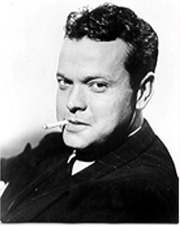
This is Orson Welles speaking from London. The Black Museum, a museum of death. Yes, here in the grim stone structure on the Thames which houses Scotland Yard is a warehouse of homicide, where everyday objects, a cotton reel, a tobacco pouch, a boot lace, all are touched by murder. Here's a shopping bag, faded green canvas square in shape large enough to envelop a human head. There you are sir, would madame like to take it? No? Nothing inside now. These wisps of blonde hair were found inside by the experts in the police laboratory, but that was a long time ago. Who did the hair belong to? There's no doubt about that. This is Vera Dawson's hair, inspector, victim number five. Yes, she's been in the habit of bleaching her hair for years. That's why it probably came out fairly easily. And the pathetic blonde hairs proved that the canvas shopping bag had been used to suffocate their owner, victim number five. That is why the bag has earned its place today in the Black Museum. From the annals of the Criminal Investigation Department of the London Police, we bring you the dramatic stories of the crimes recorded by the objects in Scotland Yards Gallery of Death, the Black Museum. Here we are in the Black Museum. Beyond these stone walls, London throbs and is alive, but within these closely guarded precincts, all is silenced. Death is quiet to me, very quiet. Come with me under the frieze of death masks, the masks of criminals of bygone days, suspended grimly below the ceiling. They were collected at a time when the forensic theorists believed that a composite face made up of the dominant characteristics of hundreds of criminal features would resolve into a picture of the typical criminal. But in 1913, the experts decided that the masks presented nothing different from your face of mine, the average law-abiding citizen. Did you say something? Oh, not this. You know that face. Yes, it's Heinrich Himmler, the German Gestapo chief. That mask was taken a few hours after he'd been into a file of potassium cyanide as he stood before his British captors at Lundberg. And perhaps you may feel easier if you keep your eyes lowered as we pass along the rows of inanimate objects, each one marked with the names of the killer and the killed. Some of the exhibits are labeled with more than two names. Ah, here we are, we've arrived at the shopping bag. One killer, Stanley Haynes. Five victims, including his wife, who is his second on the list. Here's the bag, insignificant in itself, but terrifying when considered in relation to its history, and its history is bound up with the story of the man who used it. Stanley Haynes, one-time bank clerk, petty thief, junk merchant, murderer, hanged by his shopping bag. But let's go back to join him in his junk shop. It's located in Wildron Street, North London, the place belonged to his wife's first husband. The district is poor, the shop is dusty, crammed with litter. Mrs. Edith Haynes, a semi-invalid, is confined to a bed in the living quarters upstairs. Haynes himself just lighted the gas lamp in the shop. The feeble yellow rays are reflected back from the November fog which presses darkly against the windows. The night is dim, but to a young girl, Patricia Wilson, is a beacon to which she turns for guidance. Oh, my word, what a night! I wonder if you can help me? Well, if I can. I'm a stranger here, and I'm looking for 71 Wildron Street. I can't see the numbers on the door since my torch has given out. This is number 22. You'll find 71 to the left on the other side of the road. Oh, well. The fog's getting thicker, isn't it? Yeah, I'm afraid it is. You'll have a job to find the house you're looking for. Oh, no. I promised to go and see my girlfriend there. I wish I hadn't. It was quite clear when I left home. You come far? Only from Vauxhall and our back. Perhaps I can fix your torch for you. Oh, I'll be ever so glad. If you do happen to have a spare bulb, that'll do it. Here's the torch. Yes. This. Let go of my arm. What's your name? Here, let me go. I'll hit you again if you don't take your hands off me. You would, would you? You come here! Help! Quiet, you little idiot! Oh, you're choking me! Oh, you're happening badly! How did you get down here? They've pulled this girl. They've dragged him away. He tried to kill me. Don't be absurd. She's only just come in. Stop wasting that shopping bag and pull yourself together. Hey, let me get out of here! No, wait, I'm his wife. I want to know what happened. Breathlessly, the frightened girl explained. Haines stood silent. His wife listened, horrified. The girl finished her story. What are you doing, Sam? I've nothing to say except I'm sorry. I'm sorry I shouldn't think, but you're not getting away with this. I'm going to report it to the police, but you're not safe. Oh, please, please. Now, please, for my sake, don't take it any further. I think it would kill me if the police had told them. Oh, ain't it? I'll go out. Take it easy, you little... I've got you. I'm all right. Well, she's ill. You ought to be ashamed of yourself. Go and get a doctor. No, no, I don't want anybody. Please tell me you won't make trouble. Well, for your sake then, I won't tell anyone. Thank you. I hope it didn't hurt you too much. No, I'm feeling better now. More shocked than anything else. I don't know what to say, Miss Haynes. Ah, not a word. Music In her efforts to avoid a scandal, Edith Haynes had signed her own death warrant. Police intervention at this stage might have prevented her husband from following the path which leads to the scaffold, as it was. Patricia Wilson kept her promise and nothing happened. The weeks passed and slowly, in the dark mind of Stanley Haynes, strange ideas began to take shape. The brief encounter had triggered off a demon that must be satisfied, and at last the fatal opportunity presented itself in the comely form of a Miss Sylvia Parks, age 27. Good evening. Can I see the second-hand doll's pram you've got advertised in the window? Yes, it's at the back of the shop, if you'd like to have a look. My sister's a girl. She's eight tomorrow and I can't afford much. Oh, well, this is her bargain. I only picked it up two days ago. There it is. Oh, I don't think much of that. I thought there was a catch. Oh, you have a good look at it. You won't do better for the money. No, there's one for painting. Here, here. What are you doing, other? Oh, oh! This time there was no noise to attract the attention of the invalid upstairs. With one powerful hand over his victim's mouth, Haynes reached for the canvas shopping bag. Slipping it over her head, he drew the cords tight, and there was silence. I had stopped her. I must get her out of sight. Gently does it. The aid isn't much here. It was loose in the floorboards by the back door. I must put it down quickly. Sylvia Parks disappeared into the four-foot cavity between the foundations of the building and the floorboards above the ground floor, but although Mrs. Haynes may have heard nothing upstairs, she must have sensed the horror below. Quite suddenly, before her husband could replace the boards, she appeared at the door, leaning heavily on her stick for support. What's that? Tanks. What is that? Nothing's happened. Why are you there when you keep up on me? I can't understand it. Get back where you belong. You've done something. Get out! What are you doing down there? I thought I'd smoked gas up. I've been looking in the pipes. There's a woman's hat on the floor. Where is she? Get up! Get out! She's down there. I can see her foot. Ah! Edith Haynes lay silent in death beside the body of Sylvia Parks. And what of the murderer? Was the demon satisfied? Seems that for the moment he was. According to Haynes' own story, he took himself off that night at the local public house. Felt that he needed company. Live company. All right. Even isn't the old junk man himself. How's business, chum? Business is fine. Well, you wouldn't think so, looking at that shop of yours. It looks like a blooming mawg. Why don't you give it a good clear out, eh? If you'll look after your own affairs, I'll attend to mine. All right. I was only kidding. Here, have a drink. Now. Yes. Yes, I will. I'll have a large scotch. Getting your own back, eh? All right. I asked for it. A large scotch for Miss Haynes, please, Sally. Okay. Celebrated, are you? Yes, I'm, I'm celebrating. Here. How's that wife of yours? Is she any better? My wife? Oh, yes, yes. She's much better now. Oh, I'm glad about that. She used to be a regular in here when she was married to... Well, I've known her a long time, of course. Yes. Longer than I have. Well, tell her Joe was looking after her, will you? Me and the missus have promised to come round and see her one night. Oh, well, didn't you know she's, uh, she's gone to stay with her married sister in Birmingham. Has she? I never knew she had a sister up there. Oh, yes. Oh, well, here's your drink. Bottoms up. Now I see why you're out on the loose. Oh, cheerio. Yes, I, I needed that. Whoa, it's not much fun living on your own, is it? Oh, I'm as miserable as sin when one missus pops over to see her mother. Oh, dear, it's better than having the old man popping round to see us. Oh, not that I don't like it. It's not much fun living on your own. Haymes discovered that in spite of the fact that he was not exactly alone in his dark little shop. There were too many shadows. The mice playing amongst his shabby merchandise would startle him. But without money, there was no escape. So he decided to let the back bedroom, and he advertised it discreetly in a small journal which was not circulated in his home district. His lodge would have to be a complete stranger, and so he turned out to be. But he couldn't escape from the faded canvas shopping bag, which has earned its place so well in the Black Museum. The return to Stanley Haymes and his shop at 22 Wilder and Street. The advertisement for a room to let has produced its result, and the back bedroom is occupied by a short middle-aged man with square shoulders and wary eyes. He calls himself George Smith, which is as good as any other name, but Haymes is suspicious. The lodge never ventures out except for brief moments during the hours of darkness. He behaves like a man who has something to hide, and Stanley Haymes, now desperately short of money, decides to cash in on his opportunity. Who's there? Only me. What a spade, do you? Ah, what do you want? Oh, I, uh, hope you find the room comfortable. Suits me. Yes, it's well tucked away in it. Nobody would look for you here. What are you getting at? Nothing, but I'm afraid I've got to increase your rent. Ah, it's like that, isn't it? Yes, it is. I'm no fool. You dirty little randolph to break you in off. I think so. I've got strong hands, you know. And if I did happen to disappear, things would become even more complicated for you, wouldn't they? I don't know what the devil you're talking about. Well, I'm increasing your rent from one pound a week to five pounds a week. Ah, and you're serious. If you don't like it, you can get out. I see. All right. I'll give you a free cred. That's my limit. Five or out. For five you get food and protection. So you've found out who I am, eh? Yes. Okay. I'll take your term. Here's your first, Father. The bluff has worked. Haynes had no idea that his larger was in point of fact Gary Saunders, a wanted man. His partner had squealed on him following a vicious case of robbery with violence. Now every policeman in the country is on the lookout for him. But how infinitely safer he would have been in jail. As it was, his hush money restored Haynes to his old self. And once again, the demon started working. From the end of January, the murderer met a painted lady who agreed to visit his home. It was during the night that Smith, alias Saunders, was awakened sharply from an uneasy slumber. He jumped from his bed, crossed the narrow landing, and burst into the room, which he knew Haynes occupied. It was a pretty clear case of murder. By heavens, take that thing off her head. How dare you come in here? Take that bag over and get out of my way. Stop! Stop! You paperhead! She's dead. You've killed her. Yes. She's dead, isn't she? But who did it? You or me. What do you mean, you murdering devil? I happen to have a clean record. My word of carry more weight than yours, I imagine. You know you'd frame me, would you? You're not fit to live, Haynes. Why, I'd stand around. I'm going to get the police. I'll take what's coming to me. But you're going to swing for this? I don't think so. Stop that night. I'm not going to swing for you or anybody else. Nobody knows she was here and nobody knows you. I'll get my giver. Don't do it. I told you I had a strong hand on her. Ah! Ah! You didn't think I was strong enough, did you? Now you've learned your lesson. I can't be beaten. Ah! Ah! Sylvia Parks, Edith Haynes, the unknown lady who was subsequently identified as a Mrs. Doris Luke, and Gary Saunders, four victims. And to avoid the trouble of dragging the last two down the stairs to the burial ground under the shop floor, Haynes shot them away in a cupboard in the bathroom. After that, he cleaned up and discovered nearly 2,000 pounds in notes which Saunders had hidden away in his back bedroom. This decided him to take what he considered to be a well-earned holiday. Before he went, he added yet another victim to his list, Vera Dawson, of the Bleach Tayer. We don't know how she was lured into his death shop, but we do know that she left some of her hair inside the canvas shopping bag. And at this point, I will hand you over to a young man who was the key witness in the case against Mr. Haynes. He's Mr. Peter Johnson. My wife and I were the unfortunate couple who rented the Haynes shop. When we met him, he seemed to be just an ordinary sort of chap. He told us he'd redecorated the whole place and was going off to Birmingham to join his wife. Well, for years, you know, her sister's been very good, but I've decided to find a little place in the country for her. Well, that's probably the best thing. As you see, the shop's empty now, and I've cleared all my old stuff out, and I think he looks quite nice and bright, don't you? Oh, yes, I think of just what we've been looking for, don't you, Peter? There you are, Mr. Haynes. The wife likes it. We're in. Oh, good, good. I'm sure you'll be very happy. You wanted six months' rent in advance, I believe. That's right. I'll write you a check now. You haven't got cash? Oh, not for that of mine, but the check went fine. Oh, no, no, no. Of course not. Well, here it is. It's all ready for you. We really made up our minds to take the place yesterday, you see, but, well, Julie wanted to come back today just to make sure. Well, I know you're going to be happy here. We've been happy. Here are the keys. Now I'll leave you to sort things out on your own. It was four o'clock on a Saturday afternoon, so Stanley Haynes was fortunately unable to cash the check as the banks were then closed until the Monday morning. In the meantime, Peter and Julie Johnston were having a busy weekend. They camped in the front bedroom for the night, and early on Sunday, the young wife was measuring the floors for carpeting while her husband was fixing a glass-fronted cabinet in the bathroom. What's the matter, darling? Oh, I've hit my finger with a hammer. Have you hurt yourself? No, no, just flattened my first finger. Oh, but, uh, this is funny. I'm glad you're cheerful about it. No, no, no, I mean the wall here. Don't do that, Peter. You're marking the paper. It's hollow. There must have been a cupboard here, and, um, old Haynes has covered it in for some reason. I say we could do with a cupboard. There isn't one in the whole place. Well, there's one here, all right. But, um, I'd have to redo the wall if I opened it up. Oh, you'd better leave it then. Uh, just pass me that chisel. There's a sweet. Mm-hmm. Ah, thanks. Uh, just open a little hole and see how big it is inside. It might not be worth opening the whole thing. Oh, careful. Perhaps Mr. Haynes will be angry if he comes back and finds what you've done. Ah, don't worry about him. I've paid him enough rent anyway. Ah, here it comes. Good. Now, uh, give me the torch, will you? Here you are. Thanks. Hey, there's bags of room behind here. We'll tune in. Oh. Peter. Peter, what is it? I think I'm going to be ill. Oh, darling. Get, get out of here. Go on, go on. Right outside. Why? Why? I... I can't talk. Just get right out into the street. Quick. Come on. The police were on the spot within a matter of minutes. As their cars roared into Wildron Street in answer to Peter Johnston's call, curtains fluttered in front windows, and a growing crowd appeared quickly outside number 22. Are you Mr. Johnston, sir? Yes, that's right. This is my wife. I'm Inspector Denton. Perhaps the lady had better stay out here while you chose the way up. Yes, of course. I gather you took possession yesterday. Yes, I... I only wish we'd never seen the place. Um, this is the bathroom. Have a look through that little hole in the wall. Right. Give me your torch, Robert. Here you go. Ah. Let's see. Oh. Well, I've seen a few things in my time, Mr. Johnston, but this is about my lot. I understand why you're so upset. This is the worst that it's done. I'll say it is. There's three of them in here. A man and two women. You'd better go down to your wife while we take the whole wall down, Mr. Johnston. We haven't seen the half of it yet. In point of fact, the inspector had seen rather more than half of it. The bodies of Sylvia Parks and Edith Haynes were discovered under the shop floor a few hours later. By that time, the whole building was being methodically opened up. Floors were lifted, chimneys explored, the foundations and the small patch of garden were being dug, and the word went out to get Stanley Haynes. We managed to obtain a photograph of him from one of his neighbors, but we were dealing with a wily customer. Even before he knew the chase was on, he'd shaved the top of his head, which gave the impression of baldness, and he put on horns and spectacles, which completely changed his appearance. He heard on the radio that the balloon had gone up sooner than he expected, and by then he was well away from London. Those notes which Jerry Saunders got in his last job, Superintendent, I've got the numbers. Good. And there's no possibility of the money being hidden away in 22 Wildon Street? No, sir. Haynes got it all right, and it won't belong before he starts passing some of it. Yes, we'd better notify every area in the country. As soon as one of those notes is traced, we'll be on the Haynes' tail. He might be in disguise, or he might be lying low, but he's got to spend money, and that's how we're going to find him. For obvious reasons, no mention of the money was disclosed in the press, so Stanley Haynes was unaware that he was carrying his own death sentence in the Canva shopping bag, which also contained his spare clothing. Yes, he had taken the bag with him. Perhaps it had a morbid fascination. Perhaps he thought he might use it again. But anyway, it made a convenient carrier, convenient for him and, as it transpired, convenient for the police. Days after the murders were discovered, I had a call from a young lady named Patricia Wilton. She told me how the previous November she'd been caught out in a fog and gone into the Haynes' junk shop for direction. She told me how he'd attacked her and how his wife had pleaded that she shouldn't report it to the police. Now, I've made a terrible mistake, but I had to come and tell you. We're very grateful to you, Miss Wilson. Now, if you can cast your mind back, I'd like you to try and tell me every little detail of what happened and what was said. Oh, the first words I'll really admit it, Haynes, speak sounded sort of funny and out of place. Oh, how was that? He got one hand on his throat when she'd come in and he was stimming about with something over my head. She said to him, she said, stop waving that shopping bag and pull yourself together, she said. I see. You suppose he was trying to pull the bag over your head? Oh, my goodness, I never thought of that. What sort of bag was it? Green canvas thing with a string around the top. You trace anything like it amongst the stuff he disposed of, Inspector? No, sir, no bags or cases. Yeah, and it's just possible he might still have the bag with him. Better add that to the general description. Yes, sir. By the way, a detail, a flimsy possibility, but every step had to be taken that might help to trace the murderer. Then after nearly a week of suspense, the first stolen note was reported right in London. Haynes had come back to hide amongst the teeming millions in the great city. The search was concentrated now and after nine days on the run, Haynes was caught. It was the canvas bag which attracted the attention of a plain clothes officer. It made him concentrate on the man's face and taking a chance, he approached him. Excuse me, sir. Yes? I'm a police officer. I'm sorry to trouble you, but I wonder if you'd just remove those glasses for a moment. All right. There you are. Are you Stanley Haynes? No, you've made a mistake. Perhaps you'd come along to the station with me. We may not keep you for long. Suppose I refuse. I'll still have to take you. Okay. Haynes went like a lamb and once inside the station, he readily admitted his identity. The murderer was found and the chase was over, all because of a faded green canvas shopping bag which has earned its place today in the Black Museum. Arson Wells will be back with you in just a moment. Haynes was a killer because it was his desire to kill. Except in the case of his one male victim, he killed coldly and ruthlessly. He had no pity. In fact, as we know, he would celebrate his murders. At his trial, he was obviously pleased to be the center of attraction, and for some reason he confessed to every detail relating to his first four murders. But with regard to his fifth victim, Vera Dawson, he would say nothing. But the evidence was in the bank. This is Vera Dawson's hair, Inspector. Victim number five, eh? Yes. She's been in the habit of bleaching her hair for years. That's probably why it came out fairly easily. So Stanley Haynes went to the scaffold, and the pathetic blonde hairs lie beside the faded green shopping bag in the Black Museum. Now, until we meet again sometime in the same place, I tell you another story about the Black Museum. I remain as always obedient to you. The Black Museum The Black Museum The Black Museum