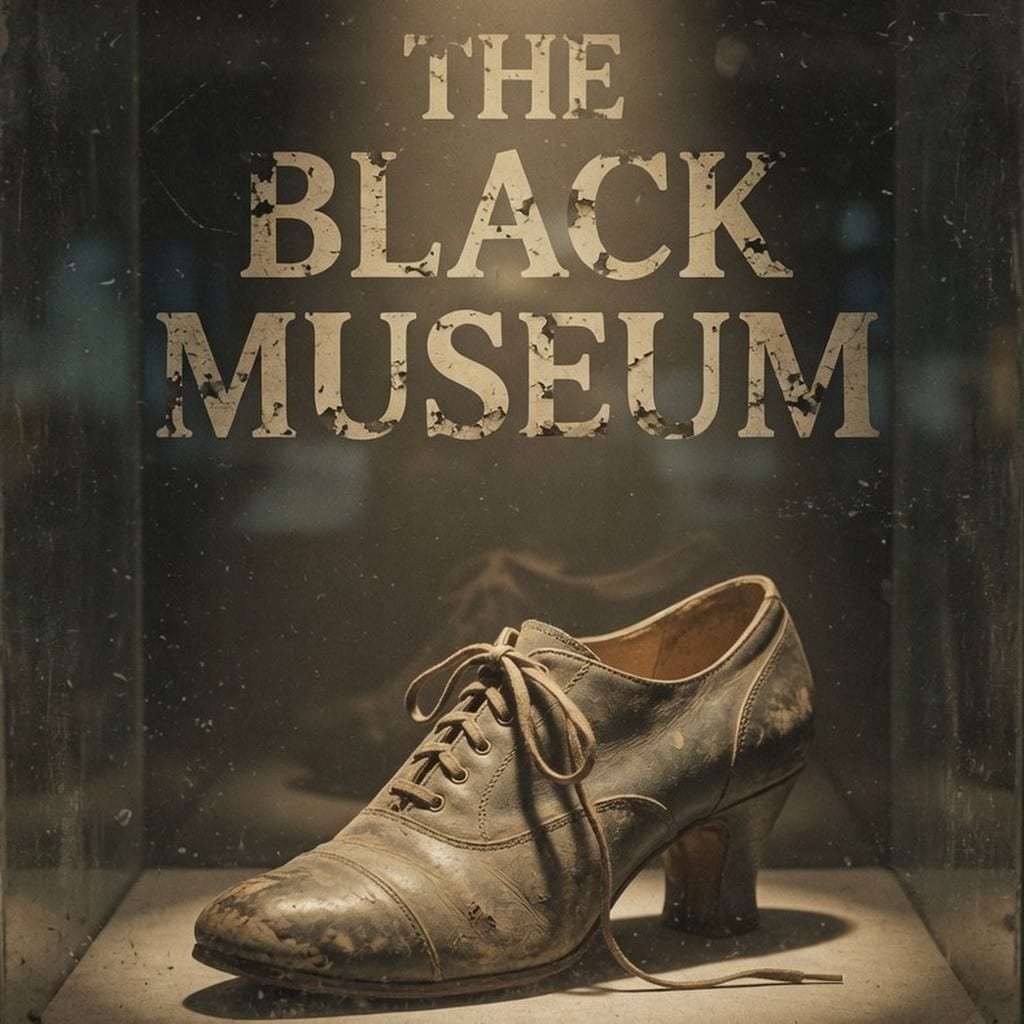
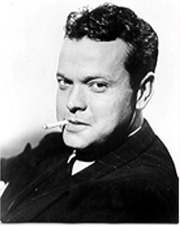
This is Orson Welles speaking from London. The Black Museum. Here in the grim stone structure on the Thames which houses Scotland Yard is a warehouse of homicide, where every day objects, a paperweight, a woolen muffler, an old-fashioned hat pin, a drinking glass, all are touched by murder. Here's a bit of frosted glass. It's a familiar object you've seen, such glass before in the upper panels of the doors of older houses and perhaps the one in which you live. Let's in more light, the owner used to say. One man climbing to his old-fashioned apartment said to his son, hello, what's this, glass from the landing? From the door, dad. It looks like a frosted panel fell out. Yes, and pretty jaggedly. Be careful, son, those shards are sharp. Well today the glass shards can be seen in the Black Museum. From the annals of the Criminal Investigation Department of the London Police, we bring you the dramatic stories of the crimes recorded by the objects in Scotland Yard's gallery of death, the Black Museum. In just a moment you will hear the Black Museum starring Orson Welles. Please open, now. Now the Black Museum starring Orson Welles. And here we are, the Black Museum. Scotland Yards Museum of Murder. Here lies death. Here's a pacifier, nippled end, ivory ring. This in the Black Museum. Yes, as it seems there was a will. And where there's a will, there's a way. Even to infanticide. Here's a pair of Andioms. Brass, graceful in pattern, clean in execution. Observe the shining brass of this one, the ugly blotch on the other. A woman was pushed violently. Her head strikes with malice, a forego. This was murder. Nice, here we are, the glass shards. They're sharp, pointed, dangerous to life and them, even in themselves. They are glistening, gleaming in their white frosted danger. So once they were part of a whole, the glass panel, as I told you, of an apartment door, they would come to that. Let's begin this tale with the ringing of a doorbell. Maybe no one is home. Well, we'll try again. Sorry to have kept you waiting. Oh, sorry to have disturbed you, ma'am. I've been sent looking for a shelfer. Chat name is Simmons. There's no one here by that name. And I can tell you, sir, there's no one by that name being in this neighborhood. Well, not in my memory. And I've lived here about now in 20 years. Oh, well, thank you, ma'am. Gerard's really works, the beacon it's called. Well, I'll have to find another errand boy if they can't give me better steers than this. Well, good day, ma'am. Good day. That's a bit strange. There's no beacon garage in this neighborhood. Of course, this was not a neighborhood for garages and items of that sort. This was strictly residential, mostly semi-detached houses with a bit of garden and an occasional block of apartments or flats, as they're still called in London. And to one of those apartment houses came Charles Fly and his son, Charles Jr., home after their respective days work at business and college. When will they put lights in these stairs, Dad? You know, after someone breaks a leg in the dark. I just hope it isn't your mother. So do I. I don't know what's the landing. Dad turns just ahead. I know. Hello, what's this? Glass on the landing? From the door, Dad. Looks like the frosted panel fell out. Yes, and pretty jaggedly. Be careful, son. Those shards are sharp. I said, do you suppose Mother let the door slam so hard the glass broke? Well, I'll ask her when we get inside. Your key handy. Oh, right here, Dad. Thanks. Funny, I've never known your mother to use the chain on the door in her life. Oh, with the glass broken like that. What good's the chain? I can reach in and clip off the chain from here through the broken glass. Dad, there's someone in there. Your mother, probably. No, it's not. It's a man, a little fellow. Junior, get on down to Riverdale Road. There's a police box there. Call them, quickly. What about you, Dad? Go on, now. I'll stay here and watch him. Hurry. Yes, all right. If you say so. Chain's off now. Why not? He's only a little fellow. Here now. What are you putting in my suitcase? You shouldn't have come in, Governor. Everyone do your bit. I could. I'm leaving. With your suitcase and what I've packed in it. With the pin bag. I can handle you. So foolhardy. Mr. Fly should have stayed outside. He might have stayed alive. As it was when the police did arrive with Charles Fly Jr. Senior was very dead. The call to Scotland Yard was automatic after that. Inspector Howard proceeded with the preliminary questioning as his technical experts combed the apartment. I know you had quite a shock, my boy, but we need your help and right now. I'll try my best, Inspector. We've checked the apartment. The intruder, whoever he was, had packed a suitcase and was about ready to leave. It's Dad's own. It was his suitcase. All right. Now, is the exit door open? Yes, sir. It was his suitcase. All right. Now, is there anything else you know of that's missing? My mother said something before she collapsed about her bracelet. I looked. It's missing. Can you describe it in detail? On items like that, we publish it in the Yard's daily Gazette. It's secularized to every station, jeweler and pawn shop in England. Well, it was gold, about an inch wide, engraved with a kind of floral design. There were 25 diamonds, small ones, in the pattern. Dad gave it to Mother on her 25th anniversary. I see. Very good. Now, you've been in excellent health and you're certain he was a short man. Well, I saw him through the broken pane. He was just about five feet tall. Quite a little fellow. I guess that's why Dad went in after him. Dad didn't know he had a gun. Housebreakers try to say away from guns in England. The penalties are too severe. Yes, Sergeant? No M.O. sir, just the broken pane of glass. Thank you. Anything beyond that first shell? Not a thing. One shot was fired, that's all. No M.O. sir? Means of operation. Anything that's recognizable. Most of these people have a kind of trademark. Completely subconscious, but it helps us to find them. Too bad there's nothing, then. We'll do our best. All right, Sergeant, I want the neighborhood canvassed. Did anyone notice a small man sounding the drum? Did anyone see a small man leaving the premises and check every carnival, fair and circus for a small fellow who's a sharpshooter? One cartridge, one shot and bullseye. Got that, Sergeant? Aye, sir. We can make a start anyway. Police routine. Sounding the drum. That's a new term. What does it mean? Listen to the Sergeant as he canvases the neighborhood. Tell me, Mom, in the past day or so, has anyone rang your bell and asked for someone who doesn't live here and left in a hurry? Do you follow the term now? It's what Americans would call casing the joint. Find out if anyone's home by ringing the bell. If there is, make an excuse and get away fast. If there isn't, find a way to break in and steal whatever may be lying about within easy reach. It's simple, effective, very professional. But the police are professionals, too. Excuse me, sir, I'm from the CID. Sergeant Gordon, my credentials. Oh, what's up? I'm making inquiries to see if anyone's called your house in the past few days. What? Oh, no, no, we've all been away the past two weeks. We only got back today. Oh, well, thank you then. Sorry to trouble you. Yes? Forgive me for troubling you, Mom. I'm Sergeant Gordon, CID, my credentials. What's happened? We aren't in any trouble, are we? Oh, now, now calm yourself, Mom. No trouble for you at any rate. It's just that I wanted to ask you a question or two. Oh, yes? Could you tell me if anyone has called at your house during the past few days and asked for someone who doesn't live here, and that if they were in? What a silly question. No, Mom, it's a very serious question. So, will you put your mind to it? Well, no. I'm absolutely sure. Nobody. Yes? Sergeant Gordon, CID, my credentials. Yes? Has anyone rang your bell in the past few days and asked for someone who doesn't live here? No, thank you. Yes? Sorry to disturb you, Mom. I'm Sergeant Gordon, CID, my credentials. Oh, oh please, yes? Did you, that is, has anyone rang your bell in the past few days and asked for someone who doesn't live here? Oh, that would be a foolish thing. Why, yes, there was. Just yesterday afternoon, he asked for a chauffeur or something, said the fellow worked at the Beacon Garage. And you remembered this? I certainly did. Why, Mom? Well, because there's no such place hereabouts as the Beacon Garage, and I ought to know. I've lived here 20 years. I see. Rather a foolish error. Now that you mention it, I'm not sure that it was an error. You seem rather a nasty little man. Oh, is that so? Why? Too dapper, too quick. Much too little for a man. He was shorter than I am, and I'm only five feet two. Could you describe him in more detail, perhaps? Well, he had dark hair, grew very low on his head, and his eyes were sort of shifty. Blue, but shifty. The kind of thing you see in the cinema, you know, and those pictures about bookmaking and that. Anything else, Mom? Well, not that I remember, not offhand at any rate. [♪Music playing in background. [♪Music playing in background. Now two people still living have seen this little man, the dead man's son and the woman at whose door he sounded the drum. A description is in hand, two descriptions, which tally in every point. And then Sergeant Gordon came into Inspector Howard's office with another fact, a very solid fact. What's this, Sergeant? The weapon, sir. Found it behind the hedge of number 21, three houses up from the flats where Flyer was killed. How'd you get onto it? Ah, we found a young fellow who'd been walking his girl past the flats on her way from the bus. This little man ran out of the flats, almost knocked the girl over, but he kept going. Our young fellow turned around to protest, saw him throw something over the hedge. We looked. There it is. Ah, nasty little gun. Well, shell jammed in the chamber. Oh, no wonder he fired only one shot. But he pulled the trigger twice. Well, we can drop our search in the circuses, Sergeant. I doubt if this fellow is the sharp shooter we thought he was. I think now we'll concentrate on classification by size. Shall we get to it, Sergeant? We seem to have our work cut out for us again. Surely the picture takes shape, dim at first, as if seen through frosted glass, like the glass shards to be seen today in the Black Museum. In just a moment, we will continue with the Black Museum starring Orson Welles. And now we continue with the Black Museum starring Orson Welles. Again, it's compounded of hard work, good police training, and a little luck. They start with nothing. They start with the wrong theory that their man is a sharp shooter. They have to abandon this, and they start fresh. With the dullest and therefore the hardest kind of police routine, checking the files. He's a little man. Everyone's agreed on that. Ask Criminal Records to send us the dossiers on every man we have on file under five feet, two inches in height. Carefully, the inspector in charge and his sergeant comb through these dossiers, and finally, by reason of cross-checking, this one in jail at the moment of the crime, that one in some other part of the country, others in the other part of the country, others with perfect alibis, the list of little fellows is reduced to four. You take these two sergeants, I'll work over the others. Anything that rings a bell, the smallest detail. Yes, sir. For over an hour, the two men are silent, reading, thinking, trying to relate something in the files to the facts that they already have. And then they exchange dossiers and start again. By this time, the lamps are lighted, the Thames flows like black glass outside the window of the inspector's office. All at once. I may have something, sir. Which file? Larry Mason. His nearest relatives, an uncle and an aunt, are recorded here as living in Beacon Road. Does that mean anything to you, Sergeant? It doesn't to me. I'll see it in my report in passing, Inspector. When I talked with the woman who'd seen the fellow sounding the drum, he told her the chauffeur he was looking for, Wacken, walked at the Beacon Garage. And she made quite a fuss over the fact that there is no such garage in the neighborhood. She was quite emphatic about it. Interesting. Let me see the description. I see. Five feet, one and a half inch, the smallest of the lot. Beacon Garage, eh? And relatives on Beacon Road. Not important, perhaps. And yet, all important, as the inspector thought it through. We'll say a man needs a false name at a certain moment. He says the first thing that comes into his mind. It seems rather natural that the place his nearest relatives live should be lurking somewhere just below his consciousness. Well, it's mighty slim, but it's worth a try. And having decided it was worth a try, Inspector Howard and Sergeant Gordon set out to trace their prime, if tiny, suspect. Mason? Yes. He lived here. Oh, lived? You mean he's left? He didn't leave. What then, ma'am? Did he die? He could have, for all I care. I threw him out. Didn't pay his rent for three weeks. I can't afford dead ends, I can't. Have you any idea where he's gone? No. What's more, I don't care. Next point, please. Next point of inquiry was the Beacon Road address, and Larry Mason's uncle. About your nephew, Mr. Mason. What about him? Have you any idea of his whereabouts? Who wants to know? My name is Howard, Inspector Scott of Yard. In trouble is he again. We are not certain yet. He may be. We'd like to talk to him. Well, if you find him, I'd like to talk to him too. Long enough to tell him not to come round for me for help. Sergeant Gordon visited the pubs and hangouts where Larry Mason had been known to spend his time. In one of them, he found a friend of Mason's. Larry? I ain't seen him in a long time. Not since he was sent away for breaking and entering. He hasn't been round at all. And I can't say I'm sorry. No. Why not, friend? He worked for me when I had my license and was making a booklet for the police. He worked for me when I had my license and was making a book legitimate. He was my clerk, see? Then one day he walks off, just like that, with ten quid. I don't expect to see him again. He knows that little job cost me my license. And he knows what will happen to him if he shows his face in here again. How much to go on? How to find a man, except the brush strokes that fill the picture of the little fellow's character. Unreliable, a thief, and where his friends are concerned. Now, think back in that. One of the daily gazette VR publishers with descriptions of stolen goods, missing persons, and so on. Tele-type from the Lancashire police, Inspector, huh? They've got the bracelet in the fly case. A pawnbroker turned it up. Good. It was offered to him by a tall, heavy-set fellow with a peculiar circular scar on his right cheek. That sounds like Dick Lowry. Let's have Mr. Lowry in here, shall we? Mr. Lowry was quite glad to oblige. He wasn't in hiding or anything like that, not Dick Lowry. Where'd you get it, Lowry? The Inspector wants to know. Where'd I get what? The bracelet you pawned in Bolton. I found it. You found it. That's what I said. Anything wrong in that? If you found it, no. We think you bought it. Well, now, what would I buy a bracelet with sparklers in it for? My girls don't go for that sort of thing. You sold it, didn't you? Of course. Why not? A fellow can do with a spot of cash. Lowry! Yes, Inspector? You may want to know that bracelet is involved in a killing. A killing, is it? Why, that dirty little... Oh, go on, Lowry. Start talking, Lowry. Accessory after the fact in a murder can be very nasty, you know. All right. I bought it. I paid a good price, too. From whom? Lowry, from whom? Larry Mason. Well, at last. Where do you see him, Lowry? Oh, the usual place, dog track. With him, it's horses or dogs when their necks aren't running. Finally, the patients was bringing results, as it almost always does. Canvas a whole neighborhood, comb through hundreds of files, slowly, slowly, narrow the possibilities, and finally, a direct relation is established between the crime and some person who may have committed it. After that, find the person. In this case, it was the dog tracks, South Ends. He's not here, Sergeant. The White City Raceway. Not a sign, Inspector. Wembley. They know him here, but he hasn't been around in weeks. And back to South End. No luck again, sir. No luck is right. Tell me, Sergeant, do you suppose a pint of ale will help our patients any? Aye. This one seems rather decent, Inspector. Yes, let's get on with it. Oh, excuse me. Oh, I'm sorry, sir. I didn't mean to come against you. That's all right. No harm done. Hold it, young fella. I think I know you. Do you? You're Larry Mason. Not me. My name's Leonard Martin, sir. Sorry, you'll have to prove your identity. We're from Scotland Yard. A twist of luck, a turn of chance. Two weary policemen in search of a relaxing moment run across the killer they've been hunting for weeks. At the Yard, Larry Mason was not having a particularly relaxing time of it. Do you insist on denying you're Larry Mason? I do. Look, Mason, you've been away for a while. Now you know about these things. Your fingerprints are the prints on Mason's record. Dick Lowry swears he bought the bracelet from you. Your landlady and your former bookmaking associate have identified you. Now let's have no more nonsense. I ain't giving you a thing. Just because I'm small don't mean you can push me around. Ah, you'd better tell us the whole story, Mason, and stop this nonsensical denial. You'll go to trial anyway, you know. And the more you lie now, the harder it'll be on you later. Now speak up, Mason. You know, they get stubborn streaks sometimes. They read somewhere somehow that the best defense is to admit nothing, not even their own identity. So they firmly shut their mouths and refused to talk about anything except the weather. The sergeant knew they had a case, a good case. Inspector Howard came in to help. I look at it this way, Mason. You can't do yourself any harm. We've got the evidence, we've got the gun. We're in the process of tracing it to you right now. The woman you spoke to will identify you in court. You had the bracelet, you've no alibi worth mentioning. You'll hang on what we've got, Mason, unless you have something which makes it manslaughter in place of murder. All right. It was an accident. I never used a gun before. Never even had one. The first time is always one too many when it comes to guns. Now keep talking. How was it an accident? I broke the glass, see, after nobody answered the bell. I stuck my hand in. It was a cinch to open the door. I worked fast, but this fellow come home early or something. I tried to make the back door. No luck. It was locked with a key. So you had to come to the front. I pulled the gun because I wanted to scare him, that's all. He jumped me, ate me with something. I blacked out. That's it. I blacked out. Didn't even hear the gun go off. And when you came to, Mason? He was dead on the floor. I got out of there as fast as I could get. It was an accident. I swear it was an accident. What's your opinion, Sergeant? It's a good story, but it won't wash. Why not? That's what happened. Why not? It's very simple, Mason. You blacked out as you pulled the trigger. Therefore, you fired only once. Yes, sir. Only once? Sorry, Mason. You pulled that trigger twice. There was a shell jammed in the firing chamber. You pulled the trigger at least twice. That's no accident, Mason. That's murder. Yes, the case was complete. Each part in its correct place. And those glass shards I told you about, those two are in their correct place. In the Black Museum. Horson-Wells will be back with you in just a moment. Horson-Wells Now here in person is Orson Well. The jury quite agreed with Inspector Howard. That was no accident. And so in due course, little Larry Mason, the bookies clerk who made the fatal error of carrying a pistol, went the way of most murderers at eight o'clock one summer morning. Larry Mason's luck had run out, or had it. It was reported, you see, that as he walked to the scaffold with its thirteen steps and waiting rope, Mason murmured to his guards, they had to do this now on June 6th, Derby Day, and me with a few shillings riding on Armstrong in a big race. Curiously, although old Mason wasn't available to collect on his bet, Armstrong was the winning horse at 53 to one. And now until we meet next time, until we meet in the same place and I tell you another story about the Black Museum, I remain as always obediently yours. The Black Museum, starring Orson Well, is presented by arrangement with Metro-Goldwyn-Mare Radio Attraction. The program is written by Ara Marion with original music composed and conducted by Sydney Torch, produced by Harry Allen Towers. The Black Museum, starring Orson Well, is presented by arrangement with Metro-Goldwyn-Mare Radio Attraction. The Black Museum, starring Orson Well, is presented by arrangement with Metro-Goldwyn-Mare Radio Attraction.