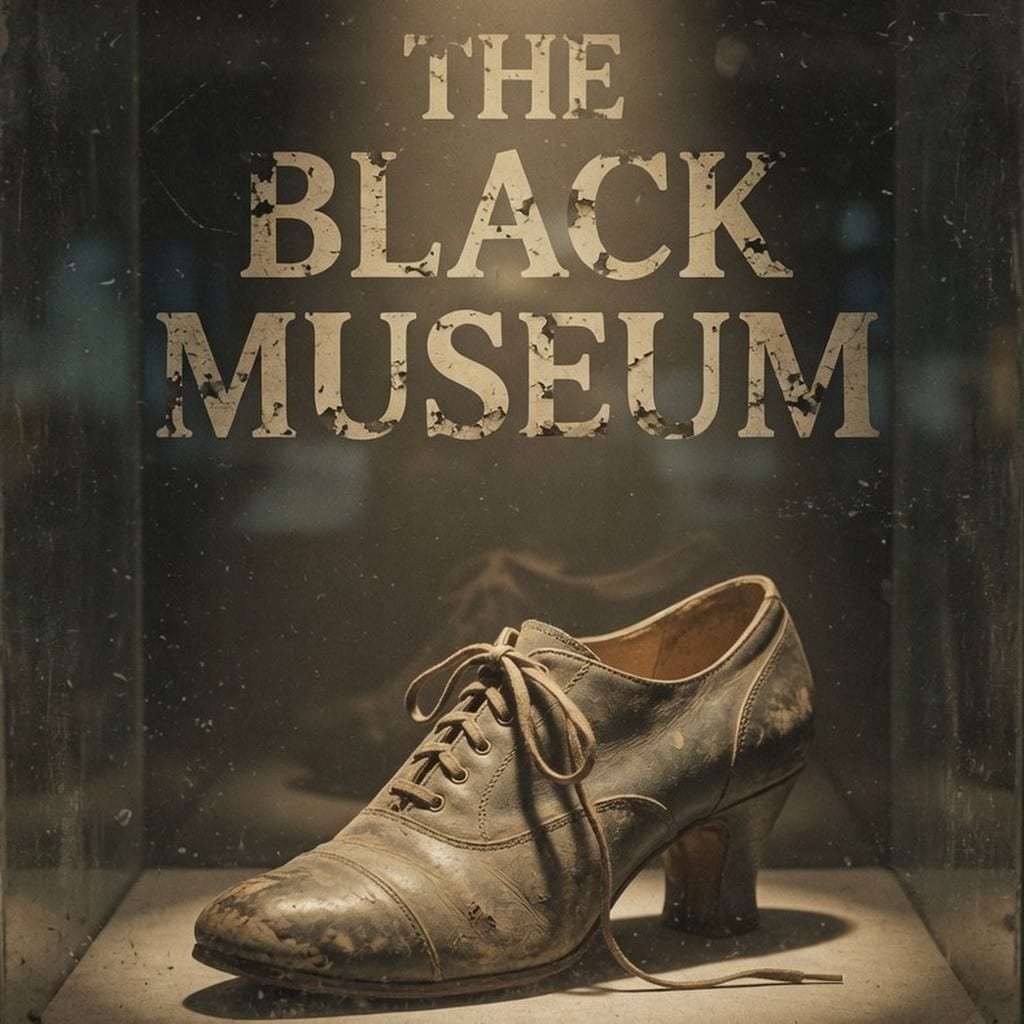
This is Orson Welles speaking from London. The Black Museum. Here in the grim stone structure on the Thames which houses Scotland Yard is a warehouse of homicides. A warehouse where a parchment lampshade, an automobile tire, a canvas tarpaulin, an umbrella, or are touched by murder. And here's a dictionary. It's a familiar object. French into English, English into French. Every high school student knows what these books are like. Word here, phrase there, merci, thank you, thank you, merci. And of course, a youth common to most young men in countries not parallel. Je t'aime. Je t'aime. Oh, you sound so, so passionate, Jill. What does that mean? In the little book, one moment, je t'aime, I love you. Now today the dictionary can be seen in the Black Museum. From the annals of the Criminal Investigation Department of the London Police, we bring you the dramatic stories of the crimes recorded by the objects in Scotland Yard's gallery of death, the Black Museum. Here we are in the Black Museum, Scotland Yard Museum of Murder. Not a very pleasant place, but it's interesting. This place is called the Black Museum of Murder. This is a place where the victims of the murder were buried. The victims of the murder were buried here. And here lies death. The people who conceived this place must have wished to raise a memorial to death. And here, collected under one roof, are the mementos of the murders from over a hundred years. Here are darts, feathered darts made for pleasure, for laughter and friendly talent. A dartboard missed. I suspect it was scratched. It was an accident. An accident, no, a murder. Ah, here we are, the dictionary. You want the English for a French word? Here it is, the French for a word in English. It's here also. Nice idea. All in one box, great convenience. Particularly for Jules Gamache, who had a bit of trouble expressing himself to Betty Brown on the beach in southern France. One war in the South of the United States. Je t'aime, je t'aime. Oh, you sound so, so passionate, Jules. What's that mean? In the little book, one moment, je t'aime oui, I love you. Right, Jules. A me, a married woman? Yes, it was. Love out of the dictionary in the summer in southern France. Because this was in 1923, that date's important, simply because radio and broadcasting were just beginning. And Jules Gamache was something of an electrical engineer. In fact, he was the only man in the little French seaside town who was able to bring music out of the air. Look, Galène, look. How you say it in English? Ah, the cat's whiskers. So, so, but no, mes chers, écoutez. Oh, Jules, what a great English music in his funny rubber ear, ma. Huh? But, Jules, for you are bright, aren't you? I love you. I must have you now, today, pas de bleu, always. Oh, Jules. A clever Frenchman who knew his way about with women. An Englishwoman vacationing in France. Why was she there? Oh, Jules, if I were a better manager, it would be better to be a... Look, I'd never have had the breakdown. I'd never have come to France, and I'd never have met you, and even your... Even your mom is sad. Oh, so that was it. But all such items come to an end someday. When summer comes to an end, at least that's the correct calculation. That's the way Betty calculated, without thinking of her, Jules. Jules. Yes, ma chérie? I... I have to go home. Oui. Je viens. I'd come also. Oh, Jules, that's impossible. However, the usual sighs and protestations, of course, is that the brief interlude that it was a trifle saddened to let it go. After all, when a woman is crowding for it, she went home anyway, to Sussex, to the Binnacle Inn, to security of sorts. And to her husband, Al. Business hasn't been too bad while you were away, Bessie. All the rooms were left this week, and the bar trade was fine. I'd best say you did all right by the bar. The landlord's got to be social girl, otherwise his customers go somewhere else. There's a difference, Alf, between social and drunk. Hear that, runner, that. I'd take a drop now and then, but I don't get drunk. Well, another customer. Business is picking up, and on the hotel side of that. Oh. How can I help you, sir? I have, I will say, one moment, please, how do you find the word? Ah, yes, I have come to stay. What do you know? A froggy. Pleased to have you, monseer. May I ask how you found this? Alf, I, uh, well, that is, I. Monsieur Brown, I, the Marveilleuse Madame Brown is the recommandation for your so select hotel. Is it not so that we have met in Provence, Madame? The little Frenchman must have been mad, mad with love. Just a little touched in the head, in any case, he'd come just as he said to stay, as he explained it to Al Brown. I am, how you say, an inventor. I have much great ideas. Yes, sure, gama, sure, but do you make any money? To make money? Je ne comprends pas. Money, uh, shillings, franks. Ah oui, beaucoup d'argent. Oh, right now I make from Canada much money. And, uh, what do you invent to get all this spokue money? The wireless. I am in the wireless very much interested. Well, monseer, if you can get music out of the air, maybe you can get some money out of the same place to pay what you owe us. Huh? You've been here a month now, and we haven't seen a shilling on your board bill. Board bill? Comment? There was another conversation shortly thereafter on the same subject, if not exactly on the same polite level. Look, Betty, he's your friend. We've got to have some money. How can I ask him for money, even if he is our friend? Yours, not mine. He doesn't take walks with me every afternoon. Al Brown, are you suggesting? I'm not suggesting, dearie, I'm telling you. Get some money out of him or out he goes. You're supposed to be the business head in this family. All right, tend to business here. Well, you never talked to me like this before. It was the first time for everything, they say. For the first time Al was in the driver's seat, and he knew it. So did Betty know it. On one of their afternoon walks, she said as much to Jewel. Jewel? Oui, ma chérie? A sec. Oh, he will do nothing, jamais. He's after me. Huh? To get money from you. Oh, ho, ho, ho, ho, ho. What are you laughing at? I'm telling you, without you it would be real nasty. Me tell us both out, and you without a permit. Well, it's not funny. He holds the whip hand. Don't you understand? Oui, one moment. Oh, oh, Jewel. Not that little book again. Oui, ça fait moins, le petit livre. Ah, ici, I have it. Like an Englishman saw, ah, when he steal his wife, but not owe to him money. Ha, ha, ha, ha, ha. Jewel was self-confident, to say the least. He behaved as if he had a plan. He said to Jewel, Never fear, mon ami. In a few days, beaucoup d'argent. You like? Oui? To better, he said. Je t'aime, ma chérie. Do not fear. All will be well. A quiet, dull New Year's morning. Routine of the inn continued, minus the overtired, oversleeping maid. After a while, the master came grumbling down the stairs. Bessie, Bessie, where are you? Ah, please. I think Mr. Gimache is done. Well, let him go to his room, then. Pardon, monsieur. Into my chambre, you wish for me to go? Oui? Oh, no, no need for that. Is there? Oh, so long as he's awake, I don't care one way or another. Where's my salt? You know I can't start a day without my salt. I know, dear. They're where you'd expect them to be, on the night of self, in their regular place. Oh, yes, I forgot. If I may disturb you, Monseigneur. Oh, but of course. The chair before the fire. Very nice, sweet. Pressure, Monse, when it is so very cold outside. Your forehead. Thanks. Bessie, Bessie, that glass is here. Where's a tablespoon and some water? Oh, I'll get them for you. Just a moment, dear. Jules Gimache stood in the bay window and watched the little domestic scene. Occasionally he riffled through his ever-present dictionary as if for a word to describe the events he was watching. Such inconsequential little event. Betty came trotting back from the kitchen with a tablespoon and a pitcher of water. She put them on the table alongside the salt and glass. Hal measured his own dosage, poured it into the glass, then he poured in the water. Almost mockingly he raised his glass as if in a toast. The Frenchman standing nearby. Then down the cante, the glass. Oh, oh, those salts taste bitter this morning. Bien, they are never sweet, no? There's nothing sweet about them. Then why complain, dear? You had more to drink than usual last night, so the salts taste more bitter than usual. One hour later. Bessie, Bessie, Bessie, get some help. Oh, it's the cramps. Oh, I can't, I can't, I can't, it's all over. Oh, Jules, get a doctor, call the cook, do something. I will try, my English is not good, But I will try. Oh, my feet, my feet, they itch, oh, they're driving me crazy. The pain, the pain, they are itching. Shortly thereafter, Alfie Brown was quite dead. And so the tragedy reached its climax. Playing its little part in that tragedy was a certain dictionary, which as I told you can be seen today in the Black Museum. Dr. Wescott, the local physician, was called at once but far too late. Alf Brown was past help. The doctor listened gravely to the stories that he told it to him. While Jules stood by, the very picture of solicitude. Oh, he went so quick doctor. And it's like I could have cramps and groans and he said the strangest things. What was that Mrs. Brown? Well he cried out at his feet, Bridget. It was almost the last thing he said. Is that right, Mrs. Brown? Well, if you say so. It's an interesting symptom, peculiar one, particular poison. Though how this household will come by, I haven't the slightest idea. Poison? But doctor, it was his sauce. Although it did good play, but they tasted more bitter than usual. Anything else, Mrs. Brown? I think, no, no nothing else. Oh, I'm so upset, confused. But what poison? How? Itching feet, bitter taste, great pain, they all point to strictening. But of course we won't be able to know for certain until there's been a post mortem. Oh, doctor, why? I can't sign the certificate under these circumstances. I have to notify the coroner and the police. Now, I think our next precaution is for you to give me the bottle, the spoon and the glass. Into my charge. Where are they? Oh, well, I don't quite... Do you... Mr. Gamache, do you remember? Je ne sais pas, Madame. Je ne comprends pas. Oh, come, Mrs. Brown. Now, now pull yourself together. You want to catch the party who poisoned your husband, don't you? Perhaps that was a better question than Dr. Wesk had realized. It was pure rhetoric at that moment as far as he was concerned. Of course, the widow wanted to catch the murderer, still took a bit of concentrated prodding of Betty's memory until she said... I know now, doctor. I put them in the drawer of the kitchen table when I left for Arthur for a moment to fetch some tea and soda. I thought it might help. They found the bottle and the glass and the spoon in the kitchen table drawer. The doctor looked at them closely. Someone's washed these thoroughly. There are still traces of water in the bottle and the glass. Mrs. Brown, I am going to the police at once. And Dr. Wesk had went to the local police. The local police went to Scotland Yard. Betty Brown went to Jules Gamache. You did it too. I don't know how, but you did it. Me? Ma chérie. Ma chérie. Impossible. You did. You killed Alfie. And you stayed right there and watched him die. Betty, you are most... How is it? Ah, oui. You are most hysterical. You know I do not kill your Alfie. You must know this. I know. I feel it in my bones. You killed him. Go away, Jules. Go away. I never want to see you again as long as I live. Sadly, as if overwhelmed by the unpredictability of women, Jules Gamache packed his things and left the binnacle in. But he didn't go far. He went to the next village and the next inn. There he waited and watched. Waited to hear from his beloved, now widowed, his Betty. Waited for developments in a case which the coroner's jury had labeled death at the hands of persons unknown. The developments were not long in coming. My name is Wesk, Mrs. Brown, Inspector Wesk, Scotland Yard. My credentials. Yes, sir. I have a few questions, particularly concerning the disposal of the poison. I'll try to answer them, Inspector. Do you know who washed out the bottle and glass? No, I'm afraid I don't. I left them in the kitchen. We're all to accept my poor Alfie's suffering. We were rather hysterical, I'm afraid. I understand. No idea on that. I see. Tell me, Mrs. Brown, have you ever used any kind of weed killer in the garden of this inn? No, sir. Not that I know of. Poison for rodents, rats, mice, and so on? No, sir. We've never been troubled by such. Have you any idea who might have wanted to kill your husband, Mrs. Brown? No, I haven't. Thank you very much, Mrs. Brown. The inspector left the front of the house, so to speak, and visited below stairs. He had a nice talk with a cook over a cup of tea. Mrs. Davies, did you wash out the sauce bottle? No, why should I? I've got enough work. And that was New Year's Day. The maid didn't come in. I had to clean up, too. Pity, not much of a New Year in this house. Did you notice the bottle at all? Well, I remember saying to Mrs. Brown that there wasn't much more than a tablespoon left in it. And perhaps she better order another bottle in case Mr. Brown was getting mad if he had none. Now, this is important, Mrs. Davies. Can you place anyone, anyone at all, in this kitchen between the time Mrs. Brown brought the bottle in here and the time Dr. West got to get away? No one but the Frenchman, sir. Mr. Gomes? I seem to remember, sir. I wouldn't want to get him in no trouble unless he deserved it. But he did come in here and jab-wrack me, and then he used his little book. Little book? He's got a dictionary, looks up the French and finds the English. Right comical he is sometimes. I see. Then he looked in his dictionary. And he said, BOP. He said something else. I didn't pay much attention. I just pointed at the kitchen drawer. Did he take the bottle out of the drawer? I wouldn't know, sir, for all I know. He just wanted to be sure it was in a safe place. I heard him open and close the drawer, that was all. Then he went out. Did he have a chance to put it back? Lots of chances. I was that busy running in and out. That's too bad. Oh, excellent tea, Mrs. Davies. The inspector was never a man to accept loose ends. He ran all his leads to Earth. This is the approach which brought him finally to where Jules Gommache was staying. Do you accuse me, inspector? Merely asking routine questions, Mr. Gommache. Did you have any reason to dislike or resent Mr. Brown? None. No, but of course not. Have you ever had any strictening in your possession? No, but pourquoi? Why should I? I can't say, sir. I can only try to fill in the blank spaces. Someone, you see, gave Mr. Brown the opportunity to poison himself. That kind of gift is murder, Mr. Gommache. Naturalement. I'm afraid I must ask you to remain in England, sir, until the case is closed. But for me this will be a pleasure. I assure you, inspector, I wish to see vengeance on this murderer. I loved Mr. Brown almost as a brother. So there it was, the smooth blank wall for Scotland Yard to face in search for some crack somewhere. The interest in the case emmered down. Nothing was happening. Then the newspapers picked up a lead, something so fantastic the men assigned to watch the Benefiel Inn and its neighbour would hardly believe their own ears. It seems that Jules Gommache began to write letters. And to the police. There is one suspect who had not been questioned, a man long subject to Alfred Brown's whims and tempers, the pot-washer at the inn, known to me only as Jules Gommache. I point the finger of suspicion. Observe, gentlemen of Scotland Yard, the comings and goings of Mr. Arthur Brookfield, solicitor to Madame Brown. This man is in and out of her residence at all hours. Certainly not all of this can be on business. Was jealousy entering the picture now? The letters aroused a good deal of attention once they leaked to the newspapers, as such things have a way of doing. Jules Gommache was quite pleased when the reporters swarmed about him, the photographers took his picture many times, in many poses. This was fame at last for an impoverished inventor living on his wits. Coming, sir. Are you asked to see me on the Brown case? Yes, sir. My name is Scott, sir. I'm the owner of a chemist's shop in Wilking. Not too far from the Benicoline, is it? Just far enough to miss some of the news, but this morning I saw this newspaper. Ah, yes, yes, our French friend. Do you know him? He was a customer of mine a few weeks back, just before Christmas. Go on, Mr. Scott. He asked for strictening. Oh, what excuse did he give? Something about experiments in the wireless. He kept consulting a small English-French dictionary to express himself. The wireless, yes, that's the new excuse. Although, while they should think the wireless operations entail the use of poisons is beyond me, did you sell him any? I did. I made him sign the poison book. The name he used was Hatch. Mr. Scott, do you think you can identify this man among a dozen others? Well, Mr. Scott? That's he, sir, the short fellow with the bright black eyes. Thank you, Mr. Monsieur le chemiste. Bonjour, c'est un plaisir. How you say, one moment please. Oui, ici. It is a pleasure that we meet again. Jules Gomesch, I have a warrant for your arrest on a charge of willful murder. I must warn you that anything you may say... Well, that's the story. And today, the dictionary which played its part in that story can be found in its place in the Black Museum. Orson Welles will be back with you in just a moment. Truly a strange, impassioned little man, that Jules Gomesch is half crazy, half sane. You wonder about him. And you know, to add to the dilemma of his personality, here's one last point. While Jules was awaiting execution, he wrote another letter to Inspector West, stating that shortly after the death of Al Brown, he, Jules, saw a woman, whether it was the woman who was the cook or his beloved Betty, he didn't know, secrete something behind some loose bricks in the garden wall at the Binnacle Inn. Of course, the police investigated. They found two small jugs, one with crystalline strychnine in it, and the other with a solution of the same poison. Now the question is, did Jules Gomesch put those jugs there himself, or did one of the women? And if the latter, why did Gomesch wait until just before his death to reveal this? Was it some odd form of gallantry? Well, I guess no one will ever know. And now until next time, until we meet in the same place and I tell you another story about the Black Museum, I remain as always, obediently yours. This is WDCBFM Glen Ellyn.