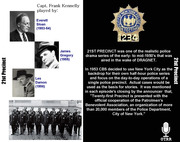
21st precinct, Sergeant Waters. What do you mean you were robbed? Oh, broken in your apartment. Where is it? 761? What apartment number? Is that B or C? You are in the muster room at the 21st precinct, the nerve center. A call is coming through. You will follow the action taken pursuant to that call from this minute until the final report is written in the 124 room at the 21st precinct. Yes, sir, all right. I'll send an officer right over there. Yes, sir. They'll be there in a few minutes. You just wait. That's right. Yes, sir, you just wait there. 21st precinct. It's just lines on a map of the city of New York. 173,000 people wedged into the nine tenths of a square mile between 5th Avenue and the East River. The security of their homes, their persons, and their property is the job of the men of the 21st precinct. The 21st, 160 patrolmen, 11 sergeants, and four lieutenants of whom I'm the boss. My name is Keel, Thomas P. Keel. I'm captain in command of the 21st precinct. I was doing night duty, 4 p.m. to 8 a.m. It had been one week exactly since I had been transferred to command of the 21st precinct from Borough headquarters of the Bronx, where I had been assigned since my promotion from lieutenant to captain in August 1954. On assuming command, the leading captain Vincent T. Cronin, who had been transferred to the office of the chief inspector, I spent the first few days getting acquainted with various conditions in the precinct by remaining on patrol as much as possible during my time on duty. This is my first assignment in Manhattan since I was a detective attached to the 34th squad. As a sergeant and subsequently lieutenant and captain, I did duty in Brooklyn, Queens, and the Bronx. On this particular night, I had been out on patrol since 6.30, and it was nearly 9.30 when I returned to the station house and walked into the muster room. Lieutenant Snyder was desk officer, and Sergeant Waters had telephone switchboard duty. Hello, captain. Sergeant, what's doing? Nothing much. Lieutenant King was wanted at Saucy. Is he upstairs? Yes, sir, I think so. Bring up there and tell him I'm back while I sign the blotter. Yes, sir. Hello, lieutenant. 21st squad, Detective Novak. Sergeant Waters on TS. Would you tell Lieutenant King that Captain Keough is back in the house? Yes, sir. Lieutenant, Captain Keough is downstairs. Yes, sir. All right. Yes, the captain awaits there. Lieutenant King is coming downstairs. Yeah, okay. You got it, Lieutenant King? Yes, sir, he's on his way downstairs. Oh, uh, the directors came through just after you left, captain. Short sleeve shirts and open collars are permissible for all men on day tours. Okay, have Fallon posted on the board. I already called him, captain. Excuse me. Yes, go ahead. 21st Precinct, Sergeant Waters. Lady, I told you before, there's nothing we can do about that. We chase robbers, we're not plumbers. I know about that. Matt, what's going? Can I talk to you here in your office? Yes, sure. I'll be in my office, Sergeant. Yes, sir. I can't send a police officer over there for that, lady. What have we got there? Go ahead. I know, but why don't you keep on? Sit down. Yes. Well, what is it? Looks like we've got a cop in a jam. From here? Yes, sir. Who? I don't know yet. Well, what's it all about? Well, the commander of the 6th Squad called up here about an hour ago. Two uniformed men jumped a burglar coming out of an apartment building. They had to take him into the courtyard, but they finally collared him. Yeah? They brought him into the station house. He admitted he was in an apartment there. He dropped a pillowcase during the chase. He had a portable radio and an electric razor, a few other things, and it came out of the apartment. They took him up to the squad down there and started to talk to him about other deals. The boy admits to about 25 burglaries. Well, what's that got to do with us? Well, the boy, his name is Eakley, Leroy Eakley, told him he burglarized an apartment in this precinct three or four weeks ago. Uh-huh, got a couple of suits, some jewelry, good stuff, a gun, about $600 in cash. Said he came down the service entrance, walked out into the street. Said as soon as he hit the sidewalk, a cop was there and shoved him against the building. Said he thought he was through. The cop went through the stuff. He admitted he burglarized his apartment. Said the cop went through his pockets and found the cash. Leon? He said the cop put the money in his own pocket, gave him back all the merchandise, hit him on the can with his nightstick and told him to get out of the precinct. Leroy said he ran to the subway station, got on a train, hasn't been back on the East Side since. What does it sound like to you? Have you got a cigarette in there? Yeah, sure, Captain. Thanks. Thanks. You're welcome. Well, I, uh, I went through our squeals. June 18th, a Mr. Philip Rootson, 761 East 68th Street, a lawyer with officers at 156th Wall. Reported his apartment had been broken into. Three suits of his, a diamond ring, a wristwatch, and a diamond pin belonged to his wife. 32 caliber SW revolver, which had a permit. And $575 in cash were taken. Well, that sounds like the same deal this boy was talking about. Yes, it does. Check this story. It's believed that he burglarized the house. He reported this on the 18th? Yes, sir. When did the burglary occur? At night of the 17th? Third of May, it was the 15th, 16th, or 17th, Captain. It was a weekend. Mr. and Mrs. Rootson left the city Friday afternoon to spend the weekend in the country. They discovered the burglary when they got back Monday morning. What time of night did all this occur? Did you find that out? I don't know for an act yet. The squad commander down there, Lieutenant McInerney, told me they were still questioning the boy. Wanted to let me know what they were developing. Uh-huh. 25th briefing, Sergeant Waters. Sergeant 761E68 Speed is on what post? Post number nine, Captain. Get out the telephone switchboard record and post this for the 4-12 and the 12-8 tours for June 15th, 16th, and 17th. Yes, sir. Bring them in here. And bring the blotter, too, right away. Something the matter, Captain? Yes, something's the matter. Get those records out and bring them in here. Yes, sir. Right away. For this and other purposes, the records of the precinct contain a detailed account of the movements of every member of the command. The blotter, for instance, shows reach tour and the handwriting of the desk officer, the assignment of patrolmen to post and motor patrol duty, the time each post is vacated for meal period, all post changes and movements during a tour of duty, and a notation of the nature, time, and location of duty performed by each member of the command. From these records, Lieutenant King and I narrowed the possibilities down to four patrolmen who had worked post number nine on either the night or late tours, June 15th, 16th, and 17th. In order to narrow the list still further, we drove to the 6th Precinct at 135 Charles Street in Greenwich Village to interview the burglary suspects. There, with Lieutenant King, I went upstairs to the 6th Detective Squad. Yes, who can I help you? We're in the guard, this is Captain Kehoe of the 21st Precinct, I'm Lieutenant King. Oh, yes, sir. Lieutenant McInerney is in his office. Thanks. Big Squad, Detective Long. Ed? Come in, man. Yes, my honor, Lieutenant Ed. Want to close the door, man? Yeah, sure. Lieutenant McInerney, this is Squad Commander Captain Kehoe. How are you, Captain? Well, I don't know. Yes, sir, I get how you feel. Do you want to sit down? Thanks. What about this boy, Ed? Well, he's a good boy, all right. He's done one bit of things since the burglary. We think he's been into 25 or 30 flats all over town, maybe more. He can't remember them all. What about the story he tells? Well, unfortunately, it sounds pretty straight, Captain. It's text with a squeal in it, God forbid. Well, that cop had his hands on a good burglar. Nine chances out of ten, he would have gotten a commendation and promotion to detective. Pay raise for one year alone would have amounted to as much as he took off the boy. That cop is an idiot. Well, a little more than an idiot. Well, an idiot with everything else, yes. You got him spotted? We've got it narrowed down to four. The complainants were away Friday, Saturday, and Sunday nights. Could have happened on any of those nights. Neither the four to twelve or twelve day tours. You didn't take the time any closer to get him? No, I thought I'd wait until you got down here. Sure squeal. You'd want to talk to him about it. Where is this boy? He's outside. I'll have him brought in. Ross? Yes, sir? Bring that Lee Roy in here. Yes, sir. We got it down to four. That's right. We've got one man who was working the four to twelve on Saturday and Sunday nights. He was swinging Friday nights. Another man who was working the twelve day was swinging Saturday nights. Those two men, the two who relieved them. Well, it's good to fix it either on the four to twelve and the twelve to eight. That would knock two of them out of the box, man. Yeah, if we got the right nights from the boy, it would be down to the man. Well, this Lee Roy was pretty vague about dates and times. He's been in so many flats he doesn't know one from the other. Yeah, who is it? Come in. Go ahead, Lee Roy. Where? Over there. Listen, I was sleeping back there. He wants me out. No, Lee Roy, your time is not your own. Sit down there. Yeah. Okay, Ross. Thank you. Lee Roy, this is Captain Gio and Lieutenant King. They're from uptown, the 21st. They want to know something about that officer taking the money off you? Oh, yeah. You told Lieutenant McInerney it was five or six hundred dollars. Yeah, that's right. Five or six hundred. You burglarized an apartment there. You took some suits, the guns, some jewelry and the cash. When did you have time to stop and count the money? Well, you know how human nature is. I found the cash in the drawer there. The first thing I was tempted to do was look at it. I saw a couple of hundreds, a couple of fifties, tens and twenties. I figured five to six hundred. I shoved it in my pocket. What does it do with the gun you got out of there? Oh, I don't care for guns. I figure you have a gun and you're going to shoot it. I never did go in for that kind of heavy stuff. I gave it to a very good friend of mine. What's his name? His name is Jack, Jack Agno. But he don't have it. He sold it, he told me. A lot of nerve. I give him the gun and he sold it. It's too strange. Where is this Jack Agno? Can we locate him? That's the easiest thing in the world. But he don't have the gun. Where is he, Leroy? In the tombs he got picked up last week on a deal. Where did he get picked up? In Times Square. I told him a dozen times if he's going to go in a public place like Times Square, he shouldn't wear a sports jacket that's three sizes too large for him. You know, a real fine sports jacket. What he called cashmere. He got it out of some flat and he fell in love with the cloth. The cloth was fine, but in a million years it couldn't have been his jacket. Some detective stopped him on Broadway and said, Hey, bud, where'd you get the coat? That was that. That's what comes with being too much a clothes horse, you know. Well, to get back to the nights, you got the gun and the money up in the 21st. I don't know. It's the 21st. I couldn't swear. Well, it was. Do you remember what night it was? What night? What were? What do you mean? Well, it had to be either Friday, Saturday, or Sunday. No. No, I couldn't remember what night it was. I've been working almost every night, nearly. My memory don't serve me on that. June 15th, 16th, or 17th, Friday, Saturday, or Sunday night. It beats the living daylights out of me, Lieutenant. That Sunday was Father's Day, the 17th. Oh, was it? Does that locate the time in your mind? I ain't seen my old man in years. Oh, my friend Jack. Jack, I know. Lieutenant Jones. Yeah, yeah. Jack was worried what to give his old man. I said he ought to give him a hit in the head. When was this you talked to Jack about it? Well, it was the night before. He said Father's Day was tomorrow. He didn't have a thing to take him. Oh, that was after I did this deal. The one with the cop. Oh, that? Yeah, because he mentioned this Father's Day to me while we were out at the trots between races. And that was the night after the night I went into that particular flat. So that must have been Friday night I was in the flat and the cop nailed me. Friday night, June 15th. If you say so, okay. What time of the night was it, Leverett? Time of the night? Yes. Well, that also would be kind of hard to say. Well, let's start at midnight. Would you say it was before or after midnight? Does it make a difference? Yes, it does. What did you do before you went over and broke into that flat? Well, let's see. I don't know. I can tell you what I did after I met Jack and he and I went to my place and I got the suits and the scum I got. Jack sure figures into your life a lot, doesn't he? Well, he's my best friend. And then from my place we went over to meet a girlfriend of his after she got off work. Oh yeah, it must have been 10, 30 or 11 I hit the flat because this girlfriend of Jack's works in the cafeteria down here in the village over 7th Avenue. She gets off at midnight. You're sure about that? Yeah, I'm telling you. Well, that's pretty well set the time for you, Captain. Friday, June 15th during the 4 to 12 tour. Yeah. Leroy, do you think you'd be able to identify the officer who took the money off you? I'll tell you the truth. I don't know about that. What did he look like? A cop with a blue suit. Was he young? Was he tall? What? Well, look, Cap, I wasn't interested in what he looked like. Young, tall, short. I don't know. All I could see was a cop. I was nailed when he took the money, slapped me with his stick and said, go. I went. I didn't turn around to see what color eyes he had. I was going to give you a chance to identify him, if you can. Well, if I can, I will. I opened up and told you about this, didn't I? If I didn't want to help you, I could have clam. A cop catches me and takes me in. I got no beef against him. But if he turns out to be a bigger thief than me, I got no regrets. No regrets at all. Except maybe that my good friend Jack is laying in the tomb all alone in the world. Now, don't you worry about that, Leroy. You'll be down there to keep company. Lieutenant King, Lieutenant McEnany of the 6th Squad and I continued to interrogate the burglary suspect, Leroy Eakley. The officer he referred to was most likely Patrolman Philip Austin, who, the record showed, was assigned to post number nine during the 4 to 12 tour on Friday, June 15. It was decided to continue the investigation at the 21st, and arrangements were made to transport the prisoner in the custody of Patrolman Gerber of the 6th Precinct, one of the arresting officers. Before we left, I phoned through C.B. to Lieutenant Snyder, the desk officer at the 21st, and gave him instructions to detain Patrolman Austin and all the members of his squad, which again was working the 4 to 12 tour for my arrival. At 1210, after having been relieved from his post, Patrolman Austin returned to the station house and walked through the front door into the musk room. Sergeant. Yes, Sergeant. Come in. What is it, Sergeant? Just a second. 21st Precinct, Sergeant Waters. Lieutenant who? Oh, Lieutenant Gorman isn't doing here until 8 a.m. Yes, sir. That's all right. What's the trouble? The captain wants to hold your squad. No? He's on his way uptown. Wait for him in the back room. Why? Just wait. Look, Sergeant, my wife's brother has a birthday party tonight. I told him I'd get over there soon after 12, as I could. He'll have another birthday next year. What do you say, Phil? Yes, Sergeant. Come here. What's it all about? You want to see me, Sergeant? Yeah. Wait in the back room for the captain. He'll be back any minute. What's the trouble? There's no trouble. Just wait. Okay, Sergeant. Oh, and don't change from your uniform. Leave them on. Look, Sergeant, he's liable to be another rowan. Will you stop giving me an argument? Go ahead. Sure, Sergeant. Come on, Phil. Yeah. I don't know. Why do I have to get all the dirty details? It's not that bad. Hi, fellas. Anybody know what this is all about? No. Big deal. The guy is in the precinct all week and he's got us jumping. Come on, Phil. Sit down. There's no sense getting worked out. I don't know if the captain wants to see us. Where is he? Look, we're all in the same boat. No, but you've got no place to go except home and to bed, Farrell. Every time somebody can think of some extra detail, they think of us. Well, don't get mad until you find out what it is. Hi, officer. What's going on? You know, as much as we do, grab a seat. They've probably got the midnight snack on the table over there now and the beer has just flown. Stop aggravating yourself. What do you expect me to do? I'm out walking a post for eight hours. When the tour is over, my time should be my own. This is something I'm going to take up with the delegates. Watch it. I'm sorry to hold you, men. Sorry, Captain. Hello, Lieutenant. Farrell. Lieutenant King and I would like to have you stay around a few minutes to help us out on something. Is that all right with you? How long will it take, Captain? Not very long, Austin. I have to go into my office. We'll be ready for you in a few minutes. Come on, then. Okay, Captain. Now, that's awesome. Have you met him before? Yes, but I didn't connect up the face and the name. It's rough having something like this for a weakening man. Yeah. Sergeant? Yes, sir? You're getting the other men in here? Yes, sir. The rest of them should be on their way. All right, Sergeant. When they get here, send them into the back room. Then let me know. I'll be in my office. Sergeant, would you ring upstairs and have no back come see me in the captain's office? Yes, sir. The kind of a record has Austin got in the department, Captain. All I got to look at is UF-42 is just fair. Good educational background, three years in the Coast Guard. Nothing outstanding in the department. Up on charges once about three years ago for leaving his post without permission. Not from this precinct. He lost five days' pay. No couple with him since. They say he isn't the best man we've got, but he's been doing his job. Go ahead, man. Thanks, Cudah. Well, what's going to happen? Don't get in a hurry, Leroy. You've got plenty of time. I'm not getting in a hurry. I'm just getting hungry, that's all. Is there a delicatessen close I'd like to send out for a sandwich? It's my luck to get collard right before supper. You'll get something to eat in a little while. But there's no time like the present. Leroy, you told us your burglarized a flat and on your way out a police officer collard you. Yeah, that's right. That's the honest to goodness trope. Now we want you to identify the police officer. Well, I told you I didn't know whether I could do that. You stood there and talked to him, didn't you? For how long? It was only a couple of seconds like that, that's all. That's long enough to get a look. It was in the nighttime. It was dark. Let me get this straight. Where was this? Right outside the service entrance of that apartment building? Yeah, that's right. Right outside. As soon as you came out the door. Yeah, it was like he was waiting there for me when I came out the door. Listen, could you send out for a sandwich for me? Soon, Leroy. I like to call on people on a ride with cold, swan, and pickle. Also croffin. Yes, as soon as we get through here. Yes, who is it? Novak. Come in. Want me, lieutenant? Yeah, Novak. I want you. Yes, this is for... I'm entitled to get something to eat before you ship me down to the tomb. The bill of fare down there ain't nothing to write home about, you know. I saw this girl that goes with my good friend Jack the other day. She was down there to see him. He says the bill of fare hasn't improved any since the last year or so, has it? And Jack ain't hard to please when it comes to food. Give him any old slap, he's happy. All right, get going, Novak. Right, I guess we're about set, Captain. Set for what? To give you a look and see if you can identify that police officer. I told you, I didn't know whether I could do that. I couldn't tell him from Adam. We think we can, Leroy. We think we know who he is. We want to give you a look and see if you agree with it. There are 23,000 members of the police department of the city of New York. With their families, the force comprises a community larger than all, but 94 of the most popular cities in the country. As in any group so large and from such varied backgrounds, occasional deviation of character is expected, and the methods of dealing with it are provided for in the laws of the state, the rules and regulations of the department, and the manual of procedure. These provisions afford the same protection to an accused police officer as to any other suspect. In all criminal cases, identification is usually the most important criterion. In this one, we proceeded to determine whether the burglary suspect Leroy Eakley should identify the police officer he accused. In addition to the principal suspect, Patrolman Austin and a dozen other officers were waiting in the back room. When we were ready, they were formed into a line and marched into the muscle room. Right, up. Left, straight. Right, stretch. Round and ease. All right, I'll tell you what the story is. All right, we're conducting an investigation. We're holding a man who has made an accusation against a police officer. I want to see right here and now if he can identify that patrolman. Farrell, would you go in the captain's office, ask them to come out here? Yes, right away, let's go. What's this cop supposed to be accused of, Captain? Among other things, receiving stolen property and failing to take proper prefection. All right, come over here, Leroy. I'll come in, but I don't know what good it'll do. There's a number of police officers there, Leroy. Take a good look at every one of them. Yeah? And tell us if you see the man who took the money off you. Then, Leroy. Yeah. You say this police officer spoke to you. If you want to hear the voice of any one of these men, just ask him to talk. If he asks any of you to talk, state your rank, name and field number. Go ahead, Leroy, take a look. Do you see the man, Leroy? I don't know. Take another look. I'd like to hear this fellow say something. Go ahead, name, rank and field number. Patrolman John Farrell, 24381. Now, can you let this one talk? Go ahead. Patrolman Philip Austin, 31650. Will you come again? Patrolman Philip Austin, 31650. Now, I can't make him. I don't see him. You want to take another try down the line? I can't make him. It was too dark there. I told you that. Officer Farrell, wait in the back room for a while. Right, sir. Sergeant, dismiss the squad. What a ten-jus! Dismissed. Come on, Leroy. Yeah, I'm coming. Let's go back in my office. I'll go anyplace. Oh, don't look at me like that. What do you want me to do? Say it with somebody if I wasn't positively sure? What do you take me for? Did you think it was any of the men there? Didn't I tell you it was dark? Go ahead, inside. Lieutenant. Yes, now back. Sit down over there, Leroy. I am. What I want to know is when I'm going to get something to eat. I went over there, Lieutenant. I'll get you something to eat, Leroy. Oh, that's good. A guy could starve to death around here. How much trouble would it be to send out to a delicatessen? I got some money I could pay for. You wouldn't let me starve, would you? No, we wouldn't let you starve. Leroy, there's something I'd like to get straight. Yeah, sure. You said you couldn't see the cop over there because it was too dark. Is that right? Yeah, that's right. It's a service entrance. Yeah, the side door to service entrance. Alvac. Yeah, Lieutenant. You just came back from that apartment building over there, right? Yes, sir. You looked at the service entrance where the cop was supposed to have called it, Leroy? Yes, sir. Was it dark? There's a light over the door. The super told me it's never out at night. In addition, that door is right under streetlights. Would you say it's light enough over there to see a man's face? Lieutenant, it's light enough to read a newspaper. What have you got to say about that, Leroy? Well, listen, maybe the electric was off that night. The electric wasn't off, Leroy. It's just a plain liar. We've been wasting our time all night. No, I've been giving it to you free. It's going around corners. We're not going to waste any more time. What about it? Did you see that cop or didn't you? You don't want to waste any more time, huh? No. All right, I won't waste any more time. I didn't see a cop because there wasn't any cop. Then why the story? Well, it's very involved. This has been very involved all night. Yeah, Cap, you got a point. Now, I told a story for two reasons. One is I told it before to my good friend Jack. You see, he was in that flat with me. I didn't tell him about the money when I found it. After we got out, we broke up and met later, just like I told you at the cafeteria where his girl worked. I figured this flat we made might belong to some celebrity and the papers would have the story and tell exactly how much cash was took. So I made up the little tale about the cop to Jack. He bought it because being a thief, he believes that's a logical thing for a cop to do. That's what he would think. Yeah, so when I got Collum tonight, I knew I was going to see Jack in the tombs again, so I stuck with a story because he's big. Boy, he's big. In addition to which, if I played it along and told the same story, maybe I'd get a break. You know, the newspapers and the D.A., everybody go for that stuff. I thought I'd get a break out of it. But I was honest. I didn't identify any cop. I didn't get anybody in a jam, not me. No, you didn't identify anybody because you might have picked somebody who wasn't anywhere near that spot. Oh, that's a point. I grant you that. I'll be right back, man. But you still got to give me credit. Captain. Yes, Sergeant. Is everything all right? That bum was lying. He pulled the whole story out of the air. That makes me feel a little better. Well, I feel better, too. Much better. Oh, Orson and Fowler are waiting. Shall I let them go, Captain? No, I will. Thanks. You men. Yes, sir. You can get changed now and go home. Right, sir. Just a second, Orson. Yes, sir. Never mind. Good night. I'll see you tomorrow. Good night, Captain. How do you like that? What? We have to stay around here on our own time on some deal we've got nothing to do with. We don't even get a word of thanks. Well, what can you do? That's the trouble. There's nothing you can do. 21st Precinct, Sergeant Waters. Where? East what? East 77th. Do both of them have guns? What is this? Oh, in the liquor store. A cop is what? Oh, wait a minute. Not so fast. What about a taxi cab? And so it goes. Around the clock. Through the week, every day, every year. A police precinct in the city of New York is a flesh and blood merry-go-round. Anyone can catch the brass ring. Or the brass ring can catch anyone. 21st Precinct, a factual account of the way police work in the world's greatest city is presented with the official cooperation of the Patrolmen's Benevolent Association, an organization of more than 20,000 members of the police department's city of New York. Left Seaman in the role of Captain Keel, Ken Lynch as Lieutenant King, Harold Stone as Sergeant Waters. Featured in tonight's cast were Bill Quinn, Bill Zuckert, Mandel Kramer, John Sylvester, and Lawson Zerby. 21st Precinct is written, produced, and directed by Stanley Niss. Art Hannah Stevens.