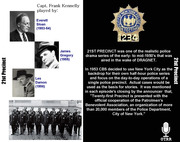
24th Precinct Sergeant Waters. Who? What happened? You fell off a truck? Yeah. Yeah. How old are the boys? Now wait a minute. You are in the muscle room at the 21st Precinct. The nerve center. A call is coming through. You will follow the action taken for soon. From this minute until the final report is written in the 124 room at the 21st Precinct. All right. You just tell them I'm sending the officers right over there. Yeah. And the ambulance. Okay. That's right. Yeah. 21st Precinct. It's got lines of fire. It's got lines on a map of the city of New York. Most of the 173,000 people wedged into the nine tenths of a square mile between Fifth Avenue and the East River wouldn't know if you asked them if they lived or were in the 21st. Whether they know it or not, the security of their homes, their persons, and their property is the job of the men of the 21st Precinct. The 21st. 160 patrolmen, 11 sergeants, and four lieutenants of whom I am the boss. My name is Cannelli. Frank Cannelli. I'm captain in command of the 21st. I was working my day tour 8 a.m. to 6 p.m. It was a bright, warm Sunday morning, and after I turned off the platoon at 8, Sector Car Number 4 came by the house for me, and I went on patrol to the precinct. We had driven uptown on part to the boundary of the 21st and started downtown on Fifth when the number of our car was broadcast with instructions to call the station house. Patrolman Farrell stopped the car at the nearest call box, and I rang in. The desk officer, Lieutenant Gorman, told me that Patrolman Patrick E. Cale had been injured while chasing boys out of a condemned tenement building on First Avenue. He had been taken to Bellevue Hospital in an ambulance. Because of the possibility of sick leave with pay or disability retirement in such cases, a commanding officer is obliged to make a detailed investigation to determine if the injury was in the line of duty. So I returned to the car and instructed Patrolman Farrell to drive to Bellevue. There we parked the car, and in the emergency ward I was told where to locate the resident who had treated Patrolman Cahill on admission. Oh, Doctor? Yes? Are you Doctor Escher? Yes, I am. I'm Captain Cannelly of the 21st Precinct. Oh, yes, yes. How do you do, Captain? How are you? Patrolman Cahill is one of my men. I understand you treated him when he came in. Yes, I did. What does it look like, Doctor? I think he has a fractured left ankle. Oh, couldn't carry his weight on it. It was swollen considerably by the time he got here. Even from an examination by palpation, it appeared to be fractured. I sent him back to make x-rays. We'll know for sure in a couple of minutes. I see. Can I go back now? Yes, yes, you are, Captain. I don't see why not. This way. He seems to be perfectly all right otherwise. A few contusions on the leg where he went through the floorboard. No indication of shot. I've given him a needle to calm him down and ease the pain. I see. I understand there's a police surgeon on the way. Yes, that's right. Well, we'll have the x-rays all made by the time he gets here. Oh, good. To the right there. Thank you. Ah, kids in the tenement. They ought to keep those abandoned buildings boarded up. Well, they're supposed to. Second door down, Captain. In here. All right, Doc. Take a deep breath and hold it. Don't breathe. Okay, Commissioner, you can breathe now. Go right over, Captain. It's all right. Nurse, this is Captain Cannelli. It's all right. He won't get in my way. Hello, Cahill. Captain, how do you feel? Well, I still hurt some. I'd be worried if it didn't. Well, I'll see you, Captain. Yeah, thanks a lot, Doc. That's all right, don't mention it. Well, what happened, Cahill? Well, sir, I was on post there. The new sailor on the corner told me some kids were in this condemned tenement. Said there were phone things out the second and third story windows and just missed a couple of the desks. All right, now let's stop the chatter. Take a deep breath and hold it. Don't breathe. All right, you can breathe now. So I went inside, Captain. I guess they heard me coming. Two little kids, eight or nine. They were on the second floor and ran up to the third. I spattered up after them. There was a weak board on the landing there and I went by two. Now we'll take a different pole. Which is your good side? Oh, any side. Well, can you roll over this way a little bit? Yeah, I'll try. Easy now. All right, you don't have to do it all at once. Oh, brother. That's it, right there. We'll see how it looks from this angle. This will be the last one. So there I was. My foot was through the floor. Yeah. I pulled it out and crawled over a window. The boards were out. I tried to lean out and I yelled down the street. The food dealer heard me. He rang in. The door wasn't battened, though. Of course it was, Captain. It sure wasn't battened very well. It was eight euros. Get in. What happened to them? All right, now take a deep breath and hold it. Don't breathe. All right, you can breathe now. Teach me what happened to them, Captain. They must have ran up to the roof and crossed over. I never saw them anymore. Now if you want to buy any prints, just let me know. No thanks. Well, I don't think there any. You'll want to kill your grandchildren. Excuse me, Captain. Now, you think you can roll off the table back under the pushmobile? Well, I rolled off of it, didn't I? I can try. All right. Now let's see how big and brave and strong you are. Come on. That's it. Come on. Oh, yes. Grab a hold of me, Kay. All right. There you are. I can't. Yeah, I can imagine. Come in. Captain, can I have your hand? Everybody's in here. Yes, Sergeant. All right, Detective. How about that, I guess, Sergeant? What is it, Sergeant? There's an accident case out there you might be interested in, Captain. On the 21st? Yes, sir. Boy, about 13 to 14 years old. Oh. I'll be back to see you, Kay. All right, Commissioner. Now let's go for a little ride. Do you want to leave this door open? Well, we can't go through it closed, can we? To the left, Captain. Doesn't look like the kid's going to make it. Well, what happened? Well, he hit the ride on the back of a newspaper truck. Truck slowed down for light going downtown on Lexington Avenue. Kid jumped off. Missed his footing and fell right under the wheels of a car that was right on the truck. How bad is he? Pretty bad, Captain. He was unconscious when we got there. He's still unconscious. You know who he is? No, sir. There's nothing in his pocket to show that. Well, what about the driver of the truck? He doesn't know him, Captain. Didn't even know he was on the truck. Oh, uh, down there through the clean door. That's him. Now another piece. That's good. Oh, forget it. Is he still unconscious, Sergeant? Yes, Sergeant, he is. I'd imagine him not to be about 13, wouldn't you, Captain? Yeah, Bob. No name anyplace, Sergeant? No, sir, nothing. All right, you better wheel him on back, X-ray. Yes, sir. Well, uh, what does he look like, Doctor? Doesn't look very good. He has no less than a brain concussion. Possibly a fractured skull. I'd say probably a fractured skull. And there appear to be internal injuries. Oh, that's too bad. How are they going to keep these kids off the truck? I don't know. Captain, you better find out who he is and get his parents down here. Get them down here in a hurry. With Sergeant Waters, I examined the clothing that was taken off the boy. The most significant item was a red and yellow club jacket with the lettering, Red Tigers on the back. In his pockets were a handkerchief, a comb, two single cigarettes, a half dozen kitchen matches, and 32 cents and change. He carried no identification of any kind. Detectives of the 21st squad under Lieutenant Matt King and of the Homicide Squad, which is responsible for the technical side of investigations in motor vehicle accidents resulting in death or serious injury, were already on the job. The homicide detectives were making an investigation at the scene of the accident to determine the exact point at which the boy hit the street, how far the automobile that hit him skidded before it stopped, and whether the accident could have been avoided. The car that struck the boy was being subjected to a brake test in the presence of the driver. Meanwhile, detectives of the 21st squad were locating witnesses, obtaining statements, and most importantly trying to identify the boy in order to notify his family. I resumed patrol and it was 11.20 a.m., more than two hours after the accident, that I returned to the station house. As I walked in the door, I saw Lieutenant King standing and talking to Sergeant Waters, who was now on telephone switchboard duty. Hello, Captain. Matt? Sergeant? Is he Sunday, Captain? Yeah, I'd like to talk to you, Captain. Just be a minute, Matt. As soon as I sign the blotter. I don't know. Kid's riding on the back of trucks. What can I expect? Oh, excuse me. Twenty-first briefing, Sergeant Waters. Well, where have you been? You're running five minutes late. Yeah. Yeah. Well, I've got to admit, that's a good one. Well, just bring it on time, will you? Okay. I don't know, Lieutenant. I think there are better excuses these days. Breaking a bunch of smarter cops. Yeah. How's the boy, Sergeant? Did you hear? He's still alive, Captain. I just checked a few minutes ago. Any identification, Matt? No, sir. We're working on that. I'll be in my office, Sergeant. Yes, sir. Come on, Matt. Yes. I gave it to Dan Goldman, Captain. Got a lot of time to identify the boy. Oh, good. I just spoke to him. Sergeant Waters. I haven't gotten any place yet. Go ahead, Matt. Yes. Well, we'll call you back in a minute. Sit down. Yes. The doctor told me the boy probably wouldn't live through the day. I know. I think it's important to get him identified and get his parents down there. Well, we're trying our best. Yeah, I know. Of course, we don't even have any idea what neighborhood he's from. That newspaper truck was coming all the way down from the Bronx. The driver said he didn't even know the boy was on there, much less where he hopped on. We ought to be able to identify him pretty quick through that club jacket. A Red Tiger, yes. A Precinct Youth Patrolman is off, but you ought to be able to reach him at home. He keeps a file on those clubs. Yes, sir, I know. I had Goldman call us home. He isn't at home. Well, he might be in church. He could be home soon. I got a call in to the Juvenile Aid Bureau, too. They're checking their records. They might have a club call the Red Tigers or something. Yeah, I don't mind. How's the cop that was hurt, Captain? Gale? Oh, he'll be all right. Sliced his ankle. I'll be shorter, man, six weeks. There'll be some way to keep those condemned buildings more secure. Yeah, I don't know what more I can do about it. I send a sergeant out every week to make an inspection of everyone in the precinct. I send a 49 downtown to the Department of Housing and Buildings in connection with everyone that can be entered. And I see that some of them are issued for the owners. Just can't keep the kids out of them. They're a tractive hazard. They're going to tear them down eventually. Why don't they tear them down now? I don't know, Matt. There's always some good reason. When did the JAB say they'd call back? As soon as they looked through their cards. If you don't hear from them, soon you'll call. Excuse me, man. 21st, please, scene, Captain Cannelli. Sergeant Waters on T.S., Captain. Yes? I just heard from Bellevue. Boy died at 1116. Oh. Yes, sir. All right. Well, you won't make it, man. Boy died. Too bad. Yeah, sure is. You are listening to 21st Precinct, a factual account of the way police work in the world's largest city. Within a few minutes after Lieutenant King went upstairs to his office in the 21st Detective Squad, he called me on the telephone to inform me that he had heard from the Juvenile Aid Bureau. They had no record of a boys club called the Red Tigers. Patrolman Ezra D. Winkler, the Precinct Youth Patrolman, arrived at the station house at 1235. With Detective Goldman, he checked through his files. There, they located a record of the Red Tigers, which showed that the club was composed of some 10 boys, 13 to 15 years of age. They had met in a basement clubhouse on East 83rd Street in the 21st Precinct. The names and addresses of several of the members were on file. There was a big hitch, however. The Red Tigers had disbanded because of a squabble among members and had been inactive since 1949. The boy we were trying to identify appeared to be no more than 14 years old. All the former members of the Red Tigers were now between 18 and 20. It was decided, nevertheless, to check out each of the former members to see if he had any information about the dead boy. By 1 p.m., Detective Goldman and Patrolman Winkler had said about this task, and somewhat later I was in my office busy reading and signing reports. Out in the muster room, Lieutenant Gorman was on duty as desk officer, and Sergeant Waters was still on telephone switchboard duty. I was on the phone with him. 25th Precinct, Sergeant Waters. Yeah. Where is it? Yeah. Yeah. Well, what's the bus stop Santon doing in the hallway there? Who was it, a drunk? All right. I'll send an officer right over there. No, just leave it where it is. Let the officer attend to it. All right. You're welcome. Hey, listen, Sergeant. Yeah? Is this where I'm supposed to be? I'm Walter Charlie, K-E-R-L-Y. What do you mean, is this where you're supposed to be? Well, a cop was around my house with a family. Yeah? A fellow named Winkler, Ezra Winkler, I think. You see from here? That's right. A Patrolman Winkler. Yeah, yeah, well, I wasn't home. He talked to my sister. Told my sister you wanted some information from me. What kind of information, do you know? Sergeant, would you file these? Yes, sir, Captain. Are you one of the fellows who used to be a member of the Red Tigers, Walter? The Red Tigers? Yeah, yeah, that was my club. I used to be a Red Tiger. Well, what's that got to do with what he wants me about? I'm Captain Kennelly. Oh, excuse me, Captain. This is Walter Curley. How are you, Walter? Oh, fine, except this cop was around to see me. He spoke to my sister. He said he wants some information from me. What kind of information, do you know? Are Ezra Winkler or Goldman around, Sergeant? No, sir, they're both out. Who's up in the detective squad? Nobody now. Lieutenant King went out for a meal. He ought to be back any minute. Well, what's this all about anyway? Got me worried, you know. What kind of information is it? Oh, there's Lieutenant King now. Oh, Matt. I got a right to know. Yes, Captain. Matt, this is Walter Curley. How are you? Lieutenant King. Hello, Lieutenant. Walter used to be a member of the Red Tigers. Oh, is that so? Listen, tell me what's so important about the Red Tigers. I haven't even started a Red Tigers in four or five years. Winkler was around to see him and he wasn't home. He left a message with his sister. Want to come upstairs with me, Walter? Why? I just want to show you something. Listen, I don't know what this is all about, but I didn't do anything. Yes, we know you didn't, Walter. Captain. Yes, Matt, come on. Can you recall all the members of the Red Tigers, Walter? Well, there were about ten of us. Ten kids. Where are they now, do you know? Oh, a lot of the guys have moved away from the neighborhood. Some of them I haven't seen for years. Upstairs, Walter. You know, I got out of school and I went to work. I don't see these guys anymore. Maybe one or two of them once in a while. It's a different world I live in now. Yeah. Well, what's the problem? I want to help you out if I can, but I'd like to know what it's all about. In here. Go ahead. What's the lock? Captain. I couldn't tell you much. Sit down there, Walter. Yeah. How did the Red Tigers come to break up? Well, you know, it's just one of those things. First of all, we were getting a little bit too old for that kind of stuff. 15, 16, you know. 13 and 14 is all right, but 15 and 16, you get a little too old. A couple of guys had a big fight over a girl in our neighborhood. We split into two factions, like. The big brawl was election night. Boy, we really tore up that slum room. They call the cops on us that night, you know. People upstairs, they call the cops. Yeah, we weren't here, right in the station house. Boy, there was something. I carried around a mouse for three weeks. This eye. What I have to do, wasn't much reason for sociability among us. So we just gradually drifted apart. Like I said, we were getting too old for that stuff anyway. Didn't the club ever have jackets made? Yeah, it's true. We had jackets. We had red and yellow ones with the Red Tigers across the back there, you know. Boy, did we have to skimp and scrape to get those things. They were $20 a piece. You know how we did it? We had raffles. It was Thanksgiving, I remember. We raffled off three turkeys. We made enough for all the jackets. $200 bucks. That was all right for kids, huh? Yeah, we were pretty smart points. Where's your jacket, Walter? My jacket? Yeah. Well, let's see. I think it's home, hanging in the closet still. That would be too small for me now. You know, I was 15, maybe 14, something like that. I've got a jacket in my office, Walter. Just like you to take a look at it and see if it's a Red Tiger jacket from your club. Sure, I'll be glad to. Be right back. Yeah, yeah. Take your time. Listen, what's this about? Is somebody in a jam? Somebody who was in a club? Oh, no, no. Nothing like that. Oh, that's good to hear. They were a nice bunch of guys. Matter of fact, one's a cop. How is Breider, you know? No, I'm afraid I don't. Lives in Regal Park now. Nice guy. Very nice guy. Walter, take a look at this. Yeah. Is this a Red Tiger jacket? Yeah, it's a Red Tiger jacket. What'd you get? Hey, how'd it get torn like that? That's a shame. Yeah. Well, whose is it? Which one of the guys? We don't know. That's what we're trying to find out. Oh, you want me to help you with that, huh? There was no name in it. Oh, no, we didn't like to put names in it because the material was so light it would show too a little bit, you know? One guy tried and then he was sorry. There's no way you can tell whose this is. Well, there were ten of us. It must have belonged to one of the ten. That's logical, isn't it? Yeah. Oh, I don't see that. I couldn't tell nothing by the size. Mostly about the same size. You know, kids. Yeah. Hey, but quiet on loud. What? Oh, I think that's mine. Is it? Oh, yeah, I think so. You see that ink spot there on the inside? Yeah, I wore it to school one day and I had a fountain pen in my pocket and a cap came off and the ink leaked out a little bit. I remember this spot. Oh, I was sick. You're sick? I think that is mine. I don't remember any of the other guys having an ink spot there. Boy, I could have killed myself that day. I thought you said your jacket was home hanging in the closet. Oh, yeah, that's what I thought it was and I'm sure it was. Hey, wait a minute. Yeah? I think if I'm not mistaken, two or three months ago my mother said to me, she said, Wal, there's a boy up there who could wear some of your old clothes. You've got a lot of stuff hanging around in the closet there. I said, all right, give it away, but don't give any of my new suits away or my new shirts and stuff. She said, all right, so I guess maybe she gave it away. There's a boy up there? Yeah. What's the boy's name? Carl, Carl, Carl Padso. Yeah, he lives upstairs on the fourth floor there. Carl Padso. How old is he? Well, I don't know, about 13, something like that, 14 maybe. Oh, just a kid. You know him when you see him? Well, sure I know him when I see him. He lives right upstairs from me. He lived there for a couple of years. Why? Walter, a boy fell off the back of a newspaper truck this morning. This kid? Is this Carl? We don't know for sure, maybe. How is he? Dead. He died. Died in Bellevue by 1115. Oh. He was wearing his jacket? Yeah. That's rough. Yeah, it's pretty rough. Kids got no business jumping on back of trucks like that. You know, I did a lot of things. I did a lot of things when I was a kid. I never did that. You can count on it. Boy, you're taking your life in your own hands there. Uh, do we have folks now? Well, we didn't know who he was until just now. We're not even positive about it yet. Oh. We tried to find out who he was before he died so we could get his parents down there to see him, but we couldn't. Would you be willing to sit down to Bellevue and take a look at the boy and tell us if it's this Carl? Yeah, if you want me to. That'd be a good idea. That's too bad. That's rough. Yeah, it's a lot the same with kids they'll do today. A radio call was put out for Detective Goldman. He returned to the station house and took Walter Curley downtown to the city mortuary at Bellevue Hospital where the young man identified the body of the boy killed that morning. As that of Carl Padstow who lived upstairs from him on the fourth floor of a tenement building at 761 East 71st Street. After the identification was made, Detective Goldman and Walter Curley returned to the station house. Sergeant Waters was instructed to go to the boy's home and notify the parents. He took Walter Curley and at 310 p.m. they walked up the stairs of the building towards the third floor. I'm telling you, you don't realize it when you're a kid. There are certain things that are dangerous. Yeah. Never learned. I just never learned. That's where I lived too. You're sure your mother's home? Yeah, yeah, I guess so. Padstow's are upstairs there on the front. Yeah, I know. Ma? Let me talk to you. Yeah. Ma? Ma? Who's here, Walter? Can you come in the living room a minute, Ma? What's the matter? Come on in the living room. I'll be right there. Fine. Hey, you want to make yourself at home? No, it's all right. You could have come in there, Walter. I was walking this... Oh, excuse me. What's the matter, Walter? Ma, this is Sergeant Waters here. How do you do, Mrs. Kelly? What did you do, Walter? Are you in trouble? No, no, no. I'm not in any trouble, Ma. I didn't do nothing. It doesn't concern him, Mrs. Kelly. Oh, that's good. I knew it couldn't. He's a good boy. Mrs. Kelly, do you know Mr. and Mrs. Padstow upstairs? Did they do something? What, Martha, just listen. The boy, Carl, was killed in an accident this morning. No. Yes. That boy, that little boy, he's 14. My goodness. My goodness. I have to go upstairs and notify him. Don't they know yet? No, not yet. He wasn't identified until just a little while ago. I identified him. Are you acquainted with the mother? Yes, I know her. Is she home? Did you see her this morning? No, I didn't see her. You know if Mr. Padstow is home? I didn't see either of them, but it's Sunday. He must be. Mrs. Kelly, we always find it best when we notify someone of something like this, if a neighbor will come along. Would you be willing to do that? Well, if you want me. I think it would help. I'd talk if you would, see. All right. I think we'd better do it as soon as possible. How many? You stay here, Walter. I think it would be best. Go in the kitchen and get some neat water. Oh, I don't know why I put a lid over it. Will go right over it? Yes. Oh, it's the same. The real same. Upstairs. Yeah, I know. A nice, quiet boy. What happened? Fell off the back of a truck. A truck? What was he doing on the truck? That's what we'd like to know. Poor woman. In front there. You tell her. I don't want to tell her. I'll tell her. She's got nothing. Now she'll have less. Now, where is it? Mr. Patsville? Yes. I'm a police officer, Mr. Patsville. Yeah, what is it? Hello, Mr. Patsville. Oh, hello, Mrs. Curley. Can we come in? Oh, yeah, sure. Thanks. What's the matter with the trouble? I'm charging water to the 21st precinct. Yeah. Is your wife home? Yeah, she's in there. She's getting dressed for me. Oh, what's the matter? Why do you want to see her? I can talk to you. Yeah. About your boy, Carl. Carl? What about him? Is he in trouble? I'm afraid I've got some bad news for you, Mr. Patsville. What? The boy hitched a ride on the back of a truck this morning. So? He fell off the back and he was hit by a car. Where is he? He's down at Bellevue. Is he all right? No, sir. He died at 1115. Martha? I'm sorry, Mr. Patsville. Martha? Maybe I should get him. Martha? I'm very worried about him. All right. Excuse me. Yeah. I'll tell them. Yeah. Mr. Martin. What is it? The poor woman. And the poor man. And the poor man. He's got a tele. Why are you facing siding waters? It's sinking? What is it, a freighter? Oh, a barge. Collision with what? Yeah. Yeah. I see. All right, you sent a police launch and an ESD over. And so it goes, around the clock, through the week, every day, every year. A police precinct in the city of New York is a flesh and blood merry-go-round. Anyone can catch the brass ring. Or the brass ring can catch anyone. Twenty-first Precinct, a factual account of the way the police work in the world's largest city, is presented with the official cooperation of the Patrolman's Benevolent Association, an organization of more than 20,000 members of the police department's city of New York. Everett Sloan, on the role of Captain Cannelly, Ken Lynch as Lieutenant King. Featured in tonight's cast were Ethel Everett, Eileen Palmer, Harold Stone, Larry Haynes, Mason Adams, and Jack Grimes, written and directed by Stanley Niff, produced for CBS Radio by John Ives. Art Hannah speaking.