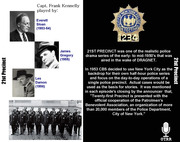
25th Preachings, George and Rory. Well, I'll allow you to basically see them. Yeah. Yeah. We're sure he didn't move out. Who told you that, lady? Yeah. You are in the muscle room at the 21st Preachings, the nerve center. A call is coming through. He will follow the action taken pursuant to that call from this minute until the final report is written in the 124 room after 21st Preachings. All right, I'll tell you what I'll do. I'll send an officer on a charge, please. Yeah, he'll be there on a rate. Do this way, son. 21st Preachings. It's just lines on a map of the city of New York. Most of the 173,000 people waged into the 910th of the square mile between 6th Avenue and the East River. It is known, if you ask them, that they lived or worked in the 21st. Whether they know it or not, the security of their home, their persons and their property is the job of the men of the 21st Preachings. The 21st, 160 patrolmen, 11 sergeants, and four lieutenants, who prove I'm the boss. My name is Kennelly, Frank Kennelly. I am captain in command of the 21st. I was working my boat tour, 8 a.m. to 6 p.m. After I had turned out the platoon, it consisted of the 64 men who would patrol the precinct for the next eight hours. I went to my office where, as had Dean Winkler, the precinct youth patrolman, was waiting to confer with me. The end of the screw year brings a variety of changes to the method of policing the precinct. We were preparing for them. Meanwhile, the ordinary routine of patrolling the precinct went on. Patrolman Paul Vaccaro, assigned to post 17, had finished his duty at a screw crossing near P.S. 79 at 9 a.m. He went to the nearest call box and rang in. Lieutenant Gorman, the desk officer, instructed him to walk to a dry goods store on 3rd Avenue and admonished the proprietor for failing to close the transom over his front door during the proceeding night. In complying with Lieutenant Gorman's instructions, he walked past a brownstone rooming house where a woman he knew to be the landlady was sweeping down the front stoop. Good morning. Good morning. Oh, officer. Yes? I want to ask you a question. Yes, ma'am, what is it? I'm Mrs. Catherine Neal. I own the house here. Yes, I know. I've got our finished room. Yes? Well, somebody's been bothering me. Give it to me. Maybe it's all my imagination, I don't know, but there's a man that lives on the second floor, Mr. Lowfield. What about him? Well, I heard he's here since Friday. Friday night, Saturday, Sunday, and Monday I haven't seen him. Maybe he's away. Oh, no, no, no, no, I don't think so. He's lived here over six years and he's never been away. Never. Well, he paid up in his rent. Oh, yes, yes, yes, he's paid up right to the minute. Did you say anything else you wanted about him, but he's regular about the house. Oh, tell me something, Mrs. You just have to see your habit. Like for instance, no one ever sees me during the daytime. I suppose he's up there sleeping in the daytime. But eight o'clock every night he comes downstairs and he walks out the door and he's out all night, almost, thanks to your habit. Well, if it isn't something... And the most confusing of all is that when I didn't see him yesterday afternoon I went up and knocked on the door. I thought maybe he was sick or something. You know, somebody that's got no friends and no one at all, I thought maybe he needed help. He didn't answer. Did you open the door to his room? Oh, no, no, no, no, no, I couldn't do that. Besides, I don't think I could get a key in there anyway. He's got the keyhole blocked with something, I think. It's not locked from the inside, is it? Why, it might be the key that's in the keyhole from the inside, buddy. If it's locked from the inside, you must be in there. Look, maybe, uh, maybe we better go up and take a look, Mrs. Yes, maybe we better. My goodness. Just let me get this trash up. It's gonna take a second. All right. Oh, tell me something, uh, how old the man is, Mr. Lowfield? Oh, he's middle-fifties, I suppose. About 65. I never asked him, I never asked him much. He's not one to talk. Just ignores everyone, ignores everyone around. What's his first name? Edwin. It's Edwin Lowfield. Well, I don't have to do for now. People walked by here and they throw everything that you think of on my stoop. They couldn't throw their cigarette capers in the gutter. They have to throw them on my stoop. Oh, go ahead. Oh, thank you. I just need the broom, right here. It's this way, the second floor. What, uh, what did you do? What do you mean? When he gets out at night, does he, uh, does he go to work? Well, I don't think so. I don't think he works at all. What does he live on? Well, who knows? Social Security, maybe. He's got the money to pay the rent. That way. Maybe the pension, I don't know. I never asked him. It's that one. Now, look, uh, you don't know whether he has any family or any friends? Well, none that I sell. I never sell any of them. Yeah, there's a key in the door, all right. Oh, that won't do you any good. I've been trying that since yesterday afternoon. The one you spoke to, saw him go out. No, no one. And he's never gone away on a trip for a weekend since he's lived here in six years? Never. No. Listen, we don't think he's... Oh, no. Well, that would be awful. Now, look, you say no one saw him go out, and he was in the habit of going out every night. Well, the key's in the door, and it's locked on the inside. Oh, my goodness. The poor old man. Look, I think we ought to kick it in. That's all right with you, of course. Wouldn't it be much better if we took the post box? Well, I think one good kick will take care of our old-time lock. Do you think we ought to? Well, the door is your property, Mrs. New. Well, maybe we better. All right, now, you just stand back over there. One good kick ought to take care of us. Be careful, though. I'll try. All right, that does it. You think we can't kick our thing back? Now, look here. You stay here. Are you dead? Yeah. Oh, my goodness. Poor old man. Yeah. This guy's been killed. This guy with his clothes on. No friends, no family, no one to take care of him. I don't know whether anyone even cares. I don't know whether there's money enough to carry him. Poor old man. You don't know whether he has any family, you don't, huh? Any relatives? I don't know. He never said a word. Never said a word about anything. Yeah. Well, let's put an address in the drawer and see if there's any papers with any names on them. I don't think there would be any. Whee! Is that real money? Yes, ma'am. That's what it looks like. How do they know we have a dime? There must be... there must be thousands. There could be. Well, how do you like that? With all that money, living in a nine-dollar hoops-per-loose room, he would have been living on Park Avenue. He lived on Park Avenue. Maybe he wouldn't have it. According to established procedure, Patrolman Vaccaro made no further attempt to examine the property of the deceased. Another resident of the rooming house appeared in the hall and was sent by the officer to call the station house and notify the desk officer. After an ambulance surgeon pronounced the man DOA in the presence of a civilian witness, the landlady, Patrolman Vaccaro recorded in his memorandum book the pedigree of the deceased, an accurate description of the body, and wearing apparel, and all the known facts concerning the time, the place, the manner, and the circumstances of the death. In the meantime, Lieutenant Gorman, the desk officer, notified the medical examiner and the 21st Detective Squad. A radio motor patrol car and the sergeant's car was dispatched to the scene. Lieutenant Matt King, the commander of the 21st Detective Squad, sent two detectives. I was told by the desk officer the circumstances involving a large amount of cash, and inasmuch as this property must be inventoried, both under the supervision of a superior officer and witnessed by a competent and responsible civilian, I went to the scene myself. While we were still waiting for the arrival of the medical examiner, a search of the premises was begun and an exact inventory of all the deceased property in the room was being taken. That's 7,400 so far. Seven thousand four hundred? I had no idea. I can't believe it. How did it all? Well, I don't imagine many people did. He never seemed to want for anything, but he certainly was going to be imposing to just make an old move. Right in the room of the drawer. Captain. Yes, Sergeant? He did his own laundry, I know. I'll be over here in a minute. Yeah. And I was going to go to the kitchen to cook his own breakfast in here. Ah, excuse me, Miss Neal. Yes, me, I'd love to call it. Well, what is it, Sergeant? Look what was in the closet. Two suitcases and a backpack. Yeah? A bonanza. Four bike books. Savings accounts. Brother, nine thousand three hundred dollars in here. Eight thousand seven hundred dollars in this one. Oh, that's too bad. Only four thousand in here. And last but not least in this one, nine thousand four hundred and fifty dollars. Well, he sure spread it around, didn't he? Well, mine, Captain, I keep it all in one place. Those look like stock certificates, don't they? Take a look at them. Ah, yes, sir. The five hundred chairs of Conciliated Edison, two hundred chairs of AP&T, two hundred chairs Pennsylvania Railroad, five hundred chairs Columbia Broadcasting System, two hundred and fifty chairs Dupont, so on, so on, so on, so on. Uh-huh. Uh, oh, and a whole stack of Defense Ponds. Yeah. Captain, I've come to the conclusion this fellow was loaded. All right, pick up the suitcase, let's take it over and get it inventoryed. Yes. Oh, here's some more you can put on that inventory, Vakero. Some more what? Some more money? Yes, bank books and securities. That makes it nine thousand eight hundred and sixty-five dollars in cash, Captain. In the one drawer. Nine thousand eight hundred sixty-five dollars? There's more. All right, when you get it totaled, enter it in your book and I'll sign it. Yes, sir, I'll do this. Then get to work on this stuff. Captain, can I talk to you for a minute? Yes, Miss Neal, of course. Oh, every one of those bills has to be listed by serial number, you know. Yes, Miss Neal. It is worth a fortune. That's what it's beginning to look like. What's happened to it? All this money, I mean. Well, we take it to the station house, the desk officer enters it in the blotter, and it gets sent down to the departmental property closest. I mean, who gets it? Who gets it eventually? Well, he might have left a will. I don't know who he'd leave his money to. He didn't have anybody. He told me time and time again he didn't have anybody. No one in the world. No one at all? Well, I think he did have a sister, but she died four or five years ago. Yes, mm-hmm. Four or five years ago. Do you know the sister's name? No, I hadn't any idea. I never mentioned it. I just remember that one day I saw him coming down the stairs in the morning, about 10 o'clock or at 10.30. Rarely had he been living here too long then, only about a year, but I'd never seen him come out in the daytime before. I said, where are you going, Mr. Lowfield? He said, to a funeral. He said his sister died. Oh, I see. Without a long island someplace. I don't know. I said I was sorry to hear the news, and he went out the door. That's the last you ever mentioned of her. The last you ever mentioned of her. Did you get much mail here, Mrs. Mills? No. I don't think he had one letter, not one letter, since he lived here. Nothing? Well, I already know. I get the mail every morning. I put on that marble table downstairs in the hall. The clinic come by there and pick it up, and I go through it every day to take out what's mine when I get it. I can honestly say that I've never seen one letter suggest Mr. Lowfield. Not even one? Not one. To the best of my recollection. Mm-hmm. Well, suppose he didn't leave a will. If he don't find it here, I don't think he did. What happens then? Well, then the estate is handled by the public administrator. What's that? Well, he's a city official whose job it is to administer the estates to people who die without leaving a will. Oh. He'll try to find relatives and claimants to the estate, and the estate will be disposed of by the surrogate's court. Well, is that good to find any relatives? As far as payments are concerned, Mr. Lowfield didn't owe anyone. He never bought anything, so how could he owe anyone? Well, in any case, it'll all be settled according to law. You know, I could really classify myself as a claimant. Could you? Yes. I've taken care of that poor old man for six years now. As a matter of fact, he made promises to me time and time again that I could have anything I wanted that he had. Just for the favors I've done him. I gave him food. I got clothes for him. I thought that his room was kept clean. He told me anything of his that I wanted I could have. I never paid any attention to him. I didn't think he had anything. I just did it out of the goodness of my heart. I think I have a right to claim. Don't you, Captain? Oh, that's something I can't pass judgment on, Ms. Neal. Well, what do you think I ought to do? Get a lawyer? You'll have to decide that for yourself. That poor old man. That poor, poor old man. You are listening to 21st Precinct, a factual account of the way police work in the world's largest city. You want to go to church, but you can't. On the church door there's a sign stating, Entrance Forbidden. Your ministers and priests and rabbis have been taken away. Your Bible has been burned. You're not allowed to own a crucifix or a St. Christopher's Medal or a mazusa. Your religion, all religions, are forbidden by order of the government. A bad dream? Yes, that's all it could be for an American citizen, because he's guaranteed the right to worship anywhere, anytime, and in any way he chooses. Some governments allow their citizens these privileges. Others deny them. But we Americans tell our government that it has no jurisdiction over religion, whatever it may be. We say so in good, clear language. Congress shall make no law respecting an establishment of religion or prohibiting the free exercise thereof. It's part of our Bill of Rights, our Constitution. Just 16 words, signed by a few men 165 years ago. These 16 words are your assurance that freedom of religion will be preserved, for you, for your children, and for generations to come. The First Amendment, freedom of religion, it is one of our freedoms. Now back to 21st Precinct and Captain Cannelli. Within another half hour a representative of the Medical Examiner's Office arrived. He made an examination of the body of John W. Lohfield and reported, pending an autopsy, that death was apparently due to natural causes. Patrolman Vaccaro, the first officer on the scene, placed a UF-95 identification tag on the wrist of the body, and it was taken to the Bellevue morgue. All the property of the deceased in the room had been collected and inventoried. It amounted to $14,655 in cash, bank books from four savings institutions showing deposits totaling $31,456, United States savings and defense bonds with a face value of $47,250, and other securities worth more than $185,000 in the current market. The totals were rechecked in the presence of a civilian witness entered by Patrolman Vaccaro in his memorandum book, which was signed by both myself and Sergeant Warren. The property was then taken to the station house by Patrolman Vaccaro and turned over to the desk officer for a transmittal to the property clerk of his department. In the meantime, Detective William Novak of the 21st Squad had been assigned by Lieutenant King to make an investigation in order to locate either relatives or close friends of the deceased. He interviewed the landlady, Mrs. Neal, to secure whatever information she had. He examined the papers and documents found in the room, and at 2 10 in the afternoon his task took him to Astoria in Queens, where he went into a new apartment building and rode the self-service elevator to the fourth floor where he walked down the hall to apartment 4D. This is the residence of Mr. George Bookum. Is Mr. Bookum home on the police officer? What's the matter? I'm Detective Novak of the 21st Squad is Mr. Bookum home? Sir, he's here. What's the matter? I'd like to talk to him. Are you Mrs. Bookum? Yes. That's right. Come in. Thank you. George! Got the ball game on in there. George! What? Someone here to see you. Who? A detective. Alright. George Yankspan. Mr. Bookum. Told you they said it took Reynolds out of there, Alma. He walked another man. He's saying my ghost. You're a detective, huh? Yes sir, that's right. William Novak of the 21st Squad in Manhattan. What can I do for you? Mr. Bookum, do you have an uncle named Edwin Lofi? Yes, that's right. It's my mother's brother. Lives in the East Seventies in New York. Well, I don't know where he lives. I haven't seen him in years. I think he did live there, George. Where's the Colonel? Afraid I got some bad news for you, Mr. Bookum. Yeah? He was found in his room this morning. Apparently he had a heart attack. Is he dead? Yes sir, that's right. I'm sorry. Well, too bad about him. From what I remember, he was a pretty nice guy. Yeah. Well, what are we supposed to do about him? We'd like Mr. Bookum to come over to Bellevue and identify the body. Why? Just a matter of procedure, sir. I always try to get a close relative or friend in cases like these. Notify them. Well, I'm not what you would call a close relative. From what I can learn, you're the closest, aren't you? Well, I guess I am the closest. But it's just my uncle and I haven't seen him in years. Not since my mother's funeral, as a matter of fact. Look, I'm sorry and all that, but I don't think it's any of my responsibility. Who the hell told you that? Well, I'm not telling you. No, that's right. I've got my own family. I've got my wife and two kids. What am I supposed to do about it? What do they want me to do? Arrange for their funeral and everything? Well, we thought you might like to, being the closest relative. Well, suppose he was my third cousin or something like that. Would you expect it if I was still the closest relative? We'd notify you. Do you still live in the same room? Yes ma'am, that's right. Why don't you see why they expect us to take care of us, your own expenses and all that. We've got no money for that. He doesn't mean that much to us. Nobody asked you to take care of any expenses. Well, somebody will if we get involved in making arrangements and all that. Don't go, George, don't be a fool. No, I've got to be at work at four o'clock anyway. I work at the hotel car in that over in Manhattan, yeah. But you still have time to come to Bellevue and make an indentification. Don't do it, George. You'll only get involved if you've got your own responsibility. No, that's right. No, I don't want to get involved. I don't want to get stuck under these expenses. I don't think you will, Mr. Bookham. It appears your uncle had a little money. Do you? Yes. I hope it's enough to cover the funeral expenses. Yes ma'am, it is. And then some. How much was it? Well, Mr. Bookham, we're not all together. Sure, there might be more than was in his room. What was in his room? Oh, it was cash and passbooks and securities worth about $275,000. Oh, wow. Yeah, $275,000. Yes, sir, that's right. Are you sure it's my uncle? I'm too sure, George. Well, it was a picture of a woman in his room in the drawer. It had, to my darling brother, written on it, from Margaret. He said it was my mother's name, Margaret. The photographer was from Jamaica. I checked him out, I looked up his records, and I got the address where your mother formerly lived. In Farsay. Yeah, I went around the building there and spoke to the super. He remembered that you worked for the Coronet in New York. I checked the name there and they gave me this address. I need you to make an identification and a race for the criminal, George. I think you walked too after all. You're his closest relative. Oh, sure, Alma. I intend to do everything I can. As I remember him, George, he was a nice old man, really nice. He was always good to me when I was a kid. And he was crazy about my mother. I'll do anything I can to help you, Detective Novak. Yeah, yeah, and anything. I just want to be of all the assistance I can. I want to help. Well, you can come over to Belgie with me and identify him. And then what? Just so the medical examiner releases the body and you can make any arrangements for the funeral if you want. Well, where's the money? It was taken to the 21st Precinct Station House. It'll be safe there, won't it? Couldn't be much safer. It gets entered in the blotter and turned over to the property clerk at the department. Oh, no aspersions, man. I was just concerned. I'm the closest relative, you know. Mr. and Mrs. Bookham left immediately with Detective Novak for Bellevue morgue in order to identify the body of George Bookham's uncle. During this time, I had been out on patrol at the precinct in Sector Car Number 4, and I returned to the station house at 2.40 p.m. in time to turn up platoon for the night tour at 4. I got out of the car, walked up the front steps, and into the muscle room, where Lieutenant Gorman was desk officer and Sergeant Waters was now on telephone switchboard duty. Hello, Captain. Oh, what's going on, Sergeant? Nothing much, sir. Just had a call from the press about the old man and the money. Oh, I referred them all up to the detective. Good. Oh, and Lieutenant King said he'd like to see you when you get back in the house. Oh, I'll bring him upstairs and tell him I'm back. Yes, sir. I'll sign the form. Yes, sir. Captain, floor at. Honey, very surprised, Detective Howard. This is Sergeant Waters on PSY. Yes, Sergeant. Lieutenant King wanted to know when Captain Cannelly got back in the house. He's back. Do you want to talk to the Lieutenant or shall I tell him? You tell him. Okay. How'd you get hold of Lieutenant King, Sergeant? I spoke to Howard upstairs, the Captain. He's telling the Lieutenant you're back. Okay. Oh, there's something I want you to do for me, Captain. 21st Precinct, Sergeant Waters. It's Oman McKarrow, Box 14. Lieutenant Gorman wants to talk to you, McKarrow. Hold the phone. Yes, sir. McKarrow's ringing in, Lieutenant. Okay, I'll talk to him, Sergeant. Yes, sir. Yes, sir, Captain. I'm giving a talk at the Lenox Hill Lions Club next week, Sergeant. Yes, sir. And I want to dwell on the connection between parking regulations and safety. Now, would you get together with the 124 man and dig out some recent aided and accident cards to deal with accidents which are the direct result of illegal parking or double parking or anything of that nature? Yes, sir. I want three or four good examples to illustrate the points I have to make. Yes, sir, I understand. See what you can do. Hello, Captain. Oh, Matt, Lieutenant King. Yes, Sergeant. It's been a rather interesting development in that low field, Captain. You know, the man who died with all the money in his home. Yeah. Oh, I'll be in my office, Sergeant. Yes, sir. An attorney called me a little while ago. What? An attorney called me, too, before I went out on patrol. Said he represents Mrs. Neal, the landlady. He wants to put in a claim for services against the estate. He wanted some information. I told him we had nothing to do with that and he'd have to check with the public administrator. Well, this was a different attorney, Captain. But first, let me get you up to date. Novak found Mr. Lowfield's nephew, a man named George Bookum. The nephew identifies the body of his uncle, the nephew and his wife. Oh, what about this other attorney that called you? Do you remember the mailing address and the stock certificates was in care? Yeah. By the fixed name in the firm. I put in a call down there. The girl who answered the phone didn't know anything about it. Said she'd check around. About an hour ago, this lawyer called me back. Name was Hupwell. Yeah. He told me the old man had made some shrewd investments over the years. That's obvious. Yeah, but that's not the big news. He said that Lowfield did have a will. Oh? He doesn't name either the nephew and his wife or Mrs. Neal. Oh, now. That's going to be a big blow. Okay. Made no will. He left everything to Columbia University. Look, Lowfield was such a smart investor. Did the lawyer have any idea what he was doing with all that cash in his room? No, sir. He was just as surprised at it as we were. He knew about the savings accounts and the war bonds. He had no idea about the cash. Lieutenant King? Excuse me. Hello, how's that? Captain? All right. Mr. and Mrs. George Bookham. Captain Kennelly. Captain? Hello. How do you do? That's Lieutenant King. Lieutenant? How are you? Mrs. Bookham. Mr. Neal. I've just been down to Belgium, Lieutenant. Mr. Bookham identified the body that had been lost to Lizzie's uncle. Take with him, all right? As soon as we can, we're going to have him linked with Neal Pollard and ask Doria. He'll have a nice service. Wow, that'll be fine. Very nice service. Mr. and Mrs. Bookham wanted to come up here and talk to you, sir, about the property that was found in Mr. Locke's room. Well, there's no sense talking to me about it. It's been inventoried, entered in the records, and sent down to the property clerk's office at 400 Bloom Street. That's all I'm going to be well taken care of. Oh, we don't have any doubts that it'll be well taken care of. I just thought I'd, like, look at it and check over the list of what was there. Yeah, well, I'm sorry, but I don't have authority to give you permission to do that. And it's out of my hands now. Down at the property clerk's office. I don't see why we can't do it. After all, it's ours. George is the closest relative to him. It'll all be ours. How do I know about any permission? Anytime there's a question of disposition of an estate, the surrogate's court must rule on it. Any such property can't be released without a court order. Well, we didn't expect you to release it. We just wanted to inspect the inventory that you said you had. Yeah, well, I'll tell you what to do. Yeah? Detective Novak will take you to the desk officer right over there and introduce you. He'll give you the address of the property clerk and tell you who to see down there. They'll have all the information downtown. The property clerk is at 400 Bloomsbury. I don't know why this old cop will ask for all the money of the hour. As I said, that has to be determined by the court, Novak, doesn't it? Will you take them over to talk to Lieutenant Glomans? Yes. Do you want to come this way, please? Well, thank you, sir. Thank you. You're welcome. What other news? I thought you were going to tell them that. I was waiting for you to do it, Captain. Well, that's the court, John. I figured it could wait. Their second piece of shocking news in one day might be just too much. Twenty-first Precinct Sergeant Waters. Who? What happened? He fell off a truck. Yeah. Yeah. How old the boy? Now, wait a minute. Exactly where is this? No, don't touch him. Just tell him I'm sending the officers right over there. And so it goes, around the clock, through the week, every day, every year. A police precinct in the city of New York is a flesh-and-blood merry-go-round. Anyone can catch the brass ring, or the brass ring can catch anyone. Twenty-first Precinct. A factual account of the way the police work in the world's largest city is presented with the official cooperation of the Patrolmen's Benevolent Association, City of New York. This is the United States Armed Forces radio and television service. The United States Armed Forces radio and television service. The United States Armed Forces radio and television service.