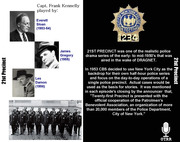
21st precinct, Sergeant Tierney. Yes? What kind of bomb? Wait a minute, just a second, take it easy. In the art gallery where? Yeah, yeah, yeah. You are in the muster room at the 21st precinct. The nerve center. A call is coming through. You will follow the action taken pursuant to that call from this minute until the final report is written in the 124 room at the 21st precinct. No, no, don't do that. The officers will be right there. Yeah. Go outside on the sidewalk and wait for them. That's right. 21st precinct. It's just lines on a map of the city of New York. Most of the 173,000 people wedged into the nine tenths of a square mile between Fifth Avenue and the East River wouldn't know if you asked them that they lived or worked in the 21st. Whether they know it or not, the security of their homes, their persons, and their property is the job of the men of the 21st precinct. The 21st, 160 patrolmen, 11 sergeants, and four lieutenants of whom I'm the boss. My name is Cannelli, Frank Cannelli. I'm captain in command of the 21st. I was working my day tour, 8 a.m. to 6 p.m. It was warm and sunny. After I turned out the platoon, I cleaned up the paperwork that had accumulated since I was last on duty 24 hours before. Then after seeing two visitors in regard to their applications for gun permits, sector car number three came by the station house for me and I went on patrol of the precinct with patrolman Eugene Dillon as operator. The other kid comes home, captain. He said to me, Pop, you promised me this year I could have a new mitt. Uh-huh. Trappery one. You know, the new style for outfielders. The movie house down on the next block, Dillon. Yes, sir. I want to stop in the candy store next one. Yes, sir. Well, he's got it all picked out. Took me down to the sporting goods store. $13 for a mitt. $13. That's a lot of money. It used to be the best mitt you could buy with $5 tops. $13. How do they expect anybody to spend $13 for a mitt for a kid, a 10-year-old? Because all the kids are getting them. I said not 13 bucks, but they're not 13 bucks for a glove. Well, he was holding back the tears, captain. I started a weekend and I thought his mother could use an Easter dress and I could use some shoes and the kid needs some clothes himself, so I said a big final no. Yeah, well, that's a lot of money for a glove. Yes, sir, you're telling me. I'll be out in a minute. Yes, sir, captain. Uh, captain, hello. Hello, Mr. Wolfsman. Always a pleasure, captain. I stopped by to tell you that we're going to have to do something about that element that's beginning to hang out here at night, Mr. Wolfsman. What can you do? A soda, captain? No, no, thanks. Not even a small chocolate? Nothing, no thanks. You think I want those kids in here, captain? I don't want them. I try to discourage them. I don't let them read the magazines or the newspapers, but they come in here anyway. I don't want them. You tell me how to get rid of them. I'll be the first one to agree. Well, the manager of the movie is complaining they're annoying the people on the way to and from the theater. Captain, believe me, they annoy my regular customers. They annoy me. Who needs them for a 10 cent soda here and a nickel candy bar there? I don't need them. But every night, there they are. And to tell you the truth, I'm a little bit scared of them myself. These 14, 15 year olds bullies. Tough talkers. They'll show me what to do and I'll do it. Keep them away from here. Yes, Dylan. The ball came over. I think you want a roll on. Yeah. Broadstone Gallery on Madison Avenue. They got a phone call a bomb was left in the place. A bomb? All right, let's go. I'll be back later, Mr. Wolfsman. A bomb? That sounds like my element in here. Go ahead, Captain. Any other information? No, sir. The dispatcher gave the call to sector cars one and two. No other details. Okay. You better go across and down the park. Yes, sir. Thirteen dollars. What did you say, Dylan? I said thirteen dollars, Captain. Thirteen dollars for a glove. We made the run across and downtown. The traffic was heavy and the Broadstone Gallery was in the exact opposite corner of the precinct. It took nearly five minutes. As we sped to the scene, I called to mind a picture of Broadstone. It was a combination auction room and art gallery. Good reputation. Large sales of estates and collections. Showings by famous painters and sculptors. Located on the ground floor of an apartment building. One large room with offices on a balcony. When we turned the corner into Madison Avenue, there were four police cars in the block. Cops were keeping the sidewalks clear in front of the gallery. The crowd was being held across the street and fifty feet on each side of the store. Okay, Dylan, let's go. Yes, sir. All right, Sergeant Jackson, Captain. Keep those people back. Get them across the street. Sergeant. Yes, sir, Captain. Now, what do we got? There was an anonymous phone call. The caller said he put a bomb in the place. There was an auction in progress. Forty or fifty people. We got them all out. Any sign of a package or anything, Sergeant? We haven't looked, Captain. The first job was to get the people out. Good. Well, what happened? Did you find anything? We haven't looked yet. This is Captain Kenley. Mr. Broadstone. How do you do? Well, this is absurd. It's really absurd. I can't think of any reason any person in his right mind would make such a call. Well, maybe he's not in his right mind, Mr. Broadstone. Let's take a look inside, Sergeant. Yes, sir. Dylan. Yes, sir. A joke. Must be a joke. Mr. Broadstone. Yes? You better get back behind the line. Well, Captain. Go ahead, please. Yes. It's all right. Behind the line. Everybody out, Sergeant? Yes, sir. Signal those men to keep the people back into Weaver Mount. Yes, sir. All right, Captain. Let's go. Dylan. Yes, sir. Have the detectives been notified? Yes, sir. I rang in. The desk officer notified them. Okay. Those chairs were set up for the auction, Captain. The officers are upstairs in the back, on the balcony. All right. Let's take a look around. If you see anything, let it lay. Sergeant, take that eye. Yes, sir. Dylan, left side. Yes, sir. I'll go down the center. Go ahead. There's a room on the side there, Captain. All right. We'll look at that left. Yes, sir. Anything, Dylan? No, sir. Somebody left an umbrella. Captain. Yes? Under the chair. Pack it. Don't touch it. Don't worry. Put it here, Captain. This row. There it is, Captain. See it? Yeah. That's just about the right size. Just about the wrong size, you mean, Sergeant? Yeah. Well, it can't stay here. No, sir. Can you move that chair without disturbing it? Yes, sir. Easy. Oh, that's good. All right. Move that one too, Dylan. Yes, sir. That's good. I don't hear anything ticking to you. Now, see that big heavy carpet on the platform up there, Sergeant? Yes, sir. It was being auctioned off. If we get it under there, that would hold any blast down to a minimum. Yes, sir. We could fold the rug over the box a couple of times, but the rug is too heavy to carry over here. All right. We'll take the box over there. Go on over, Sergeant. Flip the corner of the rug up. Yes, sir. Let me know when you're ready. I'll, uh, carry it over, Captain. All right, Dylan. You ready, Sergeant? All set. Well, easy now. It goes nothing. Oh, brother. What's the matter? Nothing's the matter, Captain. Everything's great. It doesn't weigh two ounces. Everything all right, Captain? Relax. It's too light for the explosives. You know something, Captain? What? You know, bury that glove for my kid. These days, $13 isn't so much. We opened the cardboard box to examine the contents. Inside was a lady's hat, apparently left under the chair by an excited auction patron. By that time, Lieutenant Matt King, commander of the 21st Squad, had arrived on the scene with two of his detectives. Together, we conducted a thorough search of the premises. No trace of a bomb was found. The people were readmitted to the gallery, and upstairs in the office, Lieutenant King, Detective William Novak, and I began to talk to Mr. Ernest Broadstone, the owner of the gallery, and his secretary, Miss Helen McCleese. Yes, sir. I was up here all alone. The auction was going on downstairs. I see. And you, Mr. Broadstone? Well, I was on the floor downstairs watching the auctioneer conduct the sale. This was what time? Oh, um, 10.30, 10.35. Isn't that right, Helen? Yes, sir, about. It's all right. Yes, sir. And you answered? Yes. Where were you when you answered, Miss McCleese? Right outside at my desk there. Can you remember exactly what the man said? Oh, not exactly, but pretty close. What? Well, I said, Broadstone galleries, good morning, and he said he'd like to talk to Mr. Broadstone. What tone of voice did he use, Miss McCleese? What do you mean? Well, was it high-pitched or low? Was he trying to disguise it? Oh, no, no, I don't think so. He was using a normal voice. He was very polite, really very polite. Why after he told you he'd like to talk to Mr. Broadstone? Well, I said Mr. Broadstone was very busy at the moment. He was downstairs on the auction floor. I wanted to take a message and he said he had to talk to Mr. Broadstone right away. I told him that was impossible. And he said it was very important. He's a matter of life and death. I didn't know what to do, so I told him to hold the wire, and I'd see if I could find Mr. Broadstone. And that was the extent of your conversation with the man? Yes. Did it sound like anyone you know or had spoken to before? Oh, no. It sounded familiar in no degree? No, sir. Do you think you'd be able to recognize the voice if you heard it again? Well, I couldn't say. I might be able to. When you went downstairs, Miss McLeese, did you leave the phone off the hook, lay it on the desk? No, sir. You see, we had three lines. There's a button on the phone for each of the lines, also one for local, that's in your office calls, and one for hold. I pressed the whole button and put the receiver back on the phone. You went downstairs to find Mr. Broadstone? Yes, I went downstairs to find Mr. Broadstone. Where were you, Mr. Broadstone, when she found you? Well, I was standing on the right-hand side of the gallery, observing a bidding on a particular item that was up for auction. The right-hand side as you faced the door or as you faced the rear of the room? No, as you faced the rear of the room. That's on the same side as the stairs leading down from the office? Yes, that's right. Well, what did Miss McLeese say to you when she found you? Well, essentially the same thing she told you, that the man said it was a matter of life and death. You decided to take the call? Well, Lieutenant, I have a wife and children, a lot of friends, a matter of life and death can take in a lot of territory. So I went to the phone. Did you come up here, upstairs, to take the call? No, Captain, I stayed downstairs. I went to a little ante room off the main gallery. We have an extension in there, the salesman's phone. I see. What was the conversation you had on the phone? Well, I picked up the phone, I said hello, and he asked, is this Mr. Broadstone? I said yes, and I asked who it was calling. He said something like, never mind, and he told me there was a bomb in the place. Well, I thought somebody was kidding me. That's hardly something to kid about. Yes, sir, that's what I told him. But he said he wasn't kidding, it might go off any minute. Well, I started asking him some questions, but he wouldn't talk to me. He hung up. What did you do? Well, I stood there for a minute. I didn't know exactly what to do, whether to call the police first or get the people out. There were 50 or 60 people out there in the gallery at the auction. I decided to call the police first and not to tell the people. Let the police handle that. Because if I got up there and said there was a bomb in the place, there might be a mad rush for the door and someone could be sure to get hurt or killed. But I couldn't believe, really, there was a bomb in the place. I thought somebody might be pulling a joke. So I called the police and went out to the sidewalk to wait for them. Well, that was the wisest thing to do. Oh, thank you. Well, the first one got there almost as soon as I got outside, that sergeant. I explained to him what happened. Meanwhile, another police car came up, and they told me to stay on the sidewalk. They went in and handled the whole thing. They must have handled it fine because the people started walking out slowly, no disorder, pushing, anything like that. They did a good job, all right. Well, Mr. Broadstone, did the voice of the man on the phone sound in any way familiar to you? No, I can't see that it did. Listen, at least you said he was extremely polite and rather well-spoken. Oh, yes, that's right. Did you get the same impression, Mr. Broadstone? Yes, yes, I did. His delivery was slow and even, I'd say even polite, yes. How many employees do you have here, Mr. Broadstone? Well, there's nine altogether, myself and Miss McLeese. Also upstairs in the office is the bookkeeper. She's across the hall as a porter and a shipping clerk and the four men on the floor. Have they all been with you a long time? Well, I hope you're not inferring that any of my employees is involved in this, Lieutenant. They were all here at the time. I was thinking more of a former employee, Mr. Broadstone. Oh, well, our turnover we have is very slight, very slight. Captain. Yes, Sergeant. The bookkeeper says there's a call from Mr. Broadstone. Oh, well, tell her to take the message, will you? The man says it's a matter of life and death. Well, have the bookkeeper say he'll be right with him, Sergeant. Yes, sir. Now back. Yes, sir. Get out another line outside. Yes, sir. See if we can find out where it's coming from. Go to the bookkeeper's phone. Okay, Lieutenant, right. You're going to listen in, man? Yes, Captain. Pick it up, Miss McLeese. Take your time, but don't lose him. Turn him over to Mr. Broadstone. Now? Yes, go ahead. He's going to listen out at your desk. Mr. Broadstone's office? Yes. Who? Okay, Matt. Okay, I'll set. Just ask Mr. Broadstone to come to the phone, please. But I have to tell him who's calling. You know very well who's calling. Now, please, I don't have much time. Well, all right, just a moment. Hello? I just want to tell you, Mr. Broadstone, it's still a matter of life and death. Now, look, who is this? It's me, Mr. Broadstone. I spoke to you a little while ago. I know you did, but this is a very poor excuse for a joke. It's no joke, Mr. Broadstone. Well, we couldn't find anything in the gallery. We searched. The police searched, didn't they? I would have called the police if I were you. You just hit a fool of yourself. Well, what could I do? You told me there was a bomb in the place. I'm sorry about that. There really wasn't. Well, I'd like to know why you did such a thing. Oh, because I have want something from you. A what? I want $5,000. $5,000? Please. Why? So I don't really put a bomb in your gallery. And next time I will, if I don't get the money. Goodbye, Mr. Broadstone. Wait. I'm sorry. Goodbye. Hello. Hello. $5,000 he wanted. You heard him, Lieutenant, didn't you? Yes, I heard him. What do you think, man? He was like a psycho to me, Captain. I'm scared. I'm really getting scared. Well, there's nothing to be afraid of, Mr. Cleaves. Oh, you can say that. He didn't threaten to bomb the police station. He threatened to bomb my place of business. Lieutenant. Yes, nothing. I didn't face the call. Didn't stay on long enough. Another minute and maybe we would have made it. Oh, it's too bad. Well, now how can you take some care of it? I don't see how you can possibly. We will. This had to happen to me. Why did it have to happen to me? Nothing's happened to you yet, Mr. Broadstone. We'll try to see that it doesn't. Lieutenant King was soon convinced that the man we sought was not a professional extortionist. A telephone check with the Bureau of Criminal Information showed that no complaint of this type had been reported in a considerable period of time any place in the city, although extortion by threat to bomb was once quite common. He leaned rather to the theory that the call was from a disgruntled and psychopathic former employee or a disappointed artist whose work had been turned down by Mr. Broadstone. Two detectives assisted by employees were set to work on the records of the gallery to look for just such possibilities. In addition, Mr. Broadstone was questioned closely about his personal life. The threat might have its basis there. Mr. Broadstone said he was happily married and went out with no other women. He could think of no enemies he had made through business dealing. He discounted entirely the possibility of a personal vendetta. Lieutenant King, however, instructed two of his detectives to make a thorough check to verify Broadstone's assertion. By noon, all the uniformed officers who answered the call had been instructed to resume patrol, and the case was left entirely in the hands of the detectives. I returned to my other duties. At 4 p.m., I turned off the platoon for the night tour, after which I worked with a 124 man at our first attempt to arrange the vacation schedule to the satisfaction of as many men as possible. At 6, I changed to civilian clothes, signed the blotter, and left the precinct to go off duty until the following day when I walk into the station house at 3.30 p.m. Hello, Captain. Go ahead, take the call. I'll sign the blotter. Yes, sir. 21st Precinct, Sergeant Jackson. What's going on here? Another must, Captain. Pretty quiet. I just got in. Captain? Yeah? Lieutenant King wants to know if he can see you for a minute. Yeah, sure. Before the turnout? The Captain wants to know before the turnout, Lieutenant? Yes, sir. Yes, sir. All right. I wonder if he's coming down. Yes, sir. He'll be right downstairs. Okay. There's some messages on your desk, Captain. I've got a couple more here. Oh, thanks. And Sergeant Collins went sick. Yeah? What's the matter with him? His wife rang in. He says it looks like a virus. He's got a doctor coming. Okay. Is Lieutenant Snyder in the house yet? I didn't see him come in, Captain. Tell him to come into my office when he gets here. Yes, sir. I'll be in there. Hello, Captain. Oh, Matt, come in. Thanks. Good night, Matt. Yeah, thank you. I want to talk to you about that bomb case at Broadstone Gallery, Captain. Yes, Matt. How are you doing, Matt? Nothing. I haven't heard from the boy again. No? No, sir. I've had two men planted over there around the clock. I've had a man planted at Broadstone's apartment building. Well, how does his story check out? He's all right. No women. Pretty square-dealer in business. No enemies that we could find. Good reputation all around. Mm-hmm. Well, how can I help him, Matt? Well, the squeals are piling up on me, Captain. I've had almost the whole squad tied up in this thing since yesterday morning. I've got two men planted over at the gallery now. They close at 6 o'clock. Last night I had men sitting outside in the car all night. I want to pull them off. Yeah? This guy's a psycho for sure. If he's going to put a bomb in there, he won't do it at night. I don't think. Look, just in case, what I'd like is for you to instruct your men on post over there and the sector men to take a look as often as they can. Yeah, sure, man. But what are you going to do when they open up tomorrow? Well, I'll send a couple of my best hawkshaws over there when they open up in the morning. All right, Matt, I'll give the instructions. Excuse me. 21st, please, in, Captain Cannelli. Sergeant Jackson on TS, Captain. Novak is ringing you through Lieutenant King. All right. Novak for you, man. Oh, thanks. He's one of them over there. Lieutenant King. Just a second, Lieutenant. Come in. Lieutenant King. Novak, Lieutenant. Yeah, what is it, Novak? Mr. Broadstone got a letter from the Bombardier. Just now? Well, he was out this afternoon. He just got back. When the letter came, the Secretary put it on his desk and opened it, it was much personal. What's it say? Just a second, Lieutenant. No, that's all right. I can see it. Made up of words, cut out of a newspaper and taped it down. It says, deliver $5,000 by tonight at midnight. You must not fail. As I said, this is a matter of life and death. That's all? Yes, sir, that's all. Well, how do we know where the money is supposed to be delivered? Well, that's no problem, Lieutenant. He signed his name and address. After getting further details over the phone, Lieutenant King instructed Novak to bring Mr. Broadstone and the letter into the station house. In the meantime, I turned off platoon for the night tour at 4 p.m., giving special instructions to the men concerned to keep a close watch on the Broadstone galleries during the night. Lieutenant King told me the letter was signed, Carlton Adbury. The address given was the Pleasant Apartment House on Madison Avenue, not too far from the Broadstone galleries. When Detective Novak and Mr. Broadstone arrived at the station house, they were directed to my office where Lieutenant King was waiting. Come in. Thank you. Do you remember Captain Kelly and Mr. Broadstone? Yes, of course. Sit down, Mr. Broadstone. Yeah. Where's the letter? I got it, Lieutenant. Captain. Oh, nice man. Broadstone, do you know anyone named Carlton Adbury? No. Ever heard of him? No, I can't say I have. Does it sound familiar? No, not at all, Lieutenant. A good person is such a person, how could he be so foolish to just find his name? That's the first question I'm going to ask him. But I'm grateful to him. Don't misunderstand me. Then you really think he's the right one? The story was in all the newspapers. Couldn't it be some crank, another person entirely? There are people like that. I've read about them. I've handled them, Mr. Broadstone. I read all the newspaper stories. Not one of them mentioned the fact that the man consistently referred to this as a matter of life and death. Oh, I think this is the right man. With Lieutenant King, Detective Novak, and Detective Whitey Howard, I left the precinct house a few minutes later. We drove to the Madison Avenue address given in the letter received by Mr. Broadstone. On arrival there, we asked for the manager of the apartment building. He was out. The elevator operator told us that Mr. Carlton Adbury did in fact live in the building. He said that Mr. Adbury was a man of about 40, perhaps a little older. He had a reputation of being rather eccentric in his habit. He would stay in his apartment for days or he would leave without luggage and not return for days. As far as the doorman knew, Mr. Adbury was in no financial difficulty. It was rumored he had an independent income. We had the doorman get the passkey and take us up. There it is. That one. Yeah. He hasn't gone off on one of his three day yawns, man. I don't think so. He's waiting for the $5,000. You want to try it again? Coming. Yeah? Is Mr. Carlton Adbury in? Yes, just a moment. Yes? Oh, is Mr. Broadstone in, you gentlemen? In a way, yes. Well, please come in. Have you been standing here long? I didn't hear the door at first, the electric razor, you know. Well, there's so many of you. Won't you come in the living room? No, that's hard. Yes, Lieutenant, I got you. Where are they going? Just to look around. Oh. Well, it's a very attractive apartment. Did you bring the money? No. You didn't? But that was my understanding with Mr. Broadstone. We're police officers. But I need the money. Why did you happen to pick on Mr. Broadstone? Why should he give it to you? Well, because I need it. But why him? Where have you been getting it up until now? From the bank. But they won't send me anymore. They said I have to go back to the hospital. And that's not fair, is it? It's my money. It was left to me by my mother. Why should they send it to me? I don't have to go back to the hospital just because they say so. I don't like it there. What made you think Mr. Broadstone should give it to you? Because I walk past his gallery every day. And every day there were different paintings in the window. Never the same. Always different. I don't want to go back to the hospital. Why did you threaten to leave a bomb in the place? If I didn't, why else would he give me the money? Had to be a reason. Had to be a reason for everything. Nothing back there, Lieutenant. Okay. I don't want to go back to the hospital. Do I have to? Is that where you're going to take me? Where is the stuff you were going to make the bomb out of? Oh, I wasn't going to make the bomb. I really wasn't. I knew I wouldn't need to if I frightened him enough. Did you think of what would happen to you if you didn't frighten him at all? Yes. But what difference did that make? I was going back to the hospital anyway. Well, I guess you will. After a few stops on the way. 21st Precinct, Sergeant Tierney. Yeah. Where is it you lost? Briefcase, huh? Yeah. Where did you get out of the taxi? Yeah. Yeah. And so it goes, around the clock, through the week, every day, every year. The police precinct in the city of New York is a flesh and blood merry-go-round. Anyone can catch the brass ring. Or the brass ring can catch anyone. 21st Precinct, a factual account of the way the police work in the world's largest city, is presented with the official cooperation of the Patrolmen's Benevolent Association, an organization of more than 20,000 members of the police department, city of New York. Everett Sloan and the role of Captain Cannelly, 10 Lynch's Lieutenant King, featured in tonight's cast were Jan Owen, Terry Carter, Bill Lipton, Don McLaughlin, Ken Delmar, and Ivor Francis. Written and directed by Stanley Niss. Produced for CBS Radio by John Ives. Art Hanna speaking.