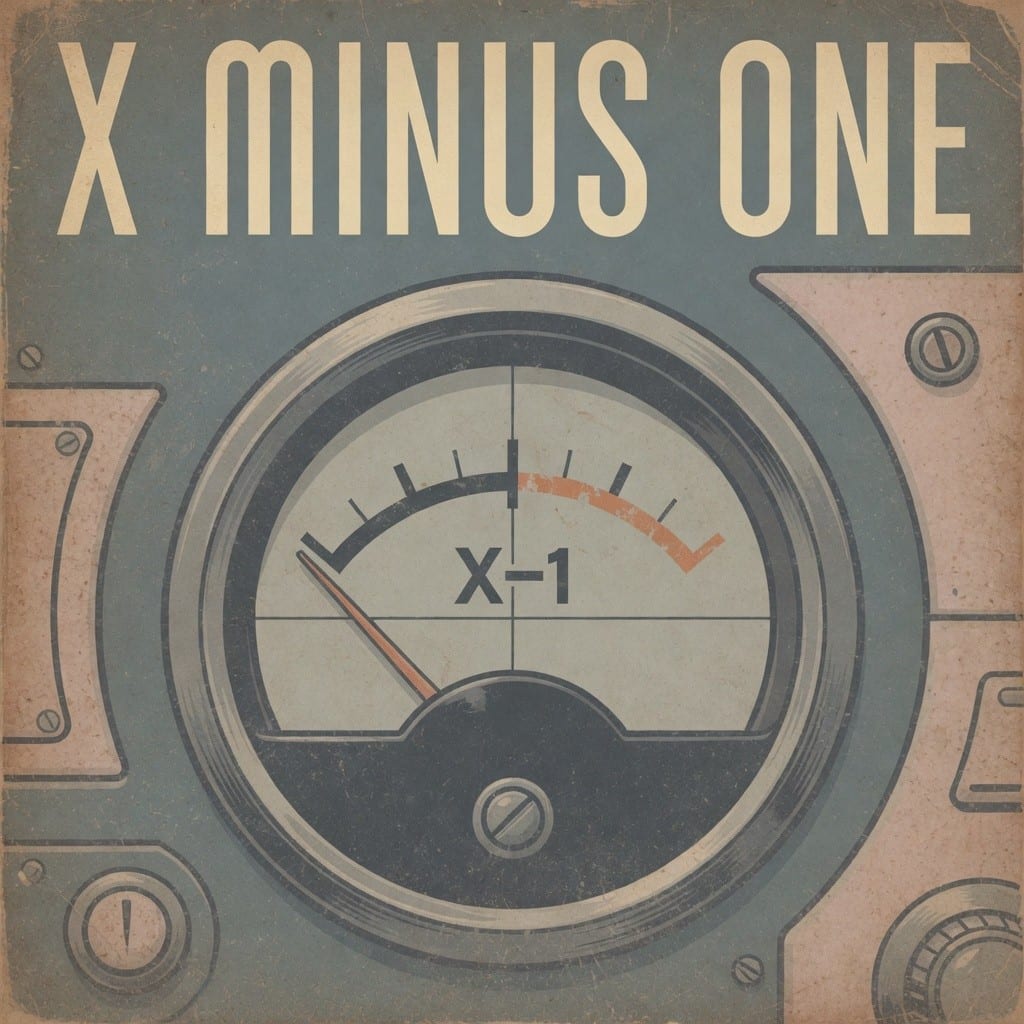
This is Walter O'Keefe inviting you to listen in on the Nightline. Tonight live the incredible life of ages yet to come in a time that might be a million years from now on X minus one. Countdown for blast off. X minus five, four, three, two, X minus one, fire. From the far horizons of the unknown come tales of new dimensions in time and space. These are stories of the future, adventures in which you'll live in a million could be years on a thousand maybe worlds. The National Broadcasting Company in cooperation with Galaxy Science Fiction Magazine presents X minus one. Tonight point of departure by Vaughan Shelton but first hear this. A garden party for a queen and you're invited. A trip to Tokyo and you'll go along. The Army football game at West Point and you have a seat on the 50 yard line. These are just a few highlights of the weekend Monitor has planned for you. Tomorrow night Jinx Falkenberg is your personal guide at the party being given for England's Queen Elizabeth in the garden of the British Embassy in Washington DC. Saturday you'll be off to historic West Point for the great Army Pittsburgh football game and that excursion will be followed later in the Monitor day by a trip to Tokyo where you'll visit the famed Japanese Kabuki theater and the exotic Ginza nightclub district. Eleanor Roosevelt, Helen Hayes, Pat Boone and Tony Perkins will be among the celebrities visiting Monitor this weekend. There'll be music, comedy by Fever McGee and Molly, Bob and Ray, features, news and sports. So start your weekend right with Monitor on Friday night and stay with Monitor all weekend long over most of these same NBC radio stations. Now X minus one and point of departure by Vaughan Shelton. Before I make this statement, I am well aware that you gentlemen are the board of directors and not likely to believe me. The overwhelming concrete fact that we face is that the Utah Flats atomic plant is short $300,000. You have asked for an explanation before the district attorney's office is called. I shall explain, but I know I will not be believed. It started with a letter I received from Dr. Winson Reed, the archeologist. He is the top man in this field. You may have heard of the Yukton discoveries and of course the Poseidon tablets found in the vault under the Sphinx. His letter introduced me to a Simon Kane who flew in from Salt Lake City and made an appointment for the following afternoon. Mr. Donner, I am sorry that Dr. Reed has left again for the field. I should like to have him with me at this meeting. Well Mr. Kane, I don't quite understand why you have come to me. I am merely a plant manager for Alai Electronics and I have no interest in archeology nor have I access to any funds. I am not here on a begging expedition, Mr. Donner. I will come right to the point. Do you know anything of the Poseidon tablets? Well, I have read newspaper accounts. The preliminary translations of the protolithic seals that surrounded the tablets indicate a civilization that flourished on the equatorial continent until it was destroyed by a natural catastrophe identified as the biblical flood at about 10,000 B.C. Oh really? I am afraid I had it confused with the Dead Sea Scrolls. Well, the lay public has not been informed that the tablets have been opened. Opened? Why yes. The original inscription surrounded them. They were in wedge-shaped characters on baked clay. They have been removed from the tablets. Well, it's all very interesting but really I think... Mr. Donner, fourteen tablets were never registered with the Egyptian Museum. They remain at large. Six of them have been translated so far. They indicate a scientifically advanced culture and particularly they concern themselves with a solar energy converter. You mean that literally? A power source from the sun? Yes, according to the preliminary translations, this solar converter delivers such fantastic power that it makes our nuclear source look as primitive as a windmill. And I suppose that's why you've come to me. Yes, we wanted to check the inscriptions against actual tests in the laboratory in a field. Well, I'm quite willing to have my engineering staff look over the plans and give you an opinion if it will help you in your research. Why, that seems quite fair. I'll bring them to your office in the morning. I suppose I half believed him at the time. I had heard of the Poseidon tablets and I knew that the frontier of archeology had been pushed back far beyond current thought by them. You gentlemen of the board of directors will have to believe me that I suspected no fraud. I had no reason to doubt Kane. I called in Rowell and Henninger, two of our engineers, and left them alone with Kane. About five o'clock I got Rowell back in my office. Mr. Donner, it's remarkable, quite remarkable. Of course, I don't quite understand the field mathematics involved. Rowell, I want a simple answer from you because I'm a simple executive type. Will that thing work or not? Well, of course, it'll need a field test, but theoretically I see no reason why it shouldn't. Should we build it? Well, there isn't any question, is there? It's revolutionary, quite revolutionary. All right, you and Henninger are assigned to it. I'll give it a project name in the morning and allocate a research budget. You'll be working with Mr. Kane. I took great care to protect the corporation's interests. I shall submit in evidence the contracts I drew up with Mr. Kane. I sent Rowell and Henninger up in an isolated shop in the west corner of the plant area, and they had a device functioning within three weeks. A week later, I checked in at the shop again and found Rowell still working with the power unit. Naturally, I asked what he was doing. You see, I'm getting ready to mount the solar energy converter on the projectile now, Mr. Donner. What projectile? Oh, Mr. Kane leased a surplus one-man rocket from the White Sands Project. We're going to rig the solar unit in it. You mean power a rocket with the solar unit? Most definitely. You see, it's a question of field mathematics and the quantum around... Rowell, I'm an administrator, not a scientist. I ask you your engineering opinion. Is this a feasible research project? Yes. Yes, it most certainly is. Using the solar converter, you could develop thrust up to escape velocity at only 10% of potential. This solar converter is creating more power than any atomic pile we have. Mr. Donner, this is it. Spaceflight. You are listening to Point of Departure, tonight's attraction on X minus one. This is... Now back to X minus one and Point of Departure. Of course, whereas the purchase of the projectile was not authorized, I should like to point out to the board that I acted most conservatively. I checked the course sheets and discovered that the rocket purchase was actually within the allowable debt limitations for my department, and so I okayed the project. However, I was concerned with the irregularity of an expenditure before authorization, so I drove out to Simon Cain's place to speak to him about it. Oh, Mr. Donner, I'd like you to meet Porter Hayes. Hi. How do you do? No, no, no, look here, Mr.... Mr. Hayes has agreed to fly the ship. Look, that's what I want to talk to you. He's with the Pan-Columbian Project and he's flown all the other types that have been flown so far. This is the one that'll make history, Mr. Donner. This ship will fly anywhere in the solar system, probably clear out to most other planets without even carrying a fuel supply. Best thing about it is the actual guarantee of a return trip. You know, those geniuses down at Pan-Columbia have plenty of ideas for getting you out there, but very few for getting you back. I've been showing, Mr. Hayes, the photographs of the original tablets and translations. You see, Mr. Donner, aren't they beautiful work? Kane, I want to talk to you in private. The cost sheets. Hey, Kane, where's the last tablet? There are only pictures of 13 here. That's right. The first 13 tablets take us through the construction of the unit and the ship and the inventor's six successful trial flights. The 14th hasn't been translated yet. It takes about a month to decipher each tablet. Do you do it yourself? Oh, no, no, no, that's a special study. My wife does it. She's an Egyptian scholar in her own right. Her father was Egypt's foremost antiquarian. I believe she's about to honor us with her. Ah, Nalja, I should like you to meet Mr. Hayes and Mr. Donner. How do you do, gentlemen? How do you do? How do you do? My dear, we thought you could give us a hint about the text of the 14th tablet. Are you far enough along? No, I am sorry. I have only just started. The language symbols are a little different from the others and it is a bit difficult to read. Well, all I want to know is when's the ship going to be ready? In good time. It's waited 12,000 years. A week or two more won't matter. During the next two weeks, I was too busy with other things to worry much about the project, but I would like to call the board's attention to the fact that I submitted multiple progress reports at five-day intervals as required by plant operating procedure. I am at a loss to understand why those reports are now missing from the files. One evening on a visit to Salt Lake, I was dining at the Pioneer Arms when I spotted Porter Hayes at the table across the room. He was with a young lady who looked familiar to me, even from the back, and of course I realized it was Nalja Kane. I felt it was discretionary on my part not to inform Mr. Kane of his wife's continuing acquaintance with Porter Hayes. On July 19th, Kane telephoned and said the airship was rigged and ready to go. I had assigned him an area in our desert test space and we scheduled the test for the next morning. I got to the test site a little late. Everything was ready and they were waiting for me. The gantry train moved back and without the usual roar of chemical rockets or the scream of jets, the ship rose gradually to about ten feet and then shot up to a couple of hundred and then stopped again. Kane was on the intercom. Hayes, Hayes, is it powering right? What did he say? He's satisfied the craft works perfectly. He's going to take it straight out for four or five hours and then come back. Well, he can't do that. There's too much he doesn't know about that ship. Tell him to come back. Let him alone. He's making history. But, but the first time... There he goes. Well, I think I'll go down the road a few miles to get some breakfast. I'll be back shortly. That was four days ago. I wanted clear to the members of the board that I have not notified the authorities. The ship carried the standard survival kit with seven days ration and water and if he had no operational trouble, Hayes could stay out at least a week. Other than filing the original flight plan with the joint astronautics board, I had no other official obligation. When Kane did not return to the test site by noon, I went to look for him. Meeting with no success, I attempted to question Mrs. Kane at her hotel room. I cannot tell you. I cannot tell you anything. Mrs. Kane, this is a matter of vital necessity to our corporation. I have exceeded my research budget on my own responsibility. I must find your husband. If something happens to the rocket, there'll be an investigation, an official investigation. It will all come out then, won't it? What? About my father. Mrs. Kane, I don't understand. What is your father to do with this? He stole the tablets. At least I thought he did. You mean the tablets that you've been translating? Yes, yes. I thought he had stolen them. Simon Kane told me that. He brought me the cases soon after we were married. I helped him smuggle them out of Egypt to protect my father. He swore if I didn't help him to translate the inscriptions, he'd expose my father and disgrace him. But, but now it's too late. He's dead. You mean your father? Yes, yes he is. Porter Hayes told me. He called me this morning. That must have been before the test. My father's been dead for six months. Murdered. Simon Kane murdered my father. He killed him and stole the tablets from him. Porter Hayes told me he has the proof. Well, well, that's, I'm really sorry, but if Mr. Kane did come into possession of those tablets illegally, there will be a great deal of litigation. Patent rights, you know. That's our primary concern. Now, of course, we'll have to have whatever proof we can. The original tablets, any photostats, notes. They are all gone. You mean Kane took them? He destroyed them. He burned them. He laughed at me this morning. He told me I could never prove they'd ever existed. However, we do have the corroborative evidence of the solar converter. It's plans at the plant, the prototype model, and of course, the rocket. Porter Hayes flew it, didn't he? He flew away. Oh, Hayes, yes, but he's on the test flight. Now as soon as he comes back, we'll have to get his affidavit. I'll admit I am at a loss to understand the absence from the plant files of all plans and prototype models of the solar converter. However, I am awaiting a report momentarily from our proving ground near Salt Lake on the return of Porter Hayes and the rocket. In the meantime, I am in receipt of a communication from Mrs. Kane, who had discovered a sketch of the 14th tablet, which remained unburned. She includes a translation, and I open this now, in the presence of you gentlemen, and I include it in my report. I am convinced that the translation, which I have never seen before, will prove to you gentlemen my probity and my good faith in the corporation's behalf. Now I open the envelope. The translation, 14th tablet, and I quote, the foregoing record is accurate, and we acknowledge a superlative contribution to science of the inventor. And there is a name here I cannot pronounce. I continue. But we must admit his greatest contribution is in the proving of an axiom, where ultimate force is involved. It is better to know none of the laws than to know most of them. On the fourth day, the aircraft returned from far space to the point of its departure. The aircraft was in excellent condition, but the solar converter was completely fused into a shapeless mass of metal of the inventor, the pilot of the craft. Nothing remained but his clothing and a handful of white dust. I must conclude my report by proffering my resignation. I will be at the district attorney's disposal when you gentlemen of the board choose to call me in. You have just heard X minus one presented by the National Broadcasting Company in cooperation with Galaxy Science Fiction Magazine, which this month features Willie Lay's factual account of the fascinating disappearance of the dodo on with the dodo hunt. Galaxy Magazine on your new stand today. X minus one has brought you Point of Departure, a story from the pages of Galaxy written by Vaughan Shelton and adapted for radio by Ernest Canoie. Featured in our cast were Dean Lyman Onquist as Mr. Donner and Ilya Bracka as Mrs. Kane. This is Fred Collins. X minus one was directed by George Voutsas and is an NBC radio network production. There's excitement in the air at night and Nightline brings it to you. Here Nightline with Walter O'Keefe, next on most of these NBC stations.