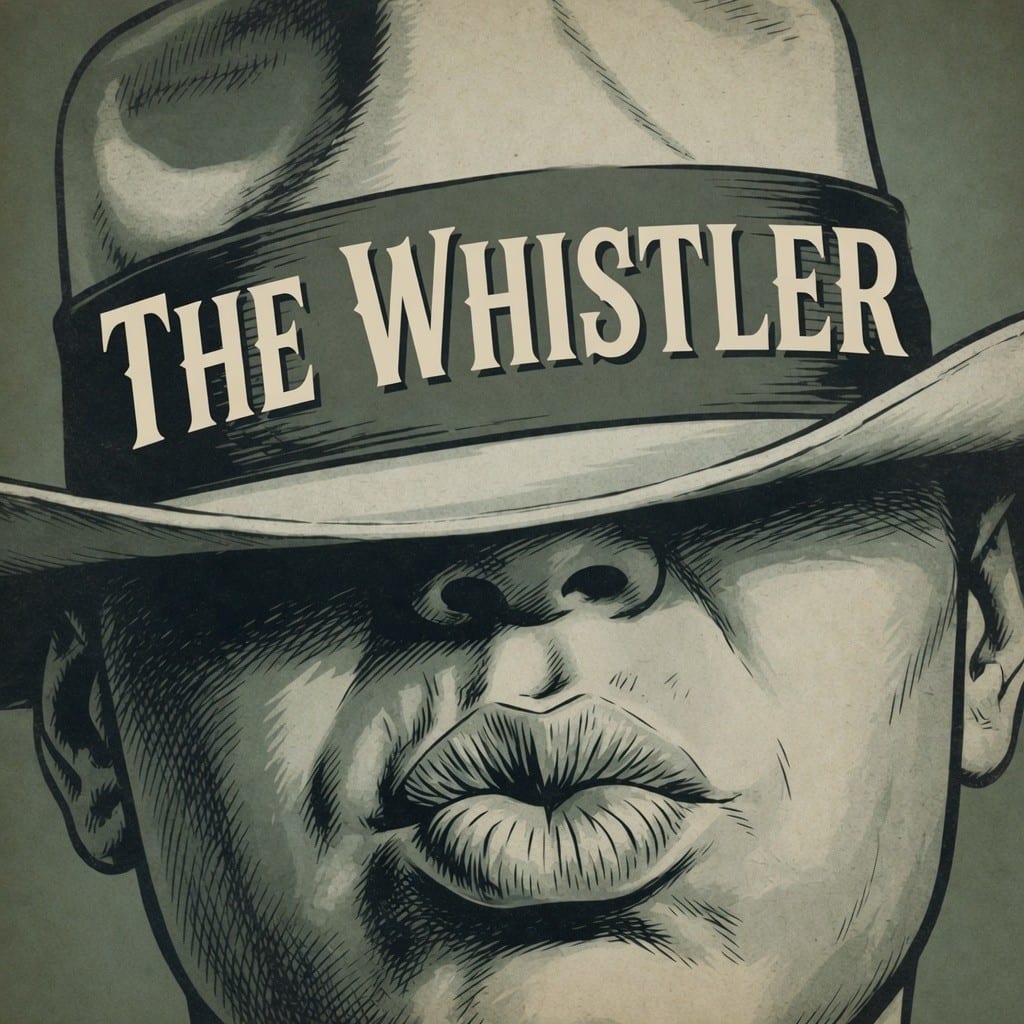
The signal oil program, the Whistler. That whistle is your signal for the signal oil program, the Whistler. I am the Whistler, and I know many things for I walk by night. I know many strange tales hidden in the hearts of men and women who have stepped into the shadows. Yes, I know the nameless terrors of which they dare not speak. Yes, friends, it's time for the signal oil program, the Whistler. Rated tops in popularity for a longer period of time than any other west coast program in radio history. And signal gasoline is tops too, tops in quality. It takes extra quality, you know, to give you extra mileage. And signal is the famous go farther gasoline. So look for the signal circle sign in yellow and black that identifies friendly dealer-owned signal stations from Canada to Mexico. And now the Whistler's strange story. Twelve portraits of Marsha. The late afternoon sun slanted through the skylight behind Marsha, making a halo of her hair as she sat legs crossed on the model's platform. Ralph paused a moment, looked past the canvas he was painting, his twelfth portrait of Marsha, studied her fresh, eager face, then back to the picture again, touching up the mouth, the delicate nose, the luminous eyes. Ralph, darling, I meant to tell you... Told you to pose, Marsha. Told you I'm almost finished. Sorry, darling. At least when it's over, you won't snap at me. You're always present after a portrait's done. Why not? To begin a painting is to sell yourself into slavery. The only way out is to finish. In just a few moments, I'll be free again. Yes, Ralph, you'll be free. The picture is nearly complete. One stroke more and loyal, loving Marsha, who would never take a penny for her hours of tireless posing, will never pose again. Ralph? Yes? Supposing someone offered you a thousand dollars for a picture. Don't talk such rot. It's a failure and you know it. That's not such a wild dream. Through with me? Yeah, that does it. All through. You can relax now. Oh, I'm so happy. I don't know if I can stand up. I've been sitting with my leg crossed under me for so long. Help me up, will you? My mind is just as cramped as your leg. Oh, always the temperamental genius. Oh well, someday you'll be rich and famous and I'll be your wife, so why should I complain? What about dinner, darling? Well, I'll have to run out and get something. You know, the only reason you're not famous is publicity, dear. People just don't know about you. I decided it's time I did something. I've been trying to get- Well, see, there are sardines and wine in the kitchen. I'll go get some cheese. Excuse me? I'll have to consult the treasury. Oh, Ralph, you never listen to me. I was about to tell you- It's strange that Marsha should hit on it. Today of all days, now that you've decided to do it. Publicity, Ralph, something that will tell the whole world of you and your paintings. Headline. Great artistic talent uncovered when model commits suicide. Fall play suspected. Artist may be brought to trial. Hmm, Ralph Winston. Winston, eh? Have to look him up. You're perspiring now as you pull open the drawer of the battered dresser in your room. Fumble for the little store of currency under the pile of handkerchiefs. And your gun with its black handle towards your hand. You realize it could happen now, Ralph. There couldn't be a better time. You'll tell them that you went out for groceries and when you return- You don't mind if I rest a minute, do you, Ralph? Thought I'd stretch out here on the couch while you're gone. No. Right ahead. Oh, you're so moody, Ralph. You used to want to celebrate when you finished a painting. Now you look as if- Yes, my chef. As if you wanted to- Ralph, don't! You press the gun into her hand. Wrap her fingers around the handle. Everything is right, Ralph. Right down to the powder burns on the blouse. A half hour later, you're on your way back to the studio with a package of cheese and a few other things for dinner in your arms. The lights are on when you get there. You have visitors, Ralph. You stop for a minute, get a hold of yourself. You know you must be careful now. Careful of everything, even of the way you breathe. What? What's going- Oh, are you Ralph Winston? That's right. What's the matter? I'm afraid I have bad news for you, Mr. Winston. Inspector Sean, homicide detail. Homicide? Over there on the couch. What? Marcia! Marcia, what'd you do with her? She was your model, wasn't she? I just finished her picture. Yeah, we saw it over there on the easel. Any idea why she'd kill herself? She'd threatened to several times. We were going to be married if I could ever make enough of my painting to support her. It seemed hopeless. Where have you been? I just left her a while ago. I went to the store for some things for dinner. See here, how'd you get here so soon? This gentleman, Mr. Sultan. Sidney Sultan Ralph, the art dealer. You heard of me here? Yes, of course. Mr. Sultan was coming up to see your paintings. He had a letter. From Marcia, Ralph. A rather unusual letter, you know. As a rule, I ignore requests from people who want me to look at paintings, but this one, there was something different about it. Marcia sent it? Something so sincere and intelligent and selfless about her letter, you know. Yes, it was different. I was just interested in seeing Marcia's and seeing the paintings. Matter of fact, just look at some of your things scattered around the room here and found them. Not bad at all, not bad at all. Thanks, Mr. Sultan. Call me Sidney, Ralph. Sidney will do for us. I think we're going to see a lot of one another. I get a big kick out of helping a young artist. You can be thankful, Sid. I mean, Mr. Sultan arrived when he did, Winston. You might have been in something of a jam. What do you mean? Under suspicion. Mr. Sultan was on his way up when he heard the shot. Rushed in to find Marcia dead and called us. Oh, so that's how it was. Now, here we are, gentlemen. Oh, this is the Herald photographer, Ralph. Let's let him take some shots. He can't do any harm and who knows, eh? Who knows? It'll be all right, my good man. You may take your pictures. Always glad to cooperate with the press. Wait a minute, I don't... Now, let's see over here by the easel, Ralph. Looking at your last picture of Marcia. Nothing like a picture, you know. Picture tells a thousand words and all that. Oh, Inspector, don't you think I shouldn't? No reason why you can't go ahead. The coroner will be here in a minute. We'll all clear out. Now, get the idea, my man. The artist here, Ralph Winston. W-I-N-S-T-O-N. Got it? Got it. Now, he's looking at the last picture he painted of the model who shot herself because no one would buy the picture so they could get married. Very tragic affair, very tragic. Marcia. M-A-R-C-I-A. Got it? Got it. Very beautiful girl. Attractive, intelligent, fashionable school, vasa, all kinds of money, giving it all up to be with a man she loved, believed in, and wanted to help. Got it. Follow Mr. Winston. That's it. And that's your story, gentlemen. Selton discovered the girl while on way to make deal with Winston to present his pictures to the public. It would have made him famous and able to marry the girl. Ah, got the ironic twist, gentlemen. Got it. Good. Now, excuse us a moment. I want a few words with Mr. Winston. Okay. Thanks a lot. Come now. Ha. Now, that was a pretty cheap stunt. Oh, good publicity, my boy. Be sure to look me up in the morning. You're assuming a lot, Mr. Selton. Sydney will do, my boy. Sydney between you and me. And I'm not assuming anything. You've got a good head on your shoulders. Ought to recognize the expedient move when you see it. What if I don't? Oh, now, none of that. Oh, I could see it all, Ralph. Page one, pictures, headlines, all of it. The moment I, the opportune moment, I might say, when I arrived at your studio tonight. Oh, you wouldn't consider any other arrangements now, would you, Ralph? Oh, you will. Let me help you. I'll be at your gallery tomorrow. Good, good. First thing in the morning, bright and early, eh? All right, Mr. Selton. Sydney, my boy. S-I-D-N-E-Y. Got it? With the prologue of Twelve Portraits of Marsha, the Signal Oil Company is bringing you another strange story by The Whistler. If you've been reading the ads about the new 1948 cars, and who hasn't, you've no doubt noticed the emphasis that's being placed on gasoline mileage. Mileage that's the result of increased engineering efficiency. Well, that's especially interesting to us at Signal, because signal gasoline has long been famous for mileage. Mileage that's the result of that same engineering principle. Because today's signal gasoline helps your motor run more efficiently. And of course, when your motor runs more efficiently, you also enjoy quicker starting, faster pickup, and smoother knock-free power. That's why in gasoline, mileage is really your best yardstick of performance. And it's why Signal says to be sure of the tops in gasoline quality. There are just two things to remember. One, in gasoline it takes extra quality to go farther. And two, Signal is the famous go farther gasoline. And now back to The Whistler. It seems as if you tell the story a hundred times, doesn't it Ralph? To the reporters, to the police officials, to the coroner when he arrives. So often that you almost believe Marsha did commit suicide while you were out of the apartment. But though at long last it's over, the fear of Sydney Selfton keeps you awake, tense, wondering how he could have heard the shot, and yet not seen you leave the apartment. Finally, at nine the next morning, you walk into his office and he takes you into a private gallery behind the main display room. You decide you're going to put it to him directly. Well, Ralph, right on time. I'd like to see that. Oh, I'd certainly. Exultant, to put it mildly. Have you seen the papers? You and Marsha all over the front page. Biggest story since the Hall Meals case, eh? Sit down, my boy. What's on your mind? Oh, lots of things to be done, my boy. If we're to have a showing of your pictures next week, strike Wiley iron and all that, eh? I see. Maybe you could clear up something for me, Sydney. Why, of course. Tell me, did you see me come out of my studio last night? See you? Why, no. You're sure you heard the shot on your way up? A shot? Well, who can tell? I heard an explosion, it might have been a blowout, car backfiring. Who can tell? But I thought... The important thing is you and I, Sydney and Ralph, making lots of money. Lots of money. Yeah, okay with you, eh? So, we must have a show very soon. Strike Wiley iron. Yes, you said that. Oh, yes, so I did. Which means you need new clothes. Now, here, I've prepared a cheque. It's in here somewhere. I just signed it a moment ago. You, uh, keep that thing around all the time? Hmm? What thing? That revolver. Oh, well, can't be too careful, my boy. Occasionally have pictures of great value around here. Things which don't require publicity to sell. Always keep it here, ready and loaded. Let's see. Oh, yes, here we are. A cheque for $500, my boy. Call it an advance. Clothes are what you need. Clothes make the man and all that, eh? Here you are. You're sure you'll get it back on my first showing? We'll double it on the first picture we sell. Nothing to it after this, uh, fortunate publicity. And the pictures, hmm, works of art. Oh, Ralph, you're a lucky man. We're lucky, lucky people. I'm still a little dazed. Well, naturally. Now, how many canvases have you done? Oh, about 50. And how many of Marsha? Well, 12. I just finished the 12th last night. Good, good. Lucky, lucky. Worth a weight in gold. You show them all at once? Oh, good heavens, no. No, first, a harmonious variety of your things. One or two landscapes, seascapes, three. No, four Marshas. I'll be out to help you this afternoon. Oh, good. Now, you'd better run along and get those clothes. A couple of suits and things. Uh, Tweedy. Yes, be good in Tweedy for the first showing. Boyish in Tweedy and, uh, you know, not too prosperous yet. Oh, and be sure to smoke a pipe, right? Right. And that's the way it is, Ralph. Sydney taking over and running your life. And it's all right with you, isn't it? Yes. The big day with the public viewing your paintings for the first time is almost too much to believe. You stand shyly on the sidelines, dressed in smoky brown tweed, a black morning band on your arm, thrilling inwardly with every bit of comment and praise, watching admiringly as Sydney handles the smartly dressed society with it. Oh, Mr. Selfdon. Yes, Mrs. Andrews. I think it was simply vile of you not to give me a chance to buy Marsha 1945. My dear Mrs. Andrews, everyone wants to buy the Marsha paintings. They were all sold almost before we opened the galleries this morning. Oh dear. Oh, now, if you'll excuse me, please. Yes, of course. Oh, Ralph? Yes? May I see you a moment? Well, Ralph, congratulations. The show has been a success. Has been? I've sold everything on the wall. Oh, that's fine, Sydney. From now on, we play host to curiosity seekers and future buyers, eh? Yeah, I guess that's right. But what if the critics... Critics? Oh, if the critics knew anything about art, they'd be in the business of buying and selling it, wouldn't they? I suppose so. I know so. Now, don't you worry about the critics, Ralph. Let's think about our next showing in, shall we say, two weeks? And you do forget the critics, don't you, Ralph? You pay no attention when they call your work, Calendar Art. There's too much praise from other sources, too much money to be spent. When it's gone, you're impatient with Sydney, anxious for him to conduct the second showing of your paintings. But six weeks go by before he finally selects another group of pictures. You sleep soundly the night before the display. Then open the morning paper on news that shocks you into a fury, sends you rushing to Sydney's gallery. All right, all right, all right. Don't tear the building down. I'll kick the door in if you don't hurry. Well, Ralph, so anxious to get into... Sydney, what's the meaning of this in the papers? Come in, come in, Ralph. Now listen to this. Sydney of Selfton, art dealer, might find he has reopened the case of the beautiful artist model, Marsha, when he suggested to this columnist that after much consideration, he was no longer certain that the explosion he heard on the night of the suicide came from the studio of Ralph Winston. This could suggest to the police that Marsha was dead before Selfton arrived on the scene in a new investigation, my friend. Well, Sydney, how could you do this to me? There, there, there, Ralph. Here, let me have a look. Here. Mention the show we're opening today. Sydney. Oh, yes, they got it straight. Mm-hmm. Selfton Galleries, nine o'clock. You showing 25 canvases, four more portraits of Marsha. Sydney, do you mean to tell me that you... What's the matter, Ralph? They got all the details straight? Well, yes. I have a terrific investment in you, my boy, terrific. But what happens to me? Nothing, Ralph, nothing. I simply inform the police if and when they question me that I was misquoted. I might even suggest that the columnist had been drinking. It better work. It will. But now, look at yourself, my boy. Now get along home. Don the morning coat and the striped trousers. You're the success type for this one, Ralph. Definitely the success type. You feel successful, don't you, Ralph? Successful and sure of yourself again as you stand around bowing politely, accepting the congratulations of the excited, wealthy dilettante who thronged the gallery to admire and criticize and buy. The second showing is almost as successful as the first, but this time the money doesn't last even as long. And as the week slipped past, you pressed Sydney to hurry the third showing, but he keeps postponing it again and again until you're almost desperate. And then one night, your telephone rings. Yes? Ralph, my boy, I want you to come over. About the showing? Yes. I thought we'd have it in the little gallery here at my office. But do you think that's large? I'm sure going to say it isn't large enough, but it is. I want this to be a private showing, just you and me. What? Can you come over right away? Yes, Sydney. Right away. Now Sydney, what is all this nonsense? You're not going to pull any more stunts like last time. Did that bother you so much, Ralph? It's just that the memory of Marsha is sacred to me. Of course I understand. Sacred. That's right. And while we're on the subject, Sydney, whatever became of all the portraits of Marsha that you sold, who bought them? Oh, a customer. Funny customer. Always manage to buy them all before the show is open. I spoke of a private showing, didn't I, Ralph? Let's go inside. What? Wait a minute, I'll get the light. Why do you... Sydney, what does this mean? All the portraits of Marsha, all 12 of them, hung side by side. Is it so strange? You got a fair price. If I wanted to buy them, that was my business, eh? Sydney, what are you trying to do? That's an admirable person, Marsha. These portraits provide physical proof of the image that I formed of her while reading her letter. That's incredible. These 12 portraits tell me so much about the girl and about you. She was good, kind, beautiful, true and true. Now this first portrait, Marsha, 1944, shows that you were in love when you painted it. Yes, I was. You idealized her beyond reality, the pinks and the blues and the gentle sunlight gliding through her hair. No woman could be so beautiful except the man in love with her. Beautiful experience. And Marsha, early 1945, you began to look on her more as a playmate. In spring 1945, ecstasy, blinding golden light, a look of joy and expectation on her face. It was the most beautiful spring I'll ever know. She was so wonderful you didn't want to paint another thing. You see, two more canvases, almost identical. So? Then a long pause in the series, Ralph. You didn't paint Marsha again until the following winter. You were tired of her. What is this, Sidney? Black magic? No, it's all there, Ralph, you see. You tried to see her again as you first saw her, but you failed. You no longer loved her. Ah, poor Marsha. A photograph would have been more just. What's all this leading up to, Sidney? Don't you think it clever of me to deduce so much information from paint on canvas? Oh, very clever, Sidney. Go ahead. I won't interrupt you again. Oh, there isn't much more. Now, here you grow panicky, the worry over a promise to marry a woman you didn't love. Your mind was straying here, groping wildly. But paint as I please. Oh, obviously. But such caricature. So grotesque, Ralph. Why, the only happy picture is this one, number 11, showing Marsha saying goodbye in the doorway. Would you have been so happy to see her leave? Never mind that. Nothing becomes more hateful than an unwanted woman, eh? Ah, poor little Marsha. And in this last portrait, you were spiteful and cruel. You put her in a tight-fitting green satin dress, her lips a flaming red slash across her face, and her eyes, you painted them a weak and watery blue. Sidney. Oh, Marsha, Marsha, how could he ever do this to you, Sidney? You fool. I actually believe you've fallen in love with Marsha. In love? In love with Marsha? No. No, I could hardly fall in love with a room full of pictures. No, Marsha doesn't exist. I can't love her, Ralph. But I can hate the man who murdered her. Murdered? Well, Sidney, you yourself said you heard the shot when I was blocks away. I was mistaken, Ralph, and you know it. You shouldn't have said that, Sidney. You should never have used the word murder. Wait, what are you doing? What do you want in my desk? Only your gun, Sidney. Ralph, you're making a terrible mistake. No, Sidney, you made the mistakes. First, in telling me about this gun. Second, in making this showing so completely- Ralph! Private Ralph! The Whistler will return in just a moment with a strange ending to tonight's story. Meantime, in place of the message about signal gasoline, usually heard at this point on the Whistler, Signal Oil Company is giving this time tonight for an announcement in the interest of public health. Have you ever asked yourself what you would do if infantile paralysis would strike someone in your home? The treatment is long, the average cost over $2,000. Fortunately, however, you wouldn't have to worry about cost. For today, the National Foundation for Infantile Paralysis guarantees every victim of this dread disease, regardless of age, race, creed, or color, the immediate scientific care which alone can prevent tragic crippling. And where does the Foundation get the millions of dollars needed for this great mission of mercy? Why, from the dimes that you contribute during the annual March of Dimes. When you consider that last year those dimes took care of over 10,000 victims of infantile paralysis, you can realize how much every contribution counts. So let's all get into the march. Drop into an envelope whatever you can spare, a few dimes or a few dollars. Then mail it tomorrow morning to the March of Dimes headquarters in your city. Now back to the Whistler. There was no other way out, Ralph. As you sat at the desk watching Sidney move from picture to picture, his eyes glowing as he described Marsha, as he uncannily guessed your changing feelings toward Earth, instinctively followed the winding road that you and Marsha traveled, full of sunlight and brightness at first, finally plunging downhill into the dark valley of murder. Yes, there was no other way but to kill Sidney too. And now, moving like a man in a dream, you find yourself going through it all again, exactly as you did with Marsha. You walk forward, bend over him, press the gun into his hand, and then suddenly the room is filled with a blinding light, a flash gun, Ralph. And as you sense the movement behind the heavy drapes. What? Very good, Joe. A perfect picture, perfect. Huh? Here, Ralph, help me out. What? You can come out now, Joe. Let Ralph meet the press. That's it, my boy. Sidney, what is this? What are you trying to do? All done, my boy. One picture, a thousand words. The camera eye doesn't lie in all that. Oh, here's your caption, Joe. Are you ready? Joe. Art dealer, Trapp's murderer at Midnight Rendezvous. Yes, that's good. Midnight Rendezvous. You got it? Listen, Sidney, you can't. That's my boy. I'm not through yet. Picture shows killer duplicating original murder plan. Uh, modus operandi, that's a good phrase. Use that one, Joe. Sidney. Blank cartridges save life of dealer on eve of final showing at Selton Galleries. S-E-L-F-T-O-N. Got it? Got it. That's all now. You've got a deadline to meet. You better run along. Thanks, Mr. Selton. Oh, uh, so long, Winston. I'll be taking your picture again soon. At your trial. Sidney? Sidney, why? Why did you play with me? Use me. Yes, my boy. I had to know whether you really killed Marsha or not. Oh, you know, you were right, Ralph. I guess I am in love with the picture. Let that whistle be your signal for the Signal Oil Program, The Whistler. Each Wednesday night at the same time. Brought to you by the Signal Oil Company, marketers of signal gasoline and motor oil, and fine quality automotive accessories. Signal has asked me to remind you to get the most driving pleasure, drive at sensible speeds, be courteous, and obey traffic regulations. It may save a life, possibly your own. Stored in tonight's story were Elliot Lewis and Joseph Kearns. The Whistler was produced by George W. Allen with story by John Monsos and music by Wilbur Hatch and was transmitted to our troops overseas by the Armed Forces Radio Service. Next Wednesday for a full hour of mystery over most of these stations, tune in a half hour earlier. Enjoy the Saint as well as The Whistler. This is Marvin Miller speaking. This is CBS, the Columbia Broadcasting System.