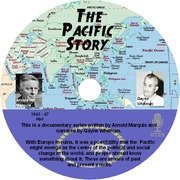
The National Broadcasting Company and its affiliated stations present The Pacific Story. Music In the mounting fury of world conflict, events in the Pacific are taking on ever greater importance. Here is the story of the Pacific and the millions of people who live around this greatest sea. The drama of the peoples whose destiny is at stake in the Pacific War. Here is the tale of the war in the Pacific and its meaning to us and to the generations to come. Music Tonight's Pacific Story comes to you as another public service with drama of the past and present and an analysis based on the documentary information of the program. Music Luzon, Philippine doorway to Japan. Music On the newly won Lingayon airstrip where General Douglas MacArthur's troops stormed the shore in Luzon, a squadron of U.S. fighting planes returned for mission over Manila. Head back over there. Watch those fighters taxiing in. That's good, that's good. Cut your motor. How was it over Manila, Ross? Pretty rugged. You got back all right. Yeah, by the skin of our teeth. A lot more Jap fighters over Luzon today than yesterday. That's what you said yesterday. It's getting tougher. We had to fight our way through them today. Japs must be sending in air reinforcements. They're not playing ping pong. Okay, we'll have your ship serviced for gas and ammunition for you in no time at all. The young fighter pilot with his parachute strapped securely to him stands by as his plane is serviced. He has seen the stiffening resistance of the enemy. For days now he's been meeting more and more opposition in the air over Luzon. He understands why. He remembers what his superiors have told him about Luzon. Now the battle for Luzon is going to be different from the battles for the other islands in the Pacific. Just recently, Premier Koizo said that Luzon is the doorway to Japan. The words of his superiors echo in his ears as he stands there watching his fighter being serviced. To begin with, Luzon is the largest and northernmost and most important in the Philippine islands. He's flown over it. He knows how large it is. As large as Belgium and Holland and Denmark put together. Luzon is the most strategically located of the large islands between Japan itself and the Dutch Indies. Now look here at this map. He remembers the big map on the wall and the officer pointer in hand indicating the strategic location of Luzon. You see the northern tip of Luzon here is only 270 miles from Formosa. Formosa lies almost directly north, just slightly to the northwest of Luzon. It was from here in Formosa that the Japanese bombers took off to blast our military installations before they invaded Luzon just after Pearl Harbor. This means that if Formosa was strong then, it is stronger now. And that land-based Japanese planes from Formosa may play an important part in the developing operations against Luzon. The most direct route to the coast of China from the central Pacific is between Luzon here and Formosa here. So Luzon is one of the strategic keystones of the war in the Pacific. This is why the young fighter pilot standing there watching the servicing of his plane has met increasingly stiff resistance in the air over Luzon. It is a foreshadowing of what lies ahead. The battle for Luzon will be one of the decisive battles of the war in the Pacific. That's what a spokesman of the Japanese high command said a few days ago. Okay, Ross, he's all set. Thanks. Gasoline enough to take you on a cook's tour of Luzon. And ammunition enough to knock out an armored division. I'll need it. Well, see you. With the invasion only a week old, Americans are fast familiarizing themselves with Luzon. It's a big island, much bigger than I ever thought. It seems to be covered with mountains and jungles. I never thought when we used to study geography that someday I'd be looking down at it. So here I am giving it to you. There's a big plane from Lingayen Gulf right down to Manila. That's why the Japanese landed in Lingayen Gulf three years ago. That's why we've landed there. Chances are that's where a big battle will develop because it's a broad open country, like an open corridor to Manila. The Japanese drove down through that plane and we're doing the same. I've got an idea that this is... This afternoon I flew over the isthmus of Ottomanon. It's a narrow neck of land between the northern part and the southern part of Luzon. The Japanese landed there just after Pearl Harbor. They were certainly smart. It was like landing at Panama. They cut off the southern part and then drove northward toward Manila. I've got an idea... Years before the Japanese invaded Luzon in 1941, they had intelligence on every foot of the terrain. And on every possible point of landing, they kept detailed charts. Here is a party right here. That is the cross's port to Formosa? Yes, sir. It is the chief port in the north of Luzon. What is this, Wally? Here. Oh, that is the Kagayan. You see it runs from Aparri down toward Manila, 260 miles away. And here is Vigan, right here. Vigan, yes. It is inland, about three miles, but it is open to shipping. That is important. How far is it from Vigan to Manila? About 200 miles. Yes. And here, about 100 miles from Manila, is Ringayan Gov. I know Ringayan well. There are mountains to the east, but the approaches from the west are level. Yes. It is a converging place of these large highways here and here. And here is one more point, General. Down here in the south. Oh, yes. Atemonan. Yes, sir. The Isthmus of Atemonan. A church has been built there with a larger steeple. Can the steeple be seen from some distance at sea? Oh, yes, sir. It is like a lighthouse. Bearings can be taken on it. Get all the details on the steeple and the approaches to Atemonan. We will have use of them. For years, Japanese had been visiting the islands and collecting information. They had covetous eyes on the Philippines, as other races before them had had. Invaders had come and gone, all trying to subjugate the peoples of the Philippines, all trying to exploit the resources and the peoples of the islands for their benefit. Five hundred years ago, it was the Chinese. In the name of Yung Lo, emperor of all China, and with the rights invested in me as governor appointed by the emperor, I here and now claim all of these thousands of islands as a protectorate of the Chinese empire. For a hundred years, we have been taking gifts through the celestial court of the emperor so that the Chinese would not come here to rule us. They have discovered the treasures of our islands, and these they know are more valuable than our gifts. A hundred years later, the Spaniards came. They were to rule the islands for three hundred seventy years. But even during the Spanish rule, the Japanese had their eyes on the Philippines. In 1592, a minister of the powerful and cunning Japanese general Hideyoshi came to Manila with a message for the Spanish governor. I bow in respect to you, governor Das Marinos, unto the crown of Spain. We are honored by your visit. I come as an emissary of his most illustrious and excellent highness, Toyotomi Hideyoshi. An emissary of Hideyoshi, the general of all the armies of Japan? The same. General Hideyoshi commands that tribute be paid to the empire of Japan. I have come to correct it. Tribute? Under God, there is no reason for the crown of Spain to pay tribute to the empire of Japan. The islands are within the orbit of influence of Japan. The crown of Spain is therefore beholden to Japan and is commanded therefore to pay tribute. I shall not pay tribute. General Hideyoshi has instructed me to inform you and through you, the crown of Spain, that unless tribute is forthcoming, the city of Manila will be attacked and occupied. You will be permitted ample time to make your decision. Hideyoshi did not live to carry out his threat against Manila. Japan closed its doors to the world for more than two and a half centuries, and the flag of Spain continued to fly over the Philippines until 1898. Say, is there anything yet on that? Wait a minute, something's coming in right now. Yeah? September 1898, American forces are now in control of the island of Luzon, largest of the Philippine islands. What do you know about that? Manila's on Luzon, isn't it? Yeah, Luzon's that northernmost island. Pretty wild country, I guess. Wait a second, something else is coming in. Yeah, what do you know about that? September 1898, Luzon, the largest of the Philippine islands, is to be made into a base for American operations to occupy the other islands of the Philippines. Well, what do you know? Things must be really poppin' over there. Looks to me like they're going to be... It was then that the Americans learned about the Philippines, about the great size of Luzon, its mountains, its rivers, its lakes, and its jungles. But now the Japanese had come out of their centuries of seclusion and again were looking toward the Philippines. Tell me, what are those Japanese looking for? You see them everywhere out here in the back country. I don't know, they seem to be explorers. Explorers? Well, as one of them told me. Let's go over and ask that fellow. Come on. I am looking for ancient porcelain jars. Think you're going to find any? Oh, yes. There were once many porcelain jars here in the Philippines, made in China during the Ming and Song dynasties. That so? Oh, yes. They were very valuable ones. Nearly everyone here in the islands has forgotten about them in these recent years. What were these jars used for originally? They were Chinese burial jars. And where are these jars usually found? Oh, they are found everywhere. Now, if you will excuse me, please, I must get along. The Japanese covered most of the Philippine islands. Explorers, businessmen, fishermen, photographers. There are many lakes in Luzon. Reports were sent back to Tokyo. In central Luzon is Bay Lake, sometimes called Laguna de Bay. This lake is 25 miles long and 21 miles wide. The Pasig River connects Bay Lake with Manila Bay. Details were sent to Tokyo about the rivers of Luzon. The Rio Grande de Cagayan flows from the southern Caraballo Mountains in the central part of Luzon up to the north coast. Many smaller streams flow into it on its way north. The Rio Grande de Cagayan is a dangerous stream. And with the passing years, they studied and made note of the peoples of the Philippines. There are many tribes in the Philippines. The best known and the most advanced are the Tagalogs of central Luzon. How many of these Tukaraks are there in Luzon? Not quite two millions. They are well educated and they have a rich literature that makes them adventurous. There is a reason for their education and their culture. The center of activity in the Philippines, Manila, with the government and all its business, is located in the territory of the Tagalog. Detailed information was also collected on the other peoples. Of which people are here in this valley? The Cagayans. They occupy the valley that runs southward from Opari. We were made to understand the Cagayans. One of the big Japanese drives in the war to come was to be made through the Cagayan country, down from Opari. And the Japanese were to meet the other peoples of Luzon. So they studied them too. The Bikols, the Pampangas, the Sambos, the Igarots, the Pangasinans, the Negritos. The Japanese studied how they lived and how they worked and the products of their labor. A report on mineral resources. There are gold and iron and chromite and coal in gold quantities in Luzon. The mines are now in operation. With proper development, their yield could be increased. In Tokyo, the location of the mines was indicated on the detailed charts. With these were kept detailed information about the operation of each mine. And in another Tokyo office, up to the minute intelligence was kept on the products of the soil. Here is the latest revised list, General. Yes. Cocoa, coffee, tobacco, cotton. Cotton will be important to us. More can be grown if some of the rice fields are taken over. Rice is the principal cultivated plant. We will need cotton. They can live on something else, can't they not? They raise sweet potatoes and maize. They would have to eat more of these than mangoes and bananas and pineapples. They do not eat very much meat. And what is this on this list? This. Here. That is abaca. In the trade it is called manila hemp. Oh yes, manila hemp. It is the strongest natural fiber. And no other fiber can take its place aboard ships. Very good. It is indispensable both to navy vessels and to merchant men. Templations that are denied it would suffer a disadvantage. A very serious disadvantage, sir. Just where in those are SS hemp produced. I can show you, sir. Here. Here on the map. Yes. Here. You see is manila. Down here to the south, down in these two provinces. Cominus north here and Cominus here. This is the center of the hemp industry. Yes. Both provinces are south of the Esmus of Atemoman. Yes, sir. That is very good. By 1940, when the tension in the Pacific was reaching the breaking point, the Japanese knew all there was to know about the hemp industry of Luzon. They also knew about the sugar centers, the cigar cigarette factories, the coconut oil mills, the copra industries. They had surveys of the rich forests of Luzon, where flourished all the woods needed for building, as well as for the production of medicines and dyes. They even had detailed information about the factories making candy, embroidery, margarine, and soft drinks. And all this information they would have used to good advantage. Two days after Pearl Harbor, it started at Begon and Lingayan. The next day the Japanese hit a party on the north coast. Americans trapped in Manila placed the advance of the enemy. They're coming right down here through the Kagayan Valley. Yes, and down here from Begon. That meant that they've got two spearheads driving south on us here in Manila. Yes, and if you ask me, there may be a third from Lingayan Gulf. We stood them on there yesterday. I got a hunch they'll be back with more muscle next time. For that matter, we can expect some landing south of us too. From the south? We might as well face it that Manila can be approached from almost any direction. That's the nature of this country. That would mean that our forces can't go out to meet the drives coming down from the north. Not very far without laying ourselves open to danger from the south. How well the Japanese knew the topography of Luzon soon became apparent. They drove southward from Apare through the Kagayan Valley, and they drove southward from Begon along the west coast. As these two forces converged, the next blow fell. December 22, 1941. New and powerful Japanese landings are being made in Lingayan Gulf. The attack was opened by bombing and strafing, and now with many of the shore installations... Well, here's where they are, right here on the map. Yes, just about a hundred miles north of us. And the new landing force is being supported by the force coming down from Begon. Look for landings in the south next. The next day, a Japanese amphibious force steamed into the south. A report from the lookout, sir. Yes? The steeple of a church has been sighted. We are taking bearings on it. Very good. That is Atemuman. Get the author. The Japanese landed at the narrowest neck of land on Luzon and drove across the Isthmus. Below them, now in their control, were the hemp industries. From the Isthmus, they drove northward. Now more landings were made at widely separated points. From the north and from the south, the Japanese drove to close the pincers on Manila and the Kagayan. The Filipinos of all the tribes are fighting valiantly alongside the Americans in a vain effort to stem the tide of the overwhelming Japanese invading forces now estimated to be more than a quarter of a million. It now appears that the American and Filipino defenders will make their stand on the peninsula of Batan. Well, they're going to be here in Manila in no time now. Yes. The way they fought their way around all the obstacles here on Luzon is amazing. It's just a matter of information. Lord knows the Japanese had plenty of that. It's difficult for me to think of Baguio, beautiful Baguio up there on the mountains in the hands of the Japanese. Yes. Well, they're already there. What a place that is. Five thousand feet above sea level. All those beautiful pine trees, the waterfalls, the canyons and gorges, the rugged passes. Well, it'll seem just as incredible to me to have the Japanese here in Manila. And soon the marching of Japanese troops, the rumble of their mechanized equipment were echoing through the streets of Manila. Are you two well-stanned or I fear? Yeah, okay. Well, how does it seem to be a prisoner? Well, I don't know. Say, look at that Japanese over there. Yeah? There's something familiar about him. Well, there's a guard here who he is, if he'll tell you. A guard? That man over there, who is he? Oh, that one? Yeah. He is second in command of the internment camp here. That so? Here he comes, coming over this way. Yeah. Say, I know who he is. I'm going to speak to him. Yeah, go ahead. Pardon me, have we met before? Oh, perhaps. We met up in the back country. You were collecting Chinese burial jars. Yeah, that's right. The Ming and Song dynasties. Well? You are no longer interested in burial jars? You will have the opportunity to know what our interests are. On the rugged, jungle-tangled terrain of the time, General MacArthur made his brilliant last stand. Here, the Filipinos and the Americans, with the sea on three sides of them, and with Corregidor at their rear, fought with the dwindling hope that they could hold out until help came. The meager reports coming out of Bataan told the story. Another ship with food and arms arrived today after successfully running the Japanese barter. But two out of every three ships attempting to reach here are being sunk. February 2, 1942. Today, Bataan fell. May 6, 1942. Today, Corregidor fell. Now, American forces are again on Buzan, taking off from Philippine territory, newly rested from the Japanese, and returning to these airstrips after their missions. Stand back over there. Watch those fighters taxiing in. That's good, Ross. Cut your motor. Well, Sonny boy, how was it this mission? Well, we fixed about a dozen of planes on the ground over there, so they're going to have trouble getting into the air. Did you fix them up good, Ross? Good. Good enough. Well, you've got to leave something for the ground forces, you know. There'll be plenty. The young pilot makes note of what he has seen and what he has learned in the battle for the strategic island of Buzan. There is no time to do anything but fight. But through his mind go the words which he will write when he finds a moment. Dear mother, there is so much about this that I can't tell you. What's gone on before and what's going on now. But all of us know this. Last time the Japanese had the advantage. They could choose the place to attack, and they certainly picked some good ones. But now it's our turn. Our side knows Luzon with all its harbors and mountains and lakes as well as the Japanese do. And I've got an idea, Mom. We're not going to miss any bets. It's going to be rugged, but well, I think Huisa was right when he said, the battle for the Philippines is the battle for Japan. These are the documented facts of Luzon. And here to tell the significance of these facts in the war in the Pacific is Gain Whitman. The battle for Luzon is by far the most important action in the war in the Pacific. This is not only true from the military point of view, but also from the point of view of American prestige in the Philippines and throughout the Far East. Even before the Japanese occupied the islands, there were many Filipinos out of sympathy with the policies of the United States in the islands. These had doubted that the United States would ever grant them their freedom. Japanese intelligence promoted this idea. Before the Japanese invasion, we had said that we would defend the Philippines, and moreover, that we were able to defend them successfully. Between the Filipinos, who neither trusted nor liked the United States, and those who believed that the United States would keep its word to redeem them, there was a group that could have joined those on one side or the other. This middle group was the unknown factor. When the Japanese swept down on the islands, the rank and file of Filipinos expected us to drive the invaders into the sea. Instead, they saw us suffer the worst military defeat in our history, and they saw their islands taken over by the enemy. The loyal Filipinos fought alongside the American troops. Those who all along had been against the United States collaborated with the enemy. But what happened to that middle group was the important thing. Many, from what they saw on the islands, could only conclude that the Japanese had come to stay, that they were too well entrenched and too strong ever to be thrown out. With this line of thinking, some concluded that they'd best learn to accept and live with the Japanese. Others, less trustful of the Japanese and still hopeful that the United States would redeem its pledge, decided that they would wait and see. But what they saw was not good. They saw what happened to the United Nations in Malaya and Burma and Singapore, and in the Netherlands Indies and in the islands of Oceania, and they waited and waited. The prestige of the white man went down. For more than a year after Bataan, no one inside or outside the Philippines knew how many of the Filipinos were loyal to the United States. Then, through the Filipino underground, carried on by Filipinos and Americans in all parts of the island, the word came out, 85 percent of all Filipinos were loyal. This meant that America's years of constructive effort in the islands had been a good investment. It meant that when our forces returned, they could be assured of the health of this great majority of the Filipinos. Testimony of the loyalty of these Filipinos was the intelligence that came out. Filipinos everywhere, at the risk of their lives, provided information which, traveling through the underground channels, reached the high command of the United States. The word went back through the underground channels and out among the rank and file of Filipinos that the Americans were coming back. Now that pledge is being redeemed. And beyond what the operations on Lausanne mean to the Filipino people, the battle for Lausanne is of enormous strategic importance in the overall war in the Pacific. From recaptured airfields, the U.S. Air Forces, coupled with the naval task forces, are now able to control most of the approaches to the Northern Islands. This will mean that the enemy will have grave difficulty in reinforcing its forces and keeping them supplied. However, the Japanese are now estimated to have between 200,000 and 300,000 troops on Lausanne, along with stockpiles to keep them supplied for a bitter defense of the islands. For, as the Japanese leaders know, the reconquest of Lausanne will force their hand, not only in Japan proper, but also on the mainland of China. The Japanese know that the loss of Lausanne will put the American forces within a little more than 200 miles of the Japanese stronghold on Formosa. It will put them within striking distance of the coast of China. They foresee that from Lausanne, the Americans could throw a blockade across the China Sea, cutting communications between Japan proper and the lands and islands she has occupied in Southeast Asia and in the Netherlands Indies. The loss of Lausanne would be the most serious blow to the Japanese since the outbreak of the war in the Pacific. That's why they can be expected to make their fiercest and most desperate fight to hold Lausanne. You have been listening to the Pacific Story, presented by the National Broadcasting Company and its affiliated independent stations as a public service to clarify events in the Pacific and to make understandable the cross currents of life in the Pacific Basin. For a reprint of this Pacific Story program, send ten cents in stamps or coin to University of California Press, Berkeley, California. To repeat, for a reprint of this Pacific Story program, send ten cents in stamps or coin to University of California Press, Berkeley, California. The Pacific Story is written and directed by Arnold Marquis. The original musical score was composed and conducted by Thomas Peluso. Your narrator, Gain Whitman. This program came to you from Hollywood. This is the National Broadcasting Company.