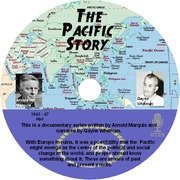
This is the story of the Pacific and its people, of the peaceful sea and the lands and lives it touches, and their meaning to us and to the generations to come. The Pacific Story, presented by the National Broadcasting Company as a public service and dedicated to a fuller understanding of the vast Pacific Basin. This broadcast series comes to you as another feature of the NBC Inter-American University of the Air, with drama of the past and present, and commentary by Owen Latimore, authority on the Pacific and director of the School of International Relations, Johns Hopkins University. The New China. China lay crushed at the turn of the century. For more than a hundred years she had resisted the Western barbarians who had come in warships and merchant vessels to beat on her doors. At the turn of the century she tried to throw out the foreigners and failed. Advanced and enlightened China, with her 450 million people, lay prostrate at the mercy of the Western powers. Old China lay helpless, but in the souls of her patriots, a new China was rising. The foreigners have established their own settlements on our soil. Foreign convos patrol our waters, and foreign goods pour into our ports. Foreigners have seized Hong Kong, Annam, Upper Burma, Formosa, Korea, and now the Western powers have cut up China into spheres of interest. The degenerate Manchu dynasty is unable to protect China. Our Manchu rulers themselves are falling in. The Manchus have governed China for 270 years, but now they must give way. Now we must have a republican form of government. At least the West, and we will follow. We will stand together, all of us. Our movement is growing strong. We have received the word of Dr. Sun Yat-sen. The revolution will overthrow the Manchu emperor and set up our own republican government. Nationalism surged through China, and in 1911 the Manchu dynasty was swept from the throne, and imperial China became a republic. Now was begun China's struggle to achieve two things, to free itself from foreign control, and to build within itself a government representing the people. But ahead lay a desperate struggle. The nationalist movement was not yet strong enough to make China a real republic. Nationalist government? I am the government here. Corrupt and ambitious warlords rose throughout the land. My army is strong enough to collect taxes and run my administration. And if necessary, fight. An arrangement could be made to supply funds to maintain your army. Funds would be necessary if you are to gain control at Peking. Funds are always necessary. Japan's only stipulation is that we have a voice in the Peking government after you take over. Japan dictate Trump to me? Oh, no, no, no, no. Only as an advisor, of course. Only as an advisor. Warlords wielding power in the provinces of China fought among themselves for ascendancy and control of the Peking government. Behind them was the hand of Japan playing one against the other. To no one was the hand of Japan more apparent than to the brilliant young military officer, Chung Ka-shek. His task was to unify China, to bring together the armies of the warlords, to fight at home while he was preparing to fight the enemy from abroad. And the time was short. This new railroad links our nations together. This is another one of our new national airlines. This new university is part of our expanding educational system. This is one of the newly trained units of our modern army. China was struggling to make ready. And when Japan attacked in 1937, Generalissimo Chung Ka-shek stood leader of a united people. With terrifying power, Japan captured China's coastal cities and ports. 90% of China's modern industry was seized or destroyed by the Japanese. China was hemmed in and cut off from supplies. Driven from their homes, 50 million Chinese refugees migrated into the interior. Can we stop a while, May? You are tired, Wu. I know. I can help. More? No, May. You are doing more than I am. We will stop, Wu. You must rest. We can stop again soon. Our pretty press must not fall into the hands of the enemy. No, no, nor our type. We will need it. We have dragged them these many miles, our press and our type. We must not give up, Ning. We shall never give up. The road ahead is as long and as rough and as dusty as the road we have come over. But we must go on. Yes, we must work together. The spirit of these people trudging along this road as far as the eye can see. I am ashamed that I am not as strong as they are. That orphaned boy dragging himself along empty-handed with hunger in his eyes. And that widow of a soldier carrying her child in a bag of rice. They are younger than you, but you as they are doing all you can do. Let us stop again. Fifty million Chinese moving into the interior, into the agricultural heart of old China. People of all classes, the rich and the poor, the high and the low, professional people and scholars, Chinese all, determined to resist and reconstruct. You are courageous, May. I never believed I could do it. Walk more than a thousand miles. You have done well, you and your classmates. We could not stay after our university was bombed. It is part of the Japanese strategy to destroy centers of education in order that learning among the Chinese may perish. But it will not perish, Chao. Not so long as we have teachers like you. It is our duty to lead. Until we were bombed out of the university, we had been pampered and wealthy. We sat in your classes in our silk and robes and studied when we wished and dawdled when it pleased us. Before we were bombed, I had scarcely walked anywhere. Thousands upon thousands of university students like yourself are walking into the interior. How much farther must we walk, Chao? As far as we have come. Or farther. Or we shall do it. But how can you set up school again, Chao? You will have nothing to start with. We have our hands. We will set up schools in the fields and in the mountains. We will hold class in caves and in mad huts. We will hold school wherever we can. But we will hold school. Nothing shall stop us. Fifty million refugee Chinese moving into a land with no industry. Millions needing to be employed and to be fed. This posed a problem almost as serious as the invasion of the enemy. Out of this crisis rose a compelling idea. Cooperatives. Small producers cooperatives owned and managed by the workers themselves. At a camp in the interior at Kuailing, a refugee from Hong Kong speaks. My name is Wan Lu Shen. I was a skilled worker in an arsenal in Hong Kong. When the Japanese took Hong Kong, I said I was a laborer. So when the food ran short on the island, I was loaded on a boat with many other useless workers and dumped on the Chinese mainland. Later the Japanese did not bother to take the useless ones to the mainland, but loaded men, women, and children on ships and dumped them into the sea a few miles from Hong Kong. I walked from the coast to here in Kuailing to get food and to do whatever I could. Did any other arsenal workers escape with you, Wan? Seven others. They are here in camp. Good. Call them together and we will help you start a cooperative to make guns and ammunition. A cooperator? Yes. If you work together, you will be like ten strong sticks instead of one single stick that can be easily broken. That is good. Go and bring the others and we will start at once. Cooperatives sprang up throughout the interior, making war ties, shoes, blankets, surgical dressings, and echoing through the hills was the Chinese slogan, Gung Ho, work together, work together. Cooperatives were set up in caves, in farmhouses, in deserted temples. The printer who dragged his press over the thousands of miles of road formed a cooperative and printed posters that appeared everywhere. Resist and reconstruct, produce for victory. Guns, bullets, foodstuffs coming out of the hills. With these tactics, workers and gorillas are holding at bay nearly half of Japan's troops in China. This is a Chinese gorilla commander. When the enemy attacks, we withdraw. When the enemy pitches camp, we harass him. When the enemy avoids combat, we attack. When the enemy retreats, we pursue. Every village is a base of gorilla operation. The watchwords of the gorillas are fearlessness, intelligent planning, secrecy of movement, suddenness, and determination in action. In the Taihang Mountains of North China, all enemy telephone and telegraph lines have been cut in the path of the enemy's advance, sir. Crews are digging up the roads and blowing up the bridges, sir, you will. This is the 15th attack of the enemy to drive us from this strategic area. We must hold him off once more. The whole countryside is watching the advance, sir. We have just received intelligence that the enemy is changing his position and is now advancing from the west instead of the south. From the west? A gorilla who has been pausing as a guide is leading an advance Japanese patrol of considerable size up the west road. They will stop at the village overnight. Then we will just have time to reach the village before they get there. We will stop at once. Surprise and superior knowledge of the countryside are the strong weapons of the gorilla. From their stronghold in the mountains, across country they go to the village. Evacuate the civilians. Take over all the domestic functions. The enemy troops move in, led by a gorilla from another locality. Sir, my men are waiting for the signal. Is each of the sentinels covered? Everyone, yes, sir. Not one can escape. The enemy troops are all battered down, sir. Does any of them seem to be suspicious? None, sir. They are very wary. We must be certain that none of them is disturbed until we are ready. All the troops in my quarter are settled down, sir. Your men are ready? They are all ready to fire. In five minutes I shall give the signal. Go back to your post. On the instant the signal is given, open fire and see that no Japanese is there. It cannot last much longer down there in the village. If we succeed it, soon it will be over. Listen to the guns down there. And look, look at the flashes in the dark. That is the ammunition we made here, Wang. Yes, we are fortunate to be so close, an arsenal hidden a little more than a mile from the village. Yes. The shooting has stopped. So quiet. There's nothing but darkness down there now. Not a gun flash in the dark. It's all over. What's that? Someone is coming. Get your rifle, Wang. Yes. You watch that side of the cave and I'll watch this side. He's calling for you, Wang. Yes. Right already? Who is it? Go, go, come, charge. The commander said it. Go, come, charge. From the village. I know his voice. Come on, go. The commander said it. How did it turn out down in the village? Well, if the enemy were killed, the stronger detachment is coming up. The commander says they will be swarming over the hills tomorrow. We must move the arsenal at once. Move the arsenal again? Tonight, yes. In the dark. The commander is sending men to help. I will get the other workers up in the hills, Wang. You get them. We will need their help. Can we stop at once? At once. We have moved this arsenal before and we know the task well. We must move every piece of machinery out of this cave. We must take every tool and instrument. The commander said the gorillas, boats, we will need nothing for the enemy. And in a few days, we will have this arsenal in full operation in another cave deeper in the mountains. Come on, come on. With these tactics, gorillas and workers are holding 300,000 well-equipped, well-trained Japanese troops at bay in North China. While the gorillas collect intelligence, eliminate spies, immobilize enemy political influence and carry out ceaseless, devastating raids, the regular Chinese army fights the powerful enemy with tactics called magnetic warfare. Spring 1943, and the Japanese plan the campaign to drive from Yichang into Sichuan Province to the Chinese capital, Chongqing. We will set out here from Yichang on the Yangtze. This is the Japanese field commander. We cannot go up the Yangtze River because of the difficulties of getting through the Yangtze gorges. The Japanese field commander's finger traces the Yangtze on a great military map. No. Instead, we will break through the mountains into Sichuan Province. We will advance up the Qing River valley? Yes. Up this tributary of the Yangtze aircraft, we proceed our column for reconnaissance and to bomb any gathering Chinese defending forces. We will need artillery to destroy Chinese six positions also. We will have it. We will use the column as a battering ram to break through the mountains and then find out. Excellent. We will then hold the mountain passes and it will enable us to bring reinforcement in great force into Sichuan. That is our plan. We will launch the campaign with our bombers. Indeed? To counter this drive through China's rice bowl and onto Chongqing, the Chinese use the methods called by Chiang Kai-shek magnetic warfare, the principle of drawing the Japanese column in the direction the Chinese wish it to go instead of the direction the enemy wishes it to go. We have engaged the enemy, sir. Very well. Hold fast until order to retreat. This is the Chinese field commander. All is in readiness for the retreat, sir. When the order comes, continue fighting as you retreat. Draw the enemy with you. Yes, sir. And if the enemy does not pursue us, you will then remain in your position and harry the entire Japanese column. If he pursues you, we will be changing the direction of his column. If he does not, he must detach troops from his main column to follow your resisting and fighting troops. With each mile, the driving Japanese column is weakened as more and more men are detached to fight the scattered Chinese resistance. With each mile, the power of the column is diminished and behind it is left a whole series of side battles. In each of these side battles, the Chinese draw the Japanese further and further away from the main column. Meantime, we have closed in, sir, and are harassing the Japanese line of communication. Continue this operation in order to hamper supplies and reinforcements, but not enough to force the enemy to stand for a pitched battle. Yes, sir. The enemy has now been drawn into skirmishes all along the line. They keep in close touch. When we have drawn them still further beyond help from their artillery, we will counterattack with mortars. Our mortars are ready, and our men are still. First, we will use the mortar, then rifles and machine guns, then grenades, and finally the bayonet. We await your order. We will wait until the lines have been extended to the utmost. Then we will counterattack. While this magnetic strategy was being carried out on the ground at Yichang, the same strategy that was used to achieve the Chinese victories at Changsha, another weapon was being used in the air. Navigator to pilot. Navigator to pilot. Pirates to navigator. Go ahead. Straight ahead, twelve o'clock. Mitsubishi bombers, three of them. Yes, Mitsubishi. Stand by. They don't know our air strength in this valley. They're turning off. They're turning off. They see our fighters above. They realize now we've let them penetrate this far, and they know they're in a trap. All pilots from squadron commander. All pilots from squadron commander. The order has come. Attack targets. Pilot to bombardier. Target. Ship's yours. Bombardier to pilot. Take her in. Teamwork and timing. Chinese air forces and ground forces smoothly coordinated, fighting in the way in which they excel. On the ground. Here is the report from the 39th detachment, sir. Thank you. The enemy has been destroyed. Orderly, have we heard from all detachments now? From all of them? Yes, sir. Then we have stopped the enemy. Now we must exploit our advantage and throw him back beyond I-Chang, where he started. Thus, new China has fought the Japanese for more than six years, trading space for time. Adversity has made her strong and resourceful, and today, new China, with her 450 million people, united and educated as never before, stands as a nemesis to Japan's dream of dominion in the Far East. And here to tell the significance of these events is one who knows China well. Owen Latimore, authority on the Pacific, for many years a resident of China, and director of the School of International Relations, Johns Hopkins University. Mr. Latimore. China's resistance is often referred to as a miracle. That is just what it is not. It is the work of human beings. The Chinese have been able to survive partly because they were willing to suffer terrible losses, yes, but it takes more than the ability to stand punishment to be a nation. In much the same way, people often talk about the Japanese being bogged down in China. That is also misleading. What are the Japs fighting in China, people or geography? To say that Japan is bogged down in China is to imply that, somehow, the Japs have taken on too much geography, too much vastness of space, too much territory without roads and railways. It leaves out the people of China. The fact is that the Japs have not bogged down in China. They have been stopped and stopped cold, not just by geography or even just by the Chinese army, but by the Chinese people, the whole Chinese nation. How did the Chinese come to be a people and a nation capable of stopping Japan? Remember that Japan had the biggest navy, the best army, the best equipment, and the most industrial power anywhere between Hawaii and the Mediterranean. Remember that only 40 years ago China was regarded as a helpless country, just about ready to be cut up into colonies. Remember that six years ago when the shooting started at the Marco Polo Bridge, the best political opinion in America and the best military opinion did not expect China to be able to hold together more than a few weeks. Resistance was the work of the new China. What made the difference between the old China and the new China? What gave the new China its vitality, its power of survival? The way in which changes take place in a nation's life is a fascinating study. The study of change in China is especially fascinating. China had been subject to intensive foreign influences for a century. Take just one example which is familiar to all Americans, the work of Christian missionaries. The missionaries were doing more than teaching and preaching religion, even when they thought that religion was their only business. The Christian religion was a vehicle, a carrier, for all the cultural influences of Europe and America. It opened a way into many books besides the Bible. It opened a way for many ideas besides dogma, ideas about science, economics, politics. While the missionaries were teaching religion, the Chinese were studying the people who taught the religion even more than they studied the religion. Curiously enough, the missionaries, like everybody else, thought that progress in China was very slow. Like everybody else, they talked of unchanging China. The truth was that China was changing very slowly in the ways that other people tried to change her, but changing much more rapidly in her own way. A great part of the change went unnoticed because it was under the surface. China changed the way a fruit ripens. It is not only the sun shining on the fruit that ripens it. There is also the vitality that the tree draws from its roots and transmits along the branches and the twigs to ripen the fruit from within. For a long time, the fruit seems to grow very slowly and not to ripen at all. The visible ripening, the ripening that we actually see, comes in a few days. That was the way China changed from old to new. The final maturing and ripening seemed to come very suddenly, but this was only the end of a long process. Foreign control of China through the unequal treaties was one thing which hid the process of change in China. Foreign laws, treaties dictated by foreigners, foreign economic power, even foreign troops and gunboats controlled many of the externals of Chinese life. To a large extent, change had to go on below the surface if it was to be a change in which the Chinese retained their independence of mind and thought and spirit. The changes came up to the surface after the revolutionary events of 1926 and 1927 when Generalissimo Jiang Kaisheng came to power and China was united under the present national government. Foreign control began to weaken and as it weakened, the new China came of age and began to run its own life. Change went on even faster after the Japanese invaded Manchuria in 1931. Japan dealt a terrible blow to China, but Japan also began to crowd out America and Britain and to loosen the hold of every country that had a grip on China. The Chinese, while struggling to prevent Japan from getting a stranglehold, were at least no longer held in a stranglehold by other countries. These were the years of the greatest and most rapid change in all Chinese history. For the first time, the Chinese were able to carry out the changes which they themselves wanted. Men of modern education and technical training were given money, government backing, and a free hand. China made her own progress and made it fast. By the time the present Japanese invasion began six years ago, the whole Chinese people had, as far as ideas and thought are concerned, made the transition from the old China to the new China. This is proved by the way in which the war has been fought, even more significant than the fact that the Chinese government has survived in the part of China which Japanese troops have not been able to reach, is the fact that the Chinese are still governing themselves in territory that the Chinese government has been driven out of. There are provinces deep behind the Japanese front lines that are still paying taxes to the government at Chongqing. Why do Chinese guerrillas fight? Because they are patriotic. Why are they able to fight? That's the really important question. They are able to fight because they have found out how to organize between fights. When they are not fighting, they are human communities. They are social organizations. They have to produce food and clothing. They have to decide on duties and responsibilities. They have to decide what resources are used for what purposes. The ability to govern themselves is what provides the ability to fight. This, in my opinion, is the sign and symbol of the new China. The Chinese of today have a government which commands the loyalty of the people. Even more important and even more fundamental is the fact that the Chinese of today have become a nation which is capable of producing out of the body and substance of the people, government of the people, by the people, for the people. Thank you, Mr. Lathamore. [♪triumphant music playing on radio and radio station in the background. You have just heard the fifth program of the new series, The Pacific Story. Next week at the same time over most of these stations, the sixth will be broadcast, The Rise of Militant Japan, with drama of the past and present and commentary by Owen Lathamore, authority on the Pacific and director of the School of International Relations, Johns Hopkins University. You may secure an illuminating handbook of the Pacific Story with background information on each program in this series with suggested further reading. This Pacific Story manual will be sent to you for 25 cents in coins to cover costs of printing and mailing. Address the University of California Press, Berkeley, California. [♪triumphant music playing on radio and radio station in the background. The Pacific Story is written and directed by Arnold Marquis. The musical score is composed and conducted by Charles Zant, your narrator, Art Gilmore. This program has been presented as a public service and another feature of the Inter-American University of the Air by the National Broadcasting Company and the independent radio stations associated with the NBC network. This is the National Broadcasting Company. [♪triumphant music playing on radio and radio station in the background. The Pacific Story is written and directed by Arnold Marquis.