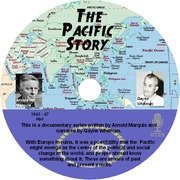
The Pacific story. This is the story of the Pacific and its people, of the peaceful sea and the lands and lives it touches, and their meaning to us and to the generations to come. The National Broadcasting Company presents the third in a series of programs dedicated to a fuller understanding of the vast Pacific basin. This new broadcast series, another feature of the Inter-American University of the Air, will deal with a different aspect of the Pacific each week, with drama of the past and present, and commentary by Owen Lathamore, authority on the Pacific, and director Walter Hines School of International Relations, Johns Hopkins University. This is the Pacific story. This is Siberia, America's nearest Asiatic neighbor. Come over here, you can see better. Oh, yes, thanks. Certainly a lot of people turned out for the launching. The launching of this warship marks the opening of a new epoch. You mean because it's the first warship built by your Russians in the Far East? Because it shows that the industrialization of Soviet Asia has become a reality. Yes. Siberia is the America of this century. Just as you Americans built a self-sufficient economy on the wilderness in the last century, so we are doing here in Siberia in this century. Now, is this better? Can you see the ship? Yes, yes. Fine. Powerful looking craft. This ship is built of steel that was made in the mills here at Komsomolsk. The iron and the manganese that went into the steel and the coal that ran the blast furnaces all were mined here in Siberia. Oh, then you're practically independent from European Russia out here, huh? Practically, yes. That's incredible. It's as if this entire industrial region just rose up out of the ground. Here it is, 1939, and it seems that only yesterday there was nothing here at all. Yesterday, as you put it, where you are standing was a fishing village. Terms. Wasn't even on the map, was it? Not on your map, perhaps. They're just about ready to send the ship down the waves. Yes. How big is Komsomolsk? Oh, 300,000 or more. It was built entirely by members of the Young Communist League. 60% of the population here is under 30 years of age. That is why we call it the City of Youth. It's moving. It's sliding down the waves. There she goes, down into the water. The America of this century. It may be at that. It may be at that. This is the new Siberia, Soviet Asia, Russia facing the Pacific and playing an important role in the affairs of the Pacific. This is America's next door neighbor, only 54 miles from continental United States. This is the land which only yesterday we thought of as- Siberia, the geographical freak, the biggest and maybe the richest country, but also the least accessible country in the world. Sure, it's big. 25 times as big as France, but what good is it without men and transport? Nothing but a wilderness of snowdrifts and wolves. The only thing it's good for is a prison. This was the Siberia of yesterday. This was the Siberia that the Tsarist regime took 60 years to conquer back in the 1700s, when the scores of native peoples were vanquished one by one, when the hundreds of thousands of Buryat Mongols resisted and were informed by a military governor. We shall send many men with firearms to your villages. You and your wives and children and village folk we shall beat and ruin. Your yurt shall burn without mercy. No one shall be taken prisoner nor permitted to be ransomed. And those who shall be taken shall be hanged and executed unto death. In the 19th century, more than a million men and women were exiled to Siberia. Chained from both ankles to the waist, six and eight prisoners chained together. They trudged, bleeding and shivering 3,000 miles into exile. Three thousand miles, the width of the United States, for Siberia is large. Six million square miles of territory, about the size of the United States and Canada put together. And here, besides the Russians, live 140 different native groups. Out of the blood of these peoples, the exiles, the natives, the Russians who plunged into the wilderness, out of this mixture has sprung a sturdy race, courageous, far-seeing, enterprising. Through the vast country of these peoples, Russia reached out to the Pacific at the turn of the century, built the Trans-Siberian Railroad, built the Chinese Eastern Railway across Manchuria. Russia was emerging as a power in the Pacific, and the whole face of events in the Pacific was being altered. Japan struck Russia with the power and deadliness of a cobra in 1905. From this date is marked much of the hatred of the Russians for the Japanese. But much more of this hatred is marked from the time of World War I, August 1918. Now, men, we're ready to debark. Every man is responsible for his own equipment. We're going over the side and down into the boats in a matter of minutes. There'll be no light, and that water's cold. Watch yourselves. At ease. Say, uh, I thought we was at war with the Germans. We are. Well, then what are we doing up here in Valvodostok, or whatever they call it, up here in Siberia? They told you. We're up here to separate the reds and the pinks and the whites. That's what I can't figure out. Us Americans up here sorting out Russians. We're not the only ones. England, San Domenico, France, and Japan, too. Japan, too, eh? Attention! Now, here are your final instructions. You take your places in the boat. And so, as a representative of His Majesty's force, I have come to talk to you as a member of the command of the American forces. The agreement of all the Allies was that none should send more than 7,000 troops into Siberia. Yes, that was our understanding. But the Japanese have sent in at least ten times that number. Seventy thousand Japanese? They have had them here for weeks. We must investigate this at once. England, France, and the United States withdrew from Siberia in 1920, and let it be known, they expected the Japanese also to withdraw. But the Japanese had plans of their own. When the Americans were safely across the Pacific, Japan seized Vladivostok. The next day, attack Nikolsk and Khabarovsk conquered the Russian coast from the Korean border to the Okhotsk Sea, and held much of it until 1925. Here was spawned the hatred which is still to be resolved in the Pacific. In Russia, a new perspective on Siberia came into being. The question is, can Siberia be defended from European Russia? Siberia is linked to Moscow by the Trans-Siberian Railroad. The Trans-Siberian Railroad is long, very long, and slender. It takes two weeks for an express train to reach Vladivostok. Do you contemplate immediate danger in the Far East? It is with us, always. If we here in Moscow should find it necessary to drain Siberia for suppliers and armies to meet a threat in the West, it would be impossible to rush them back to the East in time if Siberia were attacked. We cannot reduce the distance. The solution is more transportation. Another railroad is necessary, and roads. That would not be a solution. To build another railroad would help, but a plan far bigger than that is necessary. We must make Siberia independent. Divorce it from the Soviet Union? Politically, no, but militarily and economically, yes. That would be like moving an entire nation thousands of miles. That is what we must do. Siberia must turn its back on Russia proper and face the Pacific. With this policy, Russia undertook the most ambitious plan ever undertaken by any nation of moving entire industries from the West to the East, of establishing towns and cities where none had stood before, transforming frontier outposts into industrial centers, of making Siberia an independent economic and military unit of the Soviet Union. We will explore the resources of Siberia, and where we find resources, there we will locate our new industries. Research experts, engineers, scientists sought out the resources of Siberia, charted them. Timber, water power, oil, minerals. Great industrial plants rose out of the ground as if by magic. This is the Kuznetsk-Kubatsk cold basin. Well, part of it. How do you compare with the Donbass in Ukraine? Oh, the seams in this basin alone contain six times more cold than the Donbass. And here at Kuznetsk we have built the largest metalworks in the world. The largest metalworks in the world in a country which not many years ago was thought of only as a snowbound wilderness of prisons and wolves. There you see, they are about to pour the molten metals. There must be tons and tons of metal there. This plant alone makes more than one million tons of steel a year. Protect your eyes now. I can scarcely see it is so bright. Oh, yes, sir. Revive. What a mess of molten metal. This is repeated a thousand times every day in Siberia. For Siberia now has the largest iron and steelworks in Russia and the largest blast furnace in Asia or Europe. Scientific research find the resources and there build the industry. Now the howls of the wolves are drowned by the roar of steel mills. In the early 30s another Siberian railway was started, the Baikal-Amur Magistral, to run from the Trans-Siberian railway north of Lake Baikal straight across Siberia to the Amur River. Ah, a pretty smart piece of operations, those Russians building that new BAM railroad. Yes, but did they ever finish it? Well, I don't know. Have they stopped working on it? Well, there's some mystery about it. It's being called the Mystery Railway. Hmm, that doesn't seem possible. They were building it halfway between the Trans-Siberian railroad and the Arctic Sea so that it would be shielded on both sides by hundreds of miles of wilderness. Well, this completion has never been reported and no one outside of Russia knows if it's in operation. I've got a hunch. To transform this wilderness into a self-sufficient economy, new industries, new railroads, the Trans-Siberian single-track railway since 1894 was double-tracked. New motor roads, new air routes were developed. Thus far-seeing Russians sought to create a USSR independently capable of defense against Germany in the west and Japan in the east. June 1941, a Nazi Germany turned on Russia. Nazi Panzers and airplanes struck across the western border where under the Tsarist regime, 90% of Russia's industries had been within 500 miles of the European frontier. Eleven days after the Nazi invasion, Joseph Stalin declared in his scorched earth speech, To the enemy must not be left a single engine, a single railway car, not a single pound of grain or a gallon of fuel. The Nazis believed, and Stalin intended them to believe, that This means the Russians will destroy their mills and factories, dynamite them. It means they must push the invasion at all possible speeds. Until four months later, in October 1941, when economic experts came to the Three Power Conference in Moscow, was the full intent of Stalin's speech review. So, be judging the steel milling for operations. These plants, like many others, we uprooted from its foundation in European Russia, loaded it on trains, and moved it out here into Siberia. Moved the entire plant? All that was important to move, including the workers. We have left nothing for Hitler. The first bomb that fell on Russian soil rallied the many more than a hundred different peoples of the Soviet Union against their common foes. From the burning sands of Turkestan to the frozen tundras of the Arctic, they rallied. Ten million men of all races, tongues, colors, creeds. Fighting alongside the Russians with bravery and fury and skill are Siberians, Turkomans, Uzbeks, Tatars. Dark-skinned, tawny-skinned, slant-eyed, flat-faced Asiatic races fighting fiercely alongside Ukrainians, Azerbaijanis, and Vesarabians. Entire regiments of these colorful sons and grandsons of warrior tribes are operating in the front lines, leading the... It's understandable why you Russians should fight so fiercely in defense of your country. But why should these Asiatic peoples bounce it into miles from their home? They know this is their country, too. The Declaration of People's Rights guarantees autonomy and self-determination to all the peoples of the Soviet Union. To each people is guaranteed the right to its own language, its own culture, and its own institutions. Fruits from the native tribes of Siberia fighting on the Western Front from Vermont to the Black Sea. And in Siberia itself, an independent Red Army. A Red Army facing the Pacific, looking down over Mongolia and Manchuria, and with a watchful eye on Japan. To supply this army... We supply the power for the industrial plants in the cities of Soviet Asia. This hydroelectric plant is one of many we have built to utilize the water power of this country. Siberia has millions of square kilometers of standing timber. A vast forest reserve of the Soviet Union now lies in Asia. The fertile black plains of Siberia. From these fields comes our grain. Enough for all Siberia and for the growing millions of European Russia. The vast natural resources to support a Far Eastern army and to build an economy independent of European Russia. Self-sufficient Siberia. Self-sufficient and more. Siberia supplies itself and helps supply European Russia and the Soviet armies on the Western Front with untold millions of tons of fish, furs for hats and coats, and coal and iron to make steel to fight back the enemy. Heavy industries and industries of precision. A machine tool plant in the capital of Buryat Mongolia? This is a logical place. We think of this country as a native frontier. You are thinking of the Siberia of yesterday. Precision machinery is as important here as it is in the other machine tool plants of Soviet Asia. Precision machine tool plants. The humble industry and the whoring of wheels, where only yesterday the wind swept across the barren frontier wilderness. Assembly lines as modern as American assembly lines. Take it away! Roll out the nicks, Bomber! Here's the way! Another bomber coming off the line! Airplanes, bombers, fighters, transports rolling off the lines of Tomsk and Irkutsk. Rolling off the lines in Siberia. Like the American pioneers of yesterday, the Siberians are transforming a wilderness into a modern civilization with industries, schools, hospitals, libraries, and girding to defend it all against the enemy. On the great peninsula of Kamchatka, which points southward dagger-like from Siberia and which forms the west shore of the Bering Sea, on this great peninsula of Kamchatka, the history of the Pacific may be changed. You see, the harbor of Petropavlovsk is ice-free year-round because of the warm Japanese current. It is bigger. Much bigger than I expected. We have grown much. Petropavlovsk is the capital of Kamchatka and also the largest Soviet fort in the North Pacific. Not so many years ago we had only one doctor in all the peninsula of Kamchatka. One doctor for 250,000 square miles? Yes, but now we have more than a hundred medical centers. We have grown. Now children of many tongues are educated here. Kamchadas, Yukagirs, Lamuts, Chukchis, Eskimos, and Aluts. Development implies education. Of course. You have an air base here, do you? Yes. Petropavlovsk is an air base as well as a naval base. You see, the Japanese have their largest air and naval base just a few miles south of here, at Paramashiro. I see. Then Kamchatka represents an important development in the North Pacific, eh? Relatively, yes. Relatively. Here in Kamchatka, as you can see, we are a frontier of Soviet Asia. We are a long way from Moscow. A thousand miles, so you see, it is important that we maintain contact by aviation and radio. Yes, I have noticed that your new motor roads are, well, some of the finest I've ever seen. You are speaking of the road you saw this morning? Yes. That crosses the mountains to the west coast of the peninsula. Does it join with the railroad over there? That is another project. I understand that that new railroad would link Kamchatka to the Trans-Siberian Railroad. That could be very important if Petropavlovsk here should ever be used as a receiving point for war supplies from the United States. Yes, it could be very important. Upon the Russian control of Kamchatka and Soviet Asia, as upon the American control of Alaska and the Aleutians, will depend the events of the North Pacific. So long as powerful Soviet armies stand watch along the borders of Manchuria, so long as Soviet warships and submarines are based in Soviet Asian ports, so long as Soviet Asia's air force stands ready for action, that long must Japan divert a great portion of her armed forces. Whatever happens in Soviet Asia will have a dynamic effect upon the events of the entire Pacific. Beyond these facts of the place of Soviet Asia in the affairs of the Pacific is their underlying meaning. To interpret these facts, the National Broadcasting Company presents Owen Latimore, Director of the School of International Relations, Johns Hopkins University. Mr. Latimore. There is something very American in the impression Siberia makes on travelers and writers. You feel there the drive of a creative spirit and a young, creative society opening up the wilderness. There is an American tone of bigger and better in farming, industry, education, social life, a buoyant assurance that tomorrow will be even better than today, an eager outpouring of statistics, figures, numbers, tons, miles, horsepower. There are also differences. While in some ways the Siberian tradition is very much like the American pioneering tradition, in other ways it is ultra-modern. America grew up with the machine age. Steam and electricity were young when the American nation was young. They grew up together and spread and occupied the land together. Not so in Siberia, where scientific research and science applied to industrial techniques entered a still primitive land in a sudden invasion. I remember being shown in a Leningrad museum two cases of primitive stone knives. They looked exactly the same, except that one set of knives was obviously old and the other obviously new. The old stone knives were probably 3,000 years old. They had been dug out of an ancient stone age grave. The new knives had been made by young men of a Soviet Arctic tribe. They still knew how to make stone knives because their fathers made them this way. But the young men themselves were in Leningrad studying to become meteorologists in order to work in Arctic weather stations maintained by the Soviet air routes. That gives you a measure of the suddenness with which things are happening in Siberia, from the stone age to modern scientific meteorology in one generation. It is quite obvious that the Russians have never forgotten Japan's attempt to take a large part of Siberia away from them at the end of the last war. The Japanese ravaged the easternmost part of Siberia for several years, and it was not until 1925 that the last Japanese left. Because they have never been free of the fear that Japan might attack them again, the Russians have not been able to take their time about developing Siberia. They had to get strong enough, quickly enough, to hold their own. They could not rely on hardy pioneers and frontiersmen alone. The pioneers had to have the aid of science. It would not have done to concentrate on getting the gold out of the rivers and let the rest of the wilderness lie for the time being. Instead of sending out first the prospector and the woodsman, followed by the pioneer sector, followed by trade, followed by investment and industry, they have done everything at the same time on one broad front. One example of the complex use of science is in the development of agriculture in the far north of Siberia. Nasses of land get colder and stay colder than great bodies of water. That is why it is colder in northern Siberia than it is at the North Pole. In the coldest part of this area, there are only 74 days a year when the temperature is about freezing, and the thermometer sometimes falls to 58 below zero. Yet in this area, there is a collective farm which for four years running has harvested wheat at the rate of a little more than 14.5 bushels an acre, which is slightly higher than the average in the United States for the past 20 years. This could only be done by scientific study of both grain and soil. It was worth doing because it immensely simplified problems of food and transport in an area hundreds of miles from a railway. It made possible a community of people instead of isolated trappers and prospectors. Joseph Davies, the president's special envoy to Mr. Stalin, flew over Siberia on his way back to America. He describes what he saw, the sudden growth of a 20th century civilization in the midst of a pioneer setting, in a way which lets you see it for yourself as clearly as a picture. I told Mr. Davies, as for Siberia, I shall never forget the impression which it made. For hundreds of miles, it is one vast expanse of beautiful rolling country, dotted with lakes, groves of trees, traversed by wide sweeping rivers. There were hundreds of square miles of great fields, bigger than our township, in different colors of grain, all planted with precision and from the air, looking orderly and well-kept. All along in this frontier, which corresponds to our west, I saw great cities, boom cities, laid out in squares like our prairie towns, dotted with factories, huge plants and chimneys all over the place, one small Pittsburgh after another, cities that a few years ago did not have a population exceeding a few thousand, now with a population in the hundreds of thousands. I saw one plant which was turning out fighting planes, the models of which were unknown in June 1941, and the factories for which and the machine tools for which did not exist two years ago, and they were turning out planes at the rate of a thousand a month. End of quote. The impression of power, innate strength, vigor, and pioneer energy which one gets from this great section is extraordinary. We Americans are showing right now in Alaska that our own pioneer days are not over and done with, and that we too can combine the toughness of the pioneer with the skill and science of the 20th century. As a matter of fact, one of the great masters of life in the North, Wilhelm Steffensen, is an American. For many years he has been preaching that the North is not a place where you have to leave civilization behind. It is a place where you can and ought to take civilization with you. And as we spread civilization there, we shall meet the spread of the civilization that is taking root and growing in Siberia. Thank you, Mr. Lettermore. Music You have just heard the third program of the new series, The Pacific Story. Next week at the same time, over most of these stations, the fourth will be broadcast, Old China, with drama of the past and present and commentary by Owen Lettermore, authority on the Pacific and recently political advisor to Generalissimo Chiang Kai-shek. You may secure an illuminating handbook of the Pacific Story, which gives background information on each program in this series, with suggested further reading. This Pacific Story manual will be sent to you for 25 cents in coins to cover cost of printing and mailing. Address, the University of California Press, Berkeley, California. The Pacific Story is written and directed by Arnold Markler. Music The musical score of Pacific Story is composed and conducted by Charles Vance, your narrator, Art Gilmore. This program has been presented as a public service and another feature of the Inter-American University of the Air by the National Broadcasting Company and the independent radio stations associated with the NBC network. This is the National Broadcasting Company. Music