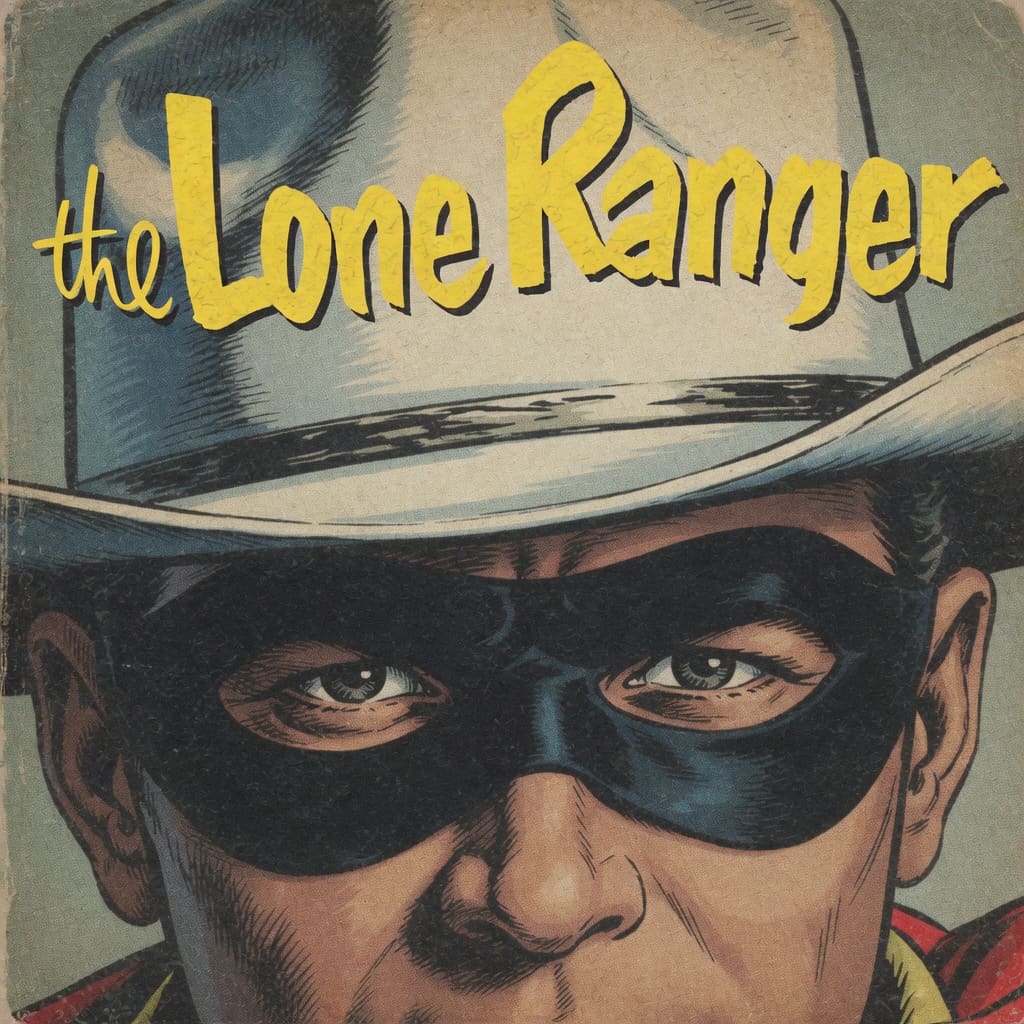
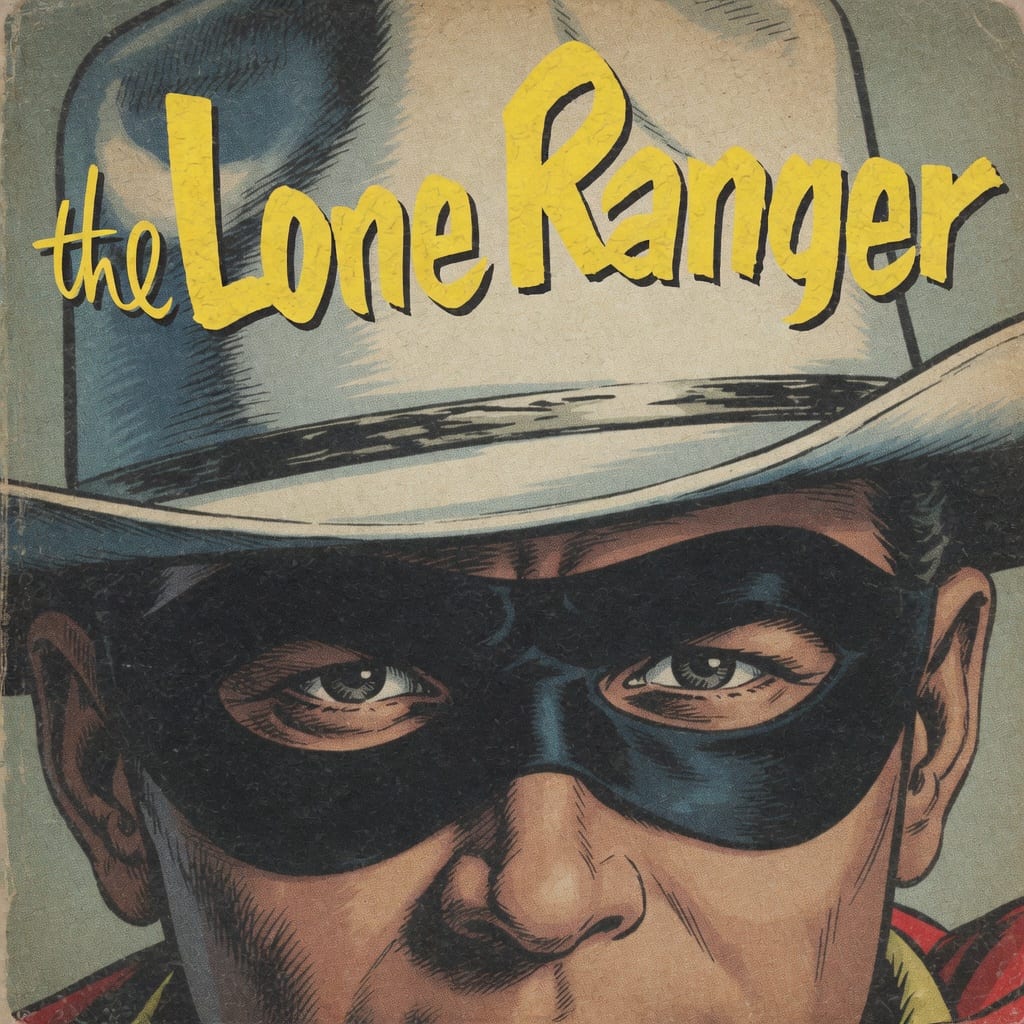
A fairy horse with a speed of light, a cloud of dust, and a hearty hi-yo silver. The Lone Ranger. Manion Tonto, the daring and resourceful mask rider of the plains, led the fight for law and order in the early western United States. Nowhere in the pages of history can one find a greater champion of justice. Return with us now to those thrilling days of yesteryear. From out of the past come the thundering hoofbeats of the great horse Silver. The Lone Ranger rides again. The Lone Ranger and Tonto rode through Medicine Canyon in Dakota Territory on their way to investigate rumors that Sioux Indians on a reservation were threatened by starvation. A few miles from their destination, the masked man and his Indian friend drew rain to rest their horses. Indians had painted many pictures on the smooth south wall of the canyon. The Lone Ranger was particularly amused by a colorful painting of the American flag. It's upside down, Tonto. Ah, me no. I wonder why Indian artists generally paint the flag with a blue field at the bottom. Me not know why, but most all Indian painters do it that way. I'm sure they don't realize that the inverted flag is a sign of distress or warning. Kimasabe, do you hear hoofs? Someone's riding toward us. An Indian. Ah, me see him. Him wear eagle bonnet. Tonto, he's our old friend, Chief Spotted Bear. Chief shot. Him fall. There's an Indian on top of the south wall. Ah, me see him. Him got rifle. I'll give him something to think about. Due to the distance, the Lone Ranger's shots missed the Indian at the top of the canyon, but they served to drive him back out of view. Monsensile! Monsensile! While riding toward the fallen chief, the masked man kept a sharp watch on the rim, ready to fire again if the Indian reappeared. At the side of Spotted Bear, the Lone Ranger and Tonto drew rain and dismounted. Oh, easy, steady big foot. Easy, scout. Easy, fella. Now, watch the top of the canyon, Tonto. You see how badly our old friend is hurt. He's alive, but hurt plenty bad. There's a surgeon at Fort Pearson. Fort on the other side of the reservation. Not too far. There's a cave nearby. Me carry Chief there. The cave, just a short distance from the scene of the shooting, was large enough to shelter the horses as well as the men, and a nearby spring furnished ample water. The old chief lay on a blanket and was still unconscious when the masked man finished bandaging his wound. Well, we've done all we can, Tonto. We not know if him live or die. I'd like to know who shot him. Me sure it's Indian from reservation. Tonto, Spotted Bear, has been a peace-loving leader. A new chief may mean an uprising. Now, it's more important than ever that we know what's going on in the Sioux village. Ah. Let me go there? Yes. Learn all you can. Stay several days if necessary. I'll stay here and help our friend fight for his life. If he dies, I'll join you in the village. Otherwise, I'll be here when you return. It was two days later while Tonto was still away from the cave when the old Indian came out of a coma, opened his eyes, and spoke for the first time. Water. Good for you, chief. Now I'm sure you're going to recover. That same afternoon at Fort Pearson, several miles beyond the reservation, Colonel Dane, the commandant, shook the flabby hand of a congressman from the east, the Honorable Horace Quigg. Congressman Quigg, it's a pleasure to have you here. Sit down. Sit down. Thank you. This trip has been time wasted, Colonel Dane. Well, I'm sorry. I thought you came west to investigate conditions. As a member of the House committees on both military and Indian affairs, I've been investigating. But I've learned nothing I didn't know before I left Washington. Yes, come in. Colonel Dane, sir, there's a delegation of Indians here. A new chief wants to see you. You're welcome, chief. But, uh, who are you? I am called Many Feathers. I am new chief of Ogallala Su. Well, well, an educated Indian. Where is the old chief, spotted bear? He has gone to land of great mystery. So he's dead. Spotted bear was a good friend. Who is fat man? Why, you arrogant savage. Congressman Quigg comes from Washington. He helps make our laws. Why are you here, chief Many Feathers? My people hungry. I come to demand meat as promised in treaty. Well, I have shared army stores with spotted bear, but now our own supplies are nearly exhausted. The land is fertile. The grass is tall. Indians should raise wheat and cattle. We not farmers. We hunters and warriors. While there are plenty buffalo, we ask nothing. Now buffalo gone. What we eat, early grass. Mr. Quigg is joking, chief Many Feathers. He hasn't seen conditions in your village. Maybe him afraid to come look. Afraid? Why, you impudent savage. Give me a squad of soldiers, and I'll go from one end of the Sioux nation to the other. That great honor for my people. I'll visit your reservation tomorrow. Late that afternoon, the Lone Ranger was sure he had won the fight to save Chief Spotted Bear's life. The aged Sioux leader had just finished drinking a cup of broth when Tonto rode into the cave with an aged Indian woman sharing his horse. Go, Scout. Go, fella. Easy, Scout. Me bring Spotted Bear's wife. Well, that's fine, Tonto. She'll be able to care for him. Tonto helped the old woman from Scout's back. Without a word, she went to Spotted Bear's side. Me find her singing death song outside Sioux camp. What about the man who shot Spotted Bear? Me trail him to camp. Him young fella called Many Feathers. Spotted Bear, did you hear that? Uh, me hear. Many feathers. His son me adopt. A son? And he shot you? Him good Sioux. Him think white man make fool me. Maybe him right. Him want to save tribe from starving. Kimo Sabe. Yes. People in village think Spotted Bear dead. Them choose Many Feathers, new chief. And him want war with soldiers. He'd have no chance. Other Indians help. Plenty Indians from other tribes go to Sioux village. We must learn more about his plans. Me go back to village? Yes, and I'll go with you. Spotted Bear's wife will be here with the old chief. Uh, me got clothes. You dress like Indian? Yes, I'll stain my skin and put on war paint. We'll go to the reservation tomorrow. And to be on the safe side, we'll leave our saddles and bridles here and ride bareback. We'll make Indian packs and rope bridles. The following morning, an army ambulance accompanied by seven cavalrymen commanded by Corporal Mahoney rolled across the Sioux Indians' vast reservation. Get up. Get up. The pompous congressman Quigg sat beside the corporal who drove the ambulance and had his horse tied to the tailgate. Suddenly, the corporal cried. The Saints preserves us. I see a hundred engines. Maybe two hundred. They're charging. Ho, ho, ho. I've got to get to my horse so I can fight. You take the reins, Mr. Quigg. Turn the ambulance around and head for the fort. Get out of here. Get out of here. Come on. Get out. The troopers opened fire on the attacking Indians and in the running gunfight soon ran out of ammunition. Get out of here. Get out of here. Indian bullets ripped through the canvas top of the ambulance and whistled over the troopers' heads. But strangely, the Indians made no attempt to kill, capture, or pursue the cavalrymen. Instead, they closed in around the ambulance driven by the congressman and brought it to a halt. In the forefront of the painted brave surrounding the ambulance, many feathers sat on a paint horse. His dark eyes were contemptuous as he looked at the panic-stricken Quigg. Welcome, Mr. Quigg. If this is a joke, hungry men do not joke. You are a prisoner. At a word from the chief, three braves seized the congressman. Despite his struggles, Quigg was dragged from the ambulance and searched. Then, while his hands were being tied, he said... You'll gain nothing by this outrage. We gain much. We purposely allowed soldiers to escape. They take news to fort. You are important men, so Colonel Dane will ride with all men he can muster to rescue. He'll kill you all. You wrong. Colonel and troops will be decoyed into badlands by some of my men. Before they return, we will capture fort. But you can't... Some of my men will put on army uniforms. Others will hide in buildings around parade ground. When cavalry comes, we open gate. When cavalry inside, we open fire from all sides and kill everyone! Hang on! About an hour after the capture of the congressman, the Lone Ranger and Toto, disguised as Cheyenne warriors, reached the place where the ambush had taken place. They drew rain and dismounted beside the abandoned ambulance. Oh, easy, stay there, big fella. Easy, scum. Toto, this looks bad. Ah, plenty bad. Bullet holes in canvas. I don't see any bodies. And here tracks are many horses. It looked like soldiers get way. Them ride to fort. Toto, look at this stovepipe hat. I think the Indians captured a civilian. Plenty of papers scattered on the ground. Yes, I'll look at them. Look like letters. They are letters. And they're addressed to Honorable Horace Quigg, a member of Congress. Oh, me hear of him. He'd been touring the West investigating army posts and Indian reservations. Now Indians got them. Now what do we do? If the Sioux intend to keep him alive, they'll probably hold him in a new camp. We'll have to find it and do our best to rescue him. His capture may touch off the worst of all Indian wars. Plenty hard, fine trail to new camp. There are lots of tracks around here. Too many. Look like Sioux ride in all directions. Trail is all mixed up. We'll do our best. As the Lone Ranger and Toto continued a slow, painstaking examination of the confusing Indian trails, Corporal Mahoney faced Colonel Dane and other officers in the headquarters building at the fort. And that's how it was, Colonel. The hooping engines came charging down and then... You deserted Mr. Quigg, yes? Nothing could be gained by staying with him, sir. Our only chance was to run. Colonel, I think Corporal Mahoney and his squad are blameless. They had no orders to stand and die in face of overwhelming odds. Corporal, are you sure the congressman was captured? That I am, sir. Looking back from the hill, I saw them toting him away. Gentlemen, do you know what this means? Unless we save Quigg, we may be court-martialed. What are your orders, sir? Have the trumpeter sound to arms and boots and saddles. Yes, sir. Thanks to Quigg and his kind, this regiment is in no shape to take to the field. We'll have to muster every man and use every horse that can walk. You'll be leaving the fort practically defenseless, sir. What else can I do? The Indians will oppose us with more men and better arms and horses than we have. Even if I lose the fort, I'll have to do all I can to save that confounded Quigg. Come on. Rushing downstairs from his office on the second floor of the headquarters building, the colonel led his aides out on the parade ground, where the regiment was forming. Orderlies were standing by with the officers' horses. Open the gate. Yes, sir. Regiment, prepare the mount. Prepare the mount. Mount. He is on the hills west of the fort. He'll go after the me. Right by fours. Forward. Forward. Forward. The curtain falls on the first act of our Lone Ranger adventure. Before the next exciting scenes, please permit us to pause for just a few moments. Now to continue. Night had fallen when the Lone Ranger and Tonto finally reached the Indian camp deep in the Badlands. Leaving their horses outside the circle of wigwams, they cautiously scouted the village. As they reached an opening on the east side of the Ring of Lodges, Tonto whispered, Only old men, squaws, children here. Then the Braves have gone raiding. Maybe Quig's not here. He is. He's probably being held in the chief's lodge. Where is it? It all isn't in a ring. There's an opening circle. We'll see if anyone's there. Confident that their Cheyenne disguises would not be detected in darkness, broken only by the glow of dying fires, the Lone Ranger and Tonto made their way to the chief's wigwam. The inside of the wigwam was faintly lighted by the glow of fires. The Lone Ranger and Tonto saw the congressman lying on the ground, tightly bound. The Lone Ranger whiffed out a knife and stepped to Quig's side. Take it easy, Quig. We're friends. You're going to kill me. Keep your voice down. I'm a white man. I'm going to free you. You're an Indian. Another Indian like many feathers. Wait until Washington hears about... Keep quiet! Seeing that the rawhide thongs were being cut, Quig became convinced that he was truly in the hands of men who hoped to rescue him. He quickly told of Many Feathers' plot against the fort. The Lone Ranger listened, then said... We haven't a second to lose. Here, Quig. There's a war button and blanket. Put them on. Whatever you say. Kimasari. Yes? Indians outside. Them camp guards. They've heard us. Can you see them? They're six men. Too old for warriors. Them armed with bow, arrow, knife, tomahawk. Many feathers probably gave all the rifles to the men who were to attack the fort. Isn't that right? All right, I'll go first. Follow me and bring Quig. I wish I were out of this. Here goes. Kule! Kame! The Lone Ranger's guns and a sharp command surprised the camp guards. They fell back but held their bows ready. Then Tonto and Quig came out. Though the congressman wore a blanket and headdress, his size and the sound of his boots told the guards that their white prisoner was being rescued. The Lone Ranger fired as he ran, and his bullet struck the arms of two Indians who were fitting arrows to their strings. Get Quig to the horses. I'll cover you. The Lone Ranger's revolver fire drove back the Indians momentarily, but not until a thrown knife slashed the Lone Ranger's sleeve. As the Lone Ranger fired again, two tribesmen fell wounded. The others dodged into the shadows of the wigwams, trying to head off the fugitive. Come on, we'll make it. Hey, Silver. Come on, Scout. Run faster, Quig. I can't. Let me help you. Scout and Silver had heard the Lone Ranger shout and came running up as the three men reached the edge of the village. Here come horses. I'll take Quig on my horse. Easy, silly, big fella. Come on, Quig. Up you come. Yes. There you are. Come on. In the meantime, Colonel Dane and his men were lured many miles from the fort, only to lose track of the Indians they pursued in the rocky badlands. While the troopers hunted the enemy, the decoy band of braves rejoined the main force of Indians. Under cover of darkness, picked men scaled the wall of the fort overpowered the sentries. Then opened the main gate. After leaving Tonto and Congressman Quig some distance from the fort, the Lone Ranger rode on and saw Indian warriors pouring through the gate. In his Indian disguise, the Lone Ranger attracted no attention as he rode into the fort with the others. Tonto, so easy, silly, big fella. He saw many feathers on the parade ground giving orders in the Indian tongue. Then the chief spoke in English. Is any warrior here who speak like white men? I do. Come here. Cheyenne, what is your name? I am Cole, Shosi Wagatak, man who travels alone. Maybe you help lure soldiers into fort. Stay with me. It breaking day. They may see that something wrong. I will have braves in soldiers' uniforms on the walls. You will answer if questions are asked. You are wise, chief. But what about flag? If soldiers return after sunrise, they will know something wrong unless they see flag. Come. We look for flag. Leading the parade ground, the lone ranger and many feathers climbed the stairs to the colonel's office. The headquarters building occupied the position of a blockhouse in the corner of the stockade, its second floor windows being above the walls. Now the first rays of the rising sun gleamed through the east windows as the lone ranger opened a chest. Here, flag. As the lone ranger bent to take the colors from the flag locker, many feathers suddenly jumped back and whipped the tomahawk from his belt. You not Indian. You spy. What you mean? There, where sleeve of shirt cut. I see white skin. Now you die. Half turning from the locker, the lone ranger reached for his guns as many feathers threw the hatchet. The lone ranger dodged an instant too late. The handle struck his head a glancing blow just as he triggered one of the guns. The bullet missed the rebel leader of the Sioux. The impact of the tomahawk handle staggered the lone ranger for a moment. Like a panther, many feathers sprang at him with a knife. Evading the knife thrust, the lone ranger crashed a sledgehammer blow to the Indian's jaw. Many feathers went limp, his knees buckled, and he dropped to the floor. Then a bugle sounded in the distance. The soldiers are coming. They'll have to raise the flag. There was no time to tie many feathers. The lone ranger rushed to the parade ground with the flag and raised it to the top of the pole. The flag was upside down, a signal of distress. The lone ranger raced to his horse for his pack of clothing, then hurried back to the colonel's office. He saw many feathers still unconscious on the floor and through the window observed that Colonel Dane had halted the cavalrymen about a quarter of a mile from the fort. Quickly, the lone ranger stripped off his Indian disguise. After he was dressed in his own clothes and his mask was in place, many feathers regained consciousness. The Indian looked at the mask man for a moment, then said, I know you. You men who shot at me in Canyon. That's right. And my friend and I saved the life of Spotted Bear. So he is alive. Yes. And your trap for the soldiers has failed. Look out the window. The soldiers have been warned of trouble in the fort. They've halted. How them know of trouble? Look out the other window and you'll see. The colors are flying upside down. It is you and your warriors who are trapped. You can't fight your way out. And if you try to hold the fort, you'll be starved and surrender. My people are holding big hostage. If you mean Congressman Quigg, he's free. I know when truth is spoken. I have lost. Many feathers. You're a brave man of high ideals. You were willing to do anything to help your people, but you've only hurt them. Yes. I hurt them. Now they're sure to starve. But I am glad Spotted Bear is living. I shot him with heavy heart because I thought I could do more for tribe than he do. Do you want to add to your people's misery? No. Then tell them to throw down their weapons. Lead them out to the soldiers under a white flag. They aren't likely to be punished. Other tribes have done worse and will only return to their reservations. Yes, but soldiers will hang me. You were willing to take Spotted Bear's life for the welfare of your people. Are you not willing to risk your own? My life belongs to my people. I do as you say. Many feathers. Let me shake your hand. Now. Now we'll go and arrange a surrender. An hour later, a conference was in progress in the commanding officer's office at Fort Pearson. The Lone Ranger was there with Colonel Dane, to whom he had identified himself. The group also included Tonto and the Honorable Horace Quigg, both of whom had arrived shortly after the surrender of the rebels. The colonel spoke to the masked man. Mister, it's a good thing you thought of flying the killers upside down. Otherwise, the whole course of history in the West might have been changed today. Many feathers might become a great man. I hope the authorities don't insist on hanging him. I'll recommend that he be held as a prisoner of war. What do you think, Congressman Quigg? He's a promising young man. He taught me a valuable lesson by showing me the need of fair treatment to the Indians. I bear him no ill will. Good for you. After he pays for his rebellious conduct, I'll try to get him a job in the Bureau of Indian Affairs. Colonel, what are you going to do with the other Indians who took part in the outbreak? I'll return them to the reservation as soon as Chief Spotted Bear is able to return. He'll be well enough to go home in a few days. Colonel, those Indians need food. I know that from first-hand observation. Have you any suggestions, Congressman? Yes. Share what food you have with them. I'll see that more supplies are forthcoming. Good. And draw up a list of recommendations for improving the military establishments, giving better treatment to the Indians. I'll present them to Congress and use all my influence to see if they're put into effect. That's fine, sir. Otto, we're through here. We'll return to the cave. Wait. Yes? You saved my life. What's more important, you did the nation a great service. Isn't there something we can do for you in return? What did you say about the nation? I said you'd done the nation a great service. That statement, sir, is the greatest reward a man can receive. Adios. Adios. Goodbye, Colonel Dane. Goodbye, sir. Colonel, I shall eulogize the masked man in the halls of Congress. Who is he? He's a man for whom no word of praise is expressive enough, sir. He's the Lone Ranger. This is a feature of the Lone Ranger Incorporated, created by George W. Trendle, produced by Trendle Campbell Muir Incorporated, and directed by Charles D. Livingston. Tonight's drama was written by Fran Stryker. The part of the Lone Ranger is played by Brace Beamer. Let's go. 病병 Lone Ranger The Lone Ranger The Lone Ranger Het woogie in the hall