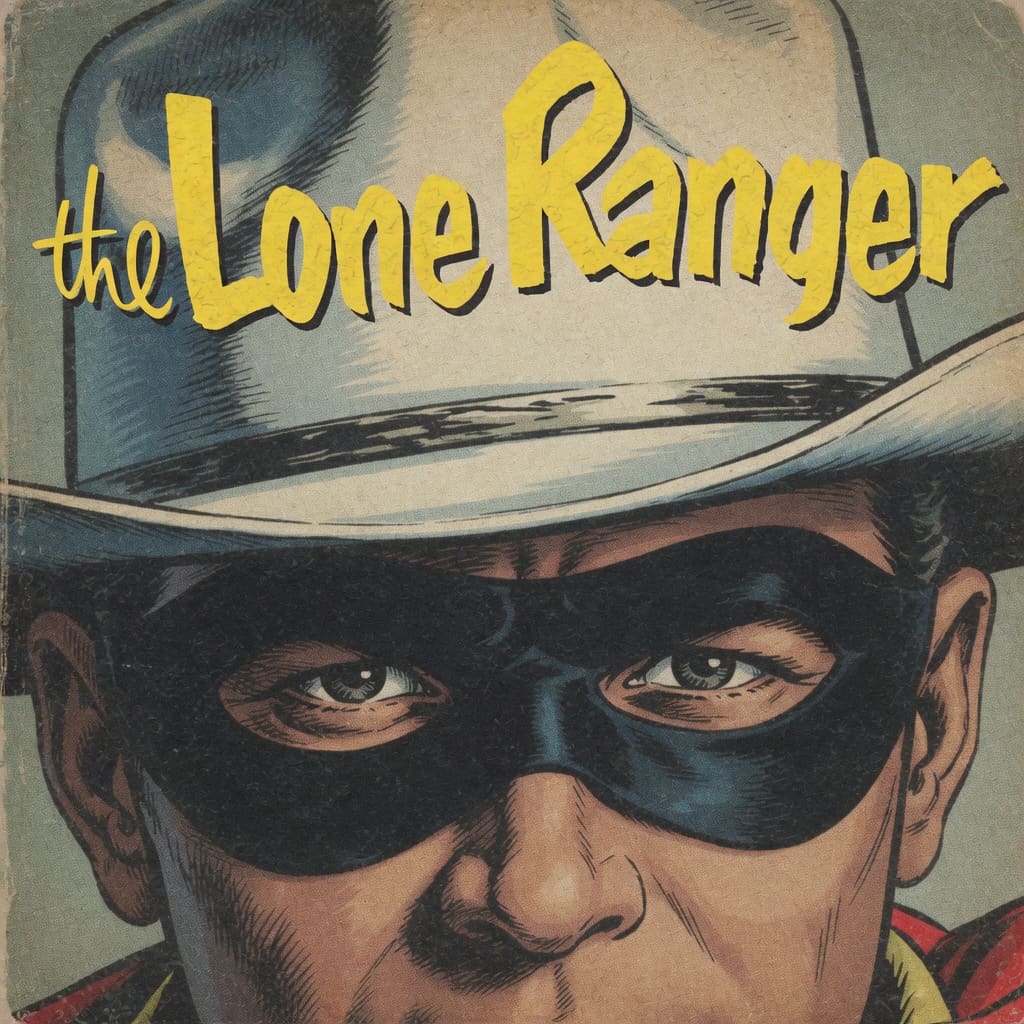
With the speed of light, a cloud of dust, and a hearty hi-yo silver, the Lone Ranger. With his faithful Indian companion, Toto, the daring and resourceful mask rider of the plains led the fight for law and order in the early western United States. Nowhere in the pages of history can one find a greater champion of justice. Return with us now to those thrilling days of yesteryear. From out of the past come the thundering hoofbeats of the great horse, Silver. The Lone Ranger rides again! Come on, Silver! Let's go, big fellow! Are you still there? The Lone Ranger and Toto were riding east from Salt Lake City along the route that was used by the Oberlin Mail. They rounded the bend and suddenly, they saw three Indians pursuing a rider who spurred his horse desperately in a race for his life. Come on, Toto, we'll help that man! Come on, Silver! As Silver's shot hoofs pounded the plains, the masked man and Toto drew their guns and started firing from the saddle. The surprised Indians turned as bullets streaked close to them, too close for comfort. They turned their ponies and headed for the hills. Their intended victim drew rain. He turned to thank his rescuers. Hold it, hold it, hold it, big fellow! Thanks, thanks a lot, mister. They almost got... Oh, your mask... My mask needn't worry you. You've proved yourself a friend. Toto and I are planning to camp in the hills not far from here. Will you accept our hospitality? I'll be glad to. Good, let's go. Come on, Silver! Come on, down! As the Lone Ranger and Toto made camp, their guest identified himself as Ed Creighton and explained that he was a line builder for Western Union. During the evening meal, Creighton was sure that he had found two men who could be trusted. He decided to speak frankly. I told you I work for Western Union. Yes, but why are you here? The telegraph line comes no farther west than Omaha. Confidentially, we're planning to extend our line to the Pacific. Oh? I've been mapping the route for the transcontinental line. I'm on my way back to New York with a report from my boss, Hiram Sibley. What route have you chosen? The Pony Express route, from Omaha to San Francisco. San Francisco, huh? A transcontinental wire linking the east and the west. Ah, but there's one problem. And I'll admit I don't know how it can be solved. What's that? Indians. As we move our lines westward, we'll be at their mercy. They'll undoubtedly attack our work crews, pull down the poles, cut the wires. No, not if they're friendly. Try to persuade them to fight on your side. Yes. That's easier said than done. Toto and I are acquainted with most of the tribes in the west. We may be able to help you. Mister, if you would. Count on it, Creighton. When you return with your work crews, your telegraph poles, and your wires, Toto and I'll look for you. The next morning, Ed Creighton resumed his journey. He traveled on horseback, on stagecoach, by mule train and railroad. And when at length he reached New York in 1861, he gave Hiram Sibley a detailed report of his trip. Sibley took the report to Washington, where he secured an appointment with the president. When he was ushered into the chief executive's office, Hiram Sibley explained the plans of Western Union. Mr. Lincoln listened closely. Then he shook his head and said, Mr. Sibley, you'll find no trees for telegraph poles on the plains. Mr. President, we'll haul our trees to the plains. And as fast as you string lines to them, the Indians will tear them down. Indians have burned the homes of many settlers, but that didn't discourage pioneering. We're aware of the difficulties ahead of us, sir, but we believe the job can be done. I envy your confidence, Mr. Sibley. I wish I might share it. But the future appears dark. Fort Sumter has been in the state of siege since January. Unless supplies are sent to our men, they'll be starved into surrender. The Confederates will open fire if we provision the fort. Americans firing on their own flag. Brother against brother. Father against son. Civil war. A transcontinental telegraph is vitally important in time of war, Mr. President. I admit that, Mr. Sibley. But war is imminent, perhaps only months away. Even if your scheme were practical, it would take ten years to string lines to the West Coast. Now, go and prove that I'm wrong. In that spring of 1861, the clouds of war were darker than most people reckoned. The rumble of catastrophe began in early April and increased in volume and intensity until the morning of the 13th day. It was 4.30 when artillery belched fire and smoke in shots at Fort Sumter. This was war. The men called out 75,000 men. Mills, factories, railroads swung into action to provision, equip, and transport a nation at war. Now, more than ever before, rapid communication was required. Mail carried by even the fastest trains was far too slow. The Western Union telegraph offices, equipped by the magic of science for almost instantaneous communication, were swamped with urgent messages. The lines along the eastern seaboard and west as far as Omaha, hummed with official orders, reports, and instructions. The telegraph lines ended at Omaha. Westward news traveled slowly. It was months before Fort Kearney, Julesburg, Salt Lake City, and Sacramento learned that Fort Sumter had fallen, and the nation was marching to war. By that time, Hiram Sibley's transcontinental expedition rolled westward. Wagon trains scattered along the route Creighton had mapped. They carried poles, heavy reels of wire, insulators, and batteries to the plains, mountains, and Indian-infested wilderness. In Washington, President Lincoln frequently went in person to the telegraph office in the War Department. He often thought of Sibley and his hopes of spanning the nation with the magic wires as he watched the brass key and the words transcribed by the operators. Mr. President, Jeff Davis is to be president of the Confederacy. North Carolina has seceded, and Virginia. South Carolina has withdrawn from the Union. Georgia seceded. Florida. Alabama. Mississippi. Louisiana. Texas. Arkansas. Tennessee. He's the West with the Union. What a Missouri, Utah, California. Well, no one knows, Mr. President. We haven't heard from the West. The males. Even the fastest is slow. I would that Sibley might accomplish the impossible, but no, even with God's help, there is a limit to what can be wrought by a mortal man. More and more of Mr. Lincoln's time was spent in the telegraph office of the War Department. Here, on a warm July 31st, the President waited tensely for the telegraph key to spell out the news of Bull Run. McDowell was in command of the Union soldiers, and everyone believed the General would win a glorious victory. Suddenly, the quiet key began to pound. Lincoln strode across the room to stand beside it. What is it, Wilson? What's happened to Bull Run? It's bad news, Mr. President. Huh? The rebels have us on the run. Our men are retreating. Burg has won the battle. Retreat! The rebels have beaten us. Our men are running away. The day is lost. The Yanks are falling back to the Potomac. The soldiers came back to Washington, weary, heartsick, defeated. Cartridge powders streaked their faces, and their ears still rung with the sound of gunfire. For many of the boys and men in the retreating army, it was the first taste of enemy shot. Mr. Lincoln was silent as he stood alone in the window of his office watching the survivors. The wounded and the dead pass through the street. The mighty army of the Potomac was straggling back to the capital, with defeat at its heels. Meanwhile, Hiram Sibley's expedition continued west. Ed Creighton was in charge of the construction of the eastern line, with a man named Jim Gamble in charge of the western line. Work crews dug post holes and placed telegraph poles along the route traveled by the pony riders. At a point between Fort Kearney and Julesburg, the long poles were planted, and wire was strung loosely from post to post, hanging about six feet above ground. The weather had been extremely hot. Buffalo was scarce, and other game had disappeared. Three young braves, one of them the son of Chief Eaglefeather, had spent the day searching for food. They were returning to their village at sundown, racing their spirited ponies. Black Hawk, the chief's son, was in the lead. As he rolled, he looked back over his shoulder, shouting to his companions. Black Hawk was challenging his friends to match his speed, to overtake him if they could. The young warrior didn't hear his friends' warning. Straight toward the line of poles and low-hanging wire, he raced. Then suddenly, the wire caught Black Hawk across the chest. He gasped in pain and surprise and fell to the ground. His friends drew rein and hurried to his side. Standing with his crew some distance away, Ed Creighton had seen the accident. He had mounted and quickly rode to join the two Indians and their fallen friends. He dismounted and moved to Black Hawk's side. I saw you fall. How badly hurt? White man's line. Catch Black Hawk. Knock him from poony. He rode right into the wire. He'd been watching where he was going. You go away. I came here to help you. Son of chief, not one help. You're the son of an Indian chief? Me, Black Hawk, son of Eaglefeather. Eaglefeather, great warrior. See here, Black Hawk, I'm sorry you spilled from your horse. You might have broken a couple of bones. Black Hawk, sir, you go away. I'll help get him back to the village. We help back to the village. Tell Chief Eaglefeather what happened to son. Creighton knew Black Hawk had been hurt. The force with which he had hit the wire must have injured his ribs, possibly breaking one or two. But worse than any physical injury was the humiliation Black Hawk had suffered. With two of his friends as witnesses, he, the son of a chief, had been knocked from his horse and sent sprawling on the ground. The loss of dignity was enough to arouse any Indian. It would surely arouse the enmity of the Indian chief. That night, a scout named Soda joined Creighton as he stood beside the covered wagon studying the horizon. Look at those hills, boss. Every one of them is a light with engine signal fire. I see them, Soda. You know what they mean? They mean trouble. Engine trouble. I was afraid of this. I wish I knew where to look for them. You don't have to look for them, boss. Those fires are blazing bright enough for anyone to see. I'm not talking about fire, Soda. I'm thinking of men. A masked man and an Indian. They saved me from redskins once. And I have a feeling I'll need help again. Mighty soon. The curtain falls on the first act of our Lone Ranger adventure. Before the next exciting scenes, please permit us to pause for just a few moments. All to continue. The Lone Ranger and Tonto had been near Carson City when they heard that Ed Creighton and his crew were in the west, stringing the wire along the route the line builder had chosen on an earlier trip to the west. The masked man and Tonto started east at once, planning to meet Creighton. Halfway between Julesburg and Fort Kearney, they sighted Indian signal fires. Come on! Lone Ranger! Come on! Lone Ranger and Tonto drew rain at the edge of the Indian village. He's got a big fellow. He's got a big fellow. They dismounted and made their way on foot past the wigwams that surrounded the council ring. They stopped and stood in the shadows of a wigwam in the center. They saw Chief Eagle Feather wearing his war bonnet, and the painted warriors of the tribe gathered around the council fire, their attention fixed on the chief. Eagle Feather was speaking. Eagle Feather heaped plenty, man. What's he saying, brother? Indians go hunting. Find no food. White man put trees without branches on plains. Drive away buffalo. All game. It has been a bad hunting season. The crops have withered in the ground for want of rain. Eagle Feather blame white man for Indian trouble. Oh, him say. Him kill white man. Tear down poles. Them gonna start war dance. Eagle Feather must not go on the war path. We'll try to reason with the chief. He'll remember us as friends. Come on, Tuttle. Let's hope he'll listen to us. In Washington, President Lincoln also faced a dilemma. Simon P. Chase, the Secretary of the Treasury, was in Lincoln's study, and Mr. Chase was discussing money. Mr. President, uniforms, weapons, ammunition, food must be paid for. Our treasury is nearly empty. I've tried to bring the matter to the attention of Congress, but the senators do not realize the seriousness of the situation. We need gold and silver desperately, but speculation has driven it from circulation. Mr. Chase, I know of only one place to secure more gold and silver. Where, sir? Tell me where. The Western Mines. I've thought of them. But we can't depend on the Western Mines. Indeed, we're not sure that the West stands with us. If we could know that California and Nevada and the territories of Colorado, Montana, Washington, Utah will be behind our efforts with all their vast gold and silver resources... Mr. President, we must face reality. Without gold and silver, we'll have to issue paper money. There's nothing to back it up. That would destroy the value of our currency. Our money would become worthless paper. I see no alternative. As the President considered the problems of an empty treasury, Ed Creighton was confronted with disaster of a different sort. He and his crew of line builders were gathered around their supply wagons. Scouts had reported that Eagle Feather's braves were on the warpath. Fearing attack, Creighton spoke grimly to his men. All of you men, stay close to the wagons. If you stray from camp, you're likely to meet a war party and lose your scouts. Hey, boss, are you giving up the job and turning back? Not on your life. We're going ahead. We continue setting the poles and stringing the wires. Good. Now, if the Redskins want to fight, we'll give it up. That's it. I've got way of rifles and plenty of ammunition. And we'll pass out extra ammunition. Hank, break open those cartridge boxes. Right, boss. Ed Creighton. It's a mass man. You're covered, mister. Get your hands up. Hold to your guns. You heard me. This man's a friend of mine. Thanks, Creighton. He's a silly big foot. Mister, I'm glad to see you. We're having Indian troubles. Yes, I know. Otto and I were in Eagle Feathers' village. Otto's there now taking care of Blackhawk. He persuaded them to wait for two days before attacking. Thanks, Otto for me, mister. That'll give us time to send for reinforcements. We'll be able to get more men to help us fight. That isn't the reason Tonto asked for the delay. What do you mean? Creighton, is your line working from here to Fort Kearney? Yes, but Fort Kearney's two days travel from here. The Indians are hungry. In order to stretch the food on hand, Eagle Feathers rationed his people. Each member of the tribe receives enough to sustain life. But even that will be cut off in two days when their supplies are exhausted. Well, I didn't know things were that bad in the village. We'll be glad to help. By helping them, you'll help themselves. You mean that we'll be able to win their friendship? Yes, and you'll be able to prove that the telegraph is the most wonderful white man's magic they've ever seen. After a demonstration, they'll believe that it's a power for good. Just tell me what to do, mister. I'll bring Eagle Feather and a few of his men here. When the Lone Ranger returned to the Western Union workmen at daybreak, he brought with him Chief Eagle Feather and four braves. The Indians wore war paint, and their eyes were flinty with suppressed anger as they looked at the men whom they blamed for their misfortunes. But they had promised the masked man to powwow in peace. They intended to keep their word. They watched silently as Creighton connected a battery box and small brass instruments to the slender wire. What him do? You and your people use fire and smoke to send messages. That right. Well, my friend is about to send a message. His words will be carried many miles to a great city. The watching Indians tried hard to conceal their superstitious fear as Creighton began to send a message. Their fear was increased many fold when a few moments later the shining instruments began to sound with no one standing near as the reply to Creighton's request came from Fort Kearney. What's that? A reply to my friend's message. May not see smoke or fire. How message sent? The words travel through the wire. Creighton, Chief Eagle Feather might be interested in knowing the message you sent. I asked for several wagons of food for the chief and his people. How food get here? In wagons from Fort Kearney. They should arrive in two days. When it comes, you and your people will know that the white man's medicine is strong and good. If medicine good, why it throw Black Hawk from Pony? This telegraph wire was hanging about six feet from the ground. Black Hawk didn't see it and ran right into it. We wait and see how medicine work. We wait two days. If food not come, Eagle Feather and Braves go on warpath. The powwow ended. Eagle Feather and his men returned to the hills where they watched the crew on the plains below. The first day passed and the sun rose on the second. From time to time, Ed Creighton sat down at the telegraph instrument and checked the progress of the wagon train with men who were stationed on the line between this point and Fort Kearney. Chief Eagle Feather watched the horizon and with him, the Lone Ranger. It was nearly sundown when the grim-faced chief said, White man, lie to this chief. Food not come for Indians. The sun hasn't set, Chief Eagle Feather. There's still time for the wagons to come. When sun go down, my people fight. Tear down white man's medicine. We... As the chief spoke, the big wagons came into view. The Lone Ranger saw them and smiled. Chief Eagle Feather saw them and stared in wide-eyed amazement. In camp with his men, Ed Creighton saw them and shouted, There it is, boys! The wagon train from Fort Kearney! We don't have to fight the Redskins! Let's go put them on our side! The Western Union men escorted the wagons to the Indian village. Bonfires were built, and for the first time in many weeks, the Indians had food enough for everyone in the tribe. Chief Eagle Feather stood in the council ring with the Lone Ranger and Ed Creighton. Creighton said, This is the first of a series of wagon trains, Chief. We'll keep you supplied with food till the dry spell's ended. And you have crops enough to feed your people. No, this, Chief, no white man's medicine. Plenty strong. Plenty good. Me glad, masked friend and tonto come. Stop Indians from starting war. There'll be no war, Chief. That right. Good. Now what, Ed? Now we'll go back to work, mister. I hope you'll stay with us till the job is done. Tonto and I'll be nearby, but from now on, it's up to you and your men. From now on, you'll see real speed, mister. Word of the power of the telegraph spread rapidly among the Western tribes. As the work progressed, the Lone Ranger and tonto found increasing numbers of Indians ready to help make white man's medicine. There was an abundance of manpower to cut and trim trees, haul them into position, and set them firmly in holes. August passed, and then September. The line was extended to South Pass and Fort Bridger, while Jim Gamble's crew strung wire from San Francisco, Sacramento, Carson City, and Fort Ruby. Creighton and Gamble raced to close the gap, linking the line from east to west. In New York City, Hiram Sibley maintained telegraphic contact with Creighton and with President Lincoln in Washington. He reported to the President how the friendship of the Indians had been won. And then one day in October, the President was in the War Department telegraph room with Salmon Chase, the Secretary of the Treasury. Both men were hollow-eyed from worry and lack of sleep. Mr. President, here is an intelligence report that is the realization of my worst fear. The rebels have sent agents abroad to enlist the aid of England and France. England and France are sympathetic to their cause. The Confederates are capitalizing on that sympathy. They're trying to borrow European gold. Mr. President. Yes, what is it, Wilson? Messages are coming from the west, sir. From Omaha? No, sir, from far beyond Omaha. Here, sir. This is from Utah. Utah! Let me have it. There are other messages coming through. Lincoln took the message, and as he read it, Secretary Chase saw the rugged face relax. The President looked up, and there was new hope in the eyes that had known anxiety and troubled grief. Mr. Chase, you were worried about the Confederates financing their war effort with foreign gold. Sir, we shall finance the Union with our own gold and silver. But, Mr. President, how? This message is from Brigham Young in Salt Lake City. It says, Utah stands firm with the Union. Gold and silver from loyal Utah. Here are other messages, Mr. President. Mr. President, with Utah, we are assured of the support of that territory west of Omaha, as far as California. Yes, Mr. Chase. If only the telegraph were finished all the way. It is. Our nation is connected from the Atlantic to the Pacific. California, sir? How? Where? This message is from Chief Justice Stephen Field in California. He says that California pledges her loyalty and her resources to the Union. Then the telegraph has been extended to California. But it cannot stand me. The Western Indians are hostile. They'll tear down the poles, cut the wire. Yes, that's what I thought. But Mr. Sibley informed me that the friendship of the Indians has been won. But how? Mr. Sibley reported that one man was responsible for winning the cooperation of the Indians. A masked man, sir. I've heard of a mysterious masked rider in the west. He's helped several officials in the government before. He's helped us again. To think of it. A nation united. Now, sir, if the Confederate States of the South were back with us. They shall be, Mr. Chase. The struggle may be long. It may be bitter. But with the aid of Western resources, we are assured of victory. The future will see a truly united States of America. Thanks to the efforts of the Lone Ranger.