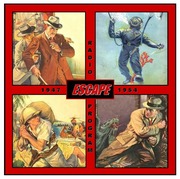
Tired out from spring house cleaning? Find your life uninteresting? Want to get away from it all? We offer you escape! You are drifting on the burning glassy surface of a tropical sea, trapped on a flimsy raft with three murderous companions from whom you cannot escape. Escape, designed to free you from the four walls of today for a half hour of high adventure. Tonight, at your request, we bring back one of our most popular escape stories. We take you to Numia in the South Pacific, a French penal colony as notorious as Devil's Island. And we invite you to escape from Numia in John Russell's The Fourth Man. The raft stood to open sea. A mat of pandanus leaves served for its sail and a paddle of wood for its helm. Its flooring was woven of reeds and bamboo sticks and rested on triple rows of bladders. It was light, elastic, fit to ride any weather. And it carried four men. Three of them sat huddled together at the far end. Their bodies were blackened with dried blood. The hair upon them was long and matted. They wore only the rags of convicts' blue canvas uniforms. On wrists and ankle they carried their mark, the dark and wrinkled stain of the manacles. There was Dubose, doctor, leader, man of the world, murderer. Friends, the thing is done. And Fennero, forger, ladies man, weakling, coward. Yes, we got away, all right. And the one known as the parrot, thief and cutthroat. So far, so good. Gentlemen, by way of celebration, may I offer you cigarettes? Cigarettes? Oh, doctor, you're a marvellous magician. Look at them, white and fresh as though they just came from the package. How did you do it? Every six months there are about 75 escapes from Numia. And not more than one succeeds. Ours would be that one I knew. And so, three weeks ago, I bribed the night guard for these very cigarettes. So that we might sit here, my friends, as we are doing and celebrate. I want a light. Yes, a light for the parrot. Oh, our doctor is a wonder. He thinks of everything. He gives us cigarettes, matches and our freedom. Wait, wait till you've got your two feet on a pavement again. That will be the time to talk about freedom. To wear starched collars again. To stroll with a girl, clean and fresh from her bath. Down the plaster of the Concord, the Rue de Rivoli. Suppose, suppose we get a storm. It's not the season of storms. Just the same. Suppose we get a storm. Fair okay, my friend. You must not be so impatient. We were convicts back there, festering in oblivion. And now we stand on the rosy threshold of the big round world again. We are men raised from the dead. Suppose we get a storm. You have got a gift of speech. But where's the ship that was going to meet us here? This is the day as agreed. It will meet us. This wind will blow us to China if we keep on. We can't lie any closer to shore. There's a government launch at Torillon. And I doubt if the native trackers have given up yet. Oh, careful parrot. They will eat you yet. I, I, I've heard about that. Is it true, doctor, that the natives keep all the runaways they can capture to fatten on them? They prefer the reward. Still, I doubt if they've entirely lost the habit of cannibalism. Yes, piece by piece, parrot. First they will sample you. Then they will make a stew of your brains. They won't miss a thing. Shut up, Fenaroo. The filthy brutes. You know, I forgot. We have one of them with us. The fourth man was steering the raft. He sat crouched in the stern, his body glistening with spray. His huge dark hands held the steering paddle. He was motionless like an idol, his eyes fixed on the course ahead. The fourth man on the raft. My friends, you are looking at a Kanaka. He will see nothing superior. No line of beauty to redeem the low angle of the forehead. They'd not be joints of the body. Nature has stamped him with a mark of inferiority. And he has set the final seal himself with a twist of bark about his middle. That prong of pig ivory through his nose. Nonetheless, he is a man. And there is a price on our heads. He could be taking us where he likes. Calm yourself, Fenaroo. He is a very simple animal. An infant, really. Does that mean he could not double-cross us? It does. He is bound by his duty. I made my bargain with his chief up the river. And this one is sent to deliver us on board our ship. That's the only interest he has in us. And he will do it? He will. But it is the nature of the native. Ah, I don't trust him. Not for a minute. The brute, the animal. You! It's you I'm talking about, you filthy brute! Parrot! Save your breath, Parrot. He speaks no language. Only a few noises, a few signs. I don't feel right on the same raft we did with that. Go on, burn yourself up in the sun. Me, I will just stretch out a little under these mats. Yes. We should all sleep a little and serve ourselves. When we awake, she'll be there, the ship, our pretty little topsail schooner, our mast standing out against the sky. And we'll be on our way to Fran. Sleep, my friend. The two younger convicts dozed down to the heat of the day. But not Dr. Dubois. He stood once again to sweep the skyline under his shaded hand. His plan had been so careful, so precise. He had counted absolutely on meeting the ship, the small schooner. One of those flitting half-piratical traders of the Copra Islands that can be hired like cabs in a dark street for any sinister enterprise. But there was no ship, and there was no crossroads where one might sit and wait. Good morning, Doctor. It's afternoon, Pinero. Oh, yes it is. I slept like a corpse. And where's the ship, Doctor? It was going to be there when we awoke. Oh, I'm thirsty. Oh, I'm dying of thirst. So be all, Pinero. Where is the flask? Oh, I'm roasted in the sun. You'll have to roast some more. This screw is put on rations. What are you talking about? Where is that water? I have it here. So you have. Do you think it's yours? It's ours, parrot. I want a drink. Think a little, parrot. We have to guard our supplies like reasonable men. We don't know how long we may be floating here. So that's how you talk now. You don't know how long, but you were sure enough when we started. I am still sure. The ship will come. She cannot stay with us in one spot. She will be cruising to and fro until she intercepts us. We must wait. Ah, that's good, good. Wait, wait. And in the meantime, what? Fry here in this heat? Our tongues hanging out while you deal us out drop by drop? Perhaps. Ah! The man does not live who can feed me with a spoon. With a spoon? Laugh, you scum! But you're in this too, with this captain who thinks of everything and still puts to sea without provisions. Go on. Laugh again. Laugh! I wasn't laughing, parrot. It's true. A bad piece of work for a captain of runaways. Unless you would die very speedily, we must guard our water. And whose fault is it? Mine, I admit it! What then? Here we are and here we must stay. We can only do our best with what we have. All right, doctor. Do your best. Give me a drink. You may have your share, of course. But be warned. When it is gone, don't come to us. To Feniru and me. Oh, what's Feniru's... My drink! Very well. A thimbleful? One thimble? This way we should have enough for three days. Perhaps more. With equal shares among the three of us. That's right. There are only three of us. Were you thinking of him, Feniru, or that pilot? He looks somewhat like us, doesn't he? But his body has never known clothing, his feet, shoes. His heart has never known the swelling that comes with feelings of love or beauty. His mind has never known a single thought. Look at those three gentlemen. You, Feniru, a forger. You, parrot, a thief. I, the de Beauze of Paris, a marseille, a murderer. And yet we are civilized men. And this is a savage animal. Our provisions are for men only. The three men awoke to their second day on the raft. They looked and saw the far round horizon and the empty desert of the sea and their own long shadows that slipped slowly before them over its smooth, slow heaving. The land had sunk away from them in the night. The trap had been sprung. As the savage sun kindled upon them with the power of a burning glass, a calm fell. An absolute calm. The air hung, waited. The sea heaved and fell in polished undulations. And the sun shone, driving in under their eyelids like white hot splinters. They crawled to the shelter of their mats, gasping, shriveling. And the water, the world of water was slack and thick as oil. Oh, Maudieu, how lonely it is. Sartre de Beauze. Yes, parrot. Look around you. What do you mean? Burn, look around. What do you see? I see water, parrot, the horizon, nothing else. What? Don't you see a sheep? A pretty little schooly? Those were your words. Where is it? Why don't you see it? It will come. It will come for just to be dead when it comes. Doctor, you say that you count on your friends, but suppose they leave you to rot here. Leave Parrot and me to rot here. That would be a joke, eh, doctor? To wait for a ship that will never come? It will come. My friends will not fail me. But why? How do you know? How can you be so sure? I have a safe vault in Paris, full of papers to be opened at my death. Those papers contain confessions. No, gentlemen, my friends will not fail me. Parrot. Eh? A moment ago you asked what I saw. Well? There was something I neglected. What was that? I see a Kanaka on this raft with us. He does not join us, he does not look at us. He sits on his heels in the way of the native, with his arms hugging his knees. He sits at the stern, motionless under the shattering sun, gazing out into vacancy. Whenever I raise my eyes, I see nothing else. Only this Kanaka. And he seems to be enjoying himself quite well. I was thinking so myself. The cannibal, the savage. He does not seem to suffer. What's going on in his brain? What does he dream there? He looks at us as though he hates us. The dirty rat. Maybe he's waiting for us to die. Maybe he's waiting for the reward. At least he wouldn't starve on the way home. And he could deliver us piece by piece. How does he do it? Has he not any feelings? I'd be wondering him, I think. It may be that his fibers are tougher, his nerves are stronger. But we have had water and he has not. And yet, see, his skin, it's fresh and moist. And his belly, round as a melon. Don't tell me this savage is thirsty. Is there any way he could steal our supplies? Certainly not. Suppose he has his own supplies hidden. What? We three, search the raft. Look under the mats. I've heard him this morning. Did you hear? No, nothing. Doctor, over there. No. No. No. You are mistaken. He has nothing hidden. You're wrong about him, Doctor, when you say he has no understanding. There is one thing he knows and knows well. Pain. No, not so much. There's come. That will teach you. Not so cheap will I wear you. Not so happy with your luck. That will make you feel. A higher race tramples the savage with or without cause. And that is natural. And the savage creeps away into his place. With his hurts and his wrongs. And makes no sign and strikes no blow. And that is natural, too. Yes, that is all very well, Doctor. But we still must have our pilot. Back my friends, back under the mats. The glare of the sun is not so bad. So the days dragged by. The second and the third. And now it was the fourth day. And still there was no breeze. And still there was no ship. Doctor, what are you staring at? At him. The savage look at him and look at us. We are dying. Our powers are ebbing. And him? Naked, wild, brutish. He is yet to give the slightest sign of complaint or weakness. Yes, yes, it's true. Night he stretches out and sleeps. Those long hours when we wrestle and fight with despair. He sleeps like a child. Many the morning he resumes his place, aft, unchanged, fixed. A growing wonder. Doctor, is this a man or a film? A man, it's a man. A miracle. It's a man and a very poor and wretched example of a man. You will find no lower type anywhere. Look at his cranial angle. The high E as the heavy bones of his skull is scarcely above an ape. Then what? He has a secret. Secret? But we see him. Every move he makes, every minute. What chance has he for a secret? How absurd. Here are we three, children of the century, products of civilization. And here is this man who belongs before the Stone Age. In a set trial of fitness, of wits, of resources, is he to win? It's absurd. What kind of secret? I can't say. Perhaps some method of breathing, some strange posture he uses to cheat the sensations of the body. Such things are known among primitive peoples, known and jealously guarded, like the properties of certain drugs, the uses of hypnotism. Who knows? We can know. We can find out. To ask him useless. He will not tell. Why should he? We scorn him. We give him no share with us. We abuse him. And so he falls back on his own expedience. He remains silent as he always has been, as he always will be. He never tells the secrets. They are the means by which he has survived from the depths of time, by which he may yet survive when all our wisdom is dusted. There are a number of ways of learning secrets. I know them all. How parrot! It would be useless. He could stand any torture you might invent. You saw how he behaved before. It's another way. Talk! Talk! I'm tired of all this talk! Tell him and throw him over! Let's be rid of this thing! We gain nothing. Then what do you want? To beat him. That's what I want. To beat him at the game. For our own sakes, for our own racial pride. We must. To outlast him. To prove ourselves his masters. By better brain. By better organization and control. Watch him. Watch him, my friends. So that we may trap him. So that we may find him out and defeat him in the end. Watch. I will watch all right, you old wing bag. I am not sleeping anymore to leave you alone with that bottle. The bottle. Oh, the bottle. I've been meaning to discuss our relations with you. Have you? We are running very short. I'm afraid we must all take a cut again. And what are we down to now, Doctor? Half a thimbleful. We must keep our wits. I say no! Then we'll put it to a vote. You say no, I say yes. Fennerud. Yes, yes, yes, anything. But give me mine now. Then it's half a thimbleful, Monsieur Fennerud. Your share, Fennerud. More, more, or I'll die. More. No more today. You must, you must. Oh, Doctor. No more today. Look, a ship, a ship! Where is it? Where is it? The bottle, Doctor! What? Here's the bottle. He drank it. Look at him. You killed him with that oar. What about the bottle? There's some left. You caught him just in time. And you caught the bottle just in time. It seems I did. And there's no ship. There will be no ship. We are done. Because of you and your dirty promises that brought us here. Doctor, liar, fool! Don't come any closer. Unless you want this flask broken over your head. No, I would not want that. Oh, Barrett, I just think. Why should you and I fight? We can see this trouble through and win, yet. This weather can't last forever. Besides, now, here will be only two of us to divide the water, yes? Yes. That is true, is it not? Feneru kindly leaves us his share. An inheritance. All right. I'll take mine now. My share now, if you please. Later we shall see. So be it. Your share. Many thanks. And now, Feneru will share to me, please. As you say. And now, another. Another good doctor. Three. That's enough, Barrett. No, doctor. It is not enough. Now, I will take your rest. No, Barrett. Stop. My arm. Your arm. I will kill you if you don't. Thank you. You see, I have manners, haven't I? And I have wisdom, too. Because I have fooled a very wise man. I told you, doctor. The best man wins. It was a very bright idea of yours. The best... So, the best man wins, Barrett. You forgot I am a doctor, didn't you? The water you would kill for has killed you. I'm not going to go without water for four days, then drink his fill and still live. Come on, Barrett. Gasp out your worthless life while I laugh. The best man always wins, Barrett. The best man always... The best man wins. Yes, doctor. Fenru. Forgot my knife, didn't you? Forgot me lying at your feet while you divided my share of the water. Came here for dead, did you? But I, Fenru, will outlast two of you. Fenru. The best man always... Lain... Your food... The water... Is running out. Barrett... Doctor? The best man always wins. Come in, come in. The long boat's back, Captain. The raft was here all the time, not ten miles away from us. Ah, that calm. Such a misfortune. Well, where are they, the passengers? We're too late. We're all dead. Will you mind your business? One is stabbed to death, another is skull-crushed, the other fried by the sun. All dead. Well, then all the better. It'll cost nothing to feed. But how... Hogsheads, my friend, the hogsheads in the after-hold. Filled them nicely with brine, and there we are. I don't understand. You're dull, Marto, very dull. The gentleman's passage is all paid before we left Sydney. I contracted to bring back three escaped convicts. Well, I'll bring them back in pickle. So if you'll go back, Marto, and bring them aboard for the trip, I'll be much obliged. Very well. Oh, there's a fourth man on the raft, Captain. A kanaka. Still alive. What do we do with him? A kanaka? No word in my contract but any kanaka's. Leave him there. After all, he's only a savage. And so Dr. Dubois and Feneraux and the parrot went aboard for a long trip to their beloved Paris, their bodies pitching and rolling gently in the huge vats of brine. On the raft, the fourth man raised his head slightly as a wind freshened from the west. He watched until the schooner turned, shaping away for Australia, and disappeared over the rim of the horizon. Then he turned his raft, spread his sail of pandanus leaves, and headed the raft eastward, back toward New Caledonia, back toward home. Feeling somewhat dry after his exertion, the native plucked a hollow reed at random from the rushes on his raft. Slowly, lazily, he stretched himself at full length in his accustomed place at the stern. He thrust the reed down into one of the bladders underneath the raft and drank his fill of sweet water. He had a dozen such storage bladders remaining, and he wove into the float sedentables above the water line, quite enough to last him safely home again. Music Escape is produced and directed by Norman MacDonald, and tonight brought to you The Fourth Man by John Russell, adapted for radio by Irving Ravitch, and featuring Barry Kroger as the doctor, Joseph Kearns as Fennero, Jane Avello as parrot, Lou Merrill as the captain, Byron Cain as morto, and Eric Rolfe as the narrator. Music is conceived by Cy Fuhr and conducted by Wilbur Hatch. Next week... groping in the dark of an African night, trapped on a dock above a crocodile-infested river, fighting for your life against a ruthless giant from whom you must escape. Music Next week, we escape with Robert Simpson's 10th story, John Jock Todd. Good night then until the same time next week, when once again we offer you Escape. Music This is CBS, the Columbia broadcasting system. Music