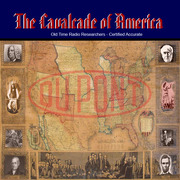
The DuPont Company of Wilmington, Delaware, makers of better things for better living through chemistry, presents the Cavalcade of America, starring John Lund and Walter Hamden. Ladies and gentlemen, 150 years ago, a young man laid the cornerstone that was to become the DuPont Company of today. And so on this 150th anniversary, we take great pleasure in presenting the story of Eluthair Irine DuPont. And now to tell you about tonight's Cavalcade of America, here is the Dean of the American Theater, Walter Hamden. Good evening. In the early youth of our country, many men came from foreign lands, attracted by the lamp of freedom and the promise of opportunity. The magnetism of a new meaningful word, liberty, brought the freedom hungry to our shores. Some poor, some rich, some talented, some with only strong hearts and willing hands. So to our story, an American from France with John Lund as Eluthair Irine DuPont. My role is that of his father. Memories are like the crystal pendants of a chandelier, sorting out the past, reflecting the multimillion events of a lifetime. Even now, so many years later, I remember one day so well, the 7th of September, 1784. We were in our home at Namur, just south of Paris. It was my 14th birthday, and my eldest brother, Victor Marie, took me by the hand and led me into the shadowed room with the curtains drawn. A room still warm with the presence of my mother, who had died a few months before. My father, the Seer DuPont, looked up as we entered and smiled sadly. Irine, this was to have been a glad occasion. Yes, I know. Mother had made so many plans. She was always brimming with plans, never for herself, but for me and for you, her sons, for our future. She had planned to make this, the ceremony of your investiture into knighthood, an important event, Irine. But now, she's gone. She isn't gone, Father. She's here. You feel that too? Victor? Sir. Place your younger brother before me. Advance, my brother, that you may receive our father's blessing and the right to bear arms. Irine, my son, you are fourteen. Three years ago, you saw me gird your brother Victor's sword on him. By birth, you have a right equal to his. But this ceremony is worthless unless you understand the meaning, the obligation that it symbolizes. Irine, this is something you must always remember. No privilege ever exists that is not inseparably bound to duty. Today, you are taking on a special obligation to maintain peace, to devote yourself wholly and forever to the service of mankind. You understand what I'm saying, every word I'm saying? I do, Father. Put your hands between mine. You promise this? My father, I promise it to God, to my country, to you, and to the blessed memory of my mother. 1784, 1785, 1786, crowded years for me. Years of an incoming tide, each day bringing me new wonders. This was an important era with prominent people visiting my father's home. Benjamin Franklin and Thomas Jefferson filled with stories of their new country, of the fight for liberty in America. Among the men that I met in my father's house, one above all I worshiped, Lavoisier. Lavoisier, the great scientist of the 18th century, chemist, philosopher, explorer of the unknown. One day I remember I was in our solarium looking over some geraniums I'd planted a few weeks before. May I act as court physician to your geraniums, Irene? Oh, Monsieur, good morning. How sad they look, like little brides left waiting at the altar. I can't understand it. They have plenty of sunlight, water. Well, flowers are like human beings. The food that gives one man muscles gives another man the gout. You think they can be saved? I think there's a chance. Here, take this little package of powder, mix it with the soil in your flower pots. And then what? And then, then let nature take its course. Within a week my geraniums were healthy and blooming, a miracle. I knew then that this was for me, this new wonder of the world, chemistry. Lavoisier took me to visit his laboratory, a fabulous jungle of boiling pots and steaming retorts and weird and wonderful smells. You see this, Irene? Here is a barrel full of the powder I gave you for your geraniums. What is it? It's nitre. And, Irene, it's a substance of considerable talent. In the soil it enriches the land and makes plants grow high and strong, but mix it with charcoal and sulphur, just the right amount, and poof, it becomes gunpowder. Is there a place here for me, Monsieur Lavoisier? What? Can I work here with you? Will you teach me chemistry? Chemistry? But I thought your father intended that you should study government and economics. But this is what I want here with you. Let me study under you. Oh, it's grimy work and dangerous. That's what I want to do. All right. If your father agrees, I shall agree also. Yes, chemistry needs young men like you, Irene. Young blood. You know, people think that the future of the world will be decided only in parliaments and on battlefields. Let me tell you this. Out of boiling pots and mixing vats, out of chemicals will come the shape of the things of tomorrow. The next few years I remember as the gayest, most pleasant of my life. I worked with Lavoisier, drinking in his wisdom. And it was then, too, that I found Sophie Madeleine Delmar, my beloved wife Sophie. And all seemed very well with the world. But all this was shattered in 1793, the year of the terror in France. Robespierre roared out his infamous edict. The Republic has no need of scientists. Lavoisier knew what was coming. He knew. But he kept working in his laboratory, an oasis of sanity in the madhouse that was France. Irene? Yes, Monsieur Lavoisier? I have a little experiment I should like to try. Now, my idea is... Open up here! Open up! We seem to have visitors, Irene. Open the door before they burst in. Citizen Lavoisier? That is I. You are under arrest. Irene, please be sure that the vats are dry before you leave. And, Irene, take my notebooks with you. I'll have no further use for them. The Republic has no need of scientists. Lavoisier was guillotined. In the midst of our mourning for that great gentleman, that great scientist, tragedy struck again. My father was imprisoned. Father in the hands of the terror. We moved to Paris to be near him. I earned a little money by managing a print press in the Capuchin monastery in Paris. And there, one night... Who is it? Who's there? Irene! Hurry! Sophie, what are you doing out at this hour? I thought you were at home. I was at the prison. I saw your father. Well, how did you get in? I'm bribed to God. How was father? Wonderful. He's maintaining all the others with his bravery. Has his number been called? It has been called, hasn't it, Sophie? Yes. Does he know? Yes, he knows. What did he say? His last words, as I left with him, have faith, have courage. The next morning, in father's prison cell, he gathered the condemned about him and he laid his plan. Come here, all of you. Listen, get closer around me, closer. Etienne, watch the guard. Yes. Warn us when he comes close to the cell. Right. What is it? What do you want with us? Now, do we go like sheep to the slaughter when they come for us? Or do we fight? Which shall it be? Let me hear. Which shall it be? We fight. That was right. I'm willing. I have a dagger. And so do I. Good. Now, if we have a chance, any chance, it will be because we maintain our positions. Every man must do his part. We'll form a wedge. The strongest man in front, two more behind him, then three, then four. That will leave us two men to guard our flanks and to help when reinforcements are necessary at any stage. Understood? Yes, sir. Yes, sir. In case we have to give way, we'll use the beds here for a barricade. But there'll be no retreat. The guards are coming. To your positions, quickly. Wait for the orders. No move. Nothing until I give the order. Halt! Ready now. Citizens, you're free. Go on. Get out. You're free. It's a trap. Oh, Ropsteher's been arrested. All prisoners are ordered free. Go home. The gates are open. Home? Free? Vive le flan! Vive le flan! We returned to our home at Newmoor, Father, Sophie, and I. On the first night at home, Father called us together. There is only one place where liberty, safety, and independence actually exist in this world today. America. That's where we shall go, all of us, to America. On New Year's Day, the year 1800, after an agonizing trip of 91 days at sea, an overloaded, leaking, battered little ship called the American Eagle struggled into the harbor of Newport, Rhode Island. We were in America. I was anxious to see this new land, to see as much of it as I could as quickly as I could. And so, when an old friend of the family, Colonel Toussard, invited me for a hunting trip in Delaware, I was quick to accept. Ah, all morning we've been hunting, not a bird to show for it. What miserable luck. Ah, let's rest here for a moment. Oh, it's a beautiful country, Colonel. Yes, isn't it? I fell in love with it the minute I put my boots on shore. You came with Lafayette, didn't you? That's right, as his captain of artillery. A fine artilleryman. I've had a dozen shots since we started, haven't hit a blessed thing yet. Well, I've done no better. That last one, I was sure I had a perfect shot, but I missed. I don't think the fault's with your aim, Colonel. No? What is it then? Have the birds become more adroit at dodging shots? No, it's this miserable gunpowder. It's a wonder anyone ever manages to make a kill with it. My boy, you're referring to the finest grade of gunpowder in the country. I know. I paid for the stuff. It's no good. Looks all right. No, no, feel it. Rub it through your fingers. Feel how harsh it is, how rough. Hmm. Yes. It does feel rough. Gunpowder must be polished smoothly. Finally. Wait a minute, quiet. Look, over there. Oh, what beauty. Get him. Ah! This fire every time. What bad luck. No, no. What bad powder. Ah. Irvine, I think you're right. Listen to me. Yes? All day you've been talking about America, about its promise, its grandeur, how thankful you are to be here. Oh, it's a magnificent country. It is. It can give you a lot, Irvine. Freedom, safety, a place to grow in. And if what you say is so, you can give America something in turn. Powder. Good powder. The whole country is crying for it. The farmer needs it to clear his land. The pioneers need it to get food and for protection. The American people will be eternally grateful to the man who gives them top grade powder. Plentiful and cheap. They must have it. It's an idea, Colonel Tussard. It's a wonderful thing to think about. It would be a wonderful thing to do. You are listening to the DuPont Cavalcade of America, starring John Lund and Walter Hampton in An American from France, sponsored by the DuPont Company, makers of better things for better living through chemistry. And now as part of the 150th anniversary of the DuPont Company, we continue our play, An American from France. The idea grew on me. The idea Colonel Tussard gave me to set up a powder factory of my own. It was more than an idea. It was an obsession. But my father was doubtful. I don't know, Irvine. It doesn't sound promising. But I know enough not to argue with you. If you've your mind set on building a powder mill, you'll do it, whatever I think of the project. But please, do me one favor. Of course. Now before you start, consult with someone who's better able to guide you than I. Someone who knows the situation here. Who? Well, go to an old friend of ours. Go to President Jefferson. Ask him. So you've finally found time to visit with me, Irvine. Oh, we do owe you an apology, I know, Mr. Jefferson. But, well, we've been so busy getting ourselves settled here in America. How is your father? Oh, quite well, sir. Oh, wonderful man, Irvine. One of my best friends. I have many fond memories of the times we spent together. He talks about you often, sir. There are many debts I owe the Sears, DuPont. While I was in France, I watched him battle for laws, extending freedom of conscience to all men. I couldn't believe that a man of his genuine humanity could be imprisoned, threatened with death by a government that pretended to proclaim the rights of man. I was overjoyed when I heard of his release. Oh, Father feels all that's past now, and possibly best forgotten. He's so enthusiastic about America, Mr. Jefferson. So sure that everything he fought for will rise and grow strong on these shores. I pray he is right. But now, what of yourself, Irvine? What are you going to do? Have you any special plans? Why, yes, sir. My idea is to start a powder mill. A powder mill? Why, yes. Yes, of course. You worked with Lavoisier, didn't you, at Asson? Yes, sir. I remember how during the early days of the Revolution, General Washington cried out over the quality of the gunpowder produced in this country. Then Lafayette came, and he brought us French powder. And I think Washington was as grateful for the powder as for the troops. Yes, by all means, Irvine, build a powder mill. Make us some good powder. After months of searching for the best site for my mill, I settled on a spot just four miles west of the town of Wilmington in Delaware. After a four-day, 130-mile trip from Bergen Point, New Jersey, over roads deep with ruts and dust, Sophie, the children, and I came to the banks of the Brandywine. Whoa! Whoa there! Is this it? This is it. It isn't much, Sophie. Well, starting points are rarely very much, Irvine. It will do. I think so, too. It will do. The beginnings were hard, as beginnings always are. But by August of 1817, we were making powder. Good powder. The mill on the Brandywine was in full operation. I'm amazed at what you've accomplished here, Hylene. Amazed and gratified. Well, we've had good luck. Good luck? Don't believe in luck. Luck's what a man makes for himself. Ah, this mill is a masterpiece. I wish my old friend Lavoisier could be here to see all this. Father, listen. The alarm. What is it? Fire. Fire at the mill. Come down to the creek and hurry. Now don't stand there watching the fire down to the creek. Father was in the midst of it all, forgetting his 77 years, directing the battle, setting up our fire lines. That night I had cause to be thankful for the precautions I'd taken. The charcoal house was a complete ruin, but the rest of the plant escaped. The next day, father came down with a chill, and four days later, he died. He was a fighter all his life, even to the end. Soon after his death, I asked Alfred, my eldest son, to bring his younger brother Henry to me. Sophie and I were sitting in our parlor when the boys entered. Henry. Oh, look at your hands. Where have you been? At the mill, in the mixing room. Well, you should be studying. You won't be admitted to West Point if you have low grades. You know that. Yes, ma'am. I'll study. Henry, come stand here. Yes, sir. Henry, many years ago in France, when I was just about your age, I stood before my father, just as you're standing before me now. A little cleaner, I hope. At that time, Henry, my father invested me with the privileges of a nobleman of France. But this is America, my son, and here neither nobility nor privilege can be inherited. But there is nobility and privilege in this country, and there always will be. There's the nobility of self-respect and the privilege of freedom. There are wonderful things to have, but the privilege of freedom, like any other privilege, is something that's inseparably bound to duty. My father said that to me, and I say it to you. I understand, Father. Good. Now kiss your mother, then run and wash your hands. Dinner's on the table. There are many things I remember. Bright days flooded with happiness, shadowed days, gray with sorrow and tragedy. But that's the normal weave of life. Outside my window, I can see the mill. Workers moving about. Father! Father! Here, Henry, what is it? Come outside, come and see. What is it? Come along, you'll see. Look at it, Father. It's the biggest wagon train in the world. Look at it. Must be 30 or 40 wagons. It's all this, isn't it? I don't know. Looks as if we're being invaded. Howdy. Are you Mr. DePont? Yes. We're headed west. We've come 10 miles out the way, just so as we can load up with DePont powder. 10 miles is almost a full day's journey. We appreciate your coming this far. How much do you need? Four barrels for a wagon, and we're 20 wagons in all. Oh, I think we can manage that. Well, the loading platform is just beyond the bend. I'll show you where. You will? Well, that's right helpful of you, sonny. Come on aboard. Here, I'll help you. May I, Mother? Of course, Henry. All right. Help me up. Here. You take the reins. I'll work the brakes. Well, how far west are you going, sir? Sonny, we're going just as far west as folks can go without getting their feet wet in the ocean. Is this your whole party? No, sir. We're meeting up with another train in Missouri territory. You have a long trip ahead of you. That's true enough. Well, thanks mildly, Mr. DePont. All right, son. It's beyond our way. Up there. Get up. Ha, get up there. Get up there. Ha. They all look so eager. So happy to be headed out west. All the way to the Pacific. With powder from the brandywine. It's a wonderful thing to think about, Sophie. It's a wonderful thing to see. Our thanks to John Lund, Walter Hamdon, and the Cavalcade players for tonight's story, an American from France. Tonight's DuPont Cavalcade was written by Irv Tunick, original music composed by the Arden Cornwell and conducted by Donald Borey. The program was directed by John Zoller. This is Cy Harris speaking. Don't forget next week, our star, Robert Taylor. The DuPont Cavalcade of America comes to you from the Velasco Theater in New York and is sponsored by the DuPont Company of Wilmington, Delaware. Make us the better things for better living through chemistry.