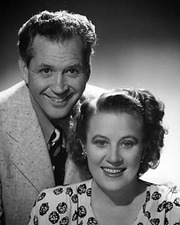
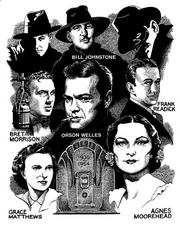
Tonight, the cavalcade of America takes the characteristic American traits of family devotion and determination to succeed against odds and portrays them in the true story of a pioneer mother, Eliza Ann Brooks. Eliza was an inspiring woman who lived in an inspiring era, the era when America was developing westward beyond the Mississippi. She had an ideal in the model which formed the basis of her story and which was the keynote of her life. Where there is no vision, the people perish. As our overture, Don Voorhees and the DuPont Cavalcade Orchestra play wagon wheels. The America of 1852. On March 20th of that year, the novel Uncle Tom's Cabin by Harriet Beecher Stowe appears. Isaac Singer patented a sewing machine. On October 10th, the first passenger train to cross the Mississippi River chuffed out of Chicago. America lost two of her greatest statesmen, Henry Clay and Daniel Webster. The pattern of the nation was changing. Migration to the distant frontiers of the west had begun. West of great hope, of limitless opportunity, of new lives. Through the vision and spirit of the thousands of men and women who moved across the plains in the prairie soon as of the forties and fifties, the nation was not only discovering itself but perpetuating itself. Among these pioneer Americans was a mother who lived in Michigan with her six children, Eliza Ann Brooks. One day she received a letter. Dear Eliza Ann, today marks the second year since I've seen you and the children. I'm working very hard and my health is much improved. You would like it out here in California. I often find myself dreaming of you and the children crossing the great plains to join me. We could build a new home and start a new life together out here. I guess that's a fantastic dream when you come right down to it though. But I sometimes feel that George Brooks had gone to California to improve his health and the family fortune. And Eliza Ann waited through the long days, weeks, months. Finally two years passed. Most wives went on waiting but not Eliza Ann. A few weeks after the letter came, her neighbors were astonished to see a big prairie schooner before her door with four teams of oxen yoked to it. Her children were helping with the loading while inside the house Eliza Ann and her daughter Vienna are looking over the last details. Vienna I hope we haven't forgotten anything. Flour, dried apples, hardtacks, and the bacon. Everything's packed mom. Now if I can only find Justin. Where did he go? He was here a minute ago. He had to say goodbye to somebody. Well fetch him and see that Elmont and Orion don't sit on the eggs. All right mom I'll go. Vienna. Yes mom. You've been a big help dear for such a little girl. Hello Mrs. Tanner. Good morning Vienna. Eliza. Come on in Sally. Eliza I've known you for a long time and if you ask me I'd say that if your husband knew you were packing off to California he'd put a stop to it. Maybe. Anyway I've written him that we're coming. Mom. Guess what. There's a big crowd collecting and Tom Snow's making a speech like it was election day and saying you're the craziest woman in the hall of Michigan. This is a fine way to talk about me on my own front porch. Well go out and see about this. Come on Sally. They're so worked up with a woman going alone Eliza Ann. As far as they know it's never been done and with that no account Jeb hired for driving. Now then Tom Snow. What did you been saying about me. This village ought to stop you Eliza Brooks. Taking six little children in a wagon from here to California. Too bad I say. And I say it's too bad it's a free country so that even women up and do what they like. As if to your guns Eliza. Well it appears I'm ready to go. Tanner are the children all aboard. One two three four five. Yes mom. I'll help you up mom. All right step on the wheel. I said so. I said. Where's the cows hiding back. Morning Jeb. Good morning ma'am. Jeb is very kind of you to be driver. Sure you're not scared. And not seeing what you're paying me Mrs. Brooks. Mom I can take red and red and can I mom. Oh you and your chickens. Oh all right Orion. Well wave goodbye to everyone children. Go ahead Jeb. Without daring to think too much about danger Eliza and set out on the journey. The trip as far as the Missouri River was like any other pioneer trip. Mire and bogs caused by the spring rain. A late arrival at council bluffs and plans and consultations to join some big wagon train. There all six children came down with a measles. Eliza and had to delay her stock. And one night when she was away from the wagon the children were listening to the stories of a casual call. Then folks in the wagon saw a whole lot of mounds by the road. Mounds in the earth. What were they Mr. Green. Fresh graves. Oh. Yeah generally Indians don't bother digging graves. But when the settlers got nearer they saw that every grave had a head on it. Red skins had chopped off the heads of the corpses and put them on top of the graves to plague their relatives. Why is the little one scared. Why note of a case where the engines took a. World. Is going on. In the. World. Not any Indian. You walk you up I tell you children to get to bed in yes mom we were hearing about well Mr. Grange here from the wagon camp I have to do good evening how do you been wanting to get a look at the lone female with the six children who know that my children have been sick with measles that's what I hear a baby still has a fever should all be getting their sleep to be strong for our journey journey where I reckon you'll be going back to Michigan now that you've lost your driver what do you mean well that Jeff Hardy yours naturally been talking to all the folks that come in from the plains and he's here to about how the engines is about to go on the warpath where is Jim I told him what he was up against he headed north Oh no you mean Jeff's gone you'll quit that'll do a rhyme. Now we'll go on without Jim. I'm sure some of the Indians are friendly mom Jeb was awful lazy we can find another drive you can but this town is full of desperate over that wait here to rent their cells as drivers to foreigners from the night Mr. Grange well tonight. So to me that's the now so long so long kids. It's in the friend get down here mom mom you are getting the measles are you. So tonight. Maybe I was wrong about this trip. All right are any of you afraid. No mom we're not afraid no if any Indians shoot will shoot down with your spoon very曼 aika displayed them that have been goodasts. I mean I have no Indians. Everybody there works in your work in a lot of command it is not. Go to sleep want it now get into your blankets children place driving on but you're on Put your arm in justice. Thanks, Grace. Thanks, Grace. Hurry up. You all tucked in? Yes, Mama. Now close your eyes and we'll all say a prayer. Now I lay me down to sleep. Now I lay me down to sleep. I pray the Lord my soul to keep. I pray the Lord my soul to keep. If I should die before... Orion, have you got those chickens in bed with you? What about the others in the smother? We could fire them. Put them outside Orion. But, Mom, can't I keep them in here just for tonight? Well, all right, dear. Let them. Oh, God, watch over us and keep us. Up there beyond the stars, you know more about things than we do. We're not the first, and we won't be the last who want to cross these prairies. Stay with us and help us, and everything will be all right. Next morning they set out. Swinging the reins over their great black oxen, little Elisha and Eliza Ann herself had to admit that a man's strength was needed for the driving. They hired a driver named Jack Brandon, and their trouble began again. One night in camp, Jack was cooking supper while Orion, age six, looked on. What you cooking in that kettle, Jack? Meas like me, to catch a rabbit? Now keep your nosy little nose poked out of there. Take that pail and go down to the spring like I told you. Say, I didn't do nothing. You don't have to shove me around. Oh, I don't, huh? I don't have to shove you, but maybe I want to. You keep your hands off me. I know how much you got that black eye last week, and you even hit little Elmon, a baby. I've never seen such an outfit. Ain't you kids never been slapped? Oh, you wouldn't understand. Give me that pail. Uh, hurry up about it. Orion. Ain't you kids never been slapped? Wish I was bigger. Orion. Has Jack Brandon been riding you again? Yeah. How can we get rid of him and get another driver? No way on earth, Orion. Look at those campfires off west. Just getting dark enough to see them. That's the rest of the wagon train. We're way back of it. Supper! Supper's ready! Come on, Lasha. Anyway, you offer to pick supper tonight so Mom can have a rest. All right, shake a leg, you kids. I've never seen such a lazy pack of coyotes in my life. Where's that drinking water, Orion? I got it. I'll dipper it out. Feel better, Mom. Yes, it is a fiddle. Get it around the fire, children. Smells like Jack fixed a special treat for us. All right, hold out your plates, folks, and I'll fill them up. What kind of meat is this? Chickens. Mom, Mom, she's killed Larry and led my chickens. That's right, kids. Both of them. Thought it was about time we had a square meal. But on that night, Orion... Oh, kill him. Those were my chickens. Orion, Jack! Either I eat chicken tonight, Mrs. Brooks, or your outfit's without a driver. Well, maybe that's better, Jack. Well, if that's the way you feel about it, I'm through. Go ahead. See how far you'll get without a real driver on these prairies. Go on, they did, and got the feel of the plains and the sailor lens, the roll of the sea, the endless flat earth, the bright sky of early summer, the dust, the sage, the pale, slow-moving rivers. They followed the river flat for days and perhaps Eliza Ann may have doubted the wisdom that has impelled her to find her husband and a new life in the West. But these were their children, these brown, laughing little savages. Her eyes at night searched the horizon for the sight of other campfires and by day for other wagons that might give them protection. But they faced their first danger alone, rounding a slight rise of ground one day to find a band of waiting Indians. What? What is it? The right straight on, Elisha. Indians? Elisha, you heard me. But hurry, get the team started. Mom, I'm kind of scared. We'll be all right. As long as they just keep looking at us like that. Indians don't get to see people passing through very often. Yeah, maybe. Children, you all asleep back there? What is it, Mom? Come here, Vienna. Look, dear. Tell the others, but don't let them get frightened. I'm out of sight. Yes, yes, I will, Mom. Keep right on going, Elisha. Yeah, Mom. Look out! Stop, Elisha! Stop! Go away! We're...we're sorry. We didn't mean to run into you, but you stepped in the way and... How? How? Tell boy. What? Tell boy. You have to buy me, Mother. That's quite a compliment, Elisha. No one ever offered before. Two blankets. No, thank you. No, thank you. No. Three. No. Mother. Buy girls. Pony. Boys. Girls. More. Mother's welcome out now, children. Yes, five boys and one girl. Three ponies. All. Well, you're very kind, but I can't consider it. No. Goodbye. Drive on, Elisha. Get it! Get it! No! Goodbye! Wanting to buy you. I've had a nerve. Now aren't you glad you were so good all the way from Michigan? Poor I'd have snapped him right up. Oh, Mother. That encounter seemed to bring them luck, for they soon caught up with the wagon train ahead. The sound of other human voices was grateful. But within a week, a couple in the train lost their children, a three-year-old son who'd wandered off in the night. The rest of the train went on, but the Brooks stayed behind to help in the search. Two days later, Elisha and Eliza Anne... Let's go back to the wagon, Mom. We've been out here for hours. I know how I'd feel if I lost one of you. We've got to find Mrs. Dennison's baby. He must be somewhere. We've looked everywhere. It's getting awful dark. Oh, all right, son. Mom! Yes? We're not making much time, are we? I only hope we get to the Sierras before the snow set in. Mom, do you think we'll ever get to California? I'll tell you about something I was thinking last night, son. About when your father was courting me. He used to bring the Bible over to read because as long as he was reading the Bible, your grandfather didn't care how often he came. And I always remembered something your father liked. The saying of one of the prophets, where there is no vision, the people perish. Don't forget that, son. Mrs. Brooks! Mrs. Brooks! Monica, Mrs. Ashley. Mrs. Brooks! They found him! Oh, Mrs. Dennison. The settler found him late this afternoon, wandering around the stage. Oh, Mrs. Brooks, I can't ever thank you enough. Me? You don't have to thank me. If you hadn't stayed behind, my husband might have let the rest of the train persuade him to give up. Oh, no. Oh, yes, oh my. I'd have never seen my baby again. You know how I... Oh, yes, yes, I know, Mrs. Dennison. Now, come on, let's go back to the wagons and get some sleep. Better start early in the morning. But now the pioneer mother faced new dangers. Dangers that threatened to defeat her determination to bring her family across an unsettled continent. Real wilderness, alkali desert, the scorching August sun, no grass, no blade of grass, a gaunt woman and six lean children, gasping oxen, two of them staggering until finally they sagged and rolled over dead. Eliza and Brooks hitched the last team to a lighter cart found by the trail. Sometimes Indians stared down at them from the bleak hills. And then one morning... Ryan. Lasha. Yenna. What time is it? Oh, it's starting to wake up. Well, I thought there was no use waking you because there's no way for us to go ahead today. Not on empty stomachs. Will we just stay here? Yes, yes we'll stay here. Right for this river. There's a better chance than anywhere of meeting other wagons. If anyone comes, they'll take pity on us. Mom, I think I see a man on a horse. Oh, you kept saying that all day yesterday. Look around if you don't believe me. He's coming this way too. Hello! Hello! I'm sure hurrying to get here anyway. Where in the life is? Be friendly. Mom, mom it, it looks like father. Father! Eliza, Eliza, Eliza! Oh! It was the end of a long journey. The pain and the toil climaxed in that nearly incredible meeting of the family by the river. It was the end of a typical American saga of the Overland Trail. And for the rest of her life, Eliza Ann Brooks was known as one of the pioneer mothers of California. Her spirit lived many years after her death. For one day in 1921 in the town of Ben Loman, California. And now, and now ladies and gentlemen, we come to the big part of this celebration. Mr. Elisha Brooks, who came to California when he was 11, is 80 years old today. Because Mr. Brooks is the outstanding citizen of this town, because he's served for many years as principal of our high school, and been one of our first leaders in every civic venture, we've come together to honor him today. Mr. Elisha Brooks. Thank you sir, thank you. My kind friends, at a time like this, a man wants to feel grateful to someone for his good fortune. I charge up mine to my mother, Eliza Ann Brooks. She's been dead for many, many years now, but her kind of person always seems alive. She was one of those gad about women, took it into her head to come to California and just came. She didn't want gold. She was like a lot of other Americans who came out here to make a new home, and do the best she could in helping to build this really priceless country we live in. I can still see our old prairie schooner creeping along just east of the Sierras. The six starving children and a woman, and the woman talking about her favorite quotation from the Bible. I can hear now, where there is no vision, the people perish. Sometimes when we were rebuilding this town, and I saw danger or trouble ahead, I decided that had better be our motto. So I give it to you straight from Eliza Ann, where there is no vision, the people perish. The cavalcade of America salutes the spirit of a pioneer mother, Eliza Ann Brooks, an example of the courage and determination to overcome hardship and despair in following an ideal, characteristics that have marked Americans in every age in the annals of our history. And now here's Basil Rysdale speaking for the DuPont Company and bringing us another story from the wonder world of chemistry. The wonder world story of chemistry is right under your feet, and under my feet too. And it starts with a queer fact that may surprise you as it did me. Shoe leather breathes. The peculiar quality of breathing or letting air pass through it helps to make leather an ideal material for shoes. Millions of interlaced fibers make up the structure of leather, giving it flexibility and strength, and at the same time making it porous. The process of tanning not only preserves leather, but also makes these fibers even stronger than they are in the natural hide. Yes, in the very leather your shoes are made of, I found a story of chemistry that goes back to the days of ancient Egypt when the pyramids were built. In those days they used vegetable materials such as oak bark to make the tanning solution. The tribes of Old Testament times are said to have discovered the value of oak bark tanning. And in the course of time, men found that other barks and woods could also be used. The list is a long one. It includes hemlock and mimosa and mangrove bark, sumac leaves, nut galls, chestnut wood. They all have one characteristic. They contain tannin, a chemical substance. An entirely different tanning agent was discovered by chemists in the late 1800s, and chrome tanning was developed. Tanning done by the salts of the mineral chromium. Yes, the same metal used for the bright plating on your automobile. As far as your shoes are concerned, chrome tanning is used mainly for the leather that goes into the uppers. Most sole leather is cured by vegetable tanning. Whichever method is used, the tanner of today also depends on a score of chemicals that aid the numerous steps in the tanning process. Chemicals furnished by DuPont, as well as other chemical companies. By applying chemical research to tanning, man was able to hasten the old-fashioned slow methods that were more costly. Now he is able to ensure uniform quality and get a better product for less money. I am told that many other chemical products are used in the making of shoes. Among them are dyes, cements, and plastics for scuffless heels. As a result, you and I have comfortable, good-looking, and more durable shoes that kings and queens couldn't have bought a few generations ago. Shoes. Over 400 million pairs made in America each year. And every pair a walking example of the DuPont pledge that does honor to all chemists. Better things for better living through chemistry. Music Next week, the cavalcade of America will present the inspiring story of John Howard Paine, the man who wrote Home Sweet Home. On tonight's program, the part of Eliza Ann Brooks was played by Agnes Moorhead. Until next week, then, at the same time, this is Thomas Chalmers saying good night and best wishes in DuPont. Music This is the Columbia Broadcasting System. Applause