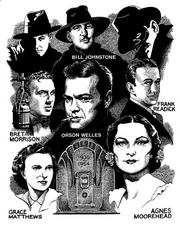
The Cavalcade of America, presented by DuPont. From the time of the first printing press in the year 1450 until late in the 19th century, all type was set by hand. The invention of the linotype or mechanical typesetter by Ottmar Mergenthaler made practical such things as inexpensive books, modern newspapers and other printed matter, thereby giving tremendous impetus to the spread of education and knowledge. Pioneer scientific achievements such as this are similar to those of the research chemist, who is constantly striving to bring more comforts and conveniences into our lives. His work is aptly expressed in the DuPont pledge, Better Things for Better Living, through chemistry. As an overture, Don Voorhees and the DuPont Cavalcade Orchestra bring us the ever popular Underneath the Stars. The DuPont Cavalcade moves forward. Ottmar Mergenthaler was born in Wurttemberg, Germany in 1854. His youth was spent in learning the mechanics trade. Our story starts in the year 1872 in Washington, D.C. in a machine shop owned by a German American named August Hall. Hall's assistant comes into the back room of the shop. Mr. Hall. Yeah, Joe. There's a young man outside asking for you. He doesn't speak very good English, but I think he's trying to say that he's a relative of yours. What is his name? Mergenthaler or something like that. Oh, yeah, yeah. I'm expecting him. Ask him to come in. Yes, sir. Come in, please. Thank you. Mr. August, I'm Ottmar Mergenthaler. Ottmar Mergenthaler. By the last time I saw you... Yeah, I know. I was a little boy. I'm 18 now. 18. I can hardly believe it. That's all, Joe. Go, go. Yes, sir. Sit down, Ottmar. Sit down. When did you arrive in America? I arrived in Baltimore yesterday. It was good of you to lend me the passage, my man. Yeah, I was glad to do so. I understand you're quite a mechanic. Yeah, yeah. I have learned the mechanics trade. I worked very hard, studied at night, even Sundays. Yeah? Yeah. I'm a good mechanic, but I had little chance to advance at home. They still think that young men have no ideas, but I remembered how you had succeeded in the new world, so that's why I wrote to you. But I hardly know if I can... I knew that you were making instruments and machines, and I'm sure that I can help you. I don't want a lot of money, cousin August, just a chance to prove that I am a good mechanic, that I can learn, and that I have an inventive mind. Well, I can't very well ship you back to Germany now that you've come this far. All right, there's an instrument over there that we are preparing for making weather observations. Take a look. See if you can understand it. Thank you, cousin August. You won't be sorry that I decided to come to America to work for you? Atman Ergantaller was soon known for his cleverness in carrying out the ideas that various inventors set before him. His constant association with these scientific minds helped develop his own inventive genius. But it was a small commission that he executed for a friend that started him towards the invention that was to make him famous. Four years pass. It is the year 1876. We find Ergantaller in the composing room of a Baltimore daily newspaper delivering a package to Ben Fulton, a printer. Well, Mr. Ergantaller, you're prompt. My daughter said you'd promise to have her music box fixed by tonight. I keep my promises. Here's her music box, as good as new. Good, that'll make Margaret very happy. Wait, I'll show you. There. Yeah, it is as good as new. Margaret realized, of course, what a favor she was asking, a busy man like you. It was a pleasure. I spent so many hours repairing instruments that never give me any music for my pain. Yes, I've heard your shop makes all the instruments for the United States Signal Service. Most of them. And then we have to keep them in repair, to say nothing of the clocks and electric bells. Then I doubly appreciate your taking the time to fix the music box for Margaret, coming here so late. I had promised. And she said you'd be kept late at your work. Yes, I'm always late. I still have got another hour's work ahead of me. Another hour's work? But the paper is already on the newsstands. Well, but we printers must get ready for tomorrow. I can't go home till I distribute my type. Distribute the type? What does that mean? I never been in a printing shop before. No? Well, if you're interested, I can show you easier than I can explain. Yes, please. Now, here is the form for today's page one. All this type you see here has to be used over again tomorrow. It must go back in my printer's case. Here, ready for use. Each letter has a special place? Yes, each letter, each numeral, each punctuation mark. I see. You have to sort out all this type, huh? That's it. I'll take this first word now. It happens to be America. I'll show you how they go back into the case. A-M-E-R-I-C-A. How fast you work. It may seem so to you. But we printers spend a fourth of every day just handling and distributing type. And then you begin all over again picking out letters to make new words, huh? Yes. It takes me almost as long to set type as it did Johann Gutenberg 400 years ago. He was the first printer to use movable type, you know. Before that, they cut the letters in large blocks. Do you mean to say that the printer's art hasn't advanced since that day? Oh, in some branches, of course. We've improved printing presses. We have better type. But typesetting is much the same. Strange, isn't it? We have designed accurate timepieces to take the place of hourglasses and sundials. Oh, you think someone could make mechanical typesetters? No, Mergenthaler. A machine that did my work would have to be so intricate that... Well, every day I make intricate machines. Instruments to measure wind velocity, rain, snowfall. Well, maybe we printers have been waiting for a good watchmaker like you. Well, I'd like a chance to work on the problem. Mergenthaler's chance to revolutionize the typesetter's art came sooner than he expected. A few days later, Mr. Fulton sent James O'Cliffane, a Washington lawyer, who had been a court reporter and a congressional stenographer, to see him. O'Cliffane and a group of friends were interested in a writing machine invented by Charles T. Moore, which so far had been unsuccessful. Moore and O'Cliffane bring the machine to August Howell's machine shop, where young Mergenthaler and his cousin look it over. It just doesn't seem right. What's the trouble, Mr. Mergenthaler? Is it bad workmanship? No. No, Mr. Moore, the model is accurate. The design is wrong, Mr. Cliffane. The design? You've just admitted Mr. Moore is an expert. Well, pardon me, gentlemen, you asked my opinion, I gave it to you. But it's based on the same principles as the typewriter. And you'll admit that's a successful invention. Oh, it's a great invention, Mr. Cliffane, but something more is needed for printing. This machine of Mr. Moore's really isn't a printing machine. This machine means that it's a very good machine. Mr. Moore's really isn't a printing machine. This machine merely prints letters in lithographic ink on a paper ribbon. And then you have to cut the ribbon into lines, separate the words, and transfer them to a lithographic stone to be printed. Well, I'm sorry you don't think it'll work, but it's not Mr. Moore's fault. It was my idea. And as he carried it out so skillfully, I'm the one to take the blame. You shouldn't blame yourself, Mr. Cliffane. Very few machines are perfect the first time they're tried out. They have to be rebuilt and re-planned. If we all continue thinking about it, one of us will be sure to strike on an idea. Don't you think so, August? If you say so, Atma. That's the way he works, gentlemen. If one idea fails, he works on another. Do you think there'd be any value in a machine that would press letters into a kind of strip, say, of paper mache, which would make a mold into which some kind of metal could be poured? Yeah. Yeah, there's an idea there. You like it? I am so sure you're on the right track that I'd be willing to gamble my time on it. That's very encouraging, Mr. Mergenthaler. Have you any objections, Mr. Howe? If Atma thinks he can make something out of your idea, I am only too glad to let him try. Mergenthaler went to work with a will, and his first crude model of a type-setting machine somewhat resembled a typewriter. It had keys to control all the letters of the alphabet, and the idea of a paper mache mold was followed. But it failed to work properly. For months, he worked to improve it, toiling all day and far into the night. We find him late one afternoon in his shop. He turns from his work to greet his wife, Emma. Oh, Emma. I didn't see you come in. Did you like the lunch I sent you today, Atma? Lunch? Oh, yeah, the lunch. It was very good. Thanks, dear, thanks. And did you eat it all? Well, all but the potatoes. But I didn't send you any potatoes. What? Why, I... Oh, Atma, you didn't even touch your lunch. There it is on the desk, forgotten. Well, I guess I was busy. Yes, I know, but you're always busy. I know, but this time I really have something, Emma. Look, here. I'll print a word for you. No, no, no, wait. I'll let you do it. Me? Yeah, yeah. Come over here to the machine. It's not hard to operate. But I might break it. No, no, no. I'll show you which key to press down. Well, if you say so. All right, now. Here. First this one. Yeah? Now that. Yeah. Now that one again. Mm-hmm. And this one. And that's a word? Yeah. You've stamped it on this strip of papier-mache. You see? Atma, you mean I made all those dents when I pressed the key? Yeah. And those dents, as you call them, are the letters of your name. Now, watch. I pour this hot liquid into the mold. There. And we'll have your name in metal type. Now, just a minute till it cools a bit. But I don't see... No, no, no, no, no. Don't touch it. It's still warm. Yeah. Yeah, now. Now I can handle it. Yeah, I pull it out. See? But it looks backwards. Oh, sure. All type looks like that. Now, you see, I inked the type. Now, Emma, you press it down on this sheet of paper, huh? Like this? Yeah, that's it. Now, look. Why, it is my name. Then your invention's finished. Oh, unfortunately, not yet. I've learned how to set a whole line of type at once, but... sometimes the papier-mache sticks to the metal. Couldn't you clean it all? Yeah, but cleaning it takes longer than setting type the old way. And besides, I can't make the spaces regular between the lines. Why? The papier-mache shrinks unevenly. Oh, but Artmore, now that you've gone this far... Yeah, now that I've gone this far, I must go farther. Six years and all, Mergenthaler worked to improve the machine. Still, the results were disappointing. Practical printers made fun of his model. His financial backers began to lose hope. But the inventor kept on working. In January 1883, Clefane is in his office as the door opens suddenly. Clefane, I have found it. Oh, it's you, Artmore. I have found the Kiatt license. Yes, you've told me that so many times. Yeah, but this time it's true. That's what you said last year and the year before. I have no more money to waste on it, and I won't borrow anymore. But Mr. Clefane, you'd like to get back the money you've already advanced, wouldn't you? And if you desert me now, I can never pay you back. Yes, I gave up all hope of that many months ago. But if you stay by me a few more months, you'll find your money doubled. It's doubled! You owe it to yourself at least to hear the idea. All right, all right. What is this new miracle you're asking me to believe in? A machine that will not only set the type, but actually cast it in metal. Yes, that would be a miracle. It will be commonplace ten years from now. You're after this? Now listen, Clefane, you can't go back on me now. But we've been over all the ideas. There's no possible way. But yes, it is. First, we'll stop using strips of papier mache. What will you substitute? There has to be a mold. We'll have separate metal matrices. Each will bear the mold of a single letter. These will be set in a line like type. And then we will pour in the hot type metal, pour it right into the machine to make a solid printing line. I see. Yes, that's a sound idea. All right, I'll help you. But this will be the last time. Mergenthaler's plan seemed practical, but it was nearly two years before he perfected his new machine. There was much doubt among publishers and printers as to its value. But at last, White Law Reed, publisher of the New York Tribune, agreed to try out the new invention. It is July 3, 1886. In the composing room situated on the ninth floor of what was then a tall building, a group of printers are talking. One is looking out of the window. Hey, there's an awful crowd down there. They got a couple of policemen holding them back. Don't lean so far out of that window, Jack. Nine stories is a long way to drop. See anything of interest, Jack? I got the box off the truck. Huh? Hey, jump over. Let me have a squint. Hey, that's a big thing, isn't it? It took eight men to move it. They have to be big and heavy to all they claim for it. I hope that block and tackle is strong. Heavy contraption like that would make an awful mess scattered all over Frankfort Street. Well, it's moving. What's that fellow doing on top of it? I guess he's going to steer it away from the telegraph wire. Oh, sure. Down its way up, Al. All right, let it come. I've seen those contraptions come and I've seen them go. Next week we'll be back to the old way again. Ah, don't you be too sure, Al. Mr. Reed isn't going to try out anything he hasn't confidence in. All Mr. Reed said was that he'd like us to compose a part of tomorrow's paper with it. If it's a failure, he'll be the first to tell us to scrap it. See, they're past the telegraph wire. You'll come a-clamming now. You want to look, Al? I'll see it soon enough. Hey, why are you so against it, Al? It'll make things a lot easier for us. I'm not for it and I'm not against it. I'm just preserving my judgment till I see how it works. Say, my brother worked for Mr. Morgenthaler down in Baltimore. And I've got one of the first plugs of machine turned out. I know, you showed it to us. It came by mail and it cost him 95 cents to send it. Yeah. It doesn't prove anything to me. Well, boys. Ah, here's Mr. Reed. Yeah. Now, here's a linotype coming. It's up to the sixth story now, Mr. Reed. It's going strong. What was that you called it, Mr. Reed? For want of a better name, I called it a linotype. That's what it turns out, a linotype. That's a good name, Mr. Reed. Mr. Paws, Mr. Reed, if this new contraption works, you'll not be needing so many of us. On the contrary, Al, Mr. Morgenthaler's contraption, as you call it, is successful. It'll revolutionize the printing business. It'll mean ten times as much printed matter. More work for all of you and many more of the type. Set up in the composing room, Morgenthaler's contraption, named the linotype by the publisher, White Law Reed, was an object of interest to everyone connected with the newspaper. As the inventor himself sits at his machine, the reporter questions him as to its possibilities. They tell me, Mr. Morgenthaler, that we'll get out the paper tomorrow with your new invention. Well, only part of the paper, Mr. Blake. You'd need about three typesetting machines like this to do the whole job. Oh, I thought I knew something about machines, but I've never seen one like this before. And I've never been interviewed before. Oh, well, you'll get used to that. My questions won't bother you. Just show me how the thing works. All right. I'll pretend I'm setting your story of my invention. My story? Well, I haven't written it yet. Well, you won't have to use this one. It's just my guess on what you'd probably say. Your setting type when you press those keys? Yeah, yeah. You notice how each key releases a bit of metal? Yes, I do. Well, each of these bits of metal is a matrix or mold. They are all held in a row, as you see there. Yes. There. I've released enough to complete a full line now. Why are you pressing that lever? It releases the line of matrices and sends it before the mold to which the metal pours down and forms what we call a slug, a leaden slug. Oh, I see. And when the slug cools, you'll have the impression of the letters on it. Yeah, yeah. That's right. That's right. I'll have a line of metal type. Now, watch each original matrix automatically travel back to its proper place, ready to be used again. Oh, yes. Oh, yes. I see. Yeah, they return at the rate of 270 a minute. So that saves our men the time they usually spend in distributing types. Yeah. It saves about a fourth of their day. And the type setting is speeded up, too. Oh, of course. Wait till I finish these other lines now. Yes. Oh, my, that's remarkable. Yeah. You know, Mr. Mergenthaler, that you'd almost think that machine could sink. Yeah. Sink. That's good. There we are. Well, here are the finished lines of type. Would you care to see them? Yes. Let's run off a proof sheet. I'd like to see the start of the story that you thought I'd write. Very well. Well, now we ink the type, huh? Oh, here's some paper. Yeah, thanks. Now, now, let's see. A new day was ushered in for printers and the reading public when a type setting machine was used this morning for the first time in getting out a daily paper. Well, Mr. Mergenthaler, that's a good newspaper leaf. Yeah, you like it, huh? But really, this is a type setting machine, a type casting machine, and a type distributing machine all in one. I wonder if you realize what this invention of yours is going to mean to the world. You've ushered in a new era in printing. Mergenthaler's Linotype was the first of three other machines which were to speed up type setting and reduce its cost. From that time on, the history of the Linotype was one of improvement. Today, it is used all over the world and has done much to help speed up education and advance civilization through the medium of the printed word. DuPont is proud to add the name of Otmar Mergenthaler to the list of inventors in the cavalcade of America. Here in the studio is Mr. Martin Good, who for 50 years has been a printer on the New York Tribune and its successor, the New York Herald Tribune. Mr. Good was one of the first men to use the Mergenthaler Linotype after its installation as described in our broadcast. I'm sure you will all be glad to hear a word from someone who knew and worked with Otmar Mergenthaler. What did he look like, Mr. Good? Well, Mr. Singheiser, Otto Mergenthaler was a medium-sized, inconspicuous man with a heavy beard. In fact, this evening I almost felt like hearing him again after 50 years. I was 22 when I came to work for the old Tribune, and it seems like yesterday. Most of us had heard of Mergenthaler's work before we actually saw the Linotype, and we were very much interested in seeing if it could do all its performance. Mr. Mergenthaler showed us in a quite modest way, and we all felt that he was a good example of the true mechanic who cared little for fame, but just worked for the pleasure of doing a good job well. The Linotype certainly changed the printer's routine and gave us greater opportunities. Having worked with its inventor will always be one of my happiest memories, and I want to congratulate the Cavalcade of America for its interesting dramatization of Mergenthaler's life. Thank you, Mr. Good. It was a pleasure to have you with us this evening and to learn a few personal facts about the inventor of the Linotype and what it meant to the men for whom he invented it. Not so long ago, printers had to hang freshly printed magazine pages up to dry, just like the family wash. In those days, the pigment colors used in printing inks mostly came from natural sources, such as earth and plant and animal extracts. These inks were very slow drying, and the colors that could be used were few in number, dull, and quick to fade. Here is just one of the many contributions research chemistry has made to printing since Mergenthaler's Linotype opened the doors to a new world of information through printed word and page. Today, the DuPont Company provides materials to make ink dry so quickly that you may enjoy a hundred-page magazine printed in colors only a few hours after it comes from the press. The colors of today are many and brilliant, and they come out of the chemical laboratory from such materials as pig lead, coal tar, and iron ore. If you were to visit the DuPont Company's plant in Newark, New Jersey, you'd see more than 400 workers busy making color pigment. One of the things you might be interested in is a new blue pigment called monastro blue. Until chemists solved the problem, the most desirable blues seemed to be attracted by soap. The blue ink would seep through the wrapper and stain the content. The new monastro blue has passed all tests for printing on soap wrappers. Indeed, manufacturers are now discovering that they can use any shade of this new blue they want. This means, for example, that you can now choose a wallpaper in bright or delicate blue tint of the new DuPont monastro blue without fear that it will lose its beauty through fading from sunlight or the action of the lime in freshly plastered walls. And DuPont chemists have so improved the manufacturing method that it has been possible to reduce the price since the introduction of monastro blue just two years ago. And here's another case. Ink makers found an imported vermilion color both expensive and difficult to print. DuPont's research chemists now provide a fine American-made vermilion of excellent properties stronger than the foreign color and at less than one-fifth the price. Such accomplishments have helped produce more beautifully printed material from the colorful pages of the magazines and books you enjoy to the packages on the grocer's shelf. Here again we see chemistry in our daily lives. People working in the DuPont company's plants and laboratories doing their share to provide, as DuPont expresses it, better things for better living through chemistry. December 7th will be the 150th anniversary of the first state to ratify the Constitution of the United States. Delaware was that state. And in honor of this event, the story of the Constitution of the United States and its inception will be the subject of the broadcast when next week, December 8th, at the same time, DuPont again presents the Cavalcade of America. This is the Columbia Broadcasting System.