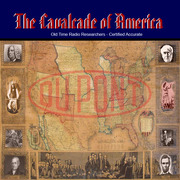
The Cavalcade of America presented by DuPont. This evening's program in the Cavalcade of America presented by DuPont is the direct result of the large number of written comments received by the sponsors some weeks ago following the broadcast entitled Songs That Inspire the Nation. We hope our listeners will find the same enjoyment in the stories behind American songs of home. How these songs can be written and sung. Since this nation is first of all a land of homes, the home songs occupy an important place in our history. And just as music is interpreted in terms of home, so can be the developments of science and industry. The best proof of service rendered by chemical research lies in the many comforts and conveniences that it's brought to every home. These contributions are summed up in the DuPont ideals. Better things for a better living through chemistry. Love of home has always been a prominent state of the American people. Our country was founded and settled by sturdy pioneers who above all sought permanent homes for themselves and their families. This home-loving instinct is reflected by many of our best-known songs. But the most famous of all home songs was written by a man who during all his days was a wanderer on the face of the earth. John Howard Payne was born on June 9, 1791 in New York City. His childhood was spent in a little cottage at East Hampton, Long Island, which today is a national shrine. In 1806 he entered Union College as connected. We find Dr. Lifflett Knott, president of the college, returning home one evening. His servant opens the door for him. Good evening, Doctor. Good evening, Henderson. Young Payne arrived? Yes, sir. I told him you'd return shortly after your faculty meeting. Well, I'll see if he's still up. I want to speak to him. Is the room over here, you know? Yes, sir. Well, young man. Good evening, sir. Yes, I'm Dr. Knott. How do you do, Dr. Knott? I rather thought you'd be a fleet. Long sailing trip up to Hudson, usually tiresome. I waited up to thank you for inviting me to stop at your house, sir. Yes, Mr. Menace Fleeker of Albany made the arrangements. He told me you'd need extra students for your studies. He also said that you have a keen mind, but that you haven't been guided along the scholastic line. No, sir. I want to be an actor. An actor, eh? Do you think you have the spionic ability? Well, I'd be close, oh, sir. But my parents wanted me to go to college before I made any definite decision about my future. I hope you won't let this ambition interfere with your studies. Oh, no, sir. I promise to do my work faithfully. If I'm not to be an actor, well, perhaps I could be an author. I see you've been at work. Tomorrow's lesson? No, sir. I've just been writing. Writing, eh? What's the fun of acting? Nothing important, sir. Just trying to write some poetry. Poetry? I didn't know you were a poet. It isn't much good, I'm afraid, sir. You see, I'm a bit homesick. Not that you haven't all tried to be kind to me, but I'm so fond of my family and my mother. Yes, yes, naturally, naturally. But I've called what I've written home. Were they subject? May I see it? Yes, sir. Yes, sir. Where burns the loved heart the brightest, cheering the social breast? Where beats the fond heart lightest, its humble hopes possessed? Where is the smile of sadness of meek-eyed patients born, worth more than those of gladness which murk bright cheeks adorned? Pleasure is marked by fleekness to those who ever roam, while grief itself has sweetness at home. Dear home, well... I know it isn't very good, sir. Ah, it has merits, John. Yes, I like that last line of the first stanza, while grief itself has sweetness at home. Dear home. Someday I'll try to write a better poem about home. After the death of his mother some years later, the home John Howard St. Louis had built was broken up. And in spite of Dr. Knott's hopes that pain would follow a scholastic career, the young man chose the stage of his profession. Popular at first both in New York and London, his extravagances were a hindrance to his career. After several unsuccessful seasons, he took to writing plays, the most popular of which was Brutus or The Fall of Cardewan. But his greatest bid to fame was to come. We find him in London in 1823 at the famous Covent Garden, where preparations are being made for his play Clary or The Maid of Milan. The English actor, manager Charles Campbell is conducting the rehearsal. Let's take the scene again leading to the entrance of Clary. Miss Tree? Yes, Mr. Campbell. Stand by, please. We begin where the servants of Vespina Giocosto meet in the garden and discuss Clary. Go on, please. Vespina Giocosto. Oh, the Lady Clary. I'm sick of the very name. I would great man to leave the Duke to go. Bringing us all the way from Milan to wait on such a... How can she help herself? Hasn't the Duke given orders that she has never suffered the past the boundaries of the park in daytime? On out the door is locked and guarded as mighty as the old state prisoner. She doesn't like to live here. That's plain to be seen. I believe the Duke has enticed her here on the false witness. I leave the poor girl to my very soul. Hush, here she comes now. All right, Miss Tree. Here's where you come on. I'm supposed to sing the song on my entrance, Mr. Campbell. Very well, proceed. The music isn't ready yet. I have the word... After all the time we've waited for it, that song had better be a good one. I thought Cain had said it was already squired. Mr. Paine said he was getting Mr. Henry Bishop to make a proper arrangement of it. Oh, I see, I see. Well, get on with the scene then. After the song, Vespina speaks. Yes, sir. Bless me, ma'am. What a silly song that was and how sickily you sang it. Where might you have heard that song, ma'am, if I might be so wrong? Where I learned other lessons I ought near to have forgotten. It is the song of my Lady Zilly. The Hymn of the Lonely Heart. It is the first music heard by infancy in its cradle. And our cottagers blending with all their earliest and tenderness recollections. Never cease to feel its magic... Mr. Campbell. Yes, Mr. Paine and Mr. Bishop. Hold it, please, hold it. Well, Mr. Paine. Morning, Mr. Campbell. How do you do, Mr. Bishop? How do you do, Mr. Campbell? We've been waiting for you. I hope we'll have that song at last. Yes, Mr. Campbell, we have it. It'll have to be a very good one. Live up to your flattering description, Mr. Paine. The Hymn of the Lonely Heart, whose magic is felt until death. I think the song has elements of popularity, Mr. Campbell. Well, let's hear it. Did you write the music, Mr. Bishop? It's a tune Mr. Paine heard of peasantry when he was travelling in Sicily. He didn't remember it all, but when he hummed it for me, I recognised it as an old Sicilian folk tune. I've embellished it... Will you try it, Miss Tree? You'll find the piano in the wings there, Mr. Bishop. Thank you. After you, gentlemen. Thank you. Remind those steps leading to the stage. Indeed. I, er, I'm anxious to hear the music, Mr. Helms, and dear. It is sincere, Miss Campbell. I wrote it when I was living in a parish garret, thinking about the little cottage I lived in when I was a boy. Can you say all right, Mr. Bishop? Thank you, Mr. Squires. Shall I have the piano moved on stage? No, it's right all right, Mr. Squires. Thank you. Will you sing it, Mr. Paine? Well, if Miss Tree wouldn't mind, I'd rather her... Of course, Mr. Paine. I already know the words. All right, Miss Tree. Let's hear the hymn of the lonely heart. With pleasure's a call of death Though we may roam Wherever so humble There's no place like home A charm from the skies Seems to hallow us there Though it be through the world Is near met with elsewhere Home, home So home sweet home, the best known of all home songs was born. John Howard Paine later retired from his theatrical career in London and returned to the United States, where he became interested in helping the American Indians. And through his political interests, he was appointed Consul General to Tunis on the north coast of Africa. In 1861, we find him in the consulate on his 60th birthday as his secretary comes into the room. The young American sailor wants to speak to you, Mr. Paine. Very well. Send him in. Yes, sir. Why, what's that, Mr. Jones? Why, that's the Royal Tunisian Band come to serenade you on your birthday. Well, well, serenading me with my own song. That was very thoughtful of my friend, the bay. Yes, sir. Will you see the young American now? Of course. This way, please. Thank you. Here's the young American, sir. I am, young man. What can I do for you? Well, I want to go home, sir. I was told that you could fix it for me. You'll tell me the circumstances. Well, sir, I ran away to sea and sail around over a year. I was looking forward to going home. Well, sir, I'm afraid I was stuck waiting a bit and missed my boat. I didn't desert, sir. I was too glad to be going home. They told me at the dock that you could fix it for me. I'm sure we can. Mr. Jones here will see what he can do. I haven't any money. That's something an American consul is supposed to arrange, too. Thank you, sir. It's mighty good of you. Hearing them play that song outside makes me want to go home all the more. You never know how good home is till you're away from it, do you, sir? That song brings back memories, eh? Certainly does, sir. A man who wrote those words must have had a wonderful home. Well, as a matter of fact, he never really knew a home. You know him, sir? Very well. You see, I wrote those words. You, sir? Yes, my boy. So I can appreciate your anxiety to see your home again. How often I have been in the heart of Paris, Berlin, London, or some other city, and have heard people sing or hand organs play home sweet home without having a shilling to buy myself the next meal or a plate to lay my head on. The world has literally sung my song until every heart is familiar with its melody. Yet I have been a wanderer to my fortune. John Howard Payne died in 1851 and was buried in far-distant units and it wasn't until March 1883, 32 years later, that the body of the author of Home Sweet Home was returned to its native land. Stephen Collins Foster, the author of Home Sweet Home, Stephen Collins Foster was another American who reflected his love of home in his melodies. There is no more loved song than old folks at home, and this was not the only home song that was to bring him fame. In 1852, he married Jenny McDonnell, and part of their honeymoon was spent as guests of John Rowan, Jr. at his beautiful plantation near Bardstown, Kentucky. One evening on the veranda, John Rowan is talking with Mrs. Foster. Where is Stephen this evening? I haven't seen him since dinner. Composing music, undoubtedly. You say that as if you resent Stephen's writing music, Jenny. Well, I didn't mean it that way. But on such a beautiful evening like this, with the wonderful moon, it does seem a bit unusual for a man to close himself up in a house with a piano. Well, Stephen's music is beautiful, Jenny. It frees the very spirit of the Southland. That's strange too, isn't it, for a man who was born in Pennsylvania? Yes, there's something universal about John's music. Jenny! John! I finished it. New song, Stephen? Yes. Would you care to hear it? Oh, yes. All would, I'm sure. Shall we go inside? Yes, sir. Well, what's the inspiration this time, Stephen? Your home, John. My plantation here? Yes, John. In the first place, this house. It's staceless and dignitary. You know its patterned after the lines of Independence Hall in Philadelphia. Well, I didn't know that, John, but I do know it's very beautiful. Will you lead the way to the parlor, Jenny? Yes, indeed. After you, Stephen. Thank you, sir. You know, this morning when I awakened, I looked out of the open window. I heard the wood thrush and the mockingbird. The slaves were singing in their quarters. I felt the sunlight streaming through the branches of a great tree. And in the distance, the fields of corn. I wanted to put it into music, and I did. Well, play it for us, Stephen. I'm anxious to hear it. A song inspired by my old Kentucky home? That's what I called it. I heard you use that term last night. The sun shines bright in my old Kentucky home This summer the dark is again The corn crops bright and the meadows all in bloom And the birds make music all the day Weep no more of my plenty Weep no more of my plenty A contemporary of Stephen Foster's, James Bland, wrote a song, Carry Me Back to Old Virginia, which, though it didn't mention home in its title, was destined to become a symbol for the longing of the wanderer away from home and family ties. An incident is recorded while Carry Me Back to Old Virginia was being played and sung at an open-air concert near Philadelphia. Pardon me, sir, but I noticed that the song affected you. Yes, sir. It brings tears to my eyes. You're a Virginian too, then, sir? Yes, sir. I'm from Australia. The sentiment of the song, the music and the words made me think of my home down under. We're all brothers when it comes to songs like that, I call it. I've been wiping my eye all through that tune. You're a friend of mine, too. I'm glad you're here. I'm glad you're here. I'm glad you're here. Are you from Virginia, sir? No, sir. I'm from Vermont. That song is to me a symbol of home. I've been away from mine a long time. I don't think it matters where we come from. Home means home to everybody, I call it. The cavalcade of America presented by DuPont moves westward, where no one is more sentimental or home-loving than the roving cowboy who makes his home wherever there's a herd of cattle to be brought up to around the country. In the early 90s, on a ranch 18 miles west of the little cow town of Ballinger, Texas, the cowboys are gathered together after a long day's work, singing their favorite songs. A small boy sits beside his mother on the ranch house steps and listens to the harmony. From the pallid lips of a youth who lay on his dying bed at the close of day. Hi. No soft songs. I'm from Mother. Yes, baby. No soft songs. I wonder why. Well, because most of the cowboys are wanderers, I reckon. They haven't been a real home. There's no one more sentimental than a man without home ties. Yes, I know. But the cowboys do have a home song, Mother. They're always singing it, and they call it the home sweet home of the west. I know. That's my favorite of all of them. Hey, fellas, won't you all please sing the home song of the west? Young Jamie, the home sweet home of the west, boys, a special request. How about that? Give it to them, please. Oh, give me a home where the buffalo roam, where the deer and the animal play, where seldom is heard a discouraging word, and the skies are not cloudy all day. Home of all the rain, where the deer and the animal play, where seldom is heard a discouraging word, and the skies are not cloudy all day. That small boy was David Geyer, whose special transcription of Home on the Range many years later was to bring into the attention of the greatest audience it had ever known. It attracted the attention of one of America's greatest singers and was sung from one end of the country to the other. Shortly after it had been chosen as the official song of the Texas Rangers, a musical reporter questions Mr. Geyer about the song. How did you come to recreate this song, Mr. Geyer? Well, it was always a favorite of mine, in my blood, I guess. When I was a boy, I used to beg the cowboy to sing it. My mother used to sing me to sleep with it. It meant home to me. I was fond of it, and I thought perhaps that others might be too. No doubt about that, Mr. Geyer. I understand that when Mr. John Charles Thomas appeared recently in the Hollywood Bowl, the entire audience got up and yelled for him to sing it. Mr. Thomas had done much to popularize the song. He and Home on the Range seem to belong to each other. When the Texas Rangers adopted it as their official song, they made Mr. Thomas an honorary member. It's a beautiful old song, all right. Who wrote the words? Well, no one seems to know. Cowboy songs like Grass on the Frayer sprang up overnight. The original author and composer are lost in tradition. But the song itself seems to be popular in all parts of the West. It has a kind of universal appeal. I've heard it sung by the cowboys after a roundup beside the campfire. And I've heard it played by great orchestras. I've heard it sung as a solo. But no matter where I hear it or who sings it, to me it will always be the home sweet home of the West. Be ever so humble. There's no place like home, wrote John Howard Payne. And those words are echoed by many other home songs, which are the favorites of a home-loving nation. All honor to their authors and composers, whose poetry and music are an inspiration to the cavalcade of America. About this time of year, we begin to realize that summer heat is with us again. It seems only yesterday that most of us were shivering in our overcoats and wishing for the good old summertime. But now we're trying to figure out ways of keeping cool. A few years ago, a businessman in one of our big cities told me what he did to keep going during the hot weather. As soon as he came to work in the morning, he locked his office door and stripped to his underwear. He dictated his letters over the office telephone. And at frequent intervals during the day, he retired to a shower bath he'd had installed next to his office. In that way, he was able to put in a full day's work. It seems ridiculous that anyone should have to take such measures to be comfortable in a modern world. And it is ridiculous today when air conditioning systems are available. It's safe to say that air conditioning or air cooling will be regarded as a necessity for stores, factories, offices, and homes in the not-far-distant future. Chemistry plays a large part in air cooling because most refrigerating systems use chemicals for reducing and controlling temperature. Chemists have developed a number of such chemicals, which are useful as refrigerants, and several of them are made by DuPont. Their use by important manufacturers of air conditioning equipment is helping to provide summertime comfort for millions of people. A famous American humorist once said, everybody talks about the weather, but nobody does anything about it. People still talk about the weather, but the last half of that remark is no longer true. The air conditioning people and the DuPont chemists have done something about it. Besides what it means in cool comfort, in making working conditions easier, the manufacture and installation of air conditioning equipment is providing work for thousands of people. Air conditioning is another example of how the ingenuity of the mechanical engineer plus the untiring work of the chemist has created a new industry. This development, like many others, illustrates the important truth expressed in the DuPont phrase, better things for better living through chemistry. Music Heroes of Texas will be the title of the broadcast week at this time when DuPont again presents the Cavalcade of America. Music This is the Columbia Broadcasting System. Music WABC, New York.