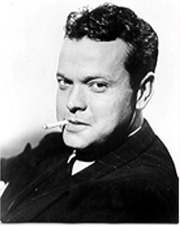
This is Orson Welles speaking from London. The Black Museum, a repository of death. Yes, here in the grim stone structure on the Thames, which houses Scotland Yard, is a warehouse of homicide, where everyday objects, a dictionary, a stenographer's notebook, a clothes hanger, all are touched by murder. Here's a postcard. It's a familiar object, slightly soiled in its passage through the mails, usual cancellation over the stamp, an ordinary dress, 29 St. Paul's Road, London. The message, oh yes, on the message side, a drawing, rather well done, of the rising sun. Rather a conventional representation, isn't it, Sergeant? Yes, sir, conventional, still a rather unconventional matter. Murder? Yes, yes, it is unconventional. You know, Sergeant, I've often wondered why they hold so many executions at sunrise, why they end lives at the beginning of the day. Anyway, that postcard today, with the rising sun on it, can be seen among the other exhibits in the Black Museum. From the annals of the Criminal Investigation Department of the London Police, we bring you the dramatic stories of the crimes recorded by the objects in Scotland Yard's Gallery of Death. The Black Museum. In just a moment you will hear the Black Museum starring Orson Welles. Now the Black Museum starring Orson Welles. And here we are, in the Black Museum, Scotland Yard's Museum of Murder. Yes, here lies death in a variety of forms, swift or slow, merciful or cruel, death is here, laid out, remembered in detail and perhaps waiting to strike again. Here's a typewriter. This is an instrument of death, yes? Worthy of the Black Museum, definitely. The criminal care, the vicious planning that went into its use. Until the person who received the letters written on this machine, in desperation, took her own life. Here's a child's toy, a tiny metal aeroplane. It's rusty in places, the propeller doesn't turn anymore, but there were fingerprints on this. They placed a killer at the scene of the crime, for which he was hanged. Now here we are, the postcard. The postcard with its drawing of a rising sun. It's clear at once that a skilled hand drew this tiny picture. In this case many things were clear, almost at once, and conclusions were drawn. However, that of course is the story, the story which begins for us as Alfie Vine and his elderly mother turn into the entrance of 29 St. Paul's Road, London. Alfie, I refuse to go a step further until you've told me what this is all about. I'm surprising you, Mums. Oh, you've come all this way, are you going to spoil it all now? I'll not set foot in this house until you stop all this mystery. Oh, Mums. Well, this is where I've got my rooms. You're living here? Oh, 29 St. Paul's. You know the address. It's rather dirty. My place is all right. It's only the outside and it's cheap. Alfie, you've not wanted to show me this before. I want to show you the girl who's waiting upstairs. Alfie, you haven't gone and got married. Not yet, Mums, but we're planning, so I want you to meet her. All right, I'll go in. They went in. The shabby young man, the rusty black clad grey haired woman. They climbed the stairs, one flight only, only one but enough for Mrs. Vine to see the scabby walls, the dirty stair rail, the untidy hall. Alfie placed his key in the lock and turned it and opened the door. Light from the window revealed a single room, a wash stand, a bed. How do you? The mother had reason to scream. There was a young lady on the bed, clad in the remnants of a nightgown. The gown, the sheets, the pillow were blood stained. Why wouldn't they be? The young lady's head had been severed from her body. His mother, given into the care of a neighbour, Alfie Vine summoned the police. Shortly thereafter, he faced Inspector Wood and Sergeant Cross of the CID, Scotland Yard. It's obvious, Vine, that this Alice Courtland was, what shall we say, more than a fiancé to you. We was married. I didn't want my mother to think we'd gone and done it without her knowing, so we planned to do it over again after Mums met her. Where were you last night, Vine? Working? Oh, you can check on the postal clerk, night shift. Where? Charing Cross Substation. Oh, check that, Sergeant. Yes, sir. Of course. You work nights a lot, Vine. It's a split schedule, Inspector. Two or three times, sometimes more a week. You don't think I'd done Alice in, do you? We're not thinking anything yet. Not until we find out from the lab exactly when she died. Poor Alice. She didn't have much of a life. Nothing to depend on till she met me. What did she do at night while you were working? I never asked. We trusted each other, we did. I see. Sergeant, I want the neighborhood... The inspector was skeptical. You could hear it in his voice. The story was hard, to say the least. It became a trifle more odd when Sergeant Cross reported... They knew her all right. Every buyer in the district, but not as Alice Vine. In most places, she was Daisy Cummins. Spectre understood. Came as no surprise, therefore, when a frightened little man, a Marty Shaw, ship's cook on leave, turned up at the yard. Yes, sir. I knew Daisy, but I wasn't with her Wednesday night. No, sir. Not then. When did you see her last? That was Tuesday night, Inspector. And before that? Monday. And Sunday too, sir. We had dates, Daisy and me, whenever I was ashore. We always had a few drinks together at the Ork, at the Rising Sun, places like that, along St. Paul's Road. But not Wednesday night? No, sir. Not the night she got herself killed. No, sir. Why not? She had a date with somebody else, sir. Oh, how do you know? I saw him, sir. In the Rising Sun. I saw him. Mm-hmm. Were you jealous? No, sir. I was with Daisy's friend Margie. Good looker, too. Can you describe the man Daisy was with? Well, I had a look at him. I believe I could. Well, could you pick him out of a group? Well, I might, sir. I'd try for you, Inspector. I'd really try. Apparently, a step forward is about to be made in the case. The ship's cook gives his description. Not very big. Slim-like, too. Shabby, but in a genteel kind of way. About 30 years old. Always doodling like with a pencil. Kind of fella can always pick up a check. A description. Not much to go on, but a start. Again, the canvases covered the area. And now the various barmaids and tavern keepers remembered a man like that. Remembered seeing a man like that with Daisy, alias Alice, the girl who literally lost her head. However, there were no further traces of the man in question. Inspector Wood and Sergeant Cross went back to the bedroom in St. Paul's Road. All right, Sergeant. With a fine tooth comb, the whole room down to the baseboards, and behind them if necessary. The detectives took the tawdry little room apart. The bed was dismantled, the window shades were unrolled, the washstand and its piping were completely explored. The bureau was investigated, the drawers were pulled out. Their contents tossed on the bed. Hello. Here's something, Inspector. Ah, a postcard, I see. Postmarked the day before. Where was it? Caught in the back of this drawer, between the backboard and the bottom. Interesting. What do you make of that drawing, Sergeant? It looks like the old Jap flag to me. I don't know of any Japanese eating place near here, Inspector. Dear Daisy, meet me at 8.15 at the... whatever the picture means. It's a rising sun, isn't it, Sergeant? And there is a rising sun. Where that shore fellow saw her on Wednesday night. Rather well drawn, almost a skilled hand. An artist, maybe? Maybe. Possibly the killer as well. Right, back to work, Sergeant. There may be a few more little messages like this. They found two more hidden in the recesses at the back of the bureau. And that was all. It's a thousand to one shot, Sergeant, but we'll try publishing these in the papers. Someone may recognise the handwriting or the sketches. More likely the sketches. And someone did. Music Hello? Larry, this is May. May? This is wonderful. Is it, Larry? Of course it is. Then why haven't I heard from you in weeks? After we had our quarrel, dear, I... I thought a certain beautiful model was pretty well through with a certain artist. I should be. But you're not. Larry, have you seen today's newspapers? No. Why? It's quite simple. A girl you'd been sending postcards to was murdered Wednesday night. How... how do you know I sent her cards? They're in the paper with drawings. I know yours, Tyle. Even in the paper. I... I... I should be flattered, I guess. I'm not. Larry, the police want to know who sent those cards. May, will you believe me when I tell you I never killed anyone? I believe you. I know you. Then, for old times sake, will you help me? I'm in trouble, May. Real trouble. What would you want me to do, Harry? If anyone asks you, anyone at all, will you say we were together from 10.30 on, on Wednesday night? For how long? An hour or so. Then, you went to Earl's Court when I went to King's Cross. Will you? Were you with her? Does... does it matter, May? No. Not anymore, I suppose. Then, try to remember, May, please, 10.30, Earl's Court, King's Cross. May Hester, artist model, once upon a time in love with an artist named Larry, and now asked to provide an alibi. In fact, asked to provide an alibi which might never be needed. May Hester lived with what she knew for a day or so, and then, half-reluctantly, her feet and her conscience took her to an office in the old building on the 10s. I understand your position, Miss Hester. I'm grateful you came to see me. I... I don't believe you. I'm grateful you came to see me. I... I don't believe he killed her, Inspector, but... as long as you're looking for him, you won't be looking for the right person, will you? Well, that's one way of saying it. Miss Hester. Yes, Inspector? I think you'd better give me his name. It... it's Larry Duncan. Mm-hmm. Do you know where he lives at present? May Hester knew. She gave Inspector Wood an address on London's western edge. She left the environs of Scotland Yard. So did Inspector Wood, in company with Sergeant Cross. Mr. Duncan? Yes, I'm Duncan. I'm Inspector Wood, C.I.D. Er, my credentials. This is Sergeant Cross. Will you come in, gentlemen? No, thank you. I'm afraid, Mr. Duncan, we have to ask you to come out, with us. We need to ask you a few questions, and it'll be more convenient, down at the Yard. Well, today, the postcard with a little picture of the rising sun on it is... part of the exhibits... in the Black Museum. In just a moment, we will continue with the Black Museum, starring... Orson Welles. And now, we continue with the Black Museum, starring Orson Welles. Larry Duncan was held on suspicion of murder. The inspector was convinced of his guilt. Duncan protested his innocence. The family called in a famous defender, but despite the presence in the case of Sir John Cripps, Scotland Yard charged Larry Duncan... with the murder of Alice Vine, alias Daisy Cummins, and preparations for the trial went forward. Sir John conferred with Larry. How are you, my boy? Fairly well, sir. Does my prison palace show as yet? Not yet. I like your confidence, Larry. I didn't kill the woman, sir. However, you were seen with her that night. A man, a sailor, I believe, who had been with her the three nights previous, saw you both together in the rising sun. That's... that's why I asked May to say we'd been together after 10.30 that night. Well, they have another witness, a tram conductor, who states he saw you leave that house at five in the morning. He couldn't have seen me. I take your word. But will a jury after that false alibi? I'll have to take my chances on that, I guess. Well, we'll see. Perhaps a little further investigation may bring a few more facts to light. Sir John Cripps proceeded towards a few more facts. But he kept the deal going very quiet. Not until the trial itself did he reveal his strategy, nor the evidence he expected to produce. In fact, the first move came sometime after Inspector Wood and Sergeant Cross had placed the police case in the record. The tram conductor, one Charles Powers, was on the witness stand. And are you certain, Mr. Powers, that the prisoner in the dock is the man who saw leaving 29 St. Paul's Road that morning? I am that, sir. Positive. How, Mr. Powers? By his walk, sir. He has a kind of free-swinging stride. Thank you. You may cross-examine. Thank you. Mr. Powers, let me refresh my memory. You have said the weather that tragic morning was drizzly. Yeah, I did say, sir. It was. Thank you. And that you saw the man quite clearly by the light of a lamppost. Yes, sir. That's correct. And further, that you heard a church clock in the vicinity strike five. I did. My lord, I offer in evidence as a rebuttal of this man's testimony the reports Julia tested of the electric light company servicing that district, which contains the record that the street lights were extinguished that morning at 4.37 a.m. This man could not have seen anyone by the light of a street lamp. Mark it for evidence. And if it please the court, I have here the Julia tested records of the London Weather Bureau. Not one drop of rain fell anywhere in London that morning. Mark that for evidence. Thank you, my lord. A skilled lawyer in action is a fine thing to watch, isn't it? Here was a witness, an important witness, completely demolished. His facts called in question and his responsibility torn to pieces. The prosecution suffered from there, naturally. They attempted to regain their loss with Marty Shaw, the ship's cook. In conclusion, Mr. Shaw, you identified the prisoner as the man who was with the victim the night of the murder. I did, sir. Thank you. Your witness. Thank you. Mr. Shaw, were you frightened when you heard of Miss Cummings' death? No. Why should I be? Why shouldn't you have been? After all, Mr. Shaw, by your own testimony, you spent Sunday, Monday, and Tuesday evenings with Miss Cummings. She was killed on Wednesday. Why shouldn't you have been frightened? You mean because I was the next man to the prisoner? Next man to the murderer, perhaps. Not next man to the prisoner. Maybe I was. You realized, didn't you, that your position might turn out to be unpleasant? Yes, I guess I did. And you discussed the matter with another lady friend of the deceased? What if I did? Nothing. Nothing at all. Except perhaps that from this woman you obtained a detailed description of a certain friend of Miss Cummings, and from that description you picked out the prisoner at an identification parade? Well, Mr. Shaw, answer me. Speak up, Mr. Shaw. The judge and the jury want to hear your answer. So do I. Yes, sir. I did that. Thank you, Mr. Shaw. That is all. Another witness his testimony discredited. His motives called in question. The propriety of his identification more than called in question. The courtroom crowd was making bets as it filed out after the first day. The odds were swinging away from the prosecution and toward the young man who sat quietly in the prisoner's dock, sketching, sketching. After all, Larry Duncan was an artist. An artist wants to keep the record of his experiences. Even when his life hangs in the balance. Next day, the prosecution called May Hester. Miss Hester, how did you learn of this crime? In the newspapers. And how did you first connect the prisoner with it in your mind? Well, when I saw the postcard on the paper, the one with the drawing on it, it was Larry's, Mr. Duncan's, tile. I recognised it. What did you do? I collected the postcard. I recognised it. What did you do? I called him on the phone. What happened? He asked me to give him an alibi. A false alibi? Yes. He wanted me to say that I'd been with him that night. And what did you do? I agreed. Then I thought it over and I went to the police. Very well, Miss Hester. Thank you. Cross-examined. Miss Hester, why did you go to the police? Well, I was afraid, I suppose. Had you been in love with Mr. Duncan? I... that is... yes. Uh-huh. Was he in love with you? I thought so. Have you ever heard of an emotion called jealousy, Miss Hester? It was over. I had no reason to be jealous. I submit, Miss Hester, that when you thought it over, when you realised that Mr. Duncan had apparently gone to this woman after his protestations to you, that you were not afraid, that you were jealous enough to want revenge. That's not so. That's not so. You were afraid. Of what? That this man might try to murder you? No, of course not. Lorry, Mr. Duncan couldn't... wouldn't dare to fly. Miss Hester, when Mr. Duncan asked you for the alibi, did you know the time of the murder? No. No, sir. When did you learn of it? Here, in the medical testimony. Did the question of the time of the death enter your mind when you went to the police? No. No, of course not. I ask you again, Miss Hester. Can you say you were motivated only by fear and not by jealousy or revenge? Yes. Yes. I was only afraid. Afraid of what? I was afraid that... well, even if he hadn't done it and I... I had to swear falsely, I might get into trouble myself. And you were willing to sacrifice the reputation, perhaps even the life of the man you loved, because you were afraid to get into trouble? Objection, my lord. Irrelevant, incompetent and immaterial. I withdraw the question. That is all, Miss Hester. Thank you very much. Thereafter, the prosecution rested their case, or what was left of it. Sir John called Larry Duncan as his first witness for the defence. Testimony was short. I didn't kill her. I left her at the rising sun that night, around midnight. I didn't kill her. Nor could the Crown's prosecutor shake his statement. Next and last witness for the defence, one David Wallace, a ticket agent on a suburban railroad. Mr. Wallace, what is your address? 26 St. Paul's Road. What time did you leave your house the morning after this killing? My regular time, sir. Five minutes to five. Uh-huh. Did you see anyone that morning? Yes, sir. A man going in the opposite direction. Only one man? Only one, sir. Are you conscious that you have a rather free swinging stride? Why, do it on purpose, sir. It's good for you in the morning. With the permission of the court, I request a small demonstration. Proceed. Step down a moment, Mr. Wallace, please. Aye, sir. Now then, just turn up the colour of your coat. Ah, thank you. Put on your hat, will you? Thank you. Now, will you walk, please, as you do in the mornings? Chest out, breathe deep and all, please. Like this, sir. It was unmistakable, the free swinging stride. It was established that there was a man on proper, decent business walking in St. Paul's Road at five that morning. The prosecution had no cross-examination for Mr. Wallace. The Crown summed up. Sir John summed up. The judge's charge was brief and to the point. In cases such as this, if there is any reasonable doubt in your minds, gentlemen of the jury, it is incumbent on you to give the prisoner the benefit of that doubt. At eight thirty the same evening, the jury filed back into the box. The clerk solemnly intoned the old question. Have you reached a verdict? We have. Again the clerk spoke. What is your verdict? We find the accused not guilty. Here, here, here. Arson Wells will be back with you in just a moment. Today that postcard, whatever it may mean with its rising sun, proposes in a place of honor in the Black Museum.