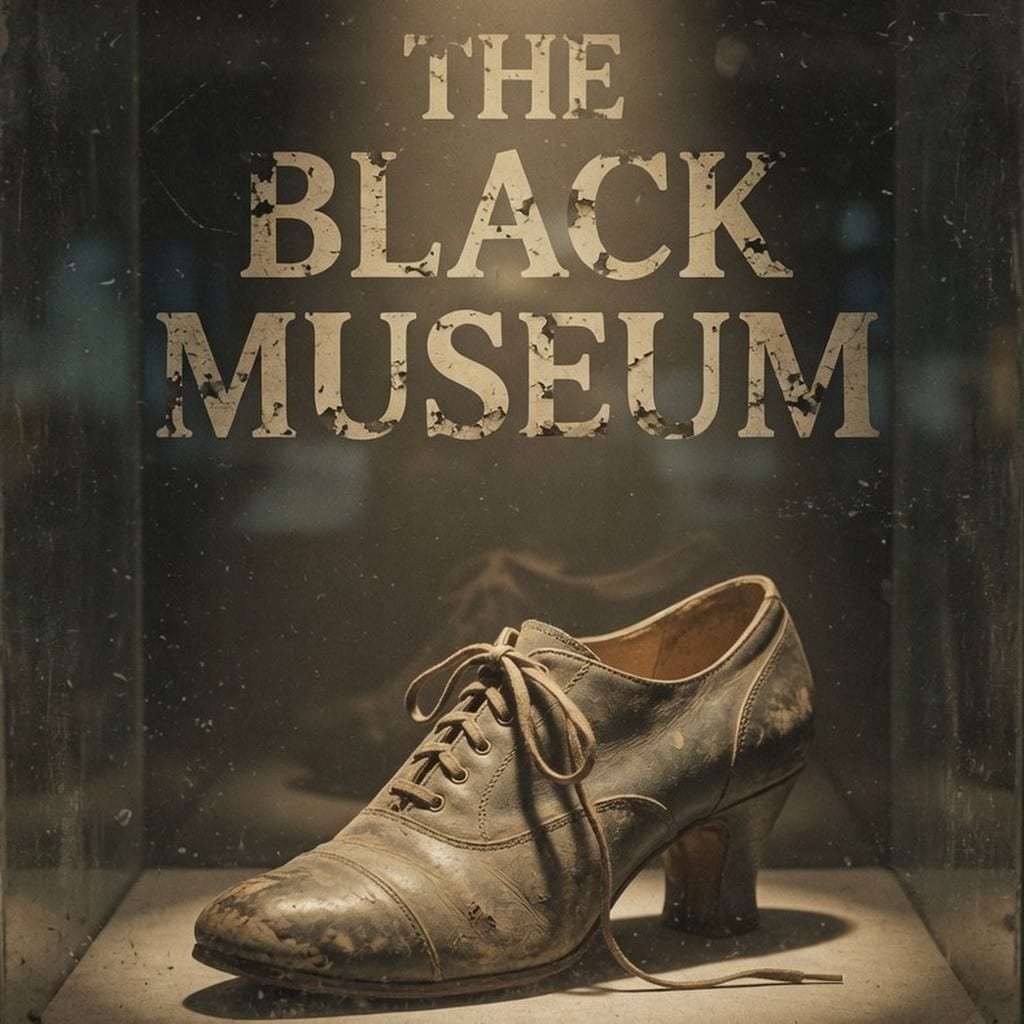
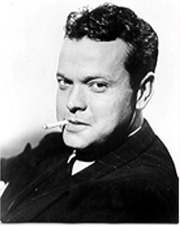
This is Orson Welles, speaking from London. The Black Museum. A repository of death. A museum of murder. Yes, here in the grim stone structure on the Thames, which houses Scotland Yard, is a warehouse of homicide. Where everyday objects, a portable typewriter, a jack for an automobile, an ice pick, all are touched by murder. Here's a pair of spectacles. It's a familiar object, neat, not too large, toward the shell, framed with gold tops. You've seen them a hundred times on girls who obviously decided that they must wear glasses. They'll make the glasses as decorative as possible, but this pair... Women's glasses, right on top in the suitcase. And pretty thoroughly smashed. Poor Daisy. Something, whatever it was, must have hit her awfully hard to smash her spectacles like this. Today... Well, today those spectacles can be seen in the Black Museum. From the annals of the Criminal Investigation Department of the London Police, we bring you the dramatic stories of the crimes recorded by the objects in Scotland Yard's gallery of death. The Black Museum. In just a moment you will hear The Black Museum starring Orson Welles. The Black Museum The Black Museum Now, The Black Museum starring Orson Welles. The Black Museum Now here we are in The Black Museum. Scotland Yard's Museum of Murder. Yes, here lies death. Who died by these objects? The dead, named here on the white labels of the black lettering, or the killers, named in equal place in equal size, wherever they are known. A mandolin string. Here we are. It's made for music, a mandolin string. Stretch it across the top of a stairway, see it blend and disappear into the dark carpet background. Stretch it ankle high and listen in the dark for the sound of falling, the sound of murder. Here's a French novel, romance, with a blackened perforation in the centre of the pages where the bullet passed, which ended romance. Now here we are, the spectacles. Rather pathetic spectacles. The lenses are cracked, the frame twisted and bent, the guilt tarnished. Many other things were tarnished, including a man's reputation by the train of events which began that morning when Mrs Oliver came to see Inspector Lasswell at the yard. I understand, Mrs Oliver. Perhaps your daughter thought she'd let you know, but didn't after all. I wish I could believe that, Inspector. I can't. Daisy was so determined when she left that night. And since she went to the train, you've heard nothing. I wired wrong. I never liked him. Something, I don't know, I thought my Daisy'd do better for herself than a chicken farmer. Anyway, I wired, asked him if Daisy was there. I received this in reply, Inspector. Thought Daisy coming Saturday, not Friday. Went to meet her, not there. Letter follows, Ron Smith. This was last Saturday? Yes. I wired on Monday. Then this answer came back the same day. The letter came in yesterday, Wednesday. Oh, thank you. Dear Mrs Oliver, you do not know how shocked I am. Daisy missing since Friday afternoon. This is really terrible. She wrote, asking me to meet her Saturday. The heartsick words of a worried man, the tone and feeling of the letter, plus the fear and the tears of the mother, sent Inspector Caswell to Locksborough and Sussex, the nearest town to Ron Smith's chicken farm, the railway terminal for the area. He turned first to that prime source of all rural information, the local pub. Evening, landlord. A pint of beer, please. Yes, sir. Of course. Haven't I seen you some place before, my good man? What? Oh, Jack Sheen. You have seen me some place before. Drink up, then. It's good to see a familiar face. A familiar face drawn by a familiar scent. You're not down here on business. I am, and so are you. I wanted to keep this quiet for a while, anyway. With that crowd over at the dartboard? Your old-time friends, Caswell, Morton of the Times, Alsop of the Guardian, Dyr of the News, and yours truly. You fellows have a sense of smell of a ferret. We have to. It's our living. Do you think the girl is dead, Caswell? There it was, in words of one syllable, literally one syllable. Do you think the girl is dead? Inspector Caswell shrugged and turned to his drink. Without a penitent effort, he drifted into conversation with the landlord, while Jack Sheen stood by, quietly, nonobtrusively. Have there been any talk hereabouts recently about a girl who's missing? Some? Well, girls get silly ideas sometimes, especially the young ones. The only silly thing about this girl was the man she went for. They get that way sometimes, even the best of them. I know what you mean. Anything wrong with the man in it? Mare do well, owes for feed. Everything in sight. Lives in a hut on his farm, not even a proper house. Oh, that's her? This Oliver girl now. Bright, sweet as they come. Real pert in them fancy glasses she always wore. Then off the deep end over this Smith fella. Never know why they'd do it. Whereabouts is this chicken farm? Right fork east, second right after the fork. You're thinking of going up there? Oh, I might drop over. Tell the girl's mother I'd look around. Maybe talk to Smith. From his letters, he's pretty well upset himself. Him? Upset over that girl? Not much. What's happened to your friend? My friend? Why, he was just... Five will get you ten, landlord. My friend is halfway there by now. Inspector Caswell was absolutely right. Jack Sheen was well up the right fork and turning into the lane that led to Ransmith's chicken farm. Who's there? I said who's there? I'm Jack Sheen of the London Daily Post. I'd like to talk to you. Ah. What makes you think I want to talk to you? Oh, most people talk to me. If they don't, I, uh... I usually write what I think they might have said. Very simple. Smart, aren't you? I know my business, I hope. Fellows down in the village suggest you don't. Yeah, they like to talk. Don't you? Not about things that ain't my business. Daisy Oliver is your business. She was. Meaning, exactly? Daisy said she was coming down last Friday. I left my gate unlocked. Like you found it tonight. She was always touchy about that. She never came, though. That's right. Now, all this talk, I'm more worried about her than I ought to be. Nancy's gonna make a fuss about that pretty soon. Well... A girl, Nancy Noble, lives up the road a piece. Me have been walking out lately. Daisy knew. I figured she'd be coming down like she wrote on account... Apparently, Mr. Ron Smith, chicken farmer, was as garrulous in his way as his hands were in theirs. He clucked on at great rate. Finally, Jack Sheen got away. Scribbled a bit in his notebook and then off to sleep. The next morning, quite early... Hello there. What? Oh, you startled me. You don't look as if you scare easy. I don't? Oh, you walking into a barn like this behind a busy girl's back. A fellow who thinks you'd make a better wife for Ron Smith than some frail little girl from the city. You know your way around, don't you? There was banter and introductions. Nancy was quite flattered, of course, over the visit of a reporter. She talked. Sure, sure, I met Daisy. Like her? All right, if you go for milk sops. I see. I heard Ron was going to marry her right after Christmas. Not if he could break the engagement he wasn't. He's all set to marry me. Oh, so that's the way the wind blows, huh? It sure does. Or did. Now, with all the fuss over Daisy disappearing, well, Ron's too upset even to think, I guess. Upset is he? He told me night before last. He said she's killed herself. So Daisy may be dead. And Ron is afraid she may have committed suicide. Well, Jack Sheen has turned up a factor, too, hasn't he? Of course, Inspector Cazzle hasn't been inactive. Mr. Jeffrey, I'm told by our host the landlord that you think you saw the Oliver girl last Friday night. I think so. I was coming up the road out past the fork. I thought I saw her wearing spectacles. Is that all? She must have turned in at Smiths. She didn't pass my place. Reed here saw her real close. Did you, Mr. Reed? Yes, sir. I met Jeffrey on the road. I was coming down to the village after fixing the septic tank out at Jeffrey's place. Girl passed real close. Oliver girl, all right. Wearing her specs and carrying her suitcase. Ah, that's right. She had a suitcase like she walked out from the train. Why, the Smith fella didn't go in and meet her. Then there was the routine visit to the cottage where Daisy usually stayed when she was in Larkspur. Did you hear from Miss Oliver, ma'am, that she was coming down here this past Friday? She didn't, and she always tailed me. If she'd planned to come down, well, you never know what with young girls being so free nowadays. And she had spent all her savings on these trips. She told me that last time she was here. When was that? Oh, about, let me see, about two months ago. She seemed so well-behaved. She seemed so nervous, poor thing. Even then, you know, jumpy. Always a little scared, like a rabbit, sort of. Oh, I don't know. I wish I didn't keep things... And finally, there was Edith Staple. Miss Staple had a friend in the outlying area, and Miss Staple had been crossing a field near the chicken farm, a kind of shortcut. Yes, Inspector, I'm positive I saw her. I saw two men on the road, too. One passed her. The men met, talked a little and went on. By the time I passed the lane to Smith's Place, she was in as far as the first shed. You saw quite a bit, didn't you? The road is on a little rise just there. I was coming up to it, and everyone was, well, sort of outlined against the sky. Well, thank you, Miss Staple. Thank you very much. There must have been a girl. Nine chances out of ten, it was Daisy Oliver. But how to prove it? Where had she disappeared to? Inspector Cassel and Jack Sheen compared notes. They stayed around Luxborough. That fact alone started the talk, which had impetus enough in any case. People don't just disappear, I tell you. She must be somewhere. She turned into Smith's Place. Won't I bet she never came out? Nice girls don't take chances going alone to men's homes. Even when they're more decent than the other elims in. They'll get him, you'll see. He did the girl in. What a bet. The talk reached Smith, of course. On the heels of the talk came Jack Sheen. Nice lot of chickens you've got here, Smith. You didn't come out here to talk about chickens. No? What then? You're trying to get more on Daisy and me. The town has plenty on you, they think. They're long tongues. They wag too much. You can't stop them, you know, quite easily. How, I'd like to know. Just ask Inspector Cassel to bring his crew out here to dig up your farm. They'll find nothing. That'll stop the talk. I'll do it. They can dig any place they want. Except I wouldn't want them to disturb my chickens. The remarks were duly reported to the Inspector. His comment was... We'll be glad not to disturb his chickens. I should think that's exactly what you would do. I don't know a thing about chickens, except roasted. Look, he was rather pointed about it, you know. Don't disturb my chickens. You know, if I were you, Cassel, I'd do some digging around that chicken run. Might save you a lot of extra trouble. You catch on, Inspector. I'll do it. The Inspector caught on to the extent of asking Ronsmith to drop in at the police station while Jeffrey and Reed and a few of the others with Jack Sheen began their digging. Oh, not much good this ground. Good enough for chickens. Got something? No, just a rotten stick. Nothing suspicious, like. There's something here. Yes, I do. Yes, I'd say you had something there. Lift out your shovel, Jeffrey. Okay. Look, I'm going to open it. I want you to witness that I neither take out nor put in any object. Ready? Yeah, all right. Okay, now, just watch this. It's the girl's suitcase, all right. I'd know those specks anyplace. Well, today, those spectacles can be found in the Black Museum. In just a moment, we will continue with the Black Museum starring Orson Welles. And now we continue with the Black Museum starring Orson Welles. And now we continue with the Black Museum starring Orson Welles. It was her suitcase. Yes, there it was, the earth of the chicken run clinging to its frayed handle, its shabby sides. Jack Sheen stopped the digging, sent Reed Pellamel for the inspector. Women's glasses, right on top in the suitcase. And pretty thoroughly smashed. Poor Daisy. Something, whatever it was, must have hit her overly hard to smash her spectacles like this. Shall we go on, inspector? Digging? Oh, of course. But, carefully. We don't want the edges of the spades to disfigure anything. The first thing they found was part of the torso. And the limbs wrapped in sacking. Finally, the head in a tin box, buried shallowly in the chicken run. The Black Museum I've had enough. Are we, are we through? Sorry, I didn't have a regular police crew for this. You can go along. And thanks. You too, Mr. Reed. Where's Smith? At your local police station, where Mr. Sheen and I will be interviewing him in a very short while. They interviewed him. It was quite simple at first. I gave him the facts. We've found her, Smith. Thanks to Mr. Sheen here and the strong arms of some of your neighbours. Well, what have you to say? First, I must warn you that anything you may say may be taken down in writing and used as evidence. Now, go ahead. I, I didn't kill her. I didn't. That's only a beginning. She came down on Friday to have it out with me. She was so nervous, she was all twitchy. She said she wouldn't be my place until, until we'd set a date for the wedding. But she knew about Nancy, she knew that. We had a row, a real hard row. I guess I gave in. I said the 27th of December, right after Christmas. Then I promised I'd tell Nancy that night. Daisy wasn't satisfied until I'd gone right out looking for Nancy. I couldn't find her. I came back and Daisy was hanging from the beam in my hut. She, she, she must have jumped from the table. It was awful. What did you do? Why didn't you go for help, a doctor? Well, I, I cut her down first. I thought there might be some life left. Did you try artificial respiration? As soon as I got her on the bed, I saw it was no use. But you still didn't call anybody. I was afraid. I panicked. I thought they wouldn't believe me. They'd all think I'd killed her and try to make it look like suicide. So you buried her? Yes, in the morning. But you cut her up first. You deliberately dismembered the body in an attempt... Have you ever tried to dispose of a body? True, a body is 76% water, but... Have you ever tried to get rid of one? It's almost impossible to burn without special apparatus. Burying it leaves it intact. How do you do? Find a lime pit? Even that isn't foolproof. What do you do? After you knew she was dead, you still wrote letters to her home. I couldn't stop doing that. If people were to believe that I hadn't killed her myself. May I, Inspector? Of course, Jack. What about these? Her glasses. You, you found them, too. How did they get this way? They, they must have fallen off when I cut her down. I suppose I stepped on them or something. Her head hit the table as I was carrying her to the bed. I, I couldn't believe Daisy was gone. I couldn't... Smith couldn't believe she was dead. Jack Sheen and Inspector Caswell couldn't believe... other items. It doesn't fit, Caswell. It doesn't. What's bothering you about it? Look, a girl who's just been told her wedding date... doesn't hang herself in the next half hour. I saw that. I sent his shoes down to London, to the laboratory. If he did step on those glasses, there'll be bits of glass on the soles or heels. I'm no Dr. Caswell, but... did you notice any rope marks on the neck? I didn't. I have sent for one of the medical examiners. We'll know all about that very soon. The hellsmith on an open charge. The least would be an illegal burial and failure to notify the proper authorities. Meanwhile, Sir Harold Hubert, one of the yard's best medical men, came to Larkspurrow. He worked, and he made his report. The girl did not die of strangulation, gentlemen. What was that? She didn't? There's a slight discoloration of the throat, but that was probably caused after death. What did she die from, then? Shock. Caused by the multiple bruises all over her body. That girl was beaten to death. Now the questions descended on Sir Harold's head in a deluge. No sign of strangulation at all. She may have been partially hung. There's congestion of the blood vessels of the throat. But she didn't die up there. If she was hung at all, she was alive when she was cut down. What else could have caused the congestion in the throat? Manual strangulation. Or she could have been knocked down, as is a logical assumption in this situation. Did you knock her down and step on her throat, Smith? Of course not. How could I have when she was hanging as I entered the building? You are certain she was hanging and dead? I know she was hanging. I'm as sure as I can be that she was dead. All right. Take him back to the cell. There it was. The expert said no hanging. The man accused contradicted that statement at every turn. Once again, the inspector and Jack Sheen went out to the chicken farm. What are you up to? Give me a boost up onto the table. Okay. Now what? I'm not going to hang myself. Come on up. I think it'll hold both of us. All right. Here I come. Not the safest perch in the world. Okay. Now what? Look here. Along the beam. What a filthy animal. Didn't Smith ever clean his place? Maybe it's just as well he never did. Look, I don't get it. He said a dozen times he found her hanging. If a rope passed over this beam, as Smith maintains... The dust up here would show the marks. You see any marks, old boy? Not a thing. Not even a bit of rope fiber. Sir Harold is right. No death by strangulation. Not by any rope which passed over this beam. I wonder how friend Smith is... Smith did his best to explain the matter. In fact, he did a trifle better than his best. That's possible. The rope must have caught in the joists. She didn't weigh very much. By the way, where is the rope? I burned it. It gave me the willies. What kind of rope was it? Ordinary hemp rope. Not sash cord? No, hemp. What did you intend it for? No special purpose. You always have rope around a farm. Inspector Castle reminded Mr. Smith quite tersely. Hemp rope leaves its fibers caught in rough wood... when it's passed over the wood. There's no sign of fibers or any mark in the dust. Well, then the dust settled back after I took her down. How did you take her down? I tied her with one arm and freed the rope with the other. Let's go back to the beginning, Smith. When did you first see her that night? She came to the gate. It was locked. She called. I let her in. We argued. Then we made up and I went to tell Nancy. When I came back... You better keep the story straight, Smith. That is the story. You said before you cut her down. You told Mr. Sheen you left the gate open... because finding it closed upset her always. Then I made a mistake. You made a mistake, all right. You made your story much too involved. You see, the laboratory has reported on your shoes. Not only are there no bits of glass in them... proving you did not step on them... but there are traces of lipstick on one... and traces of contact with human skin on both. I submit, and I shall so state to the jury at your trial... that you attacked the girl with force and violence... that you smashed her glasses on the table... that you beat and kicked her into insensibility and death. Your story tripped you and the laboratory did the rest. I'd say, Smith, next time keep it simple. But I doubt if there'll be any next time for you. Well, today those spectacles can be seen in the Black Museum. Orson Welles will be back with you in just a moment. Now here in person is Orson Welles. Exactly how Daisy Oliver met her death was never brought out... not even in the Black Museum. How Daisy Oliver met her death was never brought out... not even at the trial. Whether Ron Smith beat her to death... or whether she fell to her death, no one knows. But she was murdered, and by Ron Smith... there's no reasonable doubt about that. Nor was there any doubt about this man's character. Not only did he write of his concern over her disappearance... to Daisy's mother, not only did he write long, enduring love letters... to a girl he knew was dead... but from his cell, as he awaited trial, he sent a wreath to her funeral... palm leaves and one lily with the phrase attached... until we meet again. I wonder if they ever did meet again. Well, until next time, till we meet in the same place... and I tell you another story about the Black Museum... I remain as always obediently yours.