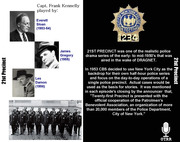
21st Precinct, Sergeant Klein. A what? How do you know something's wrong? How many days haven't you seen him? How do you know he's been in the apartment all that time? You are in the master room of the 21st Precinct, the Nerd Center. A call is coming through. You will follow the action taken pursuant to that call from this minute until the final report is written in the 124 room at the 21st Precinct. Do you have a key to get in? What makes you sure it's been bolded from the inside? All right. I'll send the officers around to have a look. Where can they find you? All right. Just stay there. I'll send them right over. 21st Precinct. It's just lines on a map of the city of New York. Most of the 173,000 people wedged into the nine-tenths of a square mile between Fifth Avenue and the East River wouldn't know if you asked them that they lived or worked in the 21st. Whether they know it or not, the security of their persons, their homes, and their property is my job. My job and the job of the 160 patrolmen, 11 sergeants, and four lieutenants, of whom I'm the boss. My name is Kennelly, Frank Kennelly. I'm captain in command of the 21st. What makes a city? Not buildings, not subways, not business. People make a city. From dawn to midnight, from midnight to dawn. The rich and the poor and the good and the bad pour their lives together and stir up the city, as in the 21st, seven days a week. It was Sunday morning and raining. I was on patrol when the chief inspector visited the precinct. In response to a radio signal, I returned to the house and conferred with the chief inspector, the commander of the uniformed force, for 35 minutes regarding conditions in the precinct. When the chief rose to leave, I walked outside with him to his car. It had stopped raining. Then I returned to the muster room and went around behind the desk to read the entry made in the blotter by Lieutenant Kenneth Gorman concerning the visit to the precinct by the chief inspector. But all right, Captain? Yeah. You worked in your biggest life. Well, you've got to expect it, Ken. He's not going to call until he's coming. I have enough today after I come back my vacation, Captain. Could have waited until the night. Where did you go, Ken? Maine. You like lobster, Captain? I love them. You ought to go up the coast of Maine. You never had such lobster. Hey, listen, I heard they never heard of a broiled lobster in Maine. The only way they fix them is boil, is that right? Yeah, all these places have this great big kettle. You've got to pick out the lobster you want from a little pen there. They're all crawling around alive. They take them and they dump it right in the kettle and pee. Guess how much we'll have for dinner for my wife, myself, and the two kids. And big lobsters, Captain. How much? Five-fifty. That's a lot of money. I'm not kidding. Come in, sir. Yes, sir. What's on your mind, sir? I can't find my family, Lieutenant. What do you mean you can't find them? I'm on a cruise to St. Paul. We've been cruising the Mediterranean for two months. We just stopped at Brooklyn-Navy Yard this morning. I can't find them. Oh, they're supposed to meet you, son? No, no, sir. They didn't even know I was coming. You see, we live in New York. I just came home and went to the house. It was really burned out. Wasn't anybody there. There was a fire. Three days ago, somebody told me. Where is this? 631 New York Avenue. Going for a precinct, Sergeant. And the whole building's boarded up. It's really burned out. All right, 18, just a second. Hold on. I can't find them. I don't know where they went. Hey, Lieutenant. Yes? Eisman's ringing in. He said let you know. That's when we're pulling up that notification on Lexington Avenue for the 44th. The car's still sitting here. I was just wondering if you knew anything about it. What about the notification on the... Did you ask around any of the neighbors? Oh, yes, sir. I asked around. Nobody's in the building. It was burned out. Keep on trying that. It's Sunday and the stores, they're all closed. What do you mean your family? Your parents? No, sir. My wife and my baby. Oh, did you ask any of the neighbors in the other buildings? Well, there isn't anybody living in the houses on either side anymore. They're getting ready to make a housing project there. And besides us, there were only five or six families left in our house. Hey, listen, do you remember the fire? A man over there told me there were some people killed. Do you remember that? Yes, there were some people killed. What's your name, sir? Rawlins, Joe Rawlins. You run the cruise of St. Paul? Yes, sir. Gunners made second class. Hey, listen, who was killed? Not my wife and baby. I don't remember the name Rawlins. I don't think so. Well, could you check? We're going to right now. I'll tell you what to do. Listen, how many people? Five. Five? Oh, God. Well, one of them was a city fireman, the others were tenants. I've got to know. How soon could I know? I'll tell you what to do, son. I'm Captain Cannelli. Yes, sir. That's my office right across the room there. It'll take a little while to look up the reports. Why don't you just have a seat in my office until we find them? Oh, that's all right. I don't mind. It'll take a few minutes, Joe. You go ahead and sit in there. I'll be right in. Yes, sir. All right. I asked Sergeant Klein to get out the aided case cards and the unusual occurrence report for the fire at 3.30 in the morning two days before. It took a few seconds, not a few minutes, but I wanted the chance to read over the reports before I spoke to the sailor again. I read them and gave Sergeant Klein and Lieutenant Gorman instructions to call the missing persons bureau and the office of the chief medical examiner to get more information concerning their subsequent investigations. Then I walked across the master room to my office. All right, Joe. How long till? Their names weren't listed among the victims. No wrong answers. Oh, man. Sit down, son. Yeah, thanks. Thanks a lot. You don't know what a relief it is, Captain. I know. Have a seat right here. Thanks. Thanks. Well, where are they? Where could they have gone? Well, that's what we'll have to find out. Do you have any other family in New York? No, sir. My folks are dead, both of them. You see, that was originally their flat there. I was based out in San Diego when I got married, and my father died and then about a year later my mother. I was about ready for sea duty again, and I was transferred to the Atlantic fleet, so Doris and me, that's my wife Doris, we decided the best thing would be to take over my mother's flat. Sounds like it was a good idea. Yes, sir. So we brought the baby on East. That was just the beginning of May. How about any close friends she could be staying with? Well, I wouldn't have any close friends. You see, I've been gone for three or four years, and I just drifted apart from any friends I did have. As far as Doris is concerned, I don't know. I shipped out just a couple of days after we moved back here. I don't know if she made any friends or who. Does she have any family here? No, sir, not in New York. Her folks live in San Diego, just outside of San Diego. She's got a sister in Missouri. Where in Missouri? St. Louis. Her sister's married to a fellow in the insurance business in St. Louis. Got a good job. I don't know where she could have gone. Beats the living daylights out of me. How about her sister's in St. Louis? No, I don't think so, Captain. It's too far and, well, I only got a small place. Three kids of their own. I don't think so. I'm sure. That was a pretty bad fire, wasn't it? The building really looked wrecked. Yeah, they don't know how it started. They're just out of the short circuit, they think. What floor did you live on, Joe? Fourth floor, fourth floor in the front. I wonder if she got anything out of there. I had a ball signed by Babe Ruth. I'd hate to lose that. They're getting rare. How old is your baby? Two. She'll be two next month. Want to see a picture? Yeah, sure. I see the cutest little thing. Yeah. Jersey. That's after me. Jersey seems the real man. He is cute. Is that your wife? Yes, that's my... We had to change buses in Columbus, Ohio. I took that on the state capitol grounds. They got squirrels out there, so tame, they just walk up and take peanuts right out of your hand. Honest. About how tall would you say Doris is? Oh, I don't know. About five-one, five-two, something like that. I don't know. Well, how much would you say she weighs? About 110, I guess. Why? No reason. Well, it must be a reason. It's something you're not telling me, isn't it? You'll listen to me. We think everybody in that building was accounted for. Who was killed? Who was killed beside the fireman on the... There was five. Who? Well, there was an elderly couple who lived on the second floor. Who else? Well, Joe, that's why I asked you the question. I don't think it's them. Who's not them? Well, there were two unidentified bodies. Yeah? Yeah, a woman and a child. Don't kid me now. Tell me the truth. I am telling you the truth. They were burnt beyond recognition, Joe. But the medical examiner's report says the woman weighed about 150 and was 5'6". Oh, she's smaller than that, Doris. She's much smaller. I know. And the child, they think it's a boy about four years old. They think, aren't they sure? Well, they were pretty badly burned, Joe. Well, if they're not identified, who could they be? Somebody must know them. Joe, where are they? Look, Joe, our report was written the morning of the fire. The missing persons bureau took over the investigation two days ago. The bodies have probably been identified by now. I've got my men out there checking. They don't answer the description of your family. Well, where is my family? Where are they? Come in. Captain, can I see you a minute? Yeah, sure. I'll be out. Don't keep anything from me. Don't keep anything from me now. Yes, Sergeant? We checked both the medical examiner and the detectives and the missing persons bureau. Yeah? The bodies of the woman and the kid are still in Bellevue morgue. Neither of them have been identified yet. They say it's been impossible to get a readable fingerprint off either of them. The descriptions don't fit the ones Joe gave me. It's hard to tell in these burn cases, Captain. The descriptions don't mean much. I know. He says his wife has a sister in St. Louis. Ask missing persons if they know about the suspect. Yes. A woman and a child unidentified in the morgue, a woman and a child missing after a fire. Two and two, Captain. All right. Get back on the box. Yes. Here. It's them, isn't it? That's what he told you? No, that's not what he told me. Well then where are they? What happened to them? We haven't any idea, Joe. But we're sure going to find out. A little before noon that Sunday, I put out a call for the patrol sergeant, Timothy Waters. He was instructed to come by the station and pick up the sailor. Together they drove over to the burned house and sought out the patrolman on post. Inquiries were made among residents in all the nearby buildings to determine whether they had any knowledge of the whereabouts of the woman and child. Meanwhile at the precinct house, the desk officer, Lieutenant Gorman, the man on the box, Sergeant Klein, and Patrolman Ryan, the 124 man, were making telephone inquiries to the homes of all neighborhood merchants who might have done business with the woman. You don't remember? Mrs. Rawlings, yeah. Sorry. She never came in your store, huh? All right, thank you. Now let's get her in there, Captain. You know what I think we ought to try, Ken? Yes, sir? Mrs. Rawlings and the child were both Navy dependents. If they got out of the building and if either of them were injured to any degree, she might have hopped in a cab and gone right to the Brooklyn Naval Hospital or St. Albans. That's impossible, Captain. That's where Navy people would head. Can I call them? No, you better call CB instead of direct. They might want to make the inquiry through the Shaw Patrol. I don't know. Sergeant, you hear me? Listen, Sergeant, I want you to call... Oh, yes, sir. Hello, Miss Crows. This is Sergeant Klein of the 21st Precinct. You own the grocery store at 619 York Avenue? No, no, no, it's all right. Nothing's wrong. We just want a little information. Let me see a bill, will you, Sergeant? You remember that fire in the building at 631 York? It was in the building at the 21st. Yeah, that's right. We're looking for a woman and a child who've been missing since then. We were getting around a little while ago and a woman and a child, Rawlins. Her name is Rawlins. Rawlins. R-A-W-L-E-N-S-E. Mrs. Doris Rawlins. Yeah, that's the one. Did she do business in your store? Yeah, I see. In case either the woman or the child was admitted as a... About five, two or three, 110 pounds. 22 years old, very pretty. Now, now, blonde. She has a little girl, two years old. You don't know her? Never saw her. All right. Thanks, Mr. Groves. I'm sorry to have disturbed you. Goodbye. Nothing, Captain. I called C.B., Captain. I'll make inquiries. All right. Who did you talk to upstairs, Sergeant? Whitey Howard, Captain. He said he'd try to locate Lieutenant King and have him go away. Okay. When did C.B. say they'd get back to us again? Right away, Captain. Is this where I report something? This way. Can I help you? My car's gone. Where's your pocket, ma'am? On 64th Street, right near Park Avenue. I just got for a few minutes to take some flowers up to my friend. Was it locked? Well, of course it was locked. I got the keys. See? The doors and windows, too? Well, everything. I was just gone a few minutes. You're sure you didn't park it someplace else? Of course not. I parked it right in front of the building, right in front. It was gone. Who's catching up there? They're all out, Lieutenant. They're busy with their safe and lock squad and a couple of burglaries we had last night. You see that door back there? Yes. The detectives are all out, man. You go through that door and talk to the officer. He'll take a report on it. Can I give you the report? No, ma'am. He'll take it. He's got the proper phone. Through the door. That's fine. Thank you very much. 21st Precinct, Sergeant Klein. Hey, Captain Cannelli. Who is it? Lieutenant King? No, sir. The division captain. Oh, don't take it right here. Go ahead, then. Captain Cannelli. Hello, Ben. Yeah. Tomorrow night? Yes, I'm working my night through. All right, sure. What? 21st Precinct, Sergeant Klein. The chief will be back at 10? Yes, he's here, sir, but he's on the phone. Okay, Ben. I'll see you. Bye. Hold on, Lieutenant. Lieutenant King calling in, Captain. Sergeant, leave a note on my desk. I'm to cover division between 7 and 10 tomorrow night for the deputy chief. He's got a PAL meeting at the Waldo. Yes. All right, I'll take Lieutenant King. Captain Cannelli. Hello, Matt. Did Whitey Howard tell you what we've got about the sailor? Yeah. Well, the poor kid's about half crazy over it. No, neither can I. Listen, it's better than even money that those two bodies down on the morgue are his wife and baby, but there's two things you can do for me. You've got the connection. Well, it just involves a couple of phone calls. Yeah. One is I'd like you to get hold of the postal inspectors and have them get us into the Lenox Hill post office on East 7th. We're interested in knowing if she left a change of address card. Yeah, okay. Well, that's fine, Matt. Yeah. And the other is to check your source at Con Ed and see if she ordered electric service at another address before or after the fire. Thanks, Matt. I certainly appreciate it. Yeah, I'm sorry to bother you at home. Okay. We'll wait for your call. So long. Will you be able to manage it, Captain? Yeah, I can. He'll get right on it. Well, I hope I'm wrong. But I think we're all just wasting a lot of time. In another half hour, Sergeant Shea returned to the station house with Joe Rollins. The sailors stood by dejectedly as Sergeant Waters reported to me that he and the patrolman on post had interviewed tenants, neighbors, and merchants. They all knew Mrs. Rollins and the child on site. Some had recalled seeing them on the afternoon and morning before the fire. Not one remembered seeing them on the street during the fire. More important, not one remembered seeing Mrs. Rollins the afternoon following the fire when most of the tenants gathered at the scene in the hope of salvaging some of their belongings. Sergeant Waters resumed patrol and left Joe Rollins sitting in my office. I read accumulated reports and approved the list of cabarets to be inspected by the patrol sergeant that night. Helen called and I made arrangements to meet her in midtown for dinner. Then I went back to reading and signing reports. Finally, the sailor raised his head. Captain. Yes, Joe? Where have they got them? Where have they got what? The bodies. Oh, not the morgues, Melville. I want to look at them. They're burned beyond recognition, Joe. I want to see them. I want to see if they're mine. Wouldn't do you any good. I want to see them. I can tell. Missing persons, Duras, this is only one possibility. That's to send to San Diego to our old dentist and get a chart of the work she's had done. They'll wire the dentist the first thing in the morning. I can't wait that long. I want to see them now. All right, Joe. I'll take you to see them. I went out into the mushroom room and told Sergeant Klein to radio for patrolman Fowl to drop his recorder on post and drive the car to the precinct house. Lieutenant Gorman told me that C.B. had called back to report that neither Mrs. Rollins nor the child had been admitted to St. Albans or Brooklyn Naval Hospitals. There was no word yet on the two important lines sought after by Lieutenant King, commander of the 21st Detectives Squad. When the car arrived, patrolman Fowl drove us down to the Bellevue Mord. On the way in, we were met by Detective Anthony Trinker of the Missing Persons Bureau. Detective Trinker had handled the investigation of this case along with the office of the chief medical examiner. He took us inside the mortuary. Joe's face was firm and expressionless. All right. That one, Arthur. That one, Arthur. Okay, Arthur. Over here now. Over here now. All right. Over here now. They don't even look like people. All right, Arthur. Thank you. Let's go this way, huh? Not even like people. This was your idea, Joe. Through there. Other seat over there. Captain. Nice, Tony. Joe. I told you identification would be impossible. I don't even know if we can identify them. I don't even know if we can identify the woman's through dental charts or x-rays. As far as the child's concerned, we can't even tell for sure whether it's a boy or a girl. That's how bad things are. Tony, you estimated the weight of the woman at 150 or so and the height five foot six. The child you said was about four years old, probably a boy. Those descriptions don't match up with Joe's family. I know they don't. The burn cases can't affect you and your results. Some of the victims appear larger, some are smaller, some the same size. It depends on a lot of factors. Look, I don't care about factors. Give me facts. That's all facts. You want a straight Joe? I've been asking for a straight all day. I've been asking for a straight. Nobody gives me an answer without a head. Why? It's as simple as this. If that isn't your family, where are they? I can answer that one. I know where they are. Detective Trinker told me he would not file his final report until after he received the dental charts and x-rays from San Diego. We walked back out to the car and rode uptown to the 21st in complete silence. Even the radio was quiet. Only four calls came over from 30th Street to the house. Inside the muscle room, Lieutenant Gorman told me that Lieutenant King had called. Both of his lines fizzled. Con Ed showed no change order and electric service for Mrs. Rollins, nor had she filed a change of address card at the East 70th Street Post Office. It was four o'clock. I turned out the platoon for the night tour. Joe Rollins stood in a corner. He watched blankly as I spoke to the men. He didn't seem to notice them as they marched out the door. He followed them out. I went after him. Joe. Where are you going, Joe? I don't know. Back to my ship, I guess. I won't bother you anymore, Captain. It wasn't any bother, Joe. It's the job. But I'm worried about you. You don't have to worry about me, sir. I'll be all right. The only thing is how to let a mother know. How can I break the news to them? It's got to be done. It's got to be done. Such nice folks. It's just a shame, a shame. Yeah. Got to let a sister know, too. You know, we stopped there a full day on the way from the coast. She showed us the real time in St. Louis. Oh, we sure did have fun. We laughed and carried on. Everything was so funny. Very funny now. You've got to give these things time, Joe. Yeah. I think maybe I'll call a sister and then let a sister call a mother. That's the best thing. I'll do it right now. It's on my mind. It's the only way to get it over with. Have they got a phone in there in that candy store? Yeah. Oh, just one more favor, Captain. You come with me while I call, just so I don't get cold feet. All right. That's what I'm afraid of. I'll get cold feet. Go ahead. I'll get some change. That's all right. I got lots of change. All right. I'll get some change. All right. I'll leave the door open, all right? Sure, if you want. I got a sister's number in my wallet. You know, in case of emergency. You dialed 211. That's long distance. You dialed 211. That's long distance. You're calling me? I want to call St. Louis, Missouri. Evergreen 9970. Evergreen 9970. St. Louis, Missouri, Ralph. What number are you calling from, please? Algarada 54599. Algarada 54599. Algarada 54599. 3155 tandem. Dial two letters plus the number. I don't know how I'm going to say it, Captain. Depart at the door at 50 for three minutes, please. Depart at the door at 50 for three minutes, please. Yes, ma'am. 25, 25, 25, 25, 25, 25, 26, 26, 26, 26, 26, I told you. You're ringing. I should've thought of what to say. I don't think anybody's home, Captain. Let them keep ringing. What are you doing in St. Louis? I got in this morning. We came about three days ago. Oh gee, it's good to hear you, baby. You don't know how good. Hey, what are you doing there? They're worried we don't have to have an operation. Oh yeah? No one to take care of the kids, so I just left in and I always noticed. How is he? Oh, he's getting along fine. I didn't expect you to come to Tampa first, Joe. I'm sorry. Oh, it's all right, baby. It's all right. How's Josie? Wonderful. Getting bigger every day. She's just lovely cousins. How do you feel? Oh, fine. Just fine. Hey, listen, I got some big news for you. You know, truth? No, nothing like that. This is really very funny. It's a riot. The house burned down. The house burned down? Joe, what are you talking about? Look, I'll explain it to you when I get there. Joe! Kiss everybody for me. I'm taking the next plane. I'll wire you from the airport. Joe, what about the house? I missed the plane, baby. I'll tell you when I get there. Goodbye. Thanks God. Joe, I'm happy for you. I'm pretty happy for myself. Except... Who are the woman and child down there? You've got your problem, work out, Joe. Let us worry about this one. 21st police, any Sergeant Klein. A truck ran into what? A truck? A store? Where is it? Where? 6-2-2? Speak into the phone, please. Did it jump the sidewalk? Did anybody hurt? How many people are hurt? Speak a little louder, will you, please? What did he do? And so it goes around the clock through the week, every day, every year. A police precinct in the city of New York is a flesh and blood merry-go-round. Anyone can catch the brass ring. Or... The brass ring can catch anyone. 21st Precinct. A factual account of the way the police work in the world's largest city is presented with the official cooperation of the Patrolman's Benevolent Association, an organization of more than 20,000 members of the police department's city of New York. Everett Sloan and the role of Captain Canale, John Sylvester as Joe. Keetered in tonight's carat were Gene Gillespie and Anzey Strickland, Lawson Zerbe, Santos Ortega, and Bob Simon. Written and directed by Stanley Ness, produced for CBS Radio by John I. Art Hanna speaking.