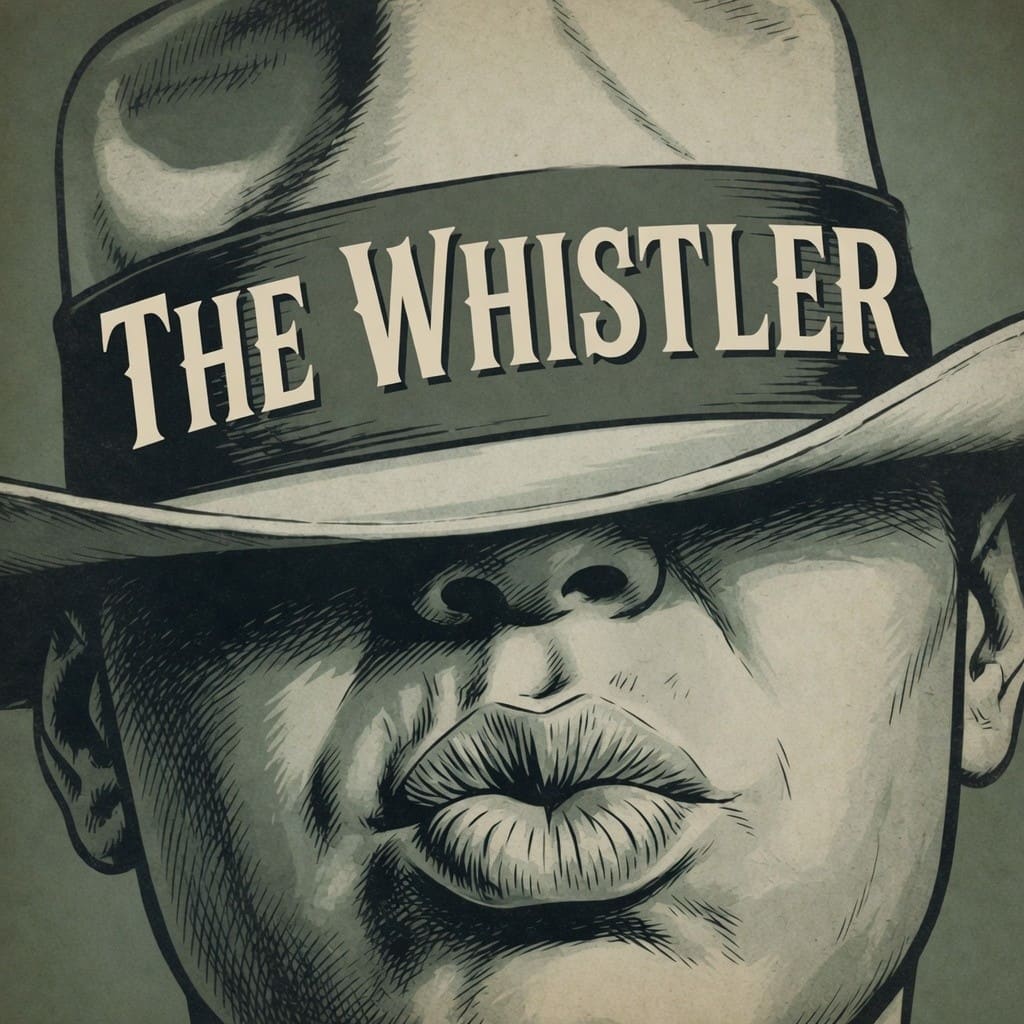
I am the Whistler, and I know many things before I walk by night. I know many strange tales hidden in the hearts of men and women who have stepped into the shadows. Yes, I know the nameless terrors of which they dare not speak. Tonight transcribed, it's the Whistler's strange story, A Woman's Privilege. In the drawing room of a Palatial Roman uterus hang a pair of priceless oil paintings, one of an Italian nobleman, the other his wife. The surfaces are cracked, the frames old and wormy, but the colors are fresh and brilliant as if they were painted yesterday. And there's a story in back of these paintings, a story that began with a traveling art broker named John Winters, of a casual trip to the picturesque Italian seaport of Venice, of the unbelievable, stunning moment in his hotel room when a quiet little artist named Julio Donate put a quarter of a million dollars in the palm of his hand. Well, Signor Winters, what do you think? Well, it's pretty hard to believe. Of course. So you will agree that I am giving it to you for almost nothing when I ask only $75,000? Seventy-five thousand for an original Montagnier. What's wrong with it? Still skeptical, eh? You're very hard to convince, Signor Winters. Suppose I leave it with you for, say, twenty-four hours so you can examine it closely. You're pretty sure of yourself, don't you? Well, there will be many, Signor, who will say it's Montagnier's best work. I'd agree with them. It is. What's funny about that? You flatter me. Huh? You see, I painted it myself. What? But the technique, the style... They were difficult to master. The oils are very hard to find and the aging of process. Eh, Signor, it was hard work, but you see, it had its reward. Is this the only one? No, I completed a pair. The other was sent a week ago to a New York broker, C. L. Brickley. I expect to hear from him tomorrow. Does he know about this one? Well, of course. I informed him in a confidential letter. I should think you'd keep it under your hat. Forgery's serious business. Oh, please, please. They are not forgeries. I claim only to paint in the manner of Montagnier. Had I intended to pawn off a forgery, would I have been so frank? Yes, but you know what's going to happen. Miss Brickley will peddle that picture as an original. Eh, Signor, what you people do with my paintings is your own business. I'm an artist, not a forger. However, I think, I think you will find me discreet enough. Now I, I must go. You told me over here in Switzerland just for this. Now wait a minute, Potter. I'll tell you again. It's the McCoy, an original Montagnier. He's pulling your leg. No one in his right mind would let a Montagnier go for 75,000. I told you he doesn't know what he's got. The artist only produced 35 paintings in his life. They're all catalog winners. There's no such thing as... I saw it with my own eyes. Are you telling me I don't know a Montagnier when I see one? And what about this Brickley? He bought the mate to it. But John, I just can't believe... All right, Potter. You don't want to advance me the money? There are plenty of others. Oh, don't do that. All right, John, it's a deal. Call me when you've closed and I'll wire the money. Ah, that's better. You'll hear from me in a couple of hours. Well, John, Donati was right, wasn't he? Your mind is whirling with figures as you hang up the phone. Hurry across town toward the address Donati left you, the little shop in the Plaza Flanquist. Yes, there's over a quarter of a million dollars in that briefcase under your arm, provided that the three people in the world who know the truth are discreet. That's the only gamble at his job. You and Donati and Brickley, the New York broker. With three who know, there's always a chance one might talk. You turn a corner into the Plaza, wondering if Brickley had just thought of that one. And the answer comes suddenly. A crowd is gathered at the front of Donati's shop. What's the matter? What happened here? Give it back, please. What is it, officer? What happened? Well, prior to the shop, Signor Donati was shot. Is this you, Potter? Yes, John, go ahead. And it looks like the deal's off. What happened? We were a little late. Brickley got there first, huh? Yeah, Brickley got there first. Thanks for the offer, Potter, but I won't need the money now. I'm on my way to New York. In just a minute, the Whistler will continue tonight's story. All of us are proud of our hometowns and rightly so. In this brief moment before we continue with our program, we'd like to offer a salute to one of our hometowns in America, New York City, hometown to more people than any other in the world. Its history is pretty well known, how it was supposedly bought for $24 worth of trinkets from the Indians, how it started under the Dutch, went to the British, and passed to the young United States after the Revolutionary War. It was our national capital for five years, and George Washington was inaugurated there. Today, it's not only the biggest, but probably the busiest and noisiest place in the world. Much of its growth and prosperity is due to New York Harbor. The port clears more than 5,000 vessels a year and ships almost half of the entire trade of the United States. But New York City is many things to many people. It's not just San Francisco multiplied by 10 or Chicago multiplied by three. It's Wall Street in Harlem, the Statue of Liberty in Greenwich Village. It's Broadway, otherwise known as the main stem or the Great White Way. More theaters are crowded in that area than any place in the world. It's the Empire State Building, the world's tallest structure. It's a parade up Fifth Avenue and a baseball game between the New York Yankees and the Brooklyn Dodgers. It's the Metropolitan Opera and Madison Square Garden. It's Rockefeller Center occupying 12 acres and 15 buildings, and it's the headquarters of the United Nations. It's the native New Yorker who never moves off his block and the immigrant who came from halfway around the world. It's the George Washington Bridge and the Holland Tunnel and Grant's Tomb. And when you've said all this, you've still only scraped the surface of what New York is like, what it's all about. But one thing is for sure, the people of New York are proud of their hometown and proud of the part it has played in the building of America. And now back to the Whistler. It's only three days from Venice to New York, and in your suitcase is a masterful piece of forgery sewed in its lining that will bring at least a quarter million on the American market. Yes, Donati was clever, wasn't he, Tom? Too clever. And to you at least, it's clear that this Brickley, whoever he is, knew that a clean deal could never be made if the secret of the forgery were shared. And that, of course, added up to Donati's murder. You have a surprise for Brickley, haven't you, John? But you know you have to be careful. On the afternoon of your arrival in New York, you walk down the corridor of an apartment building in the East Seventies. Pause and press the buzzer. Yes? I'm looking for Mr. C.L. Brickley. Oh, what did you want to see Mr. Brickley about? Well, it's a personal matter. Is he in? Just what is it you're selling, Mr.... Winters, John Winters. Well, I'm really not selling anything. Yes, the suit does need pressing, but it's really not that bad, Mrs.... Brickley. Oh, his daughter? I'm C.L. Brickley. What? Himself. Well, a woman. Mm-hmm, but a woman who is not interested in a vacuum cleaner at the moment. Perhaps some other time, Mr. Winters. All right, Miss Brickley, have it your way. A friend of mine told me you had a picture or two that might interest me. Wait a minute. What kind of a picture? Well, I'm collecting Italian Renaissance. You? Yes, C.L., I've got 11 other suits. If I'd known I was calling in such a beautiful business, man. I'm sorry, Mr. Winters. Please, come here. Shall I bring my vacuum cleaner? No charge for the demonstration. I said I'm sorry. Come on in. Please, sit down. Thank you. Is this your place of business? Yes, I'm a broker, Mr. Winters. I see. You mentioned Italian Renaissance. What did you have in mind? Oh, Venetian school in particular. Oh. You know, of course, that authentic Venetian things run a little high. How high? Three hundred thousand dollars. That's high enough. What is it? A mountaineer. Now, wait a minute. I know, I know. It's hard to believe. It came to light during the war. I was very lucky. You're positive it's authentic? I only want to see it. Oh, that won't be necessary. Let me check my briefcase here. Well, I have the picture in my safe. Just a minute. Here we are. Oh. How do you like this one? Where did you get that? Same place you got yours, Miss Brickley. Same artist, same convincing technique. Who are you? Winters. The name's Winters. That's not what I mean. Where'd you come from? Don't worry about me, lady. I'm authentic. I stick to the mountaineers. All right, Mr. Winters. Just how many of these are floating around? Two. And how many know about the two? You and me. That is, since you took care of Donati. Oh, now that's a little cruel. All right, so you had it done. What's the difference? That still leaves two. You'd be smart enough not to give the hired help your reasons. You've got it all figured out, haven't you? Well, it's water over the dam. Let's talk about the pictures. We're hooked with each other, you know that. Ha ha ha. That might not be so bad, Mr. Winters. Better make it John. All right, John. You know, we've got a lot to talk over, C.L. I know. But since you're not quite the kind of a guy I expected to meet, why don't we switch the conference to a nightclub? I'd like that. Okay. Pick you up around eight? Fine. And I'll see you. You don't dance at all like a structure. You like? I like. She is beautiful, isn't she, John? Slim, graceful. The satin of her evening gown clinging to her like a glistening white sheet. And for the moment, you forget everything else. The Montanions, the half million, the wealthy clients, everything. Everything, that is, except that you're dealing with a killer who's as sure as you are that those paintings can never be sold as long as there are two minds in the world who know they're forgery. If only she weren't so breathtaking, so beautiful. Beautiful. And what about the other two? Not at the business conference. Oh, that again. Yes, that again. They're pretty hard to find, you know. People who put out a half a million for a pair of paintings. I put out a couple of feelers before you arrived. I beg your pardon, Miss Brickley. There's a call for you, a Mr. Gross. Mr. Gross? What? Who's Mr. Gross? He's one of the clients I've been telling you about. He said it was quite important then. I'll be right back. And no matter how much you tell yourself that business is business, the feeling's still there the next morning when you call on her again at her apartment. You pause for a moment before you knock. Decide once again that nothing must stand in the way of the picture deal and the half million dollars. Well, hello, partner. Partner? Any objections? I didn't know I'd made the grade. Oh, you have, definitely. Oh, you've... Come in, I've got something to show you. Thanks. I expect to find you in a laboratory, Avery. What's going on? Hey, what's this? My laboratory, I've been busy putting your Montagnu over the jumps. Jumps? Mm-hmm, photographed it three ways. X-ray, ultraviolet, infrared. The negatives over there on the rag drawing. Well. Then I checked the colors with alcohol. Was a clever man. Was. If you insist. Mm, Donati was a clever man. Don't you think you might have been a little hasty in letting him go? Still accusing him. Cigarette? Mm, thanks. Well, what's next on the program, beautiful? Mr. Gross? I don't know, John. What do you mean you don't know? You're not getting cold feet, are you? You said he was a client. He called us. Well, I know. Well, that's good enough for me. Make an appointment with a guy for me. I want to show you. John, I... I don't know why I'm saying this. What? We could be awfully good friends. We'll discuss that. That length after you get the pictures. Pictures? What for? Well, wrap them up, darling. I'm going down to the Pennsylvania station. Yes, sir. I want to check this package. John, what are you doing? Just a minute, Marie. Here. Here you are, clerk. Ten dollars. Ten? What do I do? Just give me the claim check. Okay. There you are. Now watch. I tear it in half. See? Here, Lorraine. That's yours. What are you doing? Wait a minute, Mr. Iver. I put a note on the package. You deliver it only when both halves of the claim check are presented. Get it? But that's scrowing. Wait a minute. Ten bucks. Okay, Mr. You're the boss. Thanks. Come on, Lorraine. Frame one-fourth arriving frac A. Frame one-fourth arriving frac A. You know, I think this is all pretty silly. Maybe it is. But I'll just trust you a lot more after you fix up that appointment for me with your friend, Mr. Gross. How soon can you make it? I don't know, John. I'm not sure. Let me handle it then. When can you get hold of him? I'll call him tomorrow. It isn't easy, is it, John? You leave her standing there in the station, fighting to get her out of your mind and your heart, knowing that you must never let her come between you and the business at hand. The appointment with Mr. Gross. The next evening you go to her apartment, determined to see it through. As you walk down the hall, the door is open slightly. No! You hear her talking on the telephone. There isn't going to be any deal, Mr. Gross. You stop still and listen. Forget I ever told you to come here at eleven. It's off. Yes, I know what I told you, but that was before us. Well, it's different now. I'm changing my plan. Is that right? It's got to be this way for the present. Right. Goodbye. You stand there for a full minute, thinking. Then make up your mind. Two can play that kind of a game, can't they, John? And you know the one who wins is the one who gets there first. Yes? It's me, C.L., your partner. Oh, John, come in. Where have you been all day? Why don't you call a guy? I've been waiting to hear from you. Did you get a hold of Gross? Yes. He's not interested, John. Funny. That looked like a sure thing, didn't it? Guy has money, crazy about Italian pictures. Well, there'll be others. Sure. I've got the car outside. It's a nice night. I thought you might like to go for a drive. Sounds wonderful. Maybe over to Jersey, across the George Washington Bridge. I'll get my coat. I'll only be a minute. Well, take your time. No hurry. It doesn't take long, does it, John, now that you've made up your mind. Just a few miles of riding and talking idly, with the automatic hidden down beside you in the seat. Occasionally you glance from the road at her beautiful face in the moonlight. That's something you'll never forget, that face, with the moonlight working magic with her hair. It even looked beautiful a half hour later, when you looked at it for the last time. Only then it was very still, with a quiet wax-like beauty of death. An hour later you drop the automatic into the river, and you're back in her apartment with both hands of the claim check in your pocket, as you go through the wastebasket next to the telephone. Where did you put it? Ah, here it is. Yes, a little slip of paper and a telephone number with the name Gross. Hello? Mr. Gross? He'll be back in a minute. I'm calling for C.L. Brickley. Give him a message for me, will you? Go ahead. Miss Brickley says the appointment is back on. She changed her mind. Don't be half right. Use usophe. For example, would you say that hydrogen, the lightest known substance, is 75,000 times lighter than mercury? No, that's only half right. Brush up on your chemistry. Tell your I.D. officer you want to study with the United States Armed Forces Institute, USOPHE. It's easy. It's simple. If you don't want to be half right, use USOPHE. And now back to the Whistler. Yes, it was a long trail that finally ended in a police station near the East River, a trail that began in Venice with an artist who painted a pair of pictures in the Manor of Montaigne and died because of them. Lieutenant Brady of Homicide has done his job now. The suspect has finally begun to crack. Stop it, will you? Stop it! All right, I'll stop it. You ready to talk? Yeah, yeah, I'll talk. Turn off the light. All right, let's have it, Mr. Gross. The guy in Italy, Donati, I killed him for her. Money? Yeah. What else? Why did you want him dead? I don't know why I didn't ask questions. She sent me over there to get him and I did. When I got back, she called me and said there was one more. Money again, huh? Yeah, but she called up the night it was supposed to happen and said it was off. I went out and when I got back there was a call that was on again. That's why I came by for him. He was waiting there in front of the apartment, big as life. And that's how you happened to murder John Winters. That's it. I guess the brickly dame changed her mind. Now, a question. Do you know how the Navy's custom of piping over the side began? In the early days of the Navy, when commanders visited one another at sea, they found boarding the gangway in rough weather a bit difficult, so they were hoisted up the ship's side in a net or basket. Several members of the crew, or side boys, would be summoned to assist, the number varying according to the weight and agility of the boarding officer. The pipe was sounded for hoist away and a vast heaving. In time, however, piping over the side became a simple ritual of courtesy for a boarding officer, and so it has remained to the present time. This is but one of many interesting facts which can be found in the history of your United States Navy. The Whistler, directed by Sterling Tracy with music by Wilbur Hatch, is produced by Joel Malone and transmitted overseas by the Armed Forces Radio Service. Tonight's Whistler was written by Joel Malone and Harold Swanson. The Whistler was entirely fictional, and all characters portrayed on the Whistler are also fictional. Any similarities of names or resemblances to persons living or dead is purely coincidental. This is George Walsh speaking and reminding you to listen again next week for another Strange Tale Wide on Whistler. Thank you for watching!