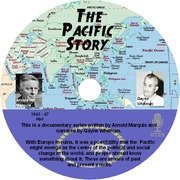
The National Broadcasting Company and its affiliated stations present the Pacific Story. This is the story of the Pacific, a drama of the millions of people who live around this greatest sea, where the United States is now committed to a long-term policy of keeping the peace. This, as another public service of the National Broadcasting Company, is the background story of the events in the Pacific and their meaning to us and to the generations to come. The menace of Japan's old order. This much is sure, you'll never eliminate the danger of Japan until you eliminate Japan's old order. Japan's old order is the men and the institutions that promoted the war in the Pacific. It is the men who have been running Japan and the way they have been running it. It's the Zaibatsu, the clique of powerful families that have run Japan's industry and commerce for generations. It's the men who shaped the government's policies and controlled the military for the last quarter century. It's the Minto Go, it's the emperor and all he stands for. On the day Japan surrendered, a group of young army officers killed a general in command of Hirohito's personal guard, threw a cordon around the Imperial Palace, and tried to capture the emperor's rescript to prevent it from being proclaimed to the world. This was the old order. We hope that peace will last for 20 years. Then we will be back again. This is the old order too. Lieutenant General Itagaki at the surrender of Singapore. We have stopped fighting because the emperor asked us to. This is the old order. The opinion of the Japanese men in the street. The emperor is infallible. He decided to end the war to save us from privation and misery. Such is his benevolence. And this is the old order. Regard for the emperor and all he stands for. It has taken years to develop this order. It is in the warp and woof of Japanese life. We have bowed to the enemy's material and scientific power. But in spiritual power we have not lost. Let us unite and work to bring our nation up as a strong and admirable nation. We have not lost. This is only temporary. This is an expression of the thinking, the point of view spawned over the course of years by the old order. By the industrial and commercial families. The Mitsubishis, the Mitsui, the Sumitomos, the Asudas and the others. By the Shinto code and by militarists and bureaucrats. Men like Sadao Araki. The Japanese army is the army of his imperial majesty. It is led by the emperor himself. Sadao Araki inspired the young Japanese to fight to dominate the world. You are the messengers of world peace. His oratory molded them into crusaders for the emperor. If your obedience is achieved simply through the threat of army discipline, the power of the army on the battlefield will never be fully developed. You officers and you men must mutually believe that you are the soldiers of the son of heaven. You must believe that the orders issued to you are in reality the expression of the imperial order of the emperor. I talked with Araki. He linked the mission of the Japanese soldier directly to the myth of the emperor. Let the fire in you blaze and show you the way. Araki had profound influence in the old order and so also did Kenji Doihara. Doihara was called the Lawrence of Asia. Let this observer who knows Asia tell you about him. Doihara speaks Chinese as well as he speaks Japanese. He's a smooth back of the scenes operator. His fort is making friends whom he can use to the advantage of Japan. But friendship with Doihara has meant death to those he duped. Not by Doihara but by those betrayed. The Chinese knew him well. I saw him once in Mongolia disguised as a monk and I saw him in Manchuria disguised as a pedlar. Many people claim to have seen him in many parts of Asia. He worms his way into the confidence of everyone, officials, soldiers, anyone he can use. He always had plenty of money at his disposal and he used it freely. In the years before 1931, Doihara took the trouble to learn firsthand all about China and the Chinese. He traveled extensively behind the scenes. In 1931 when he was a colonel, he was chief of the special service division. Special service. He was the one who engineered the Bukten incident. At that time he worked hand in glove with Lieutenant General Sashiro Itagaki, who was also a colonel at that time, and with General Toshizo Nishio. Nishio was then in charge of the army press bureau in Tokyo. These were the unholy three. Nishio, Itagaki, and Doihara. The Japanese garrison in Manchuria attacked the Chinese on the pretext that a group of Chinese had torn up a section of the South Manchuria railway. The Japanese seized Bukten. More incidents developed. Doihara engineered them. The Japanese occupied all of Manchuria. Not long after the outbreak, Doihara showed up at Harbin and took over the city. Yes, and it was just about that time that he visited Puyi at the ensign, disguised as a Manchurian nobleman, and asked Puyi, in the name of the ancient Manchus, to return to the throne of Manchuria. He went away for a time and then came back and kidnapped Puyi and took him across the Yellow Sea to Diron. The Chinese say he is also the one who engineered the incident of the Marco Polo bridge that started the war in China, and that he had a hand in the planning of the attack at Pearl Harbor. Today, Doihara is a general. After the suicide of Field Marshal General Sugiyama on September 9, Doihara was named commander of the new Japanese First Army, and on being sent by the Japanese to Lieutenant General Robert L. Eichelberger's headquarters, he made a statement. I will bend every effort to cooperate with the Americans and to facilitate their occupation. He played his role with all the smoothness that has characterized his entire career, but hardly had he assumed his new post when by order of General MacArthur, he was arrested. General Niccio is another name to remember. I talked with Niccio, that is, as much as anybody could talk with him. He was silent most of the time, taciturn. Doihara was amiable, easy to get along with, in conversation. But not Niccio, you never knew what he thought about anything. He looked at you as if you didn't exist. He answered your questions in monosyllables, made you uneasy. This was his natural manner. But I always had the feeling he made a point of making the most of it. Niccio asked to be sent to Manchuria. He looked over Manchuria as coldly as a feudal lord, looking over newly acquired lands and resources. He saw Manchuria as Japan's future base of operations on the mainland of Asia. He was one of the policy makers of Manchuria. He thought of Manchuria only in terms of its military value and the plan of aggression that he had in mind. Doihara and Ditigaki joined him in Manchuria. And together, these three became the nucleus of power in the Guandung Army, which was to be in turn the nucleus of power of the entire Imperial Army. We must control all the key positions in the government. This was Niccio. We must have the same complete control in the other departments as we have through the Minister of War. The Minister of War has direct access to the emperor. And he's the only member of the cabinet, except the minister of the navy, who has this privilege. We must be in a position to control the cabinet or force it to collapse. But, General, I am a new soldier. You have a command, Colonel Ditigaki. Use it. Niccio and the Guandung Army expected big things of Ditigaki in the field. They were disappointed. His fighting command in China was trapped, and 25,000 Japanese fell in the battle. I told you, General Niccio, I am a new soldier. You must not think of... No, no, you need not try to convince me. My spirit shall be of greater value to Japan than my body. No, Colonel Ditigaki, each of us serves in his own way. We are not thinking of you as a commander of troops. You are of great value. Leave the fighting to us. Niccio saw the value of Ditigaki. He knew that he was one of the smartest Japanese of the old order. He saw that he had gifts that made him more valuable or more dangerous than a soldier. We wondered what Niccio would do, and we found out. General Niccio has been called back to Tokyo, and Ditigaki has been appointed to succeed him. As chief of staff of the Guandung Army? Yes, as chief of staff. We couldn't see Ditigaki in that spot. But we soon learned that Ditigaki had other talents, indeed. He named Kuniyaki Koiso to his staff. Koiso was later to become premier. And as head of the Guandung Army's military police and espionage, he named Tojo, who also was later to become premier. Ditigaki has changed the name of Manchuria to Manjokuo. Well, they've finally done it. Yes, and he is going to set it up as a puppet state with Henley Puyi as emperor. Meantime, another Japanese was rising to power among the stalwarts of the old order in Manchuria. Hingoro Hashimoto. Our sublime mission is to dominate the world. These were his exact words. You must take it upon yourselves to chop off the head of any individual, whether he is a public figure or a private citizen, who dares to stand in the way of your divine mission. He framed the young firebrands in Manchuria, and they swore their loyalty and determination. I swear to behead any individual who seeks to thwart our mission. I swear to have no contact, whatever, with foreigners or their thoughts. I swear to devote my life to the Japanese domination of the world. Under Hashimoto, murder became a method. The young officers he trained suspected not only foreigners and public officials, but private citizens. He burned his stamp into the souls of the young Japanese under his command. December 1937, the Japanese were driving on Nanking. Hashimoto was in command of the shore batteries along the Yangtze. There are still some foreign ships in the river below us, Colonel Hashimoto. Oh, yes. What is that gunboat down there, Major? That is the American gunboat Panay. And what of those other ships? Freighters? Yes, sir. Here, take these binoculars. Uh-huh. American and British cargo ships? Yes, sir. Our intelligence from the merchant ships is that they say that the Yangtze is not our Japanese dream, and they will not leave until they have completed their business. Our orders are to clear the river of shipping. Does that mean Chinese shipping or all shipping? The order says clear the river of shipping. Take the necessary action, Major. Use airplanes and the shore batteries. And that order, Colonel King Goro Hashimoto, made history. The sinking of the Panay brought Japan to the brink of war with the United States. This frightened many Japanese, even the most ardent militarists. This was not the time for Japan to be precipitated into war with the United States. Japan was not ready. The incident was closed. But among the militarists, Hashimoto had one high regard. Hereafter, he was to be important. Meantime, Itagaki's work in Manchuria had been outstanding. He was called back to Tokyo to become Minister of War, and he called back Tojo, made him Vice Minister of War, and requested him to carry on in Japan the same sort of policing and espionage that he had directed so well in Manchuria. One day, Tojo's espionage dragnet came up with a bigger catch than he had ever bargained for. They plotted to murder Admiral Yonai. Admiral Yonai? The Premier? Yes. They were all ready to strike when we took them. They are now in jail. All of them, all except the leader. Who is he? Hashimoto. Hashimoto? Admiral Yonai, the Premier, learned that Hashimoto, whom he knew well, was the arch-conspirator. Yonai was uneasy for days, but Hashimoto walked around scot-free. Well, nine days later, the resignation of Yonai was announced. They all kept close watch to see what would be done about Hashimoto. Wasn't long before Prince Konoe issued a statement. Therefore, by an election, Kengoro Hashimoto is named head of the committee to draft the new political and economic structure of Greater Japan. The direction of the committee would be in the hands of Hashimoto, and he will, of course... This was the old order. Konoe was Premier, but the power behind the throne was the army clique. Nishio and Itagaki still pulled the strings. By 1941, they had worked together for ten years, and when Konoe's government fell, they made their influence tell. We must see that the Premier is appointed whom we can trust without question of doubt. It must be a man strong enough to control the cabinet. Whom do you have in mind? It can only be Hideki Tojo. Tojo became Premier. By special act of the Emperor, he retained his post as Army Chief of Staff. It was Tojo who took Japan into the war against the United States, the crowning achievement of the old order. The old order had won control of the government, had won the approval of the Emperor to have a Premier who was also Chief of Staff, and was able to announce, as Tojo did to the Japanese Empire on the day of Pearl Harbor, that... The Emperor has a declared war on the United States and Great Britain. Tojo had come up through the ranks of the old order as the other war makers had. He indoctrinated the army with his hate. He gave his soldiers something to shoot at. Japan is determined to destroy the United States and Britain. Tojo did his utmost for nearly three years. But even when his cabinet fell, another disciple of the old order, the man Tojo had made a member of his staff back in the days of the Manchurian adventure, Kuniyaki Pueso, was named to succeed him as Premier. The old order was still in power. Kuniyaki Pueso was no different from the others. He had been Chief Secretary to the Supreme War Council, Vice Minister of War, and Governor of Korea. He surrounded himself with a set of the same militarists and bureaucrats that had come up to power with him. General Sugiyama, one of Japan's arch-militarists, had been identified with every Japanese aggression from the Mukden incident of Pearl Harbor, became war minister in Pueso's cabinet. And this same General Sugiyama was to be one of the first to kill himself after the surrender of Japan. The Tojo government had made way for the Kowiso government, but Japan was still in the hands of the same clique, and Kowiso made no bones about it. We will further strengthen our ties with Germany, and we will befriend the neutral countries in order that they may offer positive cooperation with Japan. But the old order is not only these men. Kowiso, Tojo, Itagaki, Nishio, Hashimoto, Doihara, Araki, and men like that. But it is also career soldiers like Tomoyuki, Yamashita, and career diplomats like Mamoru Ashikimitsu. It is these men and all the men like them and the institutions they have used that is the menace of the old order. The Privy Council is one of the institutions of the old order. It is a telling force in Japanese affairs. During the war, there were 20 members in the Privy Council. These are the words of Admiral Nomura, who was in Washington, D.C. at the time of Pearl Harbor, and who was a member of the council. The Privy Council is composed of yes men. But yes men for whom? Well, the Privy Council is composed of important generals, admirals, important politicians, and a few civilian experts in various fields. I asked the Japanese how the members were selected. They are chosen by the Premier. That means the Premier can pretty well choose the men he wants. He must consult with what advisors, of course, and the cabinet and the Privy Council itself. And the men in power have control over the Privy Council. In the sense that they can control its membership, yes. Now, would that mean that if a general were Premier, that the Privy Council might be inclined to be, well, pro-army? The Privy Council has been pro-army for years. The Privy Council is the instrument of the Japanese in power. Its formal reason for being is to advise the Emperor on state affairs and to advise the Premier in this cabinet. But the members of the Council being handpicked give the kind of advice the men in power wish. This is the explanation of Admiral Nomura's statement. The Privy Council is composed of yes men. The Emperor calls the Council to session at the request of the Premier. And to itself, the Council arrogates certain prerogatives, as in the matter of the 5-5-3 naval ratio in the London Treaty of 1930. Mr. Hamaguchi, is it true that you have accepted the 5-5-3 naval ratio? Yes, it is true. Japan's naval strength will be limited in the ratio of 3 to 5, 3 for Japan and 5 each for the United States and Britain. This is an outrage. How dare the civil authority defy the army and navy on matters of national defense? The people of Japan and the press of Japan are behind us. You have exceeded your powers, Mr. Hamaguchi. You are assuming that you have the right to control the entire foreign policy of Japan. You have violated the rights of the Privy Council to lay the facts before the Emperor before a decision is made. The Privy Council has still to ratify the treaty. It will not be ratified. It is a disgrace that Japan should enter into a naval treaty which limits us to a ratio of 3 to 5 in favor of the United States and Britain. The people favored the ratification of the treaty. The press favored it. Even some members of the cabinet favored it. In fact, nearly all of Japan favored it except the Privy Council. The Council blocked it for five months and only because of the great pressure for it was it at last ratified. The militarists of the old order were forced to back down. But the old order made known its sinister power and what it stood for in another way. Hamaguchi was murdered. The Privy Council in the words of the Japanese is... The highest body for imperial consultation on important political affairs. As such, the war could only be plotted with the consent and the help of the Privy Council. For the Privy Council is above and beyond the common people. It is indeed the instrument of the men in power. During the war, the Council met every week. How often it met in the years immediately before the war while the war was being plotted is not known. But unless it aided and abetted the plot, there could have been no war. As the Privy Council is part of the imperial system, so also is the Imperial Household Department. I talked with the Imperial Household Minister who manages the affairs of the palace. The Imperial Household Department, of course, has a no connection. What about with state affairs? Yes, so I understand. But just what does it infuse? There are a number of bureaus in the Household Department. We have, for example, a Bureau of the Treasury. We have a Bureau of the Foreign, a Bureau of Imperial Archives, a Bureau of Architecture, a Bureau of Poetry, a Bureau of Agnetical Affairs, a Bureau of Imperial Tools, and a Bureau of Culinary Affairs, and so on. And there is a staff for each of these bureaus? Oh yes, a staff for each. You must understand, of course, that the Imperial Court has investments in various banks and industrial companies. How extensive are these investments? Quite extensive, and out of the income from these sources, the households of the Crown Prince and of all the Imperial Princes are supported, but all the monies are not spent on the Imperial Household Department. Considerable sums are given each year to encourage art and education, which, as you know, are the chief interests of the Emperor. The Imperial Household Department is virtually a state within itself, and well it may be, but with its numberless officials and staffs and blackies and servants, with its vast and almost fabulous estates, the Japanese Imperial family is perhaps the richest on earth. And heading this private domain, as well as being the head of the state, is the Emperor. Not only the Imperial Army, but the entire nation regard our Emperor as a living God. For us, it is not a question of historical or scientific accuracy, it is an article of national faith. These are the words of General Senjuro Hiyoshi, another of Japan's old order. And while all Japan and Japanese do not regard the Emperor as a living God, most do regard him as symbolic of divinity and infallibility. Thus, the words of his surrendery script have special significance. The war situation has developed not necessarily to Japan's advantage. The Emperor made no admission of defeat or surrender. We have decided to effect a settlement of the present situation. The situation in Japan after the two atomic bombs had fallen. Indeed, we declared war on America and Britain out of our sincere desire to ensure Japan's self-preservation and stability in East Asia. It being far from our thoughts, either to infringe upon the sovereignty of other nations or to embark upon territorial aggression. Thus, the Emperor whitewashed Japan's motives. We have been able to save and maintain the Imperial States. Thus, in his re-script, the Emperor reassured his 70 million subjects. As the full weight of the occupation becomes felt, the power of the old order diminishes. Some of the leaders of the old order have taken their lives. Others would be tried as war criminals. But the old order is more than the men who made the war. It is also the institutions which have formulated their thinking. To change this philosophy implies many things. To rule out the old order, not merely to submerge it, means that the basic institutions of Japan must be changed. The old order in Japan cannot at once be extirpated any more than democracy could at once be extirpated. As for the men of the old order, even those who are not regarded as war criminals, their fundamental thinking cannot be changed. The same is true of most of the people who are led by these leaders of the old order. The start must be made with the younger elements. Education must be revised around the principle that the state is a completely man-made entity, not something having absolute existence above the will of man. The people must have the opportunity to learn that the sovereign right is not a mystic and transcendent power that has been inherited from ancestral gods. The people must be educated to know that the sovereign right is owned by the people themselves and must be administered by the will of the people. This is the opinion of an American educator. And because of the price the United States has paid in the Pacific and the concern of the American people for the future of the Pacific, the opinions of Americans as to Japan are now crystallizing into definite form. The Privy Council should be abolished. It should be ended completely. The Imperial Household Department should be abolished. And only a small secretarial staff furnished the throne. The theory and practice of government which places the emperor above all law must be completely eliminated. These are the opinions of informed Americans. This much is sure. You'll never eliminate the danger of Japan until you eliminate Japan's old order. That means the men who have shaped the government's policies and control the military, the taibatsu, the clique of powerful families that have been running Japan's industry and commerce, the Shinto cult and the emperor and all he stands for. The peace in the Pacific and perhaps of the world is linked directly with what happens to Japan's old order. You have been listening to the Pacific Story presented by the National Broadcasting Company and its affiliated independent stations as a public service to clarify events in the Pacific and to make understandable the cross currents of life in the Pacific Basin. For a reprint of this Pacific Story program, send ten cents in stamps or coin to University of California Press, Berkeley, California. May I repeat? For a reprint of this Pacific Story program, send ten cents in stamps or coin to University of California Press, Berkeley, California. The Pacific Story is written and directed by Arnold Marquis. The original musical score was composed and conducted by Thomas Paluso. Your narrator, Gain Whitman. Programs in this series of particular interest to servicemen and women are broadcast overseas through the worldwide facilities of the Armed Forces Radio Service. This program came to you from Hollywood. This is the National Broadcasting Company.