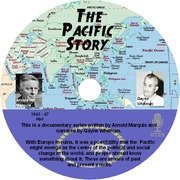
National Broadcasting Company and its affiliated stations present The Pacific Story. 🎵Music🎵 In the mounting fury of world conflict, events in the Pacific are taking on ever greater importance. Here is the story of the Pacific and the millions of people who live around this greatest sea. the drama of the peoples whose destiny is at stake in the Pacific War. Here, as another public service, is the tale of the war in the Pacific and its meaning to us and to the generations to come. Honshu, heart of Japan. If Takuchi is still living when the war is over, you'll hear of him. He will probably have a good deal to do with the government. Takuchi is on our side. Mr. Nason, that great plane below us there will be the battlefield. I remember Takuchi saying, that as we stood near the summit of Fujiyama, that the great war will be over. Tokyo will be destroyed and with it will pass all that I have been fighting these many years. Takuchi saw what was coming. We used to talk about it on the long walks we took. It was the time of Yami Barake, mountain opening time. Fujiyama and the other sacred peaks were closed during the winter. When the opening was announced, we made preparations to climb the mountain. We were prepared to go to the top of the mountain. When the opening was announced, we made preparations to climb Fujiyama and see the religious ceremonies at the shrine. We got our gear together, bought a few extra things in Yokohama, and hiked up the mountain. I love Japan, Mr. Nason. One of the things I remember best about Takuchi is the way he always said that. Japan has so much to give to the world. He talked of the elements that had risen to power in Japan. Sometimes I think that it is unfortunate that I have traveled so much. It has given me a different view. Yet I know that Japan as it is cannot survive. We must lose everything before we can find anything. For years, Takuchi had talked and written of democratic principles. He had seen others of his own thinking silenced. In 1936, he saw the assassination of a number of high Japanese by the firebrand of the Army. It was not that those who were assassinated were completely right, but it was that those who did the assassinating were wrong. We trudged up the mountain, up into the snow. It is like climbing this mountain. We stopped a moment. It is understandable to strive for the heights, but there is a way to do it. It is not forbidden to try to scale Fujisan in winter, but it is rush beyond all reason. There is a season and a way. Japan can be great within her own limits, and the season is when we have earned that greatness, and the way is the democratic way. We went on. As we neared the summit, it seemed that we were in a sea of mountains. You must remember, Mr. Nathan, that 85% of Japan is mountainous. We watched the priests perform the ceremonies, and when they were done and the many Japanese who had made the climb started down the mountain, we stood there, looking down over the Tokyo plain. That is where the Western powers will land. Must Japan go to war with us, Mr. Toguchi? It is inevitable. But certainly Japan will fight to keep the war away from her homeland. If she can. Standing there, I thought of the ring of strong bases around Japan. I remembered how the American military man visiting in Tokyo had told me that Japan had created an outer ring of bases to meet any enemy approaching from any direction. Several times, invasions had been tried. So she went about acquiring bases which we've got to realize she plans to use not only as defense bases, but possibly also as bases for aggression. Are you referring to places like Korea? Korea, yes. And all the others. The Kuril Islands and Sakhalin in the north and northeast. The Bornean Islands in the southeast. Formosa and the Pescadores in the south. And Korea and Gwandang in the west. And when this ring of defenses is broken, then the war will come to the very shores of Japan. There are only very few places where an anzada could land. And that plain down there around Tokyo is the best. It seemed incredible. The great rolling plain was a picture of peace. There was Tokyo, third city in the entire world, and 18 miles south of it, Yokohama. 14 million people live in that great metropolitan area. They call this metropolitan district the Kwanto. It is the most densely populated part of Japan. And one of the most densely populated places in the world. And yet, that is where the main fighting must be. The mountains are almost like an amphitheater about the great Tokyo plain. There will be fighting at other places too. Or Honshu will be a brace. And our five great cities will lie in ruin. I had a certain detachment from the things Takuchi said. For I had been in Japan only a few years, and he had been there most of his life. Yet as we stood there, I had the feeling that Takuchi was right. He had opposed the invasion and occupation of Manchuria. He had stood against the attack on China. And now, looking back, I know how he must have felt about Pearl Harbor. They will concentrate on Honshu. Honshu is the main island of Japan, the heart of the Japanese Empire. Mr. Nason, Japan can only be invaded by sea or by air. And because of the mountains, the invasion would have to come where the terrain permits. Like the Tokyo plain down there. Or near places like Osaka and Kobe. Or in the vicinity of Nagoya, where they could cut Honshu in two. Mr. Takuchi, you're assuming that Japan and the United States must go to war. We are heading directly for it. We started to walk down the mountain. Honshu is the island that will be hardest hit. It is the biggest island. It is the citadel of Japan. I remember a geographer saying that if you placed the island of Honshu off the east coast of the United States, it would extend from Cape Cod, Massachusetts, down to Cape Fear, North Carolina. And all along this great island are good harbors. The five big cities are all on the south or Pacific side of the island. All of these cities are all grouped around bays. Tokyo and Yokohama are on Tokyo Bay. Kobe and Osaka are on Osaka Bay. And Nagoya is on Matsuta Bay. All five of these cities are on relatively flat terrain. And the rest of Japan is so mountainous that parts of Honshu are called the Japanese Alps. So on Honshu are concentrated the most important cities in Japan and the greatest part of the population. The five cities will be blown to bits. But there are many more large cities in Japan. There are 45 cities of more than 100,000 in Japan. But only a few of these are out of the range, even of the brungs of battleships, to say nothing of airplanes. But to bomb Japan from the air would require bases. And except for Vladivostok, where could the bombers come from? Certainly the Philippines are too far away. Mr. Nathan, when the time comes, the United States would have bases. I tried to think of where those bases would be. I thought of China. But this was five years ago and we were not thinking in terms of B-29s and bases on Iwo Jima and Saipan and Okinawa, nor of aircraft carriers in terms of mass attack. You must remember that no part of Japan is more than 70 miles from the sea. Japan is long and narrow. To fly across Japan would only be a matter of minutes. Takuchi was right. Today the five cities have become the principal targets of our strategic air attacks on Japan. The fleet of 600 B-29s and fighters today spread 2,500 tons of explosives and firebombs on the great industrial centers of the island of Honshu. The massive fleet of super bombers... Before me now, as I tell this, I have a chart of Japan. I place another marker on Nagoya, 150 miles south of Tokyo. Nagoya is where the islands of Honshu may be cut in two. Takuchi said that the last time I saw him. I went down to see Nagoya. Nagoya is the center of Japan's textile industry. What is that there spinning there? That is wool. Australian wool. Australian wool. More than half of all the woolen made in Japan are made right here in Nagoya. Uh-huh. And where do you get your electric power? The best sources of hydroelectric power in all Japan are just north of us here. Is all of it used in the textile industries in Nagoya? Some changes are being made in industry here. What changes? We are expanding the industry in several directions for the sake of diversity. Yes. You see, we have a population here of almost the same as your Rosangiris. Our population is about one million and a quarter. And Rosangiris is about one million and a half. A million and a quarter people in Nagoya? It has grown very rapidly. Nagoya has an area of about 70 square miles. Los Angeles about 460 square miles. You see, we produce not only woolen, but also cotton and rayon and silk. I wondered why he had been so evasive about the industrial expansion of Nagoya. I found out. The military man told me that they were preparing for war. So they are in the process of conversion to wartime production. That's why so many of the buildings are temporary wooden structures. All the steel is going into the war industries. A lot of it is being used in a big Mitsubishi bomber plant right over there. They are beginning to knuckle down to the job before them. So Nagoya has become one of the important industrial centers of Japan. The blast furnaces and its steel mills were working day and night. A third of the workers were girls. Nagoya is not only important because of its industries, but also because of its strategic location. Its capture would mean that the Kinko to the south would be cut off from Tokyo. I could hear Takuchi saying that. I decided to go down to the Kinko district. The Kinko was once the center of Japan's light industry. The arts, the crafts, the novelties. Today it is Japan's war production center. Osaka has become the Pittsburgh of Japan. Kobe is the greatest port. There are a few ports in the entire world that can compare with Kobe. It was one of the most impressive waterfronts I've ever seen. You see that big industrial area there? It's the largest port in the world. You see that big industrial area there? Yes. That is the Mitsubishi dockyards and engine works. Mitsubishi is one of the powerful industrial family combines of Japan. It makes everything from airplanes to giant vessels. The dockyards were teeming with activity. Thousands upon thousands of men and women working on the ships. On these ways we can build vessels of any kind. Yes. Is that a battleship they're building there? Yes. That is a battleship. Powerful, isn't it? Yes. This yard and the Kawasaki yard that you see down there, both of these are used for naval construction. But of course Kobe must be thought of principally as a commercial port. 36% of all Japan's overseas trade goes out through Kobe. The great harbor was dotted with ships. Some coming, some going. Some anchored, waiting to get into a berth. You see our docking facilities are of the most modern. Yes. I've seen no finer docks or waterfront facilities anywhere. And beyond them, closely guarded with the engine plants. These marine engines will go into the ships that are being built in the various yards. You build your engines right here, eh? Practically next door to your shipyard. We have found this the most efficient arrangement. And what are those factories over there? Those are airplane engine factories. And those back there are steel mills. You make steel right here too? Yes. We make it where we use it. We need it for the ships. And we need it for our locomotives and railroad cars. That is the locomotive works right over there. I thought of Takuchi. Behind the city were the hills, which they called the Kobe Alps. Before it was broad Osaka Bay, stretching away to the southwest. The city itself was on a plane, as Takuchi had said, hemmed in by the other present mountains. How many people live here in Kobe? Oh, possibly between one million and one million and a half. A million or a million and a half people crowded into this city. And around it a hundred humming industries. Another big Japanese city facing the south. All of Japan's five big cities are on the south side of Honshu. That is because Honshu arrives like a great barrier to the continent of Asia for ships approaching from the east. They stop first in Japan, and most of them stop first here in Kobe. His words seemed almost prophetic in the light of what Takuchi had said. Because of the location of the five large cities, the greatest concentration of population and industry is on the south side. I recalled last day there that the geographer had said that the island of Honshu is a barrier to the sea lanes to the north of Asia. Just as Great Britain is a barrier to the sea lanes to the north of Europe. This is even more true when the Ryukyus, or the Okinawa chain, and Fumosa are considered. For with these islands, more than half of the approaches to Asia are commanded by the Japanese. Added to this from their greatest port, Kobe, and their greatest industrial center, Osaka, the Japanese have a landlocked passage through their inland sea to the Yellow Sea and the Sea of Japan. Therefore, the location of the island of Honshu has given the Japanese a peacetime advantage, but a wartime weakness for all their five big cities that are on the side facing the Pacific. Music Hardly a stone thrown north of Kobe is Osaka. On the chart before me, I place another marker on Osaka as I listen to the radio. Osaka's been hit again by a mighty concentration of B-29 bombers. I think of Osaka as it looked when last I saw it. 2,500 tons of bombs were dropped on the second city of Japan. 2,500 tons of bombs on a mighty concentration of war production plants and industrial slums. Takuchi was right. Music Yes, Osaka is a city of more than three and one half million, and it is still going. It's a city front on Osaka Bay and is built on a mud flat with the ever-present mountains in the background. Every Japanese lives in view of a mountain, but you see Osaka is crisscrossed with canals. I looked over at the canals, narrow, shallow waterways with sandpans and other small traps pushed by poles. The military men had said that Osaka is a poor man's Venice with Pittsburgh's atmosphere and cut up with narrow, dirty canals. There are some 40 miles of canals and waterways in Osaka and some 1,600 bridges. Some of the bridges are among the finest in the world. Beautiful triumphs of architecture, but many of them are ugly and ramshackle. And notice that there are very few wide modern streets. Most of the streets are so narrow they're hardly more than alleys. That's one reason why these sections of Osaka have been swept by fire so many times. But even after being burned down, they're usually rebuilt just as they were. The newer industries have been built around the outskirts, so the downtown district is really changing. Emphasis is on industrial production. You see there are many smokestacks? Yes, almost like a forest of them back there. It is said that there are 7,000 smokestacks in Osaka. How many factories are there here? Or possibly something under 5,000. 5,000. Many of them of course are home industries in which only a few persons work. But more than 3,000 of our factories here have more than 5 persons working in them. What is that building right up there near the castle? That? That is just the arsenal. I'll place a marker at that point on the chart before me. One of the prime targets of the B-29s was the Osaka Arsenal, the largest and most important arsenal in all Japan. Medium artillery and small arms, pistols, light machine guns, rifles, light mortars are manufactured here. The arsenal was hit directly several times. But in addition to our factories, we have our 250 banks. We even have an American bank here. You see it there? Yes. But in contrast to the modern buildings, but the old buildings, crude and clumsy buildings, many of them built of wood and brick veneer. Which district is the factory district? There is an old special district. I saw what he meant in the days that followed. All of Osaka, except the downtown business district, is industrial. Three quarters of the people live in an area 20 miles square, and the industry is all about them. The first waves of B-29s dropped high explosives. The succeeding waves dropped fire bombs. They hit the congested waterfront district, the war plants, and the thousands of home factories. Destruction of Osaka's industries would knock out Japan's most important... And through the port of Osaka here, we handle 24% of all Japan's overseas trade. I've never thought of Osaka as a port. Oh, originally it was or not. But we have dredged the harbor so that we are now able to accommodate vessels up to the very largest. As I stood there looking at the great ships coming and going, Takucha's words came back to me. Honshu is an island of good harbors. But we must remember that harbors can be used against us as well as for us. Tokyo, the Great Tokyo Plain By this time, the Great Tokyo Plain, the metropolitan area called the Kwanto, which Takucha pointed out from Fujiyama, has been hit with thousands of tons of explosives and incendiaries. Great parts of Tokyo and Yokohama have been blasted and burned. Yokohama was in flames and the smoke was four miles high. I read the report. Tokyo has been crippled as a nerve center of the Japanese war effort. As the reports come in, I place markers on Yokohama and Tokyo on the chart of Japan before me. The first stage would be bombing from the air. The second stage would be invasion. And the Tokyo Plain below us there will be the battleground. Yokohama is the second most important port in Japan. It is second only to Kobe. We stood near one of the big shipyards. You see, we have two big shipyards here. There were thousands of men working like ants over the great ships. I remember that Yokohama here had been almost completely destroyed by the earthquake less than 20 years before. The geographer who saw it said that even the harbor was destroyed when the bottom bulged up as a result of the earthquake. So since Yokohama is principally a port city, the harbor had to be dredged out before the city could be put back into operation. While crews were cleaning away the debris and constructing all the commercial buildings, other crews were getting the harbor ready. The Yokohama that exists today is a new city and the harbor is a new harbor. All those buildings you see along over there are new, the warehouses, the business houses, and all the others. They are very strong, built of concrete and steel. And you see that district up there? You pointed to a residential district on the hill. That is the foreign residential quarter. It was also rebuilt. It is all modern. Well, what about the Japanese residential districts? Oh, they are rebuilt as they were before. I saw these districts days later. They were the kind that burned so terribly in 1923 and which would burn again. And that is an automobile factory. We assemble the American automobiles here. Among the targets hit in the B-29 raid on Yokohama was the automobile plant, which since before Pearl Harbor has been turning out tanks, half-tracks, and heavy tractors. Other targets were the five oil refineries whose output is the largest in Japan. A Zato Railway is electric. It connects Yokohama with Tokyo, which is 18 miles away. The communication and transport lines were knocked out. It must be understood that Yokohama is a wide city, possibly one million at this time. About the size of Cleveland. How about taking a walk over there? That is the strategic zone. I knew what that meant. Observing or recording or photographing or sketching anything within the strategic zone is forbidden. To neglect these restrictions would bring very unpleasant results. Roaring flames swept through the Great War Arsenal within the strategic zone of Yokohama. Reconnaissance photographs taken after the fires were put out revealed at the arsenal and large parts of the Yokosuka Yard. This harbor is one of the finest I've ever seen. It is one of the finest in the world. It is large enough to shelter the greatest battle fleets in the world. I wondered if there was any special significance in that. How long is that breakwater? More than 17,600 feet. You see, Yokohama is the port that most visitors reach first in Japan. Here, Japan greets visitors and here they get their first reception from us. There were mountains of meaning in what he said. From Yokohama, 18 miles northeast of Tokyo, is almost one solid metropolitan area. Between the two cities is Kawasaki, the new industrial center which has sprung up since the earthquake of 1923. Since the invasion of Manchuria in 1931, Kawasaki has boomed with war industries. Now, American bombs are falling on Kawasaki. I place a marker at Kawasaki on the chart before me and another at Tokyo, the most important city in all Honshu, and all the Japanese Empire. Remember, Mr. Nathan, 85 percent of Japan is mountainous. There are only a few plains where invading forces can land, and that is the biggest down there. The great expanse of the Tokyo plain that Takuchi and I saw that day from Fujiyama, I have now covered by foot every mile of it. It extends more than 50 miles north of Tokyo and some 35 miles south. It extends back from the coast as much as 150 miles in some places. I remember that the military man had said that when the ring of defenses is broken, then Japan will have no defense in depth. The islands are so narrow and the city is so concentrated on the south coast that in the battle for Japan, the Japanese will have to fight from the very first on her shores. Her best defense is to keep the invader away, but now the Japanese realize that their outer ring of defenses is cracked if not already broken. We must take our special military measures. These are the words of Field Marshal General Sugiyama. The present war situation points clearly to the fact that the Japanese homeland will become a starter of war for decisive battles. These are the battle that Takuchi foresaw and General Sugiyama was one of the men whose policies Takuchi opposed. Another was Kuniyaki Koiso. If we do not rise up in a burning anger now, when will we do so? These are the words of Koiso. There is only one choice, victory or death. In Tokyo, if Takuchi is still living, he is hearing these words. And also the words of Radio Tokyo. Let the invader come. We have converted the Japanese homeland into an impregnable fortress. By our daring operations ever since the Guadalcanal campaign, we have gained time to prepare a new kind of underground warfare. All the underground fortifications are linked by well-organized communications. The underground forts will be supplied through tunnels and great stocks of ammunition, food, medical and ordnance are now ready. These fortifications are so strong that they will withstand direct hits even by the largest bombs and the largest shells. Takuchi knew well this ingenuousness of the Japanese. We talked of it many times. But it will not save Japan, Mr. Nisen. He saw more clearly than any Japanese iron you what Japan's destiny must be. Japan cannot escape destruction now. Honshu will be the main battleground. But when it is done, we will still have some 70 million people. We will be reduced to our four irons, Honshu, Hokkaido, Kyushu and Chikoku. And those responsible for the destruction will be removed. But then we shall be redeemed. When the war is over, Takuchi will probably be one of the men we will deal with. He is on our side. Then his real name can be told. You have been listening to the Pacific Story presented by the National Broadcasting Company and its affiliated independent stations as a public service to clarify events in the Pacific and to make understandable the cross currents of life in the Pacific Basin. For a re-print of this Pacific Story program, send ten cents in stamps or coin to University of California Press, Berkeley, California. To repeat, for a re-print, send ten cents in stamps or coin to University of California Press, Berkeley, California. The Pacific Story is written and directed by Arnold Marquis. The original musical score was composed and conducted by Thomas Paluso. The principal voice was that of Jack Edwards Sr. This program came to you from Hollywood. This is the National Broadcasting Company.