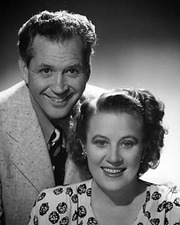
The DuPont Cavalcade of America, starring William Powell with June Dupree. Tonight, the DuPont Company brings you the oath, starring William Powell with June Dupree on the Cavalcade of America. First, here is Gaine Whitman. Good evening. Tonight, the Cavalcade of America comes to you from Buffalo. In our studio audience, our very special guests are DuPont men and women from three DuPont plants in this Buffalo area. The products of these plants, despite the fact that they are different, are chemical first cousins. They are made of the one raw material, cellulose. It is the men and women of the DuPont Company, as typified by the men and women of this audience, who helped to create and who indeed expressed the true significance of these and other DuPont better things for better living through chemistry. Now, the oath, starring William Powell as Millard Fillmore, with June Dupree as Abigail, his wife, on the Cavalcade of America. The wind that rises on Lake Erie, a chill gray day in March 1849, sweeps up the lanes of Buffalo with the rush of history and envelops a stately gabled mansion standing on a small hilltop. Here lives the most distinguished Buffalo citizen of his day, a man now sought by many reporters. Mr. Fillmore will be down right away, gentlemen. Thank you, Mr. Fillmore. But please don't hold him long. Our carriage is waiting. Mrs. Fillmore, are you looking forward to living in Washington? Oh, yes. Yes, but I know we'll always long to come back to Buffalo. We came here when it was just a frontier settlement. It means so much to us. Is it true your husband was born in a log cabin? Oh, yes. And is it true that you were his schoolteacher? Yes, I had a one-room schoolhouse and when he was 20 he came there to study. Did you suspect right away you were going to marry him? Not the first day. Or did you think he'd become Vice President of the United States? Well, here you are. Good day, gentlemen. Good day, sir. Welcome. Thank you. I'm sorry to have you to drop in on us before our departure. Well, Mr. Vice President, you seem to be calm as you face your new duties. People are always telling me I look calm, especially when I feel least calm. Perhaps that's because the more serious the crisis, the more I feel we've got to keep our heads. Then you feel a crisis is gathering, one of the most serious our country has known. Gentlemen, we are very fortunate to have Zachary Taylor as president. Being a war hero, maybe he can give us the unity we'll need if we are to hold our land together these next few years. God help us to get through those years. President Taylor. Yes? You wanted to see the vice president this morning, sir. He's here. Oh, yes. Sure meant it was. Come in, Mr. Fillmore. Thank you. Good morning, Mr. President. Ah, good morning, Fillmore. Forgive me for getting you over here at this early hour of the morning. Sit down, please. Thank you, sir. Fillmore, how are we going to break the deadlock? I don't know, sir. Do you realize that Congress hasn't passed one useful piece of legislation in the eight months we've been in office? I know. Everything stumbles on the one main issue. It's exasperating. Look at California. Why can't she be admitted? She's ready and waiting. And once you're in the Union, why in blazes can't we move ahead? You know the reason, sir. The South won't admit her as a free state and the North won't any other way. Well, last night some of the congressmen brought me a plan for breaking the deadlock. The compromise that Clay's been working on behind locked doors. Oh? How does it look, sir? Yeah, that's what I want you to tell me. I'm told old Daniel Webster approved, which seems hard to believe. Is he in his doltage? Why, no. If Webster approves, there must be something to it. Well, see what you think. Now, here's the compromise they're proposing. First, California to be admitted as a free state. The North will cheer for that. Indeed, yes. Next, New Mexico and Utah to be organized without reference to slavery, the question to be decided by the people. That will please the South. Right. Gives them a chance to even the scales. Next, slave markets to be banished from the city of Washington. Another stop for the North. Yes, but at a price, Fillmore. And here's the price. Effective federal machinery for the return of slaves escaped to the North. Good heavens, no. Raw, isn't it? I suppose they thought that I, being a slave owner, would be ready to swallow a fugitive slave act. Oh, I'm afraid the North would never endure it. And right that they shouldn't. Why, sir, it would put the federal government in the slave catching business. We'd be hounded out of office. Nothing you could do would cause more anger. Glad you spoke frankly, Fillmore. Well, I'm happy that you, a Southerner, feel as I do, sir. I think the politicians are surprised about that. I kind of think they nominated me with the idea that I'd be easy for them. But believe me, I'm not. I'm going to fight it out if it takes months. You'll see if I don't. Don't you want your breakfast, dear? You haven't touched it. Oh, no. No, I don't feel like it, Abigail. You're worried, aren't you, Mellon? My dear... Come in. Congressman Toomes is here to see Mr. Fillmore. Congressman Toomes? Are you sure? Yes, sir. Well, show him into my study. I'll see him at once. Yes, sir. That's odd. Is that Congressman Toomes of Georgia? Yes, one of the Southern leaders. Well, what do you suppose he wants? I have no idea. Well, I'll go talk to him. I'll be back presently. Ah, Congressman Toomes. Mr. Fillmore. I'm glad to see you, sir. Sit down, please. Thank you. Well, to what do I owe the honor of this visit? Well, Mr. Fillmore, I am told that before the President announced his stand a few months ago on the compromise bills, including the Fugitive Slave Act, he consulted you. That's true. Sir, we Southern Whigs who accepted you nor the North as Vice President resent your influence on the President. Indeed. Well the President made up his own mind about the compromise. He had decided before I saw him. Then he is a traitor to the South. He considers himself the President of the whole country, not of the South alone. Then you do well to caution him. Mr. Fillmore, I come to you because we Southerners no longer have the ear of the President. I have this to tell you. Yes? The South has called a meeting for this summer at Nashville, a meeting of Southern states. To what purpose? To vote on secession. You can't mean it. I do mean it. President Taylor has stated that disunion is treason. If any state secedes, he swears he himself will take the field against it. My dear sir, the soldiers who followed Zachary Taylor to victory in the Mexican War were mostly Southern soldiers. You think those Southerners would follow him now against their own people? But secession, that's monstrous. What did we fight for for so many years? What is independence without union? The South too fought for union. But today the South knows we no longer have a union. What do you mean? The North is an independent land sir, and the South is its colony. How can you say that? It's true. You yourself helped pass a tariff act some years ago for the benefit of the North. A tariff of abominations we called it. We later revised it. Not until it did ruin the South. For the North it meant wealth, for the South, high prices. That showed us the way the wind was blowing Mr. Fillmore. If we're to have a land run for the benefit of the North, then better that we pull out now and found a glorious Confederacy, not a colony. I see. Good day Mr. Fillmore. I'll see you to the front door. Don't trouble. Indeed I will Congressman. Mr. Fillmore, I understand the President will lay the cornerstone of the new Washington monument on July 4th. That's right. And will make an appeal for national unity. I hope you'll advise him how that unity may be won. Good day Mr. Vice President. Good day Congressman. Millard, has he gone? Yes. Well, come back to breakfast now dear. I'm shaking like a leaf inside. I know. Look, I fixed you what you always like when you're upset. Bread and milk. What an absurd dish. I wonder what the voters would say if they knew that the Vice President calms his nerves in a crisis by eating bread and milk. Never mind what they'd think. It makes you feel better. I wonder why. You know, I used to eat this all the time when I was a boy. Maybe that has something to do with it. Maybe. Eating bread and milk for breakfast and then tramping to school to study with the beautiful young school teacher. Everything I learned seemed so exciting then. You know, I thought it was the stories of Washington and Jefferson that were having such a heady effect on me, but I guess it was also you. Those wonderful days. You know, history, when you studied in school, has to do with heroes who face clear-cut moments of right against wrong, freedom against tyranny. It all looked so beautifully clear from that frontier schoolroom. Why, what do you mean, dear? Suppose instead of becoming one nation, the states had split apart. Could we have kept our freedom? Of course not. Why, to be free, we must be strong and united. Well, look what's happening. The freedom of Hungary crushed by the Habsburgs. In France, another Napoleon. Yes, freedom is on the run. And here... Why does it really look so dangerous here? Abigail, this summer there will be a secession meeting at Nashville. Oh, Meladon, dreadful. North and south. Soldiers are getting out their uniforms and drilling. Oh, no. Oh, poor old General Taylor. No wonder he looked so weary the last time I saw him. He's not beaten yet. The president entered office as a war hero, hated by no one. That glamour still clings to him. If it wasn't for that one great unifying force, I think the whole thing would fall apart tomorrow. You don't mean it, Meladon. If only we could recapture the old spirit of Bunker Hill in Yorktown. That's what the president means to try next month when he dedicates the Washington Monument. And if he can't do it, no man can. Ladies and gentlemen, I give you the president of the United States. Friends, friends. I won't talk long. It's too blasted hot. Fellow citizens, a great stone shaft will rise here honoring a man who led us in an hour of danger. An hour we should remember today because... Are you all right, sir? Ice water, please. Yes, sir. Oh, thanks. I'd best sit down for a moment. Had you better return to the White House, Mr. President. I reckon I'd better. You are listening to William Powell and June Dupree in The Oath on the cavalcade of America sponsored by the DuPont Company, maker of better things for better living through chemistry. As the second part of our story opens, it is the night of July 9th, 1850 at the home of Millard Fillmore, vice president of the United States. Oh, Millard, there you are. I'm so worried. Yes, I couldn't sleep. So I put on my dressing gown and came down to read. You want to sit with me a while? Of course. Would you like me to read to you? I'd love it. My eyes are so tired just now. All right. Is this the book you were reading? Orations of Daniel Webster? Yes. Oh, he's a wonderful man, Millard. For 20 years, American schoolboys have been learning his speeches by heart. Yes. He's a kind of symbol of the Union. Oh, here's a place you've marked. When my eyes shall be turned to behold for the last time the sun in heaven, may I not see it shining on the broken and dishonored fragments of a once glorious Union, on states disheveled, discordant, belligerent, on a land rent with civil feuds or drenched it may be in fraternal blood. Let their last feeble and lingering glance, rather, behold the gorgeous ensign of the Republic. You know it by heart. Now known and honored throughout the world. Oh, that's the front door. Well, I'd better open it, servants are asleep. Be careful, dear. Mr. Fillmore, the president has taken a turn for the worse. Would you come to the White House, please, sir? Oh, yes. Yes, I'll get dressed and come at once. Fillmore? Yes, Mr. President. I expect a summon soon. I would have done my best. I regret nothing except leaving all my friends. Mr. President. Mr. President. I, too, solemnly swear that I will faithfully execute the office of President of the United States. I will, to the best of my ability, preserve, protect, and defend the Constitution of the United States. Mr. President, Senator Daniel Webster is here to see you now. Oh, show him right in. Yes, sir. Come right in, Senator Webster. Thank you. Good morning, Mr. President. Good morning, Senator Webster. I hope I find you well. As well as can be expected. How soon will you be moving into the White House? Well, not for some weeks. For a while, I shall use my old office in the Senate building. I understand. Mr. Webster, our national crisis is still on us. It is deepening, Mr. President. From California come reports of growing anarchy, the lack of a government. Here, emigrants hesitate to start west. Everywhere, businessmen are fearful of the future. Are we to become impotent, even to act on our own behalf? The nation awaits your leadership, sir. Mr. Webster, do you still favor the compromise proposed by Senator Clay? I do, sir. Do you realize that if that compromise is ever enacted, with its Fugitive Slave Act, those who are responsible will win undying hatred in the North. They will be reviled till their last day. And yet I say, enact it. Let us admit California, New Mexico, and Utah at any cost. Then new energies will burst from us, and in that wild western land will grow a people that will despise slavery no matter what we here decide. In a few years, the cause of freedom will be so strengthened that the final issue can never be in doubt. What do you hear of the threat of secession? I hear that foreign powers are secretly encouraging it with hints of military aid. Senator, though I once opposed the compromise, I ask you now to be my Secretary of State and to work for its quick enactment. To that end, I gladly serve you. I'm sure that with your influence, Congress will accept the compromise and the deadlock will be broken. But I have no illusions about the price we are paying. Furniture's all on the wagon, Mrs. Fillmore. You want us to start for the White House? Yes, please, go ahead. Yes, ma'am. Come on, boys. Get up. Well, Abigail, all ready to go over? Oh, darling, I didn't see you. I thought I just drove over from the Senate building. I knew you'd be about ready to go over to the White House, so I thought we might ride over together. How wonderful. Come then. Carriages there in the driveway. But how did you get away? Oh, I've signed 11 bills this morning already. Congress is rolling them out fast now. The session may end next week. How splendid. Get in, dear. Thank you. Go ahead, William. Yes, Mr. President. Come on. Oh, dear, I've been back and forth all morning. There's so much to be done. How's it going? Fine, but there's so many problems. The rug in that oval room. You know. Yes? Well, it was in a terrible condition, so I had it taken up. And what do you suppose? There was another rug on it which was even filthier. It must have been there since James Monroe. And do you know, Millard? They've been using an open door. It's a very old door. It's a very old door. It's a very old door. It's a very old door. It's a very old door. It's a very old door. It's a very old door. It's a very old door. It's a... Well, it's a very old door. It's a very old door. It's a very old door. It's a... I don't want you to have any false ideas of how it will be. The long deadlock is over. Now the letters are coming in. What do you mean? Well, I brought some with me. Here's one. Mr. President, Benedict Arnold was our first great traitor. You are the second. Yours is the greater infamy. Oh, no. How could anyone? Here's another. Mr. President, the abolition society of our city has voted to do everything in its power to drive you from public life. Oh, darling, how unfair. Oh, I'm so sorry. There he is. There's the President. Look out. That man's going to throw something. Thank heaven I've missed you. Driver, faster, please, faster. Yes, sir. Here he is. There's still a lot of people along Pennsylvania Avenue. Sit down, dear, and drink your coffee. They're looking this way, sullen and angry. Darling, I'm sorry it had to be this way. So am I. It did have to, didn't it? You too have doubts, don't you? No. No, but... Does any man ever know if he made the one right decision? No. My moment came even before we moved into the White House. And it wasn't as simple as it looked to a Buffalo schoolboy. I know, darling. But just think, from a log cabin schoolroom to the White House, you mustn't doubt your decision. Have faith. Have faith in a country that guarantees everyone a chance, a chance to do the right thing, even though many may not understand. Thank you, dear. When the time came, one thing seemed most important. You remember those words of Webster's that you read to me that night? I remember. When mine eyes shall behold for the last time the sun in heaven, let me not see it shining on the broken fragments of a once glorious union. Let me behold, rather, the glorious ensign of the Republic, not a stripe erased, not a single star obscured, bearing for its motto, no such words of delusion and folly as liberty first and union afterwards, but liberty and union now and forever, one and insuperable. Thank you. Now here is Gaine Whitman speaking for DuPont. Tonight's cavalcade has just come to you from Buffalo, New York, where the DuPont Company has three plants just outside the city limits of the township of Tonawanda. One of them is the original DuPont rayon plant, opened in 1921. The others make cellophane, cellulose sponges, and celloseal cellulose bands. The first cellophane ever made in the United States, in fact, was manufactured here in Buffalo. DuPont chose the Buffalo area, conveniently located for rail and water shipments between East and West, because the products of these three plants are chemical brothers, or at least first cousins. The sparkling cellophane that protects so many of the things you buy, rayon yarn from which so many beautiful fabrics are made, cellulose sponges for washing dishes and washing the car, those tight-fitting little bands that close the tops of bottles securely. How in the world are they related? The answer is they are all made of one material, cellulose, which comes from wood pulp or cotton minters. Here, in a nutshell, is a picture of the healthy growth of the chemical industry in the United States. When the first DuPont plant opened here, it had about 300 employees. Today, the three DuPont plants employ nearly 3,000 men and women. We have to look a long way to find a more highly trained, cooperative, responsible group of people. Something of the scientific spirit gets into the minds and hearts of men and women who make the products of chemical science. The care, the painstaking accuracy, the conviction that what they are doing is worthwhile. Take DuPont cellulose sponges, for instance. People need sponges, and nature can't make enough of them. Even nowadays, DuPont chemistry makes them, and the men and women who control the process of turning a chemical syrup into a light, clean, fluffy sponge are justifiably proud of their job. The same thing is true of the men and women who make the other DuPont products in the Buffalo area. In fact, it is this spirit which is perhaps the most important ingredient in all of the products of DuPont chemical science. It is the hidden value you find in all of the DuPont company's better things or better living through chemistry. Music Next Monday night on Navy Day, Cavalcade is proud to present Robert Montgomery in The Admiral Who Had No Name, an exciting little known story of our Navy's first hero of the seas, John Paul Jones. Our story is one of mystery and romance during the decisive days that led to the Revolutionary War. Next week, be with us for The Admiral Who Had No Name, starring Robert Montgomery as John Paul Jones on the DuPont Cavalcade of America. Music The music for the DuPont Cavalcade was composed by Arden Cornwell and conducted by Max Miller. Our play tonight was written by Eric Barnell. On last Monday's Cavalcade, our play The Forge was written by Joseph Cochran. William Powell may currently be seen in the Warner Brothers production Life with Father. Featured with William Powell in tonight's play was June DePray. This is Bill Hamilton inviting you to listen next week to The Admiral Who Had No Name, starring Robert Montgomery on the Cavalcade of America, brought to you by the DuPont Company of Wilmington, Delaware. Applause This is NBC, the national broadcasting company.