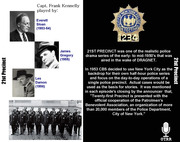
21st precinct, Sergeant Rosen. What happened to it? Was it stolen? Yeah. Yeah. Well, where'd you keep it? You are by transcription in the muster room at the 21st precinct. How long? The nerve center. A call is coming through. You will follow the action taken pursuant to that call from this minute to the next. You will follow the action taken pursuant to that call from this minute until the final report is written in the 124 room at the 21st precinct. Well, I'll tell you what you'd better do. You'd better come on in to the station house, make a report of it. No, you'd better come right away. Okay. Yeah. 21st precinct. It's just lines on a map of the city of New York. The rest of the 173,000 people wedged into the nine-tenths of a square mile between Fifth Avenue and the East River wouldn't know if you asked them that they lived or worked in the 21st. Whether they know it or not, the security of their homes, their persons, and their property is the job of the men of the 21st precinct. The 21st. 160 patrolmen, 11 sergeants, and four lieutenants, of whom I'm the boss. My name is Cronin, Vincent P. Cronin. I am captain in command of the 21st precinct. I was doing day duty, 8 a.m. to 6 p.m. After I turned out the platoon and the men marched out the front door to take over their posts, I walked through the back room out across the iron grating to the smaller building in back of the station house where the detention cells are located. There I found Patrolman Bailey, the station house attendant, cleaning up. The doors of all six cells were standing open. There had been four prisoners held over during the night, but at 7.30 a.m. the patrol wagon had come by the station house to take them to court. With Patrolman Bailey walking a step or two behind me, I conducted an inspection of the cells to see that they were clean, supplied with paper drinking cups, towels, and so forth. After I completed this inspection, sector car number three came by the house for me. I went out on patrol to the precinct. While I was so engaged, Sergeant Rosen had telephone switchboard duty, and Lieutenant Gorman was the desk officer. Sergeant. Yes, sir? Give me the communications bureau on here. Yes, sir. 21st Precinct, Lieutenant Gorman. A sick report, C.B. Patrolman James Reos, R.I.O.S. No, S like in Sam. 10th Precinct. He went sick at 8.50 a.m. at home. 792 East 93rd Street. Sergeant to call. Okay. Yeah. Sergeant. Yes, sir? I want to talk to the carer when he rings in. Okay, Lieutenant. Well, excuse me, Sergeant. You'll have to talk to the desk officer, Mr. No, I'm sorry. Excuse me, Lieutenant. Yes? I'm John Froud. I own the package store at 284 East 75th Street. Oh, yeah, yeah, Mr. Froud. What can I do for you? Well, Lieutenant, I got a license to keep a gun in the store. I had three stick-ups since I'd been there. I got this license. Yeah, what about it? Well, the gun is gone. Disappeared. What do you mean, disappeared? It's gone. I don't know. Disappeared? Well, how could the gun just disappear? You think it was stolen? I don't know. It's gone. Nothing else was taken. Where did you keep it? Well, I got wines on one side and liquor on the other. In the middle is this little counter with a cash register and wrappings in a drawer right under the cash register. When did you miss it? Last night. I went to get something else out of the drawer and I saw the gun was there. Why didn't you report it then? Well, I thought maybe my wife would know where it was. Maybe she saw it or my son. I looked all over the store and when I got home I asked my wife. She didn't see it. What about your son? Well, he wasn't home yet. I fell asleep and I didn't see him until this morning. He didn't know anything about it. Sergeant. Yes, sir. Go to call over the skipper, will you? Okay. I don't know what could have happened to it. I got no idea. How long have you had this gun? Twenty-first, please, Sergeant. Well, let's see. It's about three, four years. Just a license to carry or just to possess on the premises? Possess on the premises. All right, Mr. Proud. You wait right over there, huh? I'll put a radio call out for Captain Cronin. He'll come in and talk to you about it. Well, can't I get back to the store? My wife is there and she has to go someplace. His sister is in the hospital. No, you'd better wait for the captain and also for the detectives to come in. Well, I could come back this afternoon. They want to talk to you now. I'm sure of that. All right. I guess I'd better wait. Yeah. I guess you'd better. Section 1897 of the penal law of the state of New York, otherwise known as the Sullivan Law, is perhaps the most stringent and strictly enforced law relating to weapons in the country. A license to carry or possess a firearm that may be concealed on the person is extremely difficult to obtain. Applicants for such licenses are carefully investigated and personally interviewed by both the precinct commander and the detective squad commander. The loss of a pistol by a licensee is a serious matter, and the manual of procedure requires that an immediate investigation be conducted by the precinct commander. When the radio call was put out for me, I instructed my operator, Patrolman Fowl, to stop at the nearest call box. I rang into the station house and Lieutenant Gorman informed me of the particulars. I told him to have Mr. Fowl wait. When I arrived, Lieutenant Gorman handed me the file copy of the LD-80, the application for a pistol license, and I took the liquor store owner, Mr. Fowl, into my office, where I began to question him. Crazy, I don't know, just plain crazy. How can it disappear like that from nowhere? Well, we know it didn't just walk out by itself, Mr. Fowl. Yeah, that's a cinch gun. You kept the gun in a drawer in the counter under the cash register. Yeah. How long you been keeping it there? Well, since I got it. Your license was first issued January 23, 1953. That's how long, yeah. It's ridiculous, the whole thing. The guns are nice and W38 terrier, blue finish. Yeah, yes. Did you get the drawer locked? Well, I locked it when I closed up the store at night, Captain, but when the store was open, I didn't lock it, because what would be the sense of locking the drawer if suddenly I needed the gun? I was stuck up there three times, you know, in ten years. Who knew when it was going to happen again? When did you last see the gun? Yesterday morning when I opened the drawer, when I unlocked it. You're positive it was there then? Oh, yeah. Yeah, I keep in there also my bank book, deposit slips. I saw it in there when I went to get them out. And when did you miss it? Last night, ten o'clock, when I closed it. You had no occasion during the day to go to the drawer, see whether the gun was in there? No, sir, no. No occasion. How many employees do you have, Mr. Frodden? Employees? Yeah. Well, he is not really what you'd call an employee. Who is he? Joe. Joe who? Joe Guada. He's the fellow that comes in every morning, you know, he sweeps up, he unpacks some goods for me. And when I got a delivery in the neighborhood, he makes it. He does the same thing for Delicatessen on Third Avenue, cleans up, makes deliveries. We sort of, well, we share his time, half and half, like. How long has he been working for you? Oh, a long time. I know, three, four years. Did you ever miss anything out of the store prior to this? Nothing, no. Not a thing. I don't think Joe would do anything like this. Did he know you had a revolver on the premises? Well, it wasn't any secret, Captain. I didn't go out of my way to tell him, but there wasn't any secret. Was he in the store yesterday between the time you saw the revolver in the morning and when you missed it at night? Yeah, several times. He was in and out all day. Were you able to observe his actions on each of those occasions? Well, I didn't see him do anything suspicious, if that's what you mean. I don't think he would steal anything, Captain. I really don't. Do you have any other employees? No, sir, no. You're open from about 10 a.m. to 10 p.m.? Yeah, about. Were you there all that time? No, I live on 75th on the other side of Second Avenue. My wife comes about an hour when I go home and eat lunch, and then she comes again at supper time. You say your son helps you out in the store once in a while, too? Yeah, once in a while, Captain. He goes to CCNY and he's in the store maybe, well, like one night or two nights a week. Ella and I can eat supper together, maybe taking a picture or something like that. What's the boy's name? John, too. We call him Bud. Was Bud in the store last night? He was there, yeah, for a little while. When I came back from supper, he was there with Ella, my wife. Do you think your son might have taken it? No. Why should he? Well, you thought he might have last night. Who said that? I didn't say anything like that. Mr. Froud, you said the reason you didn't report the gun missing last night was that you went home to talk to your wife and your son, to ask them if they saw it. Yeah, I know. Now, your wife said she didn't, and your son wasn't home when you went to sleep. Oh, I didn't think he took it. I had to ask him, though, you know, before I went off half-cocked. Did you ask him? I asked him if he'd seen the gun in the store, if he'd put it anyplace besides the drawer. He said no, he didn't touch it. And what did your wife say? She said the same thing. She didn't touch it. This Joe, Joe Guder? Guada. Guada. Where does he live? In Harlem, on 26th Street, I think. But he'd be around the neighborhood of your store or the delicatessen this morning. Yeah, he's supposed to be. Did you see him this morning? No, not this morning. Isn't he supposed to come in, clean up the store? Well, I didn't go to the store this morning yet. My wife went to the store. Yeah. All right, excuse me. Sure. 21st precinct, Captain Cronin. Lieutenant King is ringing down for you, Captain. Okay. Yes, sir. Captain. Yes, ma'am. Lieutenant Cormann says you have the man who was gunned and was stolen in there. That's right. You want to talk to him? Yes, sir. I'll be right down. Okay, ma'am. Mr. Frond, I've asked the commanding officer of the 21st Detective Squadron to come downstairs. For me? Well, you've got a gun. Can't be accounted for. We've got to presume it's been stolen. But I... I don't know who would steal it. And that's partly a matter of who had access to the drawer, isn't it, Mr. Frond? Well, I guess so. Do you know anything about this Joe besides the fact that he's worked for you and the delicatessen for around three years? No, not much. Would you mind? I think so, yes. You know whether he's ever been in trouble with the police? Not since he's been working for me. At least, I don't think so. He's been pretty reliable. How much you paying? Well, he gets $22.50 from me and $22.50 from the delicatessen. Plus tips on the deliveries he makes. How old is your son, Mr. Frond? What? He's 21. He's going to be 22 in City College. Yeah, pre-marity status. Bright boy, real bright boy. He was in the Army two years. That's why he's a little late in school. But he's going to make a fine doctor. A real fine doctor. He's going to school on a GI bill? Yeah. He just got in under the wire just by a month, six weeks later. How are his grades at school? He didn't steal it, Captain. Not but. I don't want you to accuse... I'm not accusing anyone, Mr. Frond. Please, Mr. Hayden, I'm telling you. All right, we'll make sure. You don't have to make sure. I'm telling you. I just don't want you thinking he did because he did. Mr. Frond, apparently you're the one who thinks he might have. Seems to be on your mind. No, he didn't. I'm telling you. You were suspicious enough to want to talk to him before you came here. I just wanted to ask him if he's seen it. You having any trouble at home with Barton, Mr. Frond? No. No. Well, I mean, he's a boy, you know. He's a boy like any other boy. He's got ideas. He's 21 years old. He's been in the Army. He's not much of a boy anymore. What makes you think he took the gun? I don't think so. Now look, Mr. Frond, if he has got it, you better help us get it back from him before he gets in worse trouble. What kind of trouble? The kind of trouble a gun can bring. Do you think he took it? Yes. I think so. But I don't know. He says he didn't. I think so. Why do you think he took it? If he did, who knows why? Who knows why he does anything? Why he wants to quit school? Why he wants all kinds of money? Why he wants to get married? Who knows why a kid does anything? Well, maybe we'll find out. Because theft of the revolver was suspected, Lieutenant King assigned one of his detectives to go to City College and get the son out of class. In order to pursue my investigation, I instructed Sergeant Rosen on telephone switchboard duty to have a car come by the house for me. When it arrived, Mr. Frond and I got in. I told the operator, patrolling McArdo, to drive us to the liquor store on East 75th Street. Okay, Mr. Frond. Now it's something like this. Oh, wait here, McArdo. Yes, sir. We don't know that it was him, Mr. Frond. Who else? Joe wouldn't do anything like that. I just know he wouldn't. Somebody could have walked in the store. Wait. Oh, Captain. Yeah? Please don't say anything to Ellie yet. It'll be bad enough when she finds out. I mean, when we're positive. No, Mr. Frond. Twelve hours a day I spend in there with four wolves. I didn't want anything like that for him. It's my ambition. He should have a profession. Come in, Captain. Yes, thank you. Hello, Ella. John, hello. Any business? A little, not much. This is Captain Cronin. This is my wife, Ella. Mrs. Frond. Glad to know you. Well? Well what? Nothing. This is the drawer, Captain, right here. This is a very serious matter, Mrs. Frond. A dangerous weapon like that gets in the wrong hands and causes a lot of trouble. I know. Nobody knows better than me, I realize it. At what time were you in the store yesterday? Why? Ella, answer the question. Don't ask, don't ask. Well, I was here when John went to lunch, and I was here when he went home to supper. At lunch? What time was that? What time, John? About 12.15, 12.30. About 12.15, 12.30. Anyone come into the store during that time? One or two customers, maybe. Were they ever in the front of the store alone, where they could get out the drawer? No, they stood there on that side of the counter, and I waited on them. Was there anyone else in the store? Who? Joe, for instance? No, no, Joe didn't come in when I was here during lunch. I guess he was eating tea. What time did Mr. Frond get back? What time, John? A little after one. A little after one. And then what did you do, Mrs. Frond? I talked to him for a minute, and then I went. I went to go to the market and then home to fix supper. Same. And what time did you come back to the store again? When it was time for John to go home for supper. You see, Captain, she eats and she puts my supper on the stove, and then she walks over to the store and I go home. Uh-huh, and that was what time? Last night, about 6.30. About, yeah. Did anyone come into the store while you were here alone? Well, my son Barty came in. Oh, does he usually stop in when you're here alone? Sometimes. He was at his girlfriend's house. He went there from school in the afternoon. And what did he do, anything? We talked. I asked him, did he eat, and he said no, and I told him to go home and have supper. It was on the stove. He wouldn't come home because I was there. If you'd leave him alone and stop nagging him, he'd be all right. He won't leave him alone. I want him to get those crazy ideas out of his head. I want him to finish college. I don't want him to get a job and get married. What could he have? He could have a wife. Joe. Come here, Joe. Oh, hello, Mr. Frow. Miss Brown. Joe, this is Captain Cronin, police department. The policia. Ah, policia. Oh, glad to know you. Joe, Mr. Frow keeps a gun in the store. Did you know that? Yes, I know. You know where he keeps it? Yes, I know, I know. Where? In the drawer. Here. In the drawer? You only know why he keeps the gun. Yes, for robbers. Isn't that right, Mr. Frow, for robbers? Yes, Joe. When did you handle that gun last, Joe? Me? Yes. No, no, no, no, no, no, I didn't touch it. No, no, no, I didn't touch it. Not me. I don't want nothing to do with no gun. I don't like it. You afraid of the gun? No, no, no, not afraid. I just don't like it. Somebody took it yesterday, Joe. The gun? Yes. Who took it? Well, we hoped maybe it was you, Joe. No, no, no. You know that you were cleaning the drawer and you took it out by mistake? No, no, I didn't touch it. No, not today, not me. No. I don't like it. I don't go near these drawers and you're never... Do I, Mrs.? Not that I've ever seen. No, Mr. Do I, eh? No, Joe. No, no, no, I don't like guns. I don't go near the drawer. No, I can never. You want me to take out the curtains this morning, Mr. Frout? You said yesterday... Captain Crowley is talking to you, Joe. Oh. Oh, excuse me. That's all right, Joe. I'll talk to you later if I have to. You go on. Get back to work. Yes, yes. Come on and back, Joe. No, I don't go near the drawer. Never, never. No. I'll be right back, Captain, as soon as I show him what to do. All right, Mrs. Frout. Go ahead, Joe. I don't like guns. I don't think he did it, not Joe. Doesn't look that way. Maybe somebody came in from the outside while John was in the bathroom and just took it. That could happen, couldn't it? Maybe. Mrs. Frout, how long is this trouble between your son and your husband going on? Trouble? Oh, it's not trouble. It's just a family disagreement. How long has it been going on? Oh, since Bud came back from the Army almost. He says he's too old to go to school. He wants to earn a living and get married. And John's got it in his head that Bud should be a doctor, but he don't want to be a doctor. He's tired of living off a GI bill and going to college and studying when he says it doesn't mean a thing. Nothing to him. Why doesn't he quit? You'd never hear the end of it. John's crazy enough on the subject. Do you think Bud might have taken the gun? Bud? No, why would he take it? Well, he doesn't have much money. Maybe to sell it. No, he wouldn't do that. Somebody took it. Not Bud. Was Bud ever in trouble, Mrs. Frout? What do you mean trouble? I mean, was he ever arrested? No, he didn't take it. Not Bud. He was never in any kind of trouble. No. Well, it wasn't Joe. Do you see what I mean? Yep, I see. John, with Bud, take the gun. No, huh? Why? Why should he? I don't know. I just asked. No. All right, excuse me. I should. What's he doing with it? Licker store. Is Captain Cronin still there? Yeah, sure. He's here. Captain, for you. Okay. Thanks, one. Oh, that's all right. Captain Cronin. Matt King, Captain. Oh, yes, ma'am. I said Whitey Howard up at CCNY to get that Bud Frout out of class. Yeah. He just rang in and said he got him out all right. He admits taking the gun. Oh, that's all. Yes, sir. Whitey's on the way in with him. Okay, Matt. Thanks. I'll be down in a little while myself. Yes, sir. Well, I've got to get back to Station House. Oh, do you? Yeah, and I think you'd better come with me, Mr. Frout. Look at my eye. I was just there. And I can't stay in the store all day. I came here without making the bed seat. And my sister's in the hospital. I think you'd better come, Mr. Frout. All right. Well, I'll come back as soon as I can. All right. Have Joe sweep out in front as soon as he gets through, huh? All right. Bye, Mr. Frout. Goodbye. Captain. Yeah. What is it? Did Bud take the gun? Yes. Why? Why would he do such a thing? I don't know. I tried to do the best for him. Make something out of him. I spent my whole life trying to do that. So he could get someplace. Well, maybe it's a good thing he didn't get too far. We got into the car and were driven to the Station House by Patrolman McArthur. Mr. Frout didn't say a word all the way. He just sat there looking straight ahead. Possession of a gun by an unlicensed person is a serious crime in the state of New York. I wondered as much as the father did as to why the young man took the gun. There were two obvious reasons. One, to sell it. The other, to use in a robbery. A few minutes later, the car pulled out in front of the Station House. Mr. Frout and I got out. I instructed Patrolman McArthur to pick up his partner and resume patrol. As the car pulled away, we crossed the sidewalk, mounted the three worn stone steps that led to the muster room. Well, Lieutenant Dorman was desk officer and Sergeant Rosen still had telephone switchboard duty. You wait here, Mr. Frout. I have to go around and sign the blotter. All right. Where's Sergeant Rosen? Captain. No, Sergeant. All right. Well, Captain, what's it doing, Lieutenant? Not a thing, Captain. Very quiet. Good. Oh, well, you see Whitey Howard go upstairs with the young man? Oh, yes, sir. Just a few minutes ago. Okay. I'll be up there with the detective. Yes, sir. Come on, Mr. Frout. All right. I'm going to go upstairs. Is that where they happened? Yeah, yeah, he's up there. I don't understand what's going on. No, right ahead of us, Frout. I just don't understand. He struggled the worst. What are we doing for him? To take a gun to hold up somebody? Now, we don't know that that's the reason. Ah, Jim, what other reason could there be? No, that's it. He never should have got that gun. Not if I had 40 stick up side. If he'd wanted one, he'd have got one someplace. You sure of that? There. There he is. A little off the face. All right, all right now. Frout, take your time. Take your time. All right? Come in, Captain. Go ahead, Mr. Fon. Hello, bud. Huh? I'm ashamed of you. I'm so ashamed of you, I can hardly look at you. It's bad enough to steal but to steal from your own father and a gun. What are you trying to do to me? Didn't you eat my heart out enough since you got back from the Army? What are you trying to do to me now? Kill me? You've got it all wrong. I've got it terrible. I've got it lousy. That's how I got it. Ah, listen. Ah, touch me. Leave me alone. I didn't steal the gun. You didn't? No. What? What did you do? I took it out of the drawer and hid it in a case of wine on the floor by the window. Why did you do that, bud? Because he's been carrying on about my wanting to quit school and wanting to get married. He's been carrying on like mad. You're not going to quit. I quit already. I quit already. I quit already. I quit already. I quit already. I quit already, Pa, today. And I got married last week. Oh, you didn't. Yeah, I did. I was going to tell you in my last night in the store, but I lost my nerve. I didn't know what to do or what to say, and that's why I hid the gun. I didn't want it around. You thought I would do something with the gun? Did I be that crazy to kill myself? I just didn't want to take the chance. Oh, what? But how could you think that? I know, I know. I've been a little... You got married, huh? Yeah, last week at City Hall. I'm sorry, Pa. We didn't want to keep it a secret, but I wanted to get it done. I wanted it my way for a change. My way? You're right. You're right to do what you wanted to do. But I'm glad for you. I'm very glad for you. Captain, what can I say to you? I caused you so much trouble. We've got plenty of real trouble around here, Mr. Fromm. This kind of trouble, I like. 21st Precinct, Sergeant Olson. Oh, no, sir. The captain's not in the house right now. He's out on patrol. Is that who? And so it goes. Oh, it is? Around the clock through the week, every day, every year. A police precinct in the city of New York is a flesh and blood merry-go-round. Anyone can catch the brass ring, or the brass ring can catch anyone. 21st Precinct transcribed. A factual account of the way the police work in the world's largest city is presented with the official cooperation of the Patrolman's Benevolent Association, an organization of more than 20,000 members of the police department's city of New York. James Gregory and the role of Captain Cronin, Ken Lynch as Lieutenant King, featured in tonight's cast were Santos Ortega, Jack Orison, Bill Zuckert, Martin Newman, Ralph Camargo, and Ethel Everett. Written and produced by Stanley Niss, Art Hanna speaking.