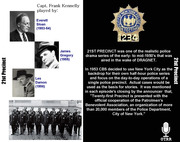
21st precinct, Sergeant Klein. He's jumped or he's going to jump? Where is he, on a ledge? Where is he? He's 71? What floor? You are in the master room at the 21st precinct. The nerve sender. A call is coming through. You will follow the action taken pursuant to that call from this minute until the final report is written in the 124 room at the 21st precinct. Yes, sir. I'll send assistance right away. Right away. You just stay there, wait for the officers. Yes, sir. 21st precinct. It's just lines on a map of the city of New York. Most of the 173,000 people wedged into the 9 tenths of a square mile between 5th Avenue and the East River wouldn't know if you asked them that they lived or worked in the 21st. Whether they know it or not, the security of their homes, their persons, and their property is the job of the men of the 21st precinct. The 21st. 160 patrolmen, 11 sergeants, and four lieutenants of whom I am the boss. My name is Cannelly, Frank Cannelly. I'm captain in command of the 21st. I was working my day tour 8 a.m. to 6 p.m. When I returned from patrol of the precinct at 2 20 p.m. the desk officer, Lieutenant Snyder, told me he had received word from the district attorney's office that nine of my men, Sergeant Collins and eight patrolmen, had been instructed to appear before the New York County grand jury at 10 the following morning. All had been at the scene when a gang of five safe burglars were apprehended three weeks earlier. I took the teletype communication concerning this matter and went upstairs to Lieutenant King's office in the 21st detective squad on the second floor. Come in. Hello Matt. Come in, Captain. How are you, Captain? All right, except for this communication we've got. What communication is that? This. Matt, there were four safe and loft squad detectives there and four of your men when that collar was made. They don't need any of my men to make a case. For the trial maybe, if it goes to bat, but not before the grand jury. I don't think so, Captain. All of those men are working their day tour tomorrow. Take nine men away and it'll really knock a hole in my platoon. What's the mistake, Captain? Some assistant down there probably told his clerk to get all the police witnesses. The grand jury, and he did. Look at it straighten out. Come in. Captain, Sergeant Fine on PS calling you. Oh, he's on one. Take it out of my desk, Captain. Thanks, Coleman. Captain Cannelli. Sergeant Fine, Captain. How soon will you be downstairs? In a few minutes. And come right away, Captain, it's important. All right, I'll be right there. I left the 21st squad and went downstairs through the back room where the attendant was sweeping up. He nodded at me and I nodded back. I stepped out into the master room. Lieutenant Snyder was talking to a couple of complainants who stood before the desk. I walked over to the telephone switch for him. 21st Precinct, Sergeant Klein. All right, you take your meal now. What is it, Captain? You got a piece of bad news, Captain. Yes, what? A woman called in here from Queens. She said she was a neighbor of Sergeant Burns and his wife. Yes. She said that Mrs. Burns just got a telegram from the Army. That boy was stationed at Fort Devon. He was killed in an accident this morning. Too bad. A neighbor said he was calling from his house. Doctor's there for Fred's wife. They think he ought to come home right away. Where is he? On patrol, Captain. All right, you better call him. Yes, sir. Communications Bureau, Patrolman Nelson. This is Sergeant Klein, the 21st. Would you have 651 call the 21st? Yes, sir. How did it happen? Did they know? No, sir. Just the telegram notifying them so far. The neighbor said it didn't say much. 651, call the 21st, please. 751, 10-4, 30-11. How old was the boy? About 19, 20. He was their only child, wasn't he? Yes. His name was Fred, too. Fred Jr. They're always talking about that joke. They love to think together. It's all they used to do when he was swinging or working the night tour, go fishing with the boys. What do I say to him when he rings in, Captain? I'd rather not be the one to tell him. Have him come into the house. I'll talk to him. Yes. 21st Precinct, Sergeant Klein. This is Lieutenant King, Sergeant. Would you tell Captain Kennelly that was a mistake? None of your men have to appear at the grand jury tomorrow. Yes, sir. I'll tell him. OK, thanks. This is Lieutenant King, Captain. They don't need any of our men for the grand jury tomorrow. Oh, good. 21st Precinct, Sergeant Klein. Sergeant Burns, Box 18. Oh, hello, Fred. Come into the station house, will you? What's he doing? Captain wants to talk to you. What's the matter? Just come in, will you? All right. Tell him to skip around on my way. I'll be in five minutes. And don't eat things that disagree with you. He's on his way, Captain. He'll be here in five minutes. Send him into my office. Yes. A large part of a policeman's job is conveying bad news. Hardly a day goes by that we're not required to notify a wife or mother, a father or husband that someone close is dead or sick or in serious trouble. These notifications are difficult enough when total strangers are involved. Telling a man you've known and worked with that his only son is dead is twice as hard. I waited in my office. I tried to read over a few of the reports that had accumulated, but my eyes turned automatically through the open door into the muster room. Finally, I saw Sergeant Burns walk in. He approached the desk, talked for a few seconds to Lieutenant Snyder. Sergeant Klein busied himself filing aided case cards. When Sergeant Burns crossed the muster room toward my office, my attention turned to the file of reports in front of me. Captain? Come in. Yes, sir. Shut the door, will you, friend? Lieutenant Snyder says you wanted to see me, Captain. Yes, that's right. Sit down, friend. Captain? I've got some bad news for you, friend. What kind of bad news, Captain? A neighbor of yours called in. Nothing happened to Ruth. My wife saw her. She's all right, yes. It's your boy. What happened to him? The Army sent a wire. He was in an accident. He's dead. Yeah? I'm sorry, friend. Are they sure? Are they sure it was Freddy? Well, all we know is what your neighbor called in and told us, friend. How did this happen? What kind of an accident? Where? I don't know, friend. Dear God, what am I going to do? How am I going to tell Ruth? She knows, friend, why I came to your home. Oh, yeah? Yeah. Nineteen years old, that's all. Just 19 years old. When he got out of the Army, he was going to try and get on the cops. I told him all the time, you don't want that, get into something where there's more money. But it made me feel good that he wanted to get on the cops, like I was setting a good example. Well, sit still, friend. Thanks, Captain. Thanks. You stay in here. Poor Ruth. Oh, there's a doctor with a friend. She'll be all right. Oh, yes, that's good. It's going to be kind of rough on her. She's got nobody else besides me and him. That's all she's got, Captain. Just me and him. Just me now. Just me. You stay in here, friend, or if you want me to stay with you. No, no, no, sir. That's all right. You don't have to stay. All right, friend, whatever you want. What I want, I? I'll be outside. Go for it. How is he? Is he all right, Captain? Yes, I think so. 21st Precinct, Sergeant Klein. All right, 15. I think somebody ought to stay in there with him, Captain. He wanted to be alone. Hello, Captain. Matt, I got my message about your men not being needed at the grand jury tomorrow. Yes, sir, I gave it to him. You know what happened? They'll laugh. Somebody got the DA's off. What's the matter? Fred Burns just got word his son was killed. Oh, that's rough. Yeah, he was a nice kid. I met him once. We went fishing. Captain, don't you think somebody ought to be in there with him? I don't know whether it's good to leave him in there alone. You ought to have company. This is one time a man doesn't need company. Not when he's crying. In about 20 minutes, Sergeant Fred Burns came out of my office. He changed to civilian clothes. I offered to have a man accompany him home. He refused. The rest of the afternoon was quiet. I turned out the platoon for the night tour at four. From 4.30 to six, I completed my paperwork and dictated a special report regarding change conditions in the precinct in connection with the reopening of the schools. Shortly after 6 p.m., I signed a blotter and left the precinct to go off duty. The following day, before I reported for my night tour, I drove to the home of Sergeant Burns and Queen. I found the street was a little difficult, but every house was alike, except for the numbers on the doors. I parked my car and headed up the flagstone walk. Number 72 was a little different than the rest. There was a black wreath on the door. Hello, friend. Oh, Captain, come in. Thanks. I hope you'll excuse the way things look around here. Oh, yeah, sure. With all that's happened and Ruth so broken up, there hasn't been much chance to get things straightened out. Well, you brought him home late last night. For a while, she's all right, Captain, and then, you know, I can't blame her. I feel that way myself. I am. Ruth. Ruth, this is Captain Ganelli. You have my deepest sympathy, Miss Burns. It's awful. It's awful. Yes, ma'am. Captain. He was going to be 19 next month. Raise a boy and see him like this in your own living room. He just got made a corporal just the day before. Army sent that flag along with him, having two soldiers come over for the... Army's been very nice about the whole thing. The CO called me up on the phone last night and told me how the whole thing happened. Would you like a cup of coffee, Captain? No, no, thanks. There's some on the fire in the kitchen. No, never mind. I think I'll have some myself. I haven't had a thing hardly since I first found out. Would you come in the kitchen with me? Sure. I'm just going in the kitchen, Ruth. I'll be right back. She's in bad shape. She's in terrible shape. I don't know how she'll be able to get through this, you know. Right in here, Captain. You sure no coffee? No, I don't think so. 19 years old. That's all. Just 19. Was the hit-and-run driver the bit? Yes, I know. Lieutenant Gorman told me when I called the station house. Oh, yes. He was here last night. Well, sit down, Captain. He and everybody from my squad, everybody to a man. That makes you feel good. As good as it can feel. Did they get the driver? No, it was in town. You see, Freddie was made caught the next night. He got a pass when he was in town. Celebrate. You know how a kid is. Everything calls for a celebration. Yes, I know. He had this other soldier with him. They went out and celebrated. I guess they had a beer or two. I don't know. He wasn't much of a drinker, just a beer or two. That's all he'd ever touched. Anyway, they were walking back to get the bus for camp. I guess he stepped out into the street and his car came along fast around the corner. The other boy got out of the way, all right, but Freddie didn't. Did the other boy get a look at the car? Yeah, he got a look at it. He said it was a black two-door. That's all he could see. The only thing he did say is he thought it was a soldier driving it. He couldn't even be sure of that. They're working on it. The MP is the state police up there in Massachusetts. I hope they get the guy. You sure no coffee, Captain? No, thanks. I hope they get him. I raised that kid from nothing to 19 years old. I put about half of me into what's laid out there in that living room. Whoever it is, I want him to pay. I wouldn't want him to do it to another man's son. I want him to pay hard. I talked to Sergeant Burns a few minutes more. Finally, his wife came into the kitchen. She was a little better. He stayed out until Monday. When he reported back on the job for the night tour, I talked to him in my office for several minutes. He seemed fairly composed considering the circumstances and told me his wife had overcome the initial shock. After I turned out the platoon, I met with a committee of three Lexington Avenue merchants who complained of high pressure solicitation of funds by little known charitable organizations. I referred them to the Department of Welfare and phoned for an appointment for them to see the Deputy Commissioner the next day. At 5.30, I went on patrol and returned to the Precinct House at 7.10 p.m. and walked over to T.S. A couple of messages for you, Captain. And there's someone waiting for you. Who's that? Well, he said he was with the... Take the call, Sergeant. Yes. 21st Precinct, Sergeant Clarence. Where is that? Yes, ma'am. And we got a call on that from someone else a few minutes ago. The officers are on their way over. They should be there any second. You're welcome, ma'am. What's that, Sergeant? A family argument over on East 67th. Who is it that's waiting for me? Lieutenant Mayland, Captain. He says he's with the 1st Army and Military Police Airborne Infantry Unit. Where is he? I asked him to wait in your office. I told him you would do back in the house any minute. He's in there. Okay, thanks. Yes. I'll be in my office. 21st Precinct, Sergeant Clarence. Lieutenant Mayland? Yes, sir. I'm Captain Cannelly. How do you do, Captain? Lieutenant Richard Mayland, 1st Army M.P. Apprehension Unit. I'm glad to know you. Sit down. Thank you, sir. Well, what can I do for you, Lieutenant? We've got an arrest to make in your precinct, Captain. Oh, you need some assistance? Yes, sir, I think we will. But that's not the problem right now. What is? This fellow is AWOL. We've had the house shaked out since last night. His wife's apartment, that is. We're 90% sure he's up there, but nobody's shown their head out of the place since we've been watching. Yes. We thought either he or his wife would come out today. We'd like to wind it up, but we don't have a warrant. And being Federal officers, we can't go in there without a warrant. We can't go in there either, Lieutenant. Not under these circumstances. We've got to have reason to believe that there's evidence of a crime or a fugitive pharma crime inside. And by crime, I mean a felony, not AWOL. He also is a fugitive in connection with a felony. Is he? Yes, sir. The Massachusetts State Police have got a warrant out from unmanned slaughter. He suspected of driving a hit-and-run car that struck another soldier and killed him. What was the name of the victim? We got the request to apprehend him from the MPs at Fort Devinus. I didn't notice whether it was mentioned in the report or not. Oh, yes, sir, here it is. Corporal Fred Burns, Jr. I think we can be of assistance to you, Lieutenant. Thanks, Captain. Anything you can do will be appreciated. We're glad to do it. The victim's father is a Sergeant of Police in this place. Yes? Yes. I like this strange coincidence. It doesn't happen every day. It's funny. I'm sorry. I guess funny is not quite the word. I told the MP officer the case was properly in the province of the detectives and I took him upstairs to Lieutenant King's office. There he said the suspected soldier's name was John Escher, Private, first class, age 22. He said that Escher had a 24-hour pass on the same night Corporal Burns was run down. Escher borrowed a car from a friend. He returned it early the next morning. There was a large dent in the front right fender and the headlight was smashed. Escher failed to report to duty the following day and had been AWOL since. This information had been forwarded to the First Army Military Police by Fort Devens MPs with a request that Private Escher's listed residence be checked. The residence was a small flat on the third floor of an old law tenement building on East 76th Street. Lieutenant King and I sought all the available information from the MP officer. How many men have you got planted over there now, Lieutenant? Well, Lieutenant, we got the request yesterday from Fort Devens. I sent two of my best men right to the address. We staked the place out. We haven't seen either her or him since we've been there. He hasn't come out. Maybe she's not there. She might have gone to meet him someplace. There's somebody there, sir. I got a hold of the people that live downstairs from them. They've been hearing voices and people walking around in the Escher place. People? That's what they said. Two people at least. Has Escher had any previous criminal records you know of, Lieutenant, before he went into the service? No, Lieutenant, no record at all. He had gone AWOL once before. That was limited to company punishment. He overstayed a leave of 48 hours. Well, Captain, I suppose we're going to have a look. All right, Matt, but there's one thing. Yes, sir? Can I use your phone to T.S.? Sure. Thanks. What do you want me to do, Sergeant Clance? This is Captain Cannelli. Put out a radio call for Sergeant Burns. Yes. Tell him to come into the station house. Yes, sir, right away. I think he'd like to go along. I'm sure he would, Captain. In five minutes, Sergeant Burns was in the station house. He appeared to accept his instructions as he wouldn't connect him with any other duty assigned. We left the precinct house for the East 76th Street address at ten minutes to eight. We're just getting dark. Lieutenant Nailen spotted the two men he had planted watching the buildings. He signaled for them to join us. Lieutenant King gave his instructions. E, Lieutenant Nailen, Sergeant Burns, and myself would lead the way up the stairs to the fourth floor. An MP and a detective right behind us would proceed straight up the stairs to the roof of the building to block an escape that way. The other officers would remain on the third floor landing. All right, you'll drop off here. Yes, sir. Let the detectives and the MPs handle it, Fred. We'll stay in the background, yes, sir. And you keep away from the boy. Yes, sir. All right, up quietly now. The door on the front. Kenny, the tally up to the roof. Right there. Okay. They're in there, I hear them. Who is it? I want to talk to John. John, is it him? Then I want to talk to you. Open the door. I'm a police officer. What do you want? Open up or I'll kick it in. Open up. Where's John? He's not here, honor. Isn't he? He is. But please, he's scared. He's scared half to death. He told me about the accident. He did. He said he didn't see that soldier. It wasn't his fault. It was watching. Why didn't they stop the car? I don't know. Where is he? He don't know either. He just didn't say so. Where is he? In there. In the bedroom. Is he armed? Does he have a gun? No, he doesn't have a gun. All right. Wait a minute, please. I don't know what's the matter with him. He's sick, I think. He came home and he wouldn't leave the house. He wouldn't let me leave, not even for food. He wouldn't have been to eat all day. He's sick. I know he's sick. All right, you stand there. You, you take care of him. I'll take care of him. Let's get him. John, open up. No. Stay away from that. Open the door. Stay away, I'm telling you. He said he jumped out the window. That's what he said. John. All right, let's push it in. Give me a hand. Okay, Lieutenant. Go on, friend. Yes, sir. Together. Now. Stay away. Again. Now. One more. Wait. Don't come any closer. Get out of that window, boy. What are you trying to prove? Don't come any closer. I'll jump. I swear I'll jump. That's four floors down to the seat. I know what it is. Don't come any closer. Now I'm warning you. Don't. Now look, John. Stay where you are. You're driving me very well. You told me you would. We can stay here all night, John. We've got all the time in the world. Stay there if you want. If you come any closer, I'll jump. I swear I will. Ring in for the S.D. and an ambulance. Tell them what we've got. Okay, Kevin. Come out of that window, boy. Get some sense. No, I'm not. This isn't so bad. It's not worth dying over. Isn't it? Can I talk to him, Kevin? Man? Sure, friend. Go ahead. Listen, son. I'm not listening. Don't try to calm me. I know you're in a little trouble. Everybody's been in a little trouble. Stay where you are. I'll go out, I swear. That'd be a smart thing to do, wouldn't it? That's going to solve everybody's problems, huh? It'll solve mine. What about your wife? What about your folks? Look, don't try to calm me. Stay where you are now. All right, now come on. Get out of there. Why make things worse than they are? It's not that bad. It's plenty bad. It's not so bad. For other people, maybe. Everybody knows you're sorry about running down that soldier. An AWOL isn't anything. It's nothing. I'm telling you, stay away. I'll go out. Did you know the soldier that you ran down? No, I didn't know. Well, then what are you worried about? Come on out of the window. You're throwing your life away over something that doesn't mean a thing to you. You'll probably get out of this whole thing anyway, but... It was an accident. Kid stepped off the curb. Right in front of you. He did. He did. I had the light with me. It wasn't my fault. I didn't even see him. I just got a little excited. That's all. Just a little excited. All right, now come on. Let's sit down and talk about it, John. Just tell us about it. What'll they do to me? Nothing much. Take my word for it. What's your guarantee? I don't have any guarantee. You'll have to take your chances. But look at the chance you're taking going out the window. All right. Now close the window. Sit down on that chair. Yes. All right. Here's a cigarette. Smoke it and relax. Thanks. All right. Get back to the job, you men. Show it to them. Right, sir. Good work, friend. Thanks, Sergeant. I really didn't want to go out the window. I didn't know what else to do about it. It was more than anything else to do. I'm Lieutenant Nailen of the MPs. Well, I figured. You're a prisoner, Lieutenant. Sergeant. You're... You're all right, Sergeant. You're okay. Thanks. I just got away with boys. Yeah. You must have one yourself. No. No, I don't, Johnny. No children. 21st Precinct, Sergeant Klein. What's the matter there? How do you know? So it goes, around the clock through the week, every day, every year. The police precinct in the city of New York is a flesh and blood merry-go-round. Anyone can catch the brass ring, or the brass ring can catch anyone. 21st Precinct, a factual account of the way the police work in the world's largest city, is presented with the official cooperation of the Patrolman's Benevolent Association, an organization of more than 20,000 members of the Police Department City of New York. Everett Sloan in the role of Captain Cannelly, Ken Lynch as Lieutenant King. Featured in tonight's cast were Wendell Holmes, Lawson Zerby, Ralph Camargo, George Petrie, Michael Dreyfus, and Elaine Ross. Written and directed by Stanley Ness. Produced for CBS Radio by John Ives. Gaylord Avery speaking.